
Note: I’ve linked some products in the article below, but this post is 100% not monetized. I won’t receive any money if you click on these links—I’m providing them just for convenience.
It’s January, which means it’s time to start sowing native plant species so they’ll be large enough to plant out in spring. Some of my slowest species I sowed in October and November (e.g., bottle gentian, American pasqueflower), and I won’t sow fast-growing—and heat-loving—plants until February or March. But January is a good time to sow plants that grow at a moderate speed; prairie smoke, wild geranium, and native violas, for instance, take about 14 to 16 weeks to fill out a standard 2.5 × 2.5 × 3.5 in. nursery pot.
I get a lot of questions about the setup I use for growing native plants, so I figured I’d cobble together a quick post to address the most important aspects of an indoor plant setup. I won’t describe here the exact setup I use (it’s overly complex for most folks), but I’ll describe a setup that I used when I started out growing plants indoors (see image below), which I think will work for most people, and is cheap and easy to set up.
To grow native plants, you only need three pieces of equipment: lights, pots, and trays. I’ll describe below what to look for in each, and I’ll conclude with some nice-to-haves that can improve your experience.
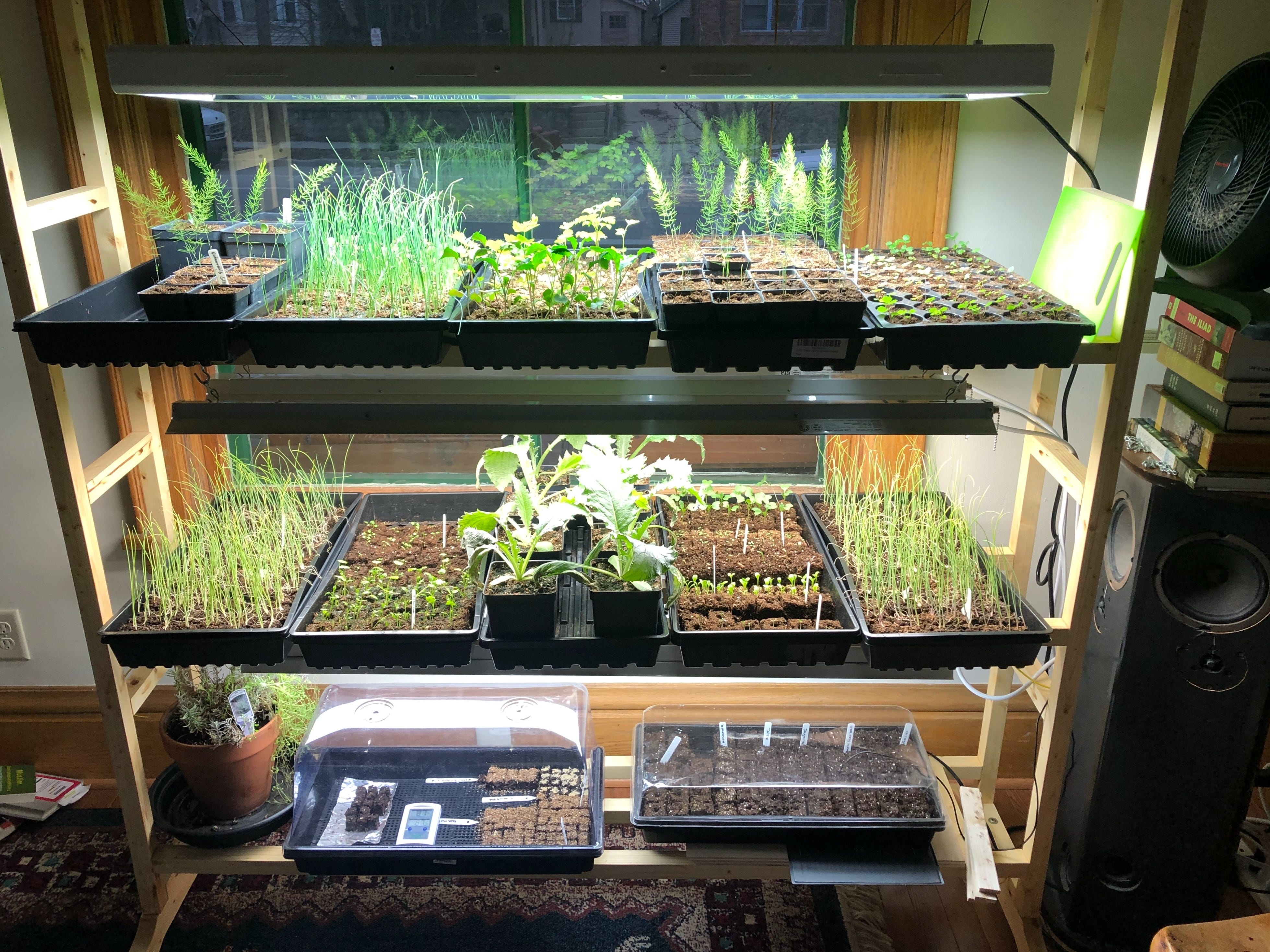
The internet is awash with misinformation about grow lights. Especially with the rise in home-grown cannabis, there are hundreds—maybe thousands—of grow light vendors competing to convince you that you need their products. But you don’t need their products, and your plants are unlikely to benefit from them.
For the average home grower raising seedlings, the best lights are usually the cheapest ones you can get your hands on. For years, I used the cheapest LED workshop lights available at my nearest big box hardware store (Menards). As of this writing, Menards sells the Pinegreen Lighting 46” 6500 Lumen LED Shop Light for $7.99. That’s the type of price you should be paying. The exact light doesn’t matter. Usually the cheapest lights are approximately four feet long. If you don’t have space for four-foot-long lights, you can usually find two-foot-long workshop lights (but they’re often a little pricier).
Generally speaking, I suggest using three four-foot-long workshop lights to cover a two-foot by four-foot growing area (eight square feet). So if you plan to grow four 1020 trays of plants (1020 trays are the standard 10 × 20 in. nursery trays), you need three workshop lights.
Different plants have different light requirements. Some plants, such as members of the milkweed (Asclepias) genus, can go dormant when day lengths are too short.1 But plants value their sleep, so too long of a day can also cause problems.2 I use a photoperiod of 14 hours on, 10 hours off for all my plants, and I think that’s a good middle ground that works for most species. You could turn your lights on every morning when you wake up at 6 a.m., and turn them off before bed at 8 p.m., but I suggest purchasing an outlet timer. Again, just buy the cheapest one. Just make sure that if your lights have three-prong plugs, you buy a timer with a three-prong socket.
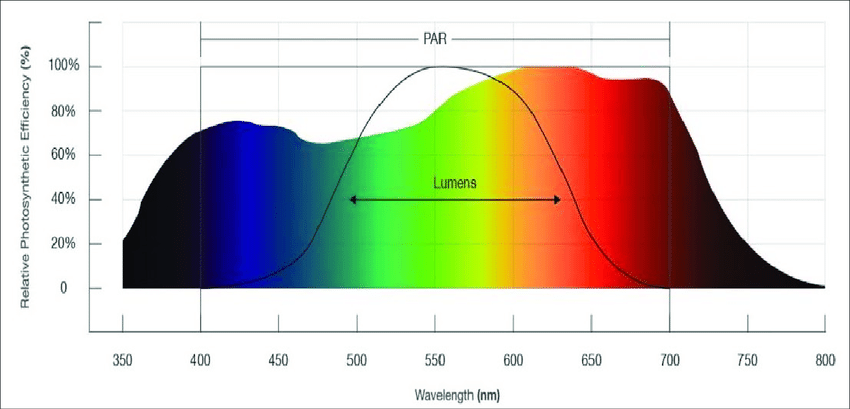
Lights are marketed in terms of their lumen output. Lumens are a measure of how bright a light appears to the human eye, but plants are not human and they don’t have eyes. Lumens measure the intensity of light weighted by the human photopic sensitivity curve, which peaks around 555 nanometers. This wavelength was chosen because our eyes are most sensitive to green light, meaning that green light appears brighter to us than other wavelengths. Plants are green because—to oversimplify—they reflect more green light than they absorb; chlorophyll absorbs red and blue light more strongly. Because lumens are weighted to human vision (peaking in the green), they emphasize wavelengths that often contribute less per photon to photosynthesis than red light (see diagram below).3
If you start looking at fancy grow lights that have more output in the red/far-red spectrum, those lights might have very low lumen values (violet and far-red light appears dim to humans), even though they are optimized for plant growth. And in many cases, professional grow lights will often not list lumens, since vendors want to avoid an apples-to-oranges comparison to human-centric lighting.
I’m not really a lighting expert, so you shouldn’t trust me. Cheap lights are inefficient, both in terms of how much energy they waste as heat, and in terms of how useful their wavelengths are to plants. The Menards lights I mentioned above are fine, but maybe they get a little hotter (wasting energy) than nicer lights, and they may be outputting too much green light and not enough red and blue light. I’ve been using lights from ActiveGrow, and they’ve worked well. I haven’t necessarily noticed improvements in my plants, but they have some nice design features that make them easy to work with, and ActiveGrow provides graphs of the relative intensity of wavelengths outputted (though I don’t know if those are third-party verified).
This part is easy. Just get yourself some 1020 trays, without holes. 1020 (pronounced “ten twenty”) trays are, as the name implies, 10 × 20 in., and they are a standard size. They cost about $1.00–$4.00 each depending on where you buy them (your local hardware store or garden store probably has them). If you want to upgrade, buy the rigid type that will never bend or break. I use “Indestructible Trays” from Neversink Tools. Their customer service is, at times, a little salty, but they make the best tools so they can be forgiven.
In general, deeper pots are better. I plant many of my natives in places where I do not have access to water. So I plant plugs that are five inches deep, meaning that root tips are five inches below the soil surface. The soil five inches deep is usually moist throughout the spring (where I live), so I hardly water my plants. If your pots are only three inches deep, you’ll probably need to water them more, because the soil is likely to dry out at three inches.
With that being said, if you’re on a budget, just make friends with gardeners and collect their used pots. The pots I prefer to use are the 2.5 × 2.5 × 3.5 in. size that you see most often at native plant sales. If you can’t find friends with used pots, Greenhouse Megastore sells packs of 32 for $2.88. Or just use another type of pot. The advantage of this type is that they are big enough to accommodate most native plants until they’re ready to be planted, but they’re small enough that you can fit 128 of them in a 2 × 4 ft. growing area.
My favorite container for native plants is the SureRoots Deep 50 Cell Plug Tray. Each plug has approximately the same soil volume as the 2.5 × 2.5 in. pots mentioned above, but they are deeper and narrower. Deeper means that your roots will be deeper in the ground at planting, which means less need to water. And narrower means you can fit more in a smaller space. So you can fit 200 plants in a 2 × 4 ft. growing area.
You don’t need shelving and fans, but they’re nice to have. With a nice shelving setup, you can grow three or four shelves of plants right on top of another, and it gives you an easy way to hang your lights. Wire shelving racks work well, and you can often find them cheap.
I like to have a very low-power fan going on my plants throughout the daytime. Constant airflow keeps fungus gnats at bay, reduces risk of fungal infection, and it makes for more resilient plants that can transition more easily to the outdoors. I favor low-power computer fans, like this one from AC Infinity. Just keep them at the lowest setting. Make sure to be careful about acclimating freshly-germinated seedlings to the fan. I usually wait until seedlings are one to two weeks old before exposing them to the fan, and I usually start them off in an area farthest away from the fan, where airflow is least intense.
Have questions? Let me know in the comments!
See, for instance, this article: Aaron I. Velez-Ramirez et al., “On the Induction of Injury in Tomato under Continuous Light: Circadian Asynchrony as the Main Triggering Factor,” Functional Plant Biology: FPB 44, no. 6 (2017): 597–611.
Note that the difference in efficiency is not huge. See, for instance, this article: K. J. McCree, “The Action Spectrum, Absorptance and Quantum Yield of Photosynthesis in Crop Plants,” Agricultural Meteorology 9 (January 1971): 191–216, https://doi.org/10.1016/0002-1571(71)90022-7.
No posts
Comments
Nothing yet. Say the first thing.
Sign in to join the conversation.