
I thought to congratulate our readers on their recent purchase of SpaceX. But rather than dwell on that, I want to focus on what some are calling a triumph, and what I suspect is the signaling of the end of the beginning for the AI boom. The top players in AI continue to suck all the air out of the room, hoovering up capital in a way that runs counter to how VC investment cycles are supposed to work, by spreading across a portfolio, and not concentrated in a handful of hyperscalers. The ROI math simply doesn't add up. Thank god for the American taxpayer.
In other news, some really interesting releases this week, in particular Algolia who’s been somewhat quiet this year.
- Michael
Datalab release lift - a structured extraction model that pulls JSON out of PDFs and images. (link)
Cohere’s North Mini Code is available on Ollama- Cohere’s first model for developers. A 30B Mixture of Experts model with 3B active parameters, built for agent software engineering. (link)
Our friends at Swirl announced Swirl 5 GA coming July 15 - SWIRL runs federated AI search and RAG across 150+ systems in real time - no copying, no index, no vector database - serving ranked, permissioned, organization-approved answers to your people and your AI agents (link)
Algolia introduces Adaptive Intent - A better way to understand search intent (link)
Centrally manage authorizations for MCP connectors - Still not the MCP management that we need but it allows enterprises to provide MCP providers through their identity providers. (link)
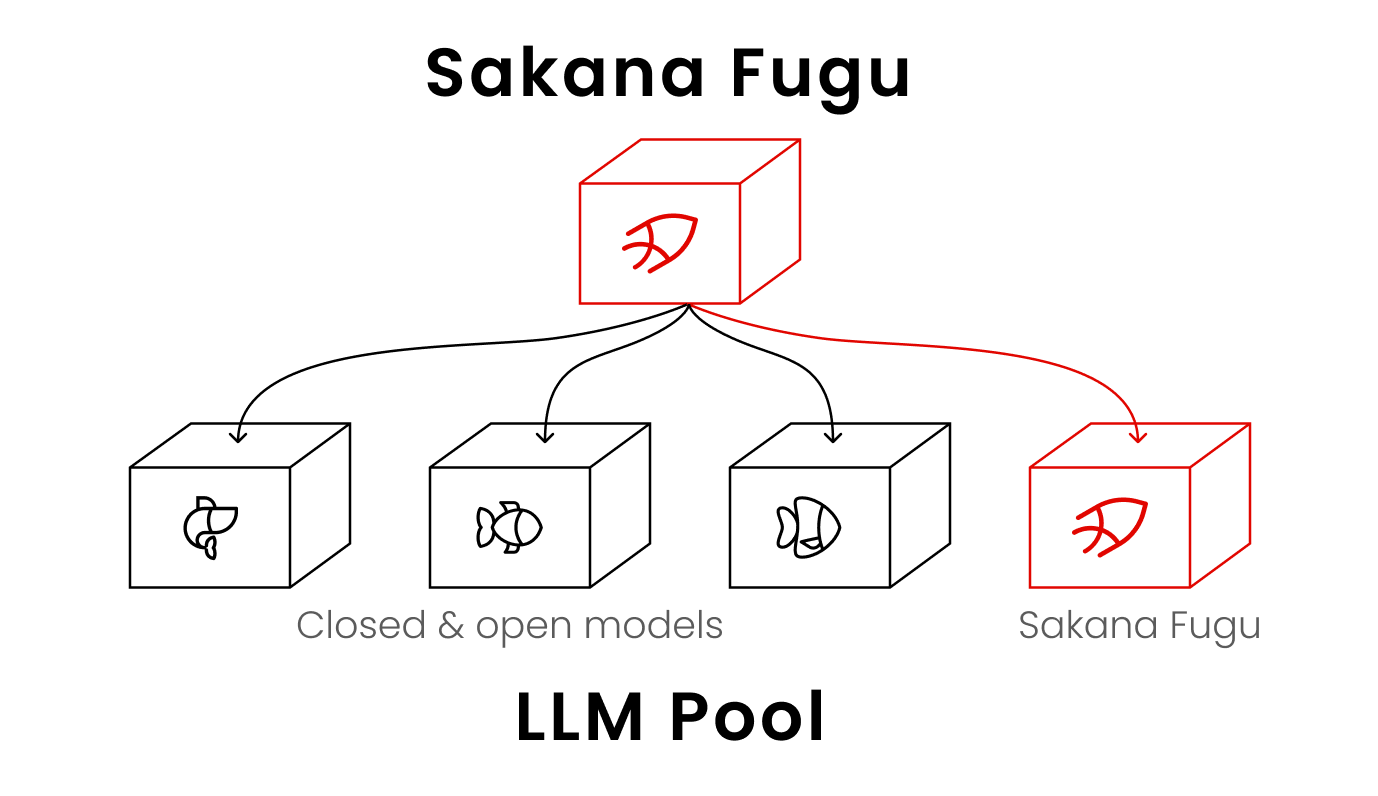
Fugu from Sakana AI is a multi-agent system that ships as a single model. Under the hood it dynamically orchestrates a pool of frontier models — routing tasks, assigning roles, and coordinating responses — but from the outside you call it like any other LLM via a standard Chat Completions or Responses API. The coordination layer is trained, not hand-coded: a compact “Conductor” model (trained with RL) designs the agent-to-agent communication topology and writes targeted instructions for each worker. A second component called TRINITY uses an evolutionary strategy to delegate three distinct roles across the model pool turn by turn. Both papers landed at ICLR 2026. Install into Codex with one curl command.
The abstraction is the insight. Multi-agent complexity hidden behind a single API endpoint means you get the performance gains of orchestration without building the orchestration yourself.
The coordinator is learned, not designed. The system discovers which models to route to and how — it isn’t a static pipeline. That’s a fundamentally different architecture than most agent frameworks.
Benchmarks against the top tier. Evaluated against Gemini 3.1 Pro, Opus 4.8, and GPT 5.5 in their highest-capability modes — worth reading the technical report to see where it lands.
Read me on Github
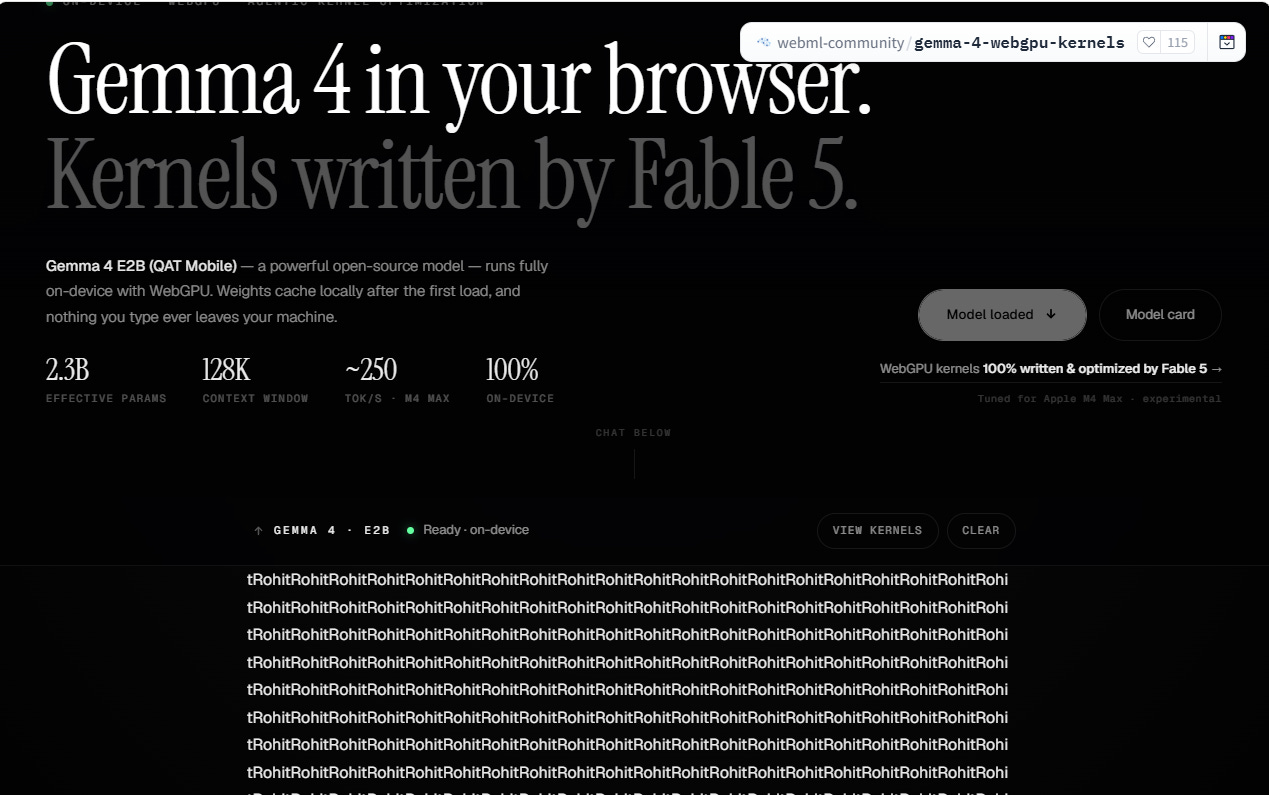
Google’s Gemma 4 E2B, a 2.3B effective parameter model with a 128K context window , now runs fully in-browser via WebGPU. The twist: it sucks. But while it sucks it’s a great leep forward for device on edge computing.
You can see in the screenshot above, A simple question “When were you trained” caused it to go into an infinite loop repeating Rohit. Stopping it and asking it again cleared the issue.
The WebGPU kernels (the low-level GPU programs doing the actual matrix math) were written entirely by an AI agent called Fable 5 before it was shut down. The agent was given the task of optimizing inference, climbed to 84 tok/s, hit a wall claiming further gains were impossible — then after safeguards were rolled back, pushed all the way to 255 tok/s on an Apple M4 Max. The kernels and the demo are now open on Hugging Face for anyone to inspect and run.
Agentic kernel optimization is a real thing now. An AI wrote and benchmarked its own GPU shaders through an evolutionary search loop. The result beat what human engineers thought was the ceiling.
On-device inference just got serious. 250 tok/s in a browser tab, weights cached locally after first load, zero data egress — this is a meaningful shift in what “private AI” looks like for end users.
The Fable 5 footnote matters. The company was shut down, but its work shipped. The kernels are open, reproducible, and live. Whatever happened to the company, the technique survived.
Read more on huggingface
Ricoh — the 90-year-old document hardware giant — invested in Weaviate through its corporate VC fund, announced June 16. The strategic logic is straightforward: Ricoh has decades of document capture technology and Weaviate has the retrieval layer. Together they're targeting the vast pile of enterprise unstructured data that companies have captured but can't actually query — scanned documents, PDFs, handwritten notes — and turning it into something an AI agent can reason over.
Distribution matters as much as the tech. Ricoh operates in ~200 countries with deep enterprise relationships. That’s a go-to-market channel most vector DB startups can’t build in a decade.
“AI-ready data” is becoming its own infrastructure category. This deal signals that legacy enterprise vendors see vector databases as the missing layer between their data capture hardware and the AI transformation their customers are demanding.
Long-term signal for Weaviate’s staying power. Strategic corporate VC backing from a $16B revenue company is a different kind of validation than another SV funding round — it means a major enterprise partner is building their roadmap around you.
Read more at Ricoh
No posts
Comments
Nothing yet. Say the first thing.
Sign in to join the conversation.