
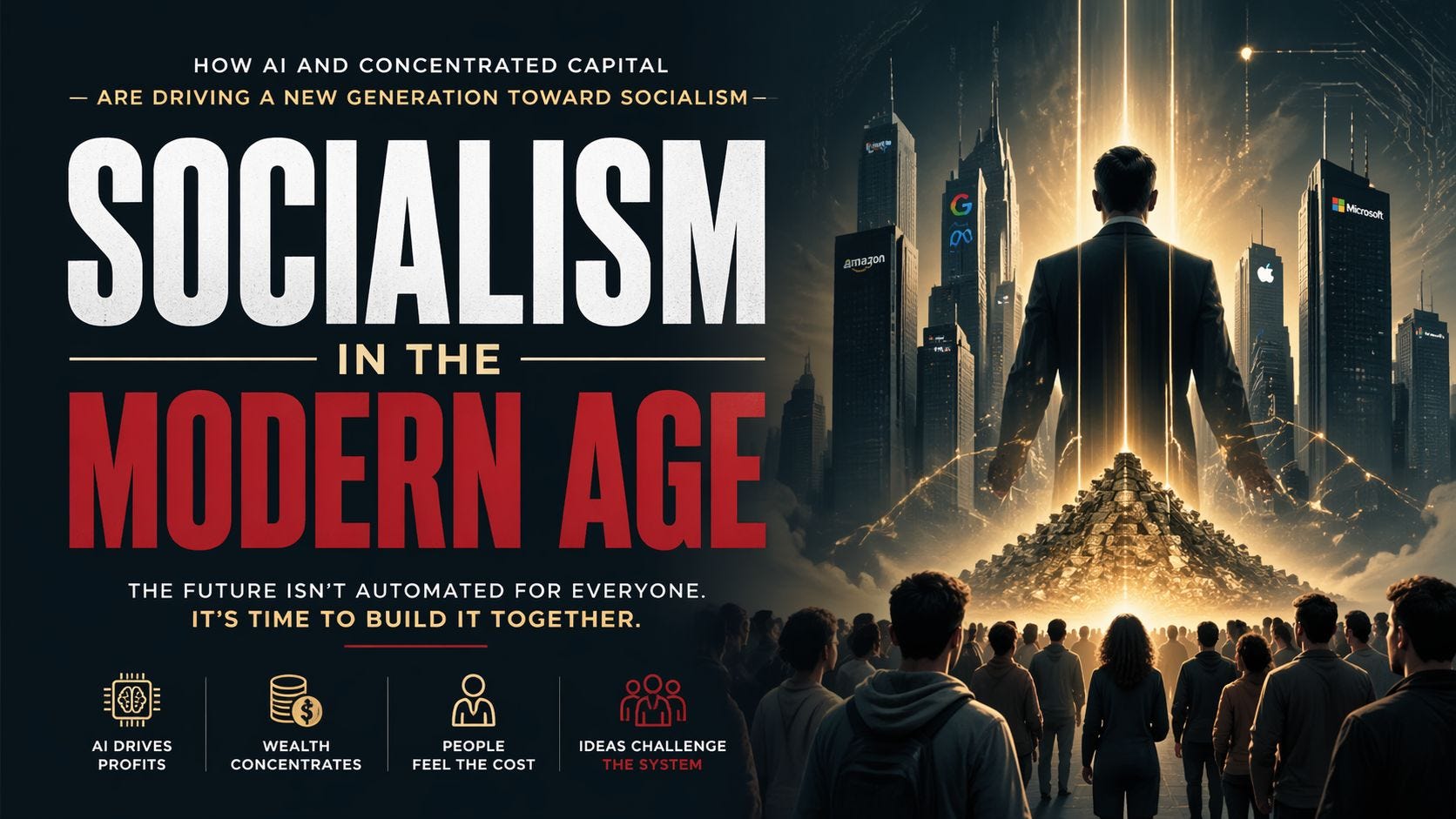
In recent polls, nearly two-thirds of young Americans report a positive view of socialism. Approval ratings for capitalism are sliding. For years now, a growing debate over socialism has permeated the media; from legacy outlets to podcasts across the political spectrum, everyone is forecasting a socialist resurgence in the U.S.
While representatives like Elizabeth Warren or Bernie Sanders once represented popular outliers, the election of socialist New York City Council member Mamdani has added fresh fuel to the fire.
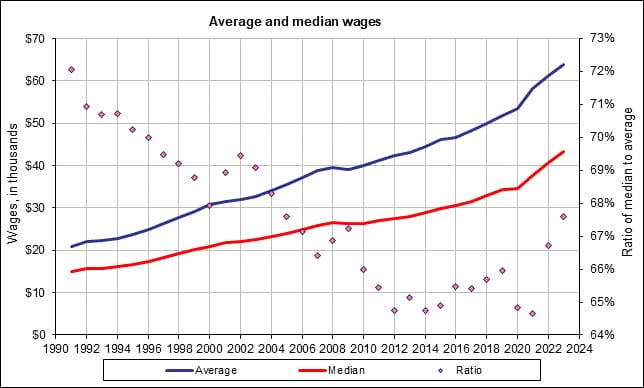
The only surprising thing about this longing for a more social form of coexistence is that it took this long to gain momentum. For decades, the gap between household purchasing power and the cost of a college degree, a home, or a car (including the license) has been widening.
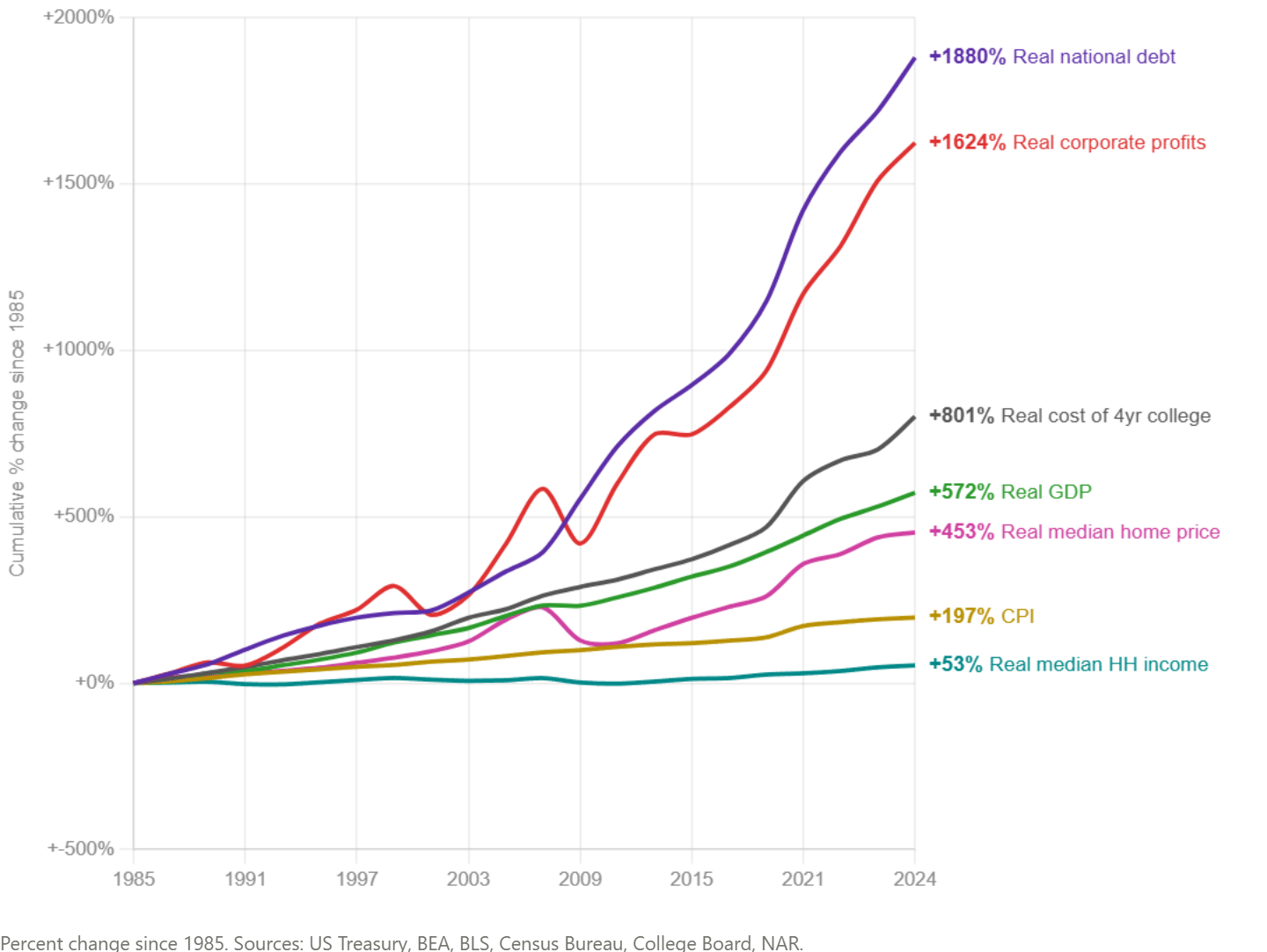
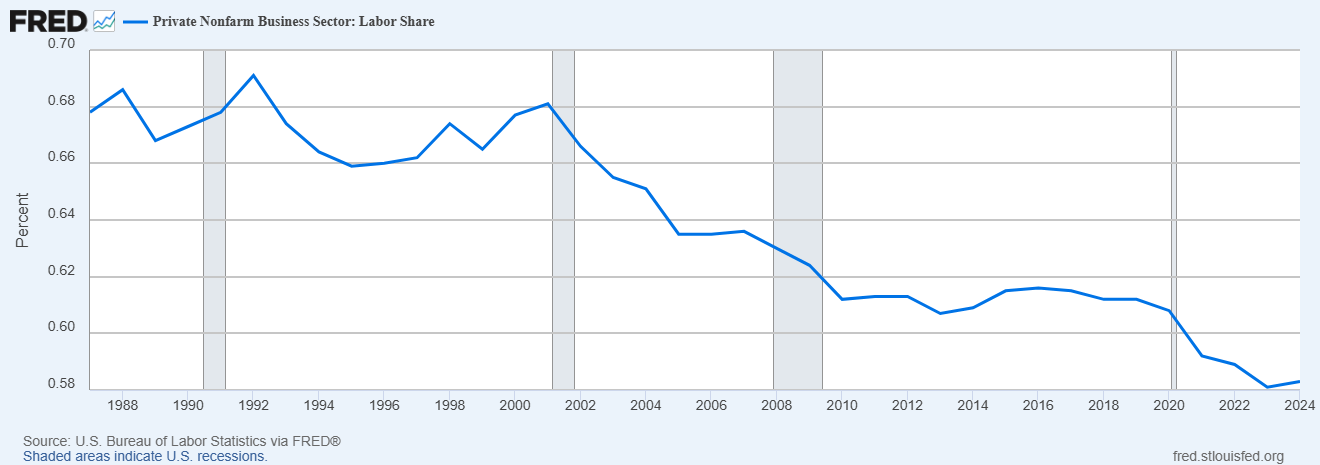
At the same time, citizens tune in to news of rising growth, corporate profits, and soaring national debt. While labor income hardly participates in that growth, the working population has a sinking feeling they’ll be the ones stuck with the bill when it’s time to refinance that debt.
Individual Income Taxes, along with Social Security and Medicare taxes, account for up to 50% of a worker's gross income (in California, it’s 37% + 13%) and contribute 85% of total federal tax revenue. Corporate Income Taxes? They generate a mere 5%.
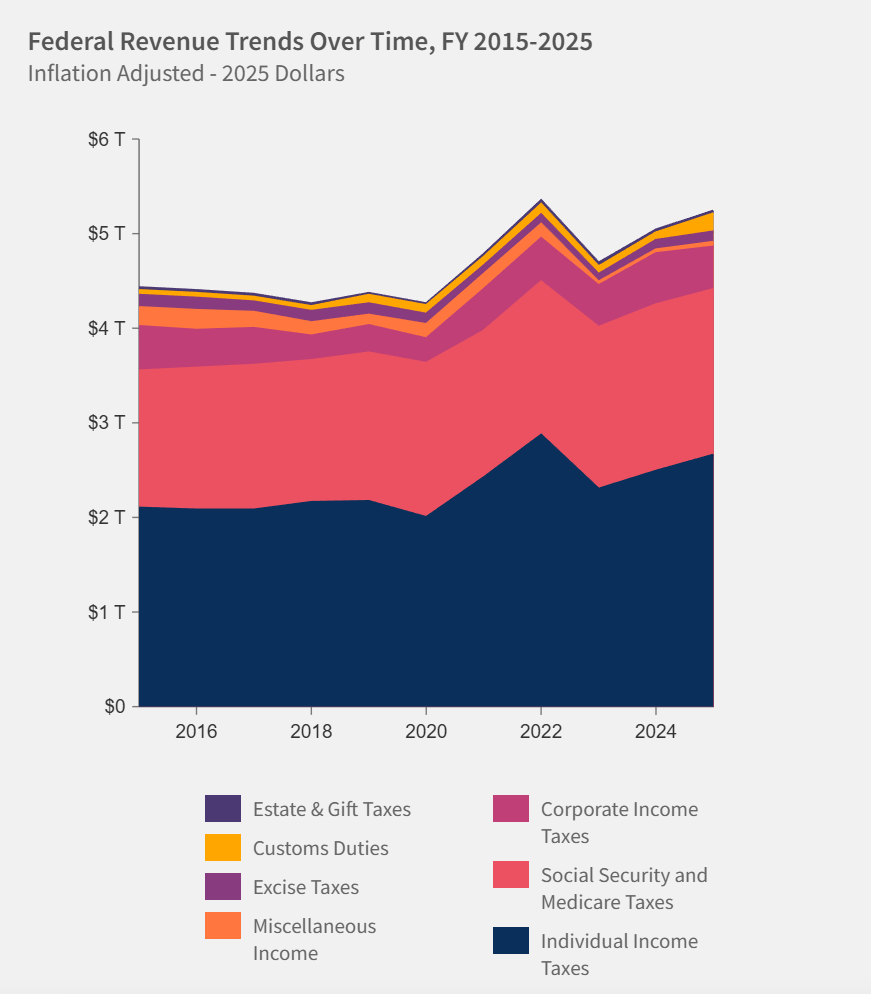
The wealthiest 0.1% pay even less. Because they avoid generating actual “income” at all costs, the wealth accumulation of centi-billionaires like Warren Buffett, Jeff Bezos, or Elon Musk is taxed at a homeopathic rate.
The founders of major U.S. tech companies are famous for taking a salary that is a fraction of what a German DAX executive earns. Taking a salary means paying taxes.
Instead, they take stock options to secure their share of the capital. This capital is only taxed upon sale—and even then, at the significantly lower rate (20%) for Capital Gains. Naturally, the goal is to avoid those taxes too, primarily by never selling shares if possible.
But how do you pay for yachts and penthouses? Simple: You borrow money, despite being super-rich. Banks will always offer billionaires the best interest rates as long as they pledge their company shares as collateral. Thus, the wealthiest people in the world live on borrowed money—and pay no taxes for lack of income.
This is the tax loophole America lives with. One might think that when the rich finally kick the bucket, the inheritance tax would right the wrong. This “Estate Tax” can be up to 40% in the U.S., but hardly anyone pays it. Much like in Germany, numerous exemptions allow savvy tax planners to pass on wealth virtually untaxed. Also analogous to Germany: interestingly, there are few organizations lobbying against inheritance tax. Because only the “fools” pay it, lobbying efforts focus on maintaining the exceptions and “preservation rules.”
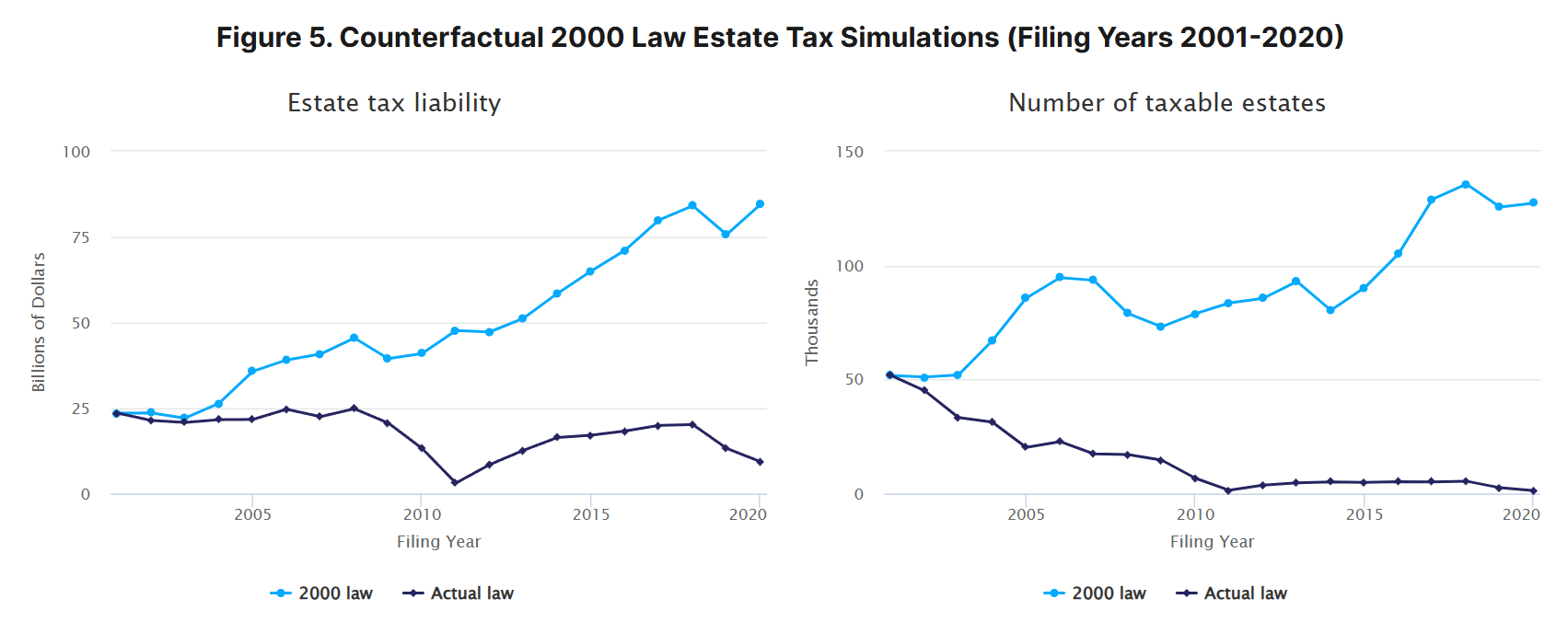
In practice, an inheritance tax that the rich don’t pay is a fantastic tool for redistribution—upward. The pinnacle of injustice in the U.S. Estate Tax system is a principle called “Step-up in Basis.” Upon death, it ensures not only that no taxes are due, but it also defines the current value of the assets as the new “cost basis” for the heir. The entire prior increase in wealth is essentially reset to zero, permanently shielded from taxation. No income tax, no capital gains, no inheritance tax.
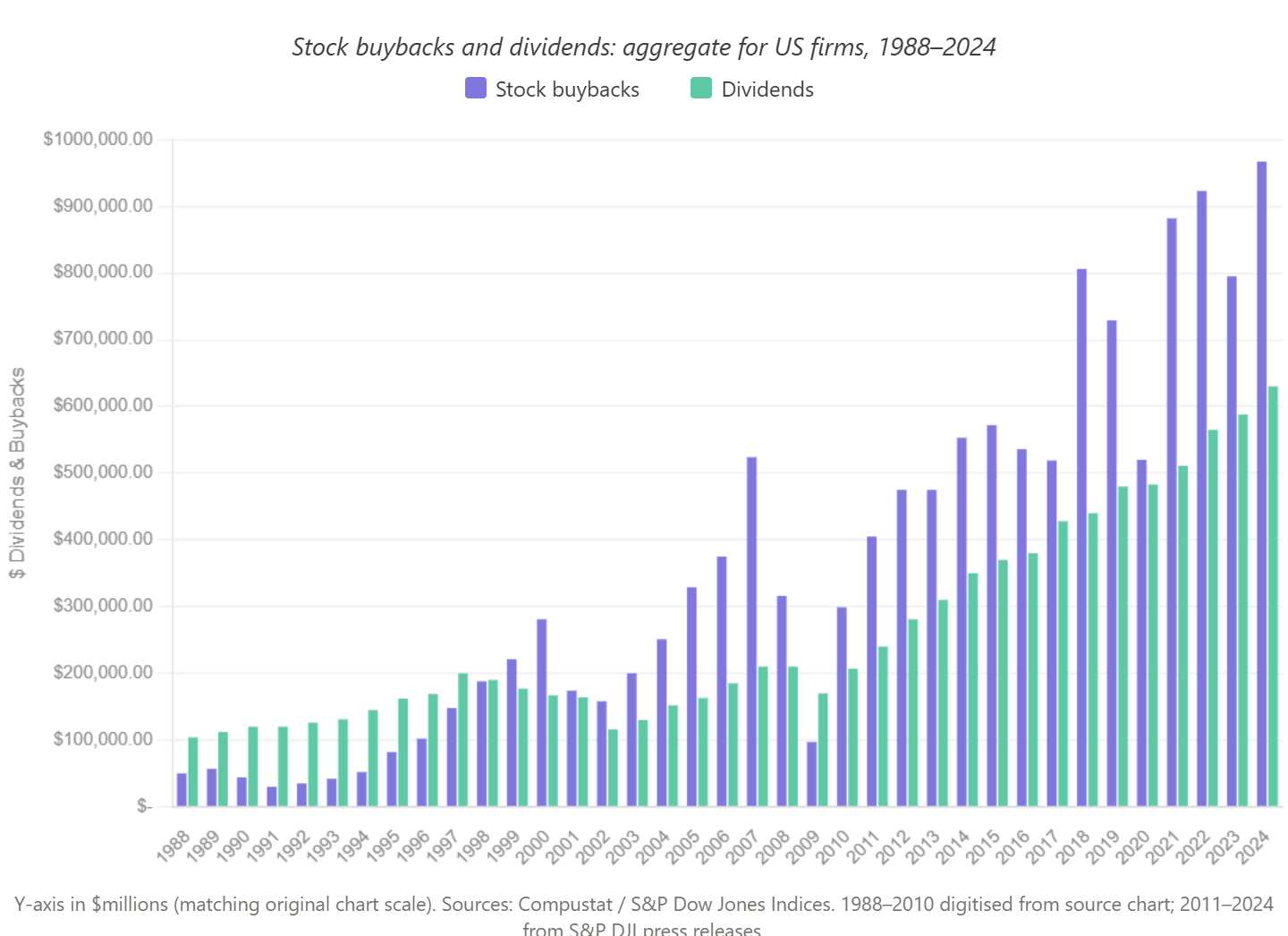
The final thorn in the side of super-rich shareholders is dividends. Although these are only taxed at 20%, even that seems too high. With a 1982 SEC rule change (Rule 10b-18), it became easier for companies to buy back their own shares. Instead of paying taxable dividends to shareholders, companies could now use their cash to boost demand for their own stock, rewarding shareholders with “paper wealth.” Since then, companies have invested significantly more in stock buybacks than in dividends.
Artificial Intelligence will only exacerbate the situation. If AI and robots—which pay no payroll taxes—work for entrepreneurs who pay almost no income taxes, the remaining human workers will have to finance the state and its debt even more heavily. Furthermore, younger generations must earn enough to cover the healthcare and elderly care of an ever-growing number of Boomers.
Increasingly, you hear voices in Silicon Valley advocating for a Universal Basic Income (UBI). From Jeff Bezos and Mark Zuckerberg to Sam Altman and Elon Musk. The wealthiest “Broligarchs” apparently all harbor a sympathy for subsidizing the population. This only seems paradoxical at first glance. The same rule applies: a stimulus package paid for by state funds is a blessing for those who don’t contribute to the financing (taxes) but would benefit massively from the additional demand. In this respect, the call for a “charity society” is hard to beat for its cynicism.
The cradle of communism was the last Industrial Revolution. A new one is at our doorstep. Nowhere does more of the GNP depend on exactly those service jobs that AI is attacking than in the U.S. Nowhere is domestic demand so significant. If the U.S. doesn’t return to a capitalism that works for the average household, they will get the socialism they deserve.
🔗 ProPublica | Penn Wharton | BROOKINGS Institute | Inspired by this Podcast
“The avoidance of taxes is the only intellectual pursuit that still carries any reward.” — John Maynard Keynes, British Economist
📋 Karp’s Daring Theses: Palantir published a 22-point manifesto on X—a summary of CEO Alex Karp’s book “The Technological Republic”—publicly declaring that inclusion and pluralism are actually quite overrated. The company argues some cultures have “produced wonders” while others have remained “mediocre, even regressive and harmful.” Additionally, Palantir calls for the development of AI weapon systems, stating, “our adversaries will not pause for theatrical debates.” Mind you, this comes from a company currently under pressure for its cooperation with ICE. Bellingcat founder Eliot Higgins put it bluntly: “These 22 points are not philosophy in a vacuum, but the public ideology of a company whose revenue depends on the politics it advocates for.” 🔗 [engadget] | [TechCrunch]
📢 Google Builds “Strike Team” for Coding: In its AI lab DeepMind, Google has tasked a team with catching up on the automation of programming. Presumably, they are worried Anthropic’s AI could soon be writing the majority of software. This would not only cost Google vital B2B revenue but also, sooner or later, decide the race for the best AI. 🔗 [The Information]
🏛️ The Pentagon Uses Banned Anthropic Model: This story is a masterpiece of state schizophrenia: The NSA is using Anthropic’s most powerful model, Mythos Preview—even though the superior Pentagon has officially classified the company as a “supply-chain risk.” The dispute began in February when Anthropic CEO Dario Amodei refused to release his models for autonomous killing weapons and mass surveillance; subsequently, “Secretary of War” Pete Hegseth blacklisted Anthropic. The NSA apparently uses Mythos primarily to scan its own systems for exploitable vulnerabilities—while the military simultaneously argues in court that these very tools are a threat to national security. 🔗 [Axios]
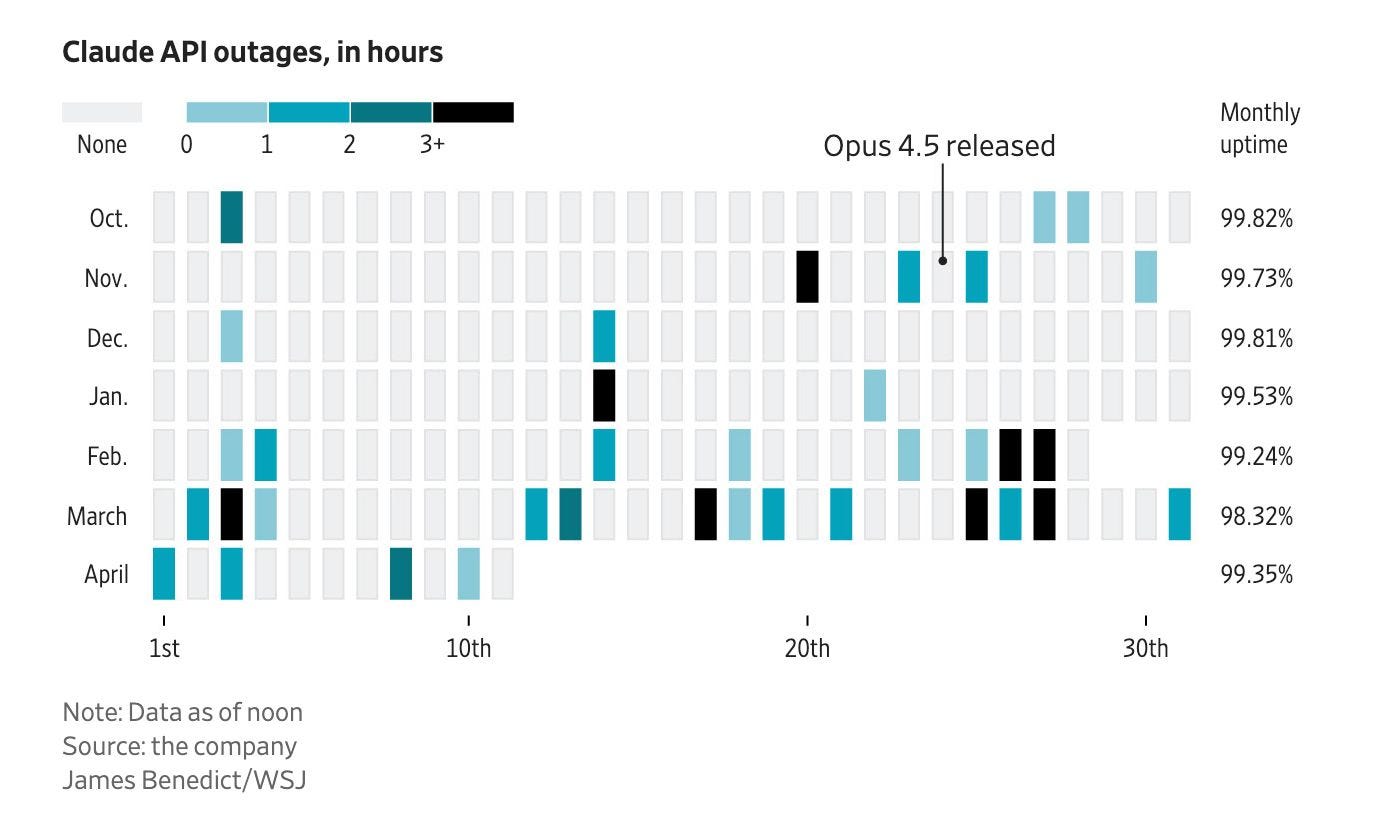
I call it “punished by success” when startups run into problems others would love to have. That’s roughly the situation for the leadership at AI provider Anthropic. Their Claude family is so popular that servers are regularly overloaded or down (standard uptimes are 99.99%).
A nice side effect: because Anthropic didn’t secure enough data center resources out of cost-consciousness, the service is suffering, but they are likely making a significantly higher return than anticipated. Restrictions enable economic action, allowing them to enforce higher prices and bill per generated token. The increased revenue combined with relatively fixed costs should be very beneficial to Anthropic’s gross margin. In the medium term, however, the company must find new computing capacity.
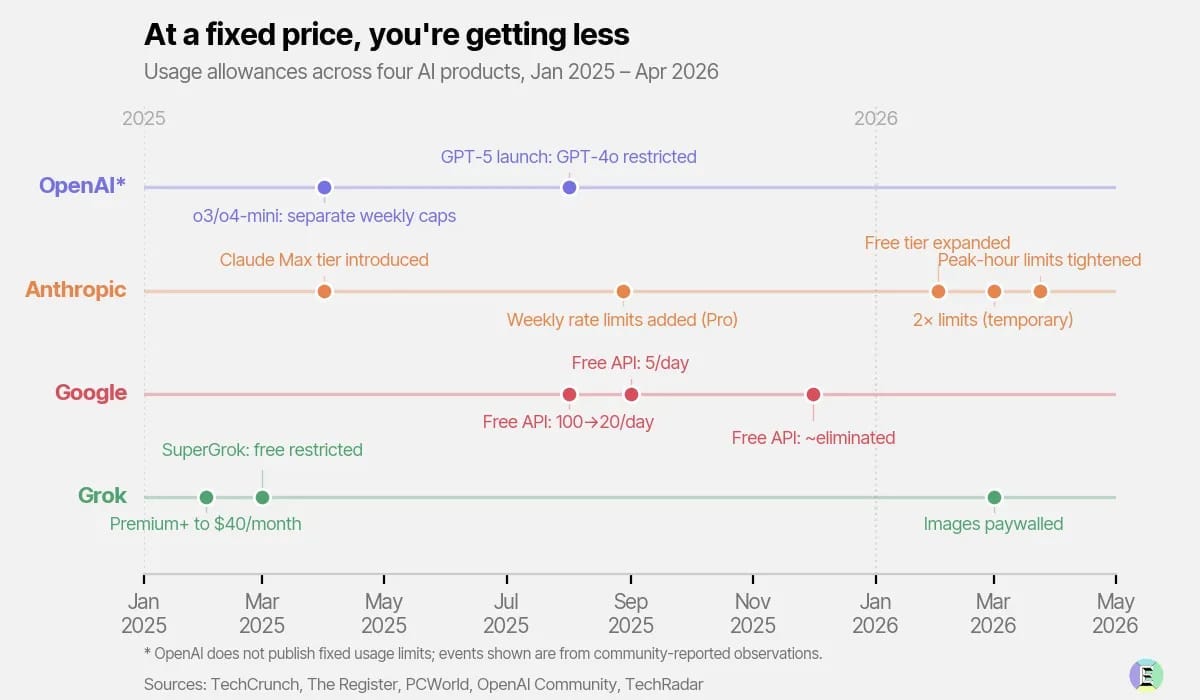
Overall, all providers are currently limiting their packages and striving to be more resource-efficient. The $20-a-month “token bazooka” is coming to an end, and the AI market is shifting toward output-based monetization.

Patrick Boyle is one of my favorite YouTubers. Not just because I value his financial background, but because he always looks at current developments through a skeptical lens, exposing frauds, scams, and questionable characters with more expertise and less ideology than your average pundit. In the latest episode, he takes on Prediction Markets. Market leader Polymarket, meanwhile, is planning a funding round at a $15 billion valuation. 🔗 [YouTube]
Monday 20. April: —
Tuesday 21. April: Interactive Brokers (AMC)
Wednesday 22. April: GE Vernova (BMO), Tesla (AMC), servicenow (AMC), IBM (AMC)
Thursday 23. April: intel (AMC)
Friday 24. April: —
No posts
Comments
Nothing yet. Say the first thing.
Sign in to join the conversation.