
From Betsy: Voting rights for all Americans are being challenged. The president has claimed, without evidence, that there is widespread voter fraud. The Supreme Court has limited the protections of the 1965 Voting Rights Act. The House has passed the SAVE (Safeguard American Voter Eligibility) Act, which would make it much more difficult for every American, but especially married women, to vote. Some Christian conservatives argue that women should not vote because they are represented by their husbands in the public sphere. So I’m republishing an expanded account of the 1848 Seneca Falls Convention, which launched the woman suffrage movement, to remind us of how hard it has been to expand and secure voting rights for all.
The first women’s rights convention in America, held in Seneca Falls, NY, on July 19-20, 1848, was not the first demand for women’s rights. It was the first formal meeting on the topic. It set the agenda for an organized movement, calling for voting rights and the abolition of laws that “place [women] in a position inferior to that of men.” It started the clock. Seventy-two years later, the country ratified the Nineteenth Amendment, removing barriers to voting “on account of sex.” In 1965, the Voting Rights Act outlawed racially discriminatory voting practices.
The Seneca Falls meeting was organized in ten days by five women: Elizabeth Cady Stanton, a recent transplant to western New York; Lucretia Mott, a prominent Quaker abolitionist from Philadelphia; Mott’s sister, Martha Coffin Wright, in nearby Waterloo; and her neighbors, Jane Hunt and Mary Ann McClintock. Ranging in age from thirty-two (Stanton) to fifty-five (Mott), the five women were prosperous wives and mothers with roles in their communities and the abolition movement. The older women were Quakers.
Stanton described them as having “souls large enough to feel the wrongs of others.” Living in a mill town had made her more aware of the hardships of working women. She saw among her neighbors the hardships and isolation most women confronted, “the mountains of sorrow and suffering endured . . . in abodes of ignorance [and] poverty.”
The newly married Stanton had met Mott in 1840, when she accompanied her husband Henry to the World Anti-Slavery Convention in London. The most liberal men in the world refused to seat Mott, head of the Philadelphia Female Anti-Slavery Association, or any female delegates “because women were constitutionally unfit for public and business meetings.” Stanton claimed that she and Mott vowed “to hold a convention as soon as we returned home and form a society to advocate the rights of women.”
The women did not meet again until eight years later, when Mott was visiting upstate New York. Gathering for tea, Stanton spilled her discontent with woman’s lot. The privileged daughter of a wealthy land developer and attorney, the wife of another attorney and abolitionist agent, and the mother of three rowdy boys, pregnant with her fourth child, Stanton had relocated from Boston, where she had servants and a social life, to Seneca Falls, where there were no sidewalks, “mud up to the [wheel] hub” and inadequate help.
“The novelty of housekeeping had passed,” she admitted. “. . .domestic life was now irksome. To keep a house and grounds in good order, purchase every article for daily use, keep the wardrobes of half a dozen human beings in proper trim, take the children to dentists, shoemakers, and different schools, or find teaches at home . . . made sufficient work to keep one brain busy, as well as all the hands I could impress into service. I had so many cares than the company I needed for intellectual stimulus was a trial rather than a pleasure.” Her words have a familiar ring.
Stanton was not the only overwhelmed homemaker present. Martha Wright, also pregnant, had published an unsigned article on the same topic: “The wife, . . . amid incessant clamor, must renew the treadmill of yesterday – must wash the same faces, make the same beds, sweep the same rooms, . . . and amid all these occupations, . . . find moments to ‘stitch-stitch-stitch’ the innumerable garments needed in a family.”
The women turned their complaints into a call to action, publishing an unsigned notice announcing “a convention to discuss . . . the rights of women,” in the Seneca County Courier.
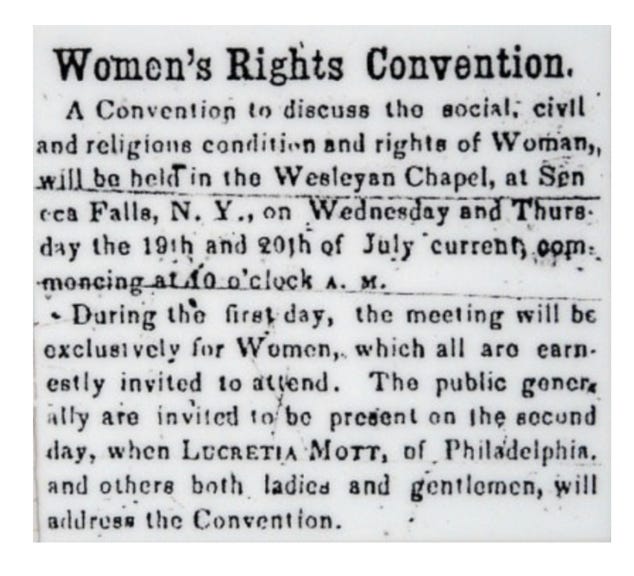
“Women’s rights” was an oxymoron because women had no rights. Under common law “coverture,” they were subject to the authority of fathers and husbands, from whom and to whom they and their property were transferred upon marriage. Legally invisible, they had no rights to their wages, their children or the personal autonomy of their bodies, no right to inherit or own property, sign contracts, bring legal actions, serve on juries or vote.
1848 was a year of upheaval. Having won its first offensive war, against Mexico, the United States had increased its landmass by one-third, fulfilling its “manifest destiny” and opening space into which slavery might be extended. Political abolitionists, like Henry Stanton, established the Free Soil Party (“free soil, free labor, free men”). Its goal was to contain slavery where it currently existed. Popular insurgences raged in Europe. Transatlantic steamers brought the news of revolutions and new waves of immigrants.
In 1847, New York had convened a constitutional convention. Proposals to remove a property qualification for Black men to vote lost. Petitions urging woman suffrage were ignored. Married women’s property rights narrowly passed before opponents managed a last-minute repeal. Electing judges passed and Stanton’s father won a seat on the state supreme court.
That year, using his legal expertise, Daniel Cady had deeded the Seneca Falls house to his daughter as a “separate estate,” a complicated maneuver. Fathers like Judge Cady had an interest in their daughters’ inheritance not being squandered by ne’er-do-well sons-in-law. He put Henry in that category because of his abolitionist activities and erratic employment. Father and daughter both lobbied the state legislature for the Married Women’s Property Act, which passed in April 1848. Supporters based their case on the “unalienable rights” promised by the Declaration of Independence.
Further, forty-four frustrated married women from western New York testified: “Your Declaration of Independence declares the governments derive their just powers from the consent of the governed. . . . [As] women have never consented to, been represented in, or recognized by this government, it is evident that in justice no allegiance can be claimed from them . . . Our numerous and yearly petitions for this most desirable object have been disregarded; we now ask your august body to abolish all laws which hold married women more accountable for their acts than infants [and] idiots.”
The new property law pertained only to property, not wages, so relatively few women benefitted. The law became a template but was not the first. In 1839, Mississippi declared that married women could own property, specifically enslaved people inherited from their family. The case related to Betsy Love, a Chickasaw woman married to white man, who wanted to sell her slaves to pay off his debts.
Perhaps inspired by the Fourth of July, Stanton used the Declaration of Independence as the basis of her “Declaration of Sentiments.” In an era in which every American could recite its preamble, her assertion that “all men and women are created equal” was startling. She appropriated and rewrote “The history of mankind is a history of repeated usurpations on the part of man toward woman,” replaced King George with “all men,” and proposed eleven resolutions to address women’s inferior “social, civil and religious condition.”
The ninth demanded voting rights: “It is the duty of the women of this country to secure to themselves the sacred right to the elective franchise.” Mott objected: “Thou will make us ridiculous. We must go slowly.” Stanton enlisted the support of Frederick Douglass, the Black abolitionist leader and editor of The North Star in Rochester. With Douglass’s promise to attend the meeting, Stanton kept her demand for suffrage in the document.
July 19-20 fell midweek in a hot summer. The organizers worried that no one would come but around 300 people convened in the Wesleyan Chapel. Bold as they were, the women chose not to preside over a “mixed” gathering of men and women, behavior deemed “promiscuous.” Indeed, another resolution addressed men resisting women speaking in public, when they delighted when women appeared scantily dressed in a dance hall. James Mott chaired several sessions, later holding his wife’s hat when she spoke. Henry Stanton was absent.
Not invited to attend until Thursday, forty men insisted on begin seated on Wednesday. Susan Anthony’s father and sister and Douglass came fifty miles from Rochester. Then thirty, Douglass had purchased his freedom a decade earlier. He was the only African American present. The suffrage resolution would not have passed without Douglass’s intervention. There is no transcript of the meeting, but he was remembered arguing that “the power to choose rulers and make laws was the right by which all others could be secured.”
On July 20, participants endorsed the resolutions and then unanimously adopted the Declaration of Sentiments by a voice vote. Sixty-eight women signed it; thirty-two men signed a separate document. Within weeks, in the face of scathing criticism, many women removed their names.
As reports of the meeting sped across telegraph lines, the hurriedly organized convention touched off a national debate about women’s rights. Ministers damned its demands as unseemly. Conservatives defended traditional womanhood. Newspaper editors proclaimed women unfit for citizenship. One called the meeting an “insane and ludicrous farce.” The Lowell Courier feared that men would have to “wash dishes, scour up, be put to the [laundry] tub, handle the broom [and] darn the stockings.” The Oneida Whig declared it “the most shocking and unnatural incident ever recorded in the history of womanhood. If our ladies will insist on voting and legislating, where, gentlemen, will be our dinners, . . . our domestic firesides and the holes in our stockings?”
Suffragists were denounced as unattractive and unmarriageable radicals, perverts, traitors and anarchists. The Philadelphia Public Ledger asserted that no lady wanted voting rights. “A woman is nobody. A wife is everything. A mother is, next to God, all powerful. The ladies of Philadelphia, under the influence of the most serious, sober second thoughts, are resolved to maintain their rights as Wives, Belles, Virgins and Mothers, and not as Women.”
Some editorials praised the meeting. The St. Louis Daily Reveille declared that “the flag of independence has been hoisted for the second time.” The Herkimer [NY] Freeman hailed women’s rights as “a great jubilee.” Douglass provided an enthusiastic report in The North Star: “In respect to political rights, we hold women to be justly entitled to all we claim from men.” The paper’s masthead declared, “Right is of no sex. Truth is of no color.” That September, however, the National Convention for Colored Citizens tabled Douglass’s resolution endorsing women’s equality.
Horace Greeley, editor of the New York Tribune, the country’s most influential newspaper, was uncomfortable with the idea of equal rights for women, but he could not deny the logic of the Declaration of Sentiments. If Americans believed “all men are created equal,” they must embrace women’s rights, including voting. “When a sincere republican is asked to say in earnest what adequate reason he can give, for refusing the demand of women to an equal participation with men in political rights, he must answer, ‘None at all.’ However unwise and mistaken the demand,” Greeley concluded, “it is the assertion of a natural right.”
Stanton called the nineteenth-century women’s movement the “greatest rebellion the world has ever seen.” Subsequent historians count the women’s rights and civil rights movements, the labor movement and all those that followed as major landmarks in the advance of our democracy.
Anthony called the campaign for suffrage “the long hard fight.” Neither she nor Stanton lived to celebrate its victory. Charlotte Woodward, 92, the only signer of the 1848 Declaration who was alive in 1920, was too frail to vote.
The Nineteenth Amendment was an incomplete victory. It did not enfranchise Indigenous women or Asian immigrants or people living in US territories or the District of Columbia. It did enfranchise Black women, but the federal government failed to protect their rights (as it had not for Black men following the Fifteenth Amendment) against blatantly racist and violently enforced restrictions in the Jim Crow South. Ratification of the Twenty-sixth Amendment outlawing poll taxes (1964) and passage of the Voting Rights Act (1965) finished the fight.
In 2013, the Supreme Court held, 5-4, in Shelby County [Alabama] v. [Eric] Holder (Obama’s Attorney General), that the safeguards established in the VRA were outdated, claiming there was no evidence of racial discrimination in voting laws. That decision marked the start of an onslaught against voting rights which continues, most recently, in a June 2, four-page, unsigned, Supreme Court order, allowing Alabama to use Congressional districts a lower court had found racially discriminatory.
In Born Equal: Remaking America’s Constitution, 1840-1920, Ahkil Reed Amar, Sterling Professor of Law at Yale, makes the case that Stanton’s Declaration of Sentiments and President Lincoln’s Gettysburg Address expanded the country’s understanding of equal rights and of the Declaration of Independence. As Stanton, Douglass, the suffragists and civil rights advocates deeply understood, voting rights are essential to representative government, the rule of law and equal rights for all.
To safeguard our democracy, we need to fight for those rights and use them.
SOURCES:
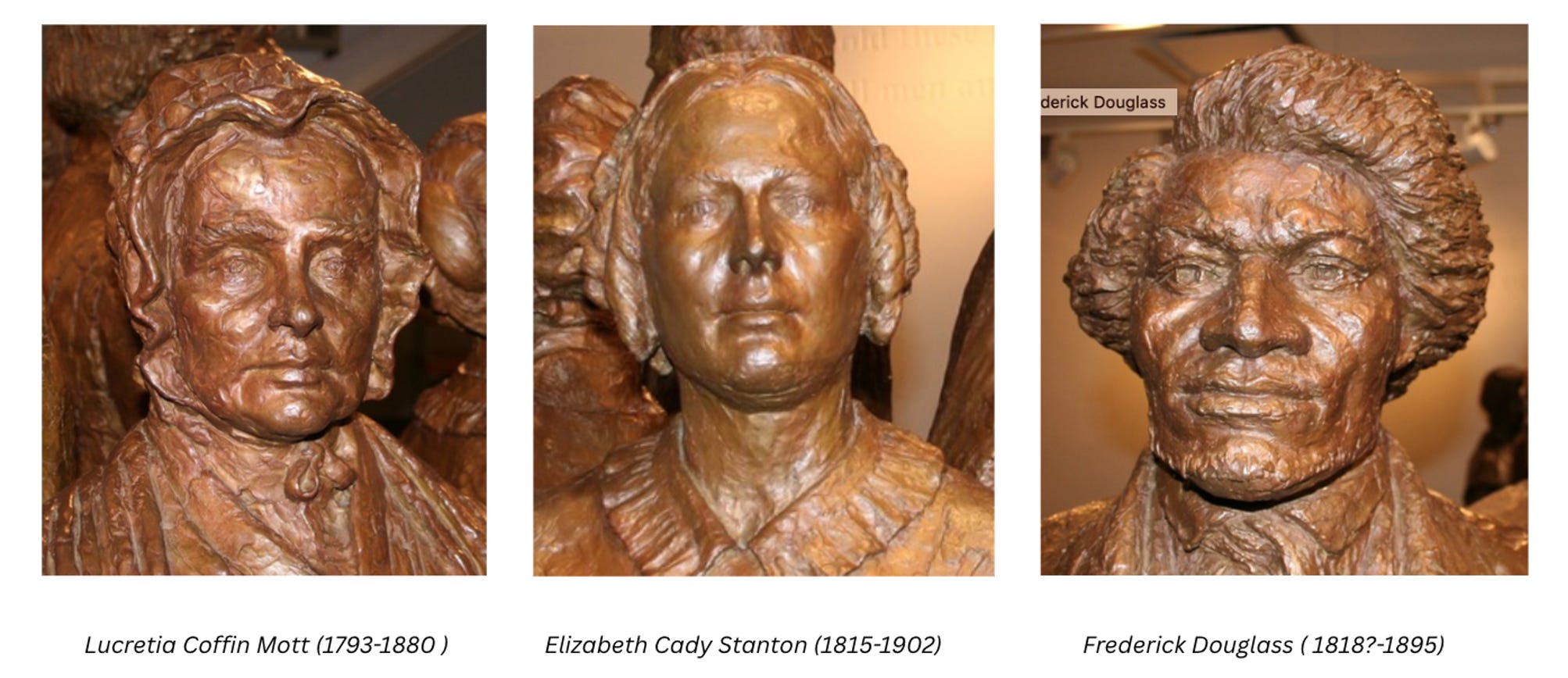
Additional illustration credits: National Park Service. Headshots from sculpture by Lloyd Little, “The First Wave” (1993), in the Women’s Rights Park Visitor Center, Seneca Falls, NY.
Elisabeth Griffith, In Her Own Right: The Life of Elizabeth Cady Stanton (Oxford University Press, 1984).
Ellen Carol DuBois, Elizabeth Cady Stanton: A Revolutionary Life (Basic Books, 2026).
Judith Wellman, “The Seneca Falls Convention: Setting the National Stage for Women’s Suffrage, History Now (March 2006), https://www.gilderlehrman.org/history-resources/essays/seneca-falls-convention-setting-national-stage-womens-suffrage.
Judith Wellman, The Road to Seneca Falls: Elizabeth Cady Stanton and the First Women’s Rights Convention (University of Illinois Press, 2004).
Ellen Carol Dubois, Suffrage: Women’s Long Battle for the Vote (Simon & Schuster, 2020).
Eleanor Flexner, Century of Struggle: The Women’s Rights Movement in the United States, rev. ed. (Harvard University Press, 1975).
“Married Women’s Property Rights,” https://wams.nyhistory.org/expansions-and-inequalities/politics-and-society/married-womens-property-act/
Lisa Tetrault, The Myth of Seneca Falls: Memory and the Women’s Suffrage Movement, 1848-1898 (University of North Carolina Press, 2014).
“Shelby County v. Holder,” Oyez, www.oyez.org/cases/2012/12-96.
Jasleen Singh and Sarah Carter, “States Have Added Nearly 100 Restrictive Laws Since SCOTUS Gutted the Voting Rights Act 10 Years Ago,” Brennan Center for Justice (June 23, 2023), https://www.brennancenter.org/our-work/analysis-opinion/states-have-added-nearly-100-restrictive-laws-scotus-gutted-voting-rights
Amy Howe and Kelsey Dallas, “Supreme Court Allows Alabama to Use Congressional Map Struck by Lower Court as Racially Discriminatory,” SCOTUS Blog (June 2, 2026), https://www.scotusblog.com/2026/06/supreme-court-permits-alabama-to-use-congressional-map-struck-by-lower-court-as-racially-discriminatory
Akhil Reed Amar, Born Equal: Remaking America’s Constitution, 1840-1920 (Basic Books, 2025).
No posts
Comments
Nothing yet. Say the first thing.
Sign in to join the conversation.