
Like many retail outlets across the South in the 1950s, Katz Drug Stores, “The World’s Leading Cut Rate Drug Store,” served African Americans in its pharmacy and aisles, but not at its lunch counter. They could order bag lunches to take out but could not sit down. On August 19, 1958, a Tuesday afternoon, thirteen students and their history teacher, Mrs. Clara Luper, challenged that policy at the Katz branch in Oklahoma City. They sat at the counter and ordered Cokes.
Their action followed a weeks’-long, student letter-writing campaign, asking the Kansas City corporation to change its policy. The children, ages six to seventeen, had practiced not responding to verbal provocation or violent assault by role playing the Luper living room. It’s unlikely they knew that the Dockum Drug Store in Kansas City, part of the Rexall chain, had surrendered after a three-week sit-in begun a month earlier.
Two of the students were Luper’s children, Calvin, 12, and Marilyn, 10, and two were their cousins. Others were her students at Dunjee High School and all were members of the NAACP Youth Council. Luper, 33, had been its Youth Advisor for year.
Refused service, the students refused to move. They opened their books and stayed put. White shoppers reacted with hostility, shouting, spitting and kicking stools. Police removed the protestors without incident. Luper had secretly arranged with Lieutenant Bill Percer, that the children would not be harmed. No one was arrested, so they continued to sit-in. Two days later, Katz desegregated sixty-five lunch counters in five states. In Oklahoma City (OKC), other eateries soon desegrated.
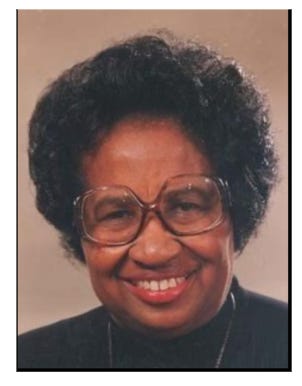
A week after the sit-in, seventeen white churches let members of her NAACP youth group attend services. At another church, they were asked to leave. “God did not intend Negroes and whites to worship together,” the pastor told them.
Buoyed by success, Luper and the Youth Council demonstrated for better treatment at John Brown’s luncheonette, the Anna Maude Cafeteria, the Skirvin Hotel and Wedgewood Amusement Park, pushing to end segregation in public accommodations in Oklahoma until passage of the 1964 Civil Rights Act.
The “mother of civil rights in Oklahoma” was born Clara Mae Shepard on May 3, 1923, in a Black community in rural Okfuskee County, an hour east of Oklahoma City. The daughter of a laundress and a Great War veteran, employed as a bricklayer, she attended a segregated high school. In 1944, she graduated from Langston University, Oklahoma’s only HBCU and the only one west of the Mississippi. A Zeta Phi Beta sorority member, she majored in mathematics and history.
Luper continued her education as the first Black student admitted to the University of Oklahoma graduate history program, where she earned a master’s degree in 1951. One professor told her, “I have never taught a nigger and never wanted to.”
Before her marriage to Bert Luper ended in divorce, they had two children, Calvin (born 1946) and Marilyn Luper Hildreth (born 1948). Chelle Marie Luper Wilson, a journalist, is the product of her second marriage to Charles Wilson, who died in 2000.
Luper lived in a deeply segregated state. Oklahoma’s constitution, approved by Congress when it became the 46th state in 1907, institutionalized segregation in schools, teacher training programs, public accommodations, hospitals, churches, parks, zoos, phone booths and drinking fountains. Its 1910 Voter Registration Act, requiring citizens to pass a literacy test, unless their grandfathers had voted before 1866 [meaning white], was struck down by the Supreme Court in 1915.
As NAACP Youth Advisor, she wrote a play about Martin Luther King, Jr. and nonviolence. When the national NAACP invited “voices from the South” to attend an event in New York City, she took her students. They had never lived in an integrated world. Returning through segregated Washington, DC, was a harsh reminder of their reality, so Luper took them to Arlington Cemetery, to remind them of how many people had died for democracy.
As her daughter Marilyn recalled, quoting Harriet Tubman, “a little bit of freedom is a dangerous thing.” Returning to Oklahoma’s racial restrictions, the young people resolved to change their circumstances, engage in non-violent civil disobedience, and sit-in at Katz’s.
Luper was the NAACP Youth Advisor for fifty years and taught American history for forty-one years, until retiring in 1991. Initially she worked in segregated schools in Spencer and Oklahoma City. When Classen High School integrated in 1968, she was one of its few Black teachers. Like Septima Clark at the Highland School in Tennessee, her “freedom curriculum” emphasized civics, citizen action and hands-on-learning. One of her students, M.T. Berry, became OKC’s first Black police chief.
In 1960, Governor J. Howard Edmondson appointed Luper to his Commission on Human Relations. She attended Dr. king’s 1963 March on Washington and was injured on “Bloody Sunday,” 1964, trying to cross Selma’s Edmund Pettus Bridge. In 1969, a year after King’s initiative in Memphis, Luper organized an OKC Sanitation Workers Strike.
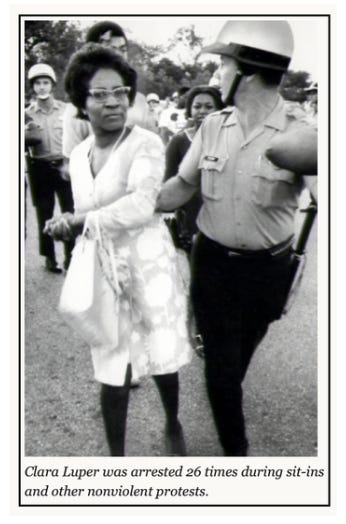
In 1972, when Democratic Senator Fred Harris resigned to run for President, Luper competed for the Democratic nomination primary against ten men. She placed sixth. The primary’s winner, Ed Edmondson, the older brother of Luper’s patron, Gov. Edmondson, who had voted for the Civil Rights Act, lost to a Republican in the Nixon-McGovern landslide.
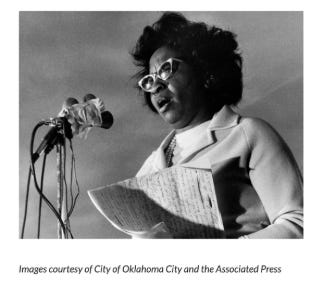
Sit-ins originated in the American labor movement, in 1936, when workers at a General Motors plant in Flint, Michigan, struck to join the UAW. Instead of walking out, they sat-in, occupying the factory and keeping scabs out, for forty-four days.
The first Black sit-in took place in a public library in Alexandria Virginia, in 1939. Barred from entering by the 1926 Virginia Public Assemblages Act, five young Black men entered separately. Each requested a library card, was refused, took a book from a shelf and read it, seated at separate tables. The librarian ran to city hall to tell the city manager, who called the police. The group’s attorney, who had planned the protest, called the press. Three hundred supporters showed up. The men were arrested for disorderly conduct.
The city opened a separate library in 1940, stocked with cast off books. In 1959 integrated the original library and in 1962 opened it to Black children. In 2019, a librarian found records indicating that the charges were still pending and asked the Alexandria Circuit Court to dismiss them.
The Congress for Racial Equality copied the tactic in 1941, as did Black residents of Des Moines in 1948, objecting to another segregated Katz Drug Store. Sit-ins were organized by students at HBCUs: at the only all-female HBCU, Bennett College, the “Belles” protested their exclusion from a North Carolina theater in 1938; Baltimore’s Morgan State students organized in 1953.
The most famous HBCU-launched sit-in was the most violent, in Greensboro, NC, organized by students at NCA&T. On February 1, 1960, four Black men ordered lunch at the local Woolworths whites-only counter. Denied service, they remained. Waitresses called the police and allies called the press. The well-mannered, well-dressed men were not arrested. The next day, more students and more press showed up. By February 5, there were 300 students, men and women, paralyzing business.
Angry white mobs tested their commitment to non-violence. They were pulled off stools and stomped. They were struck with brass knuckles and broken glass sugar shakers. Cigarettes were stubbed out on their necks. Cuts were filled with salt. Ketchup, mustard and sugar were poured on their heads. Police did not intervene until the assailants started looting. Woolworths held out until late July.
African Americans had never stopped working to advance their rights, despite the risks of economic repercussions or a violent death. The 1954 Brown decision and Emmett Till’s murder in 1955 energized both activism and resistance. Luper’s 1958 sit-in followed the success of the Montgomery bus boycott the Little Rock Nine’s attendance at a white high school.
While I learned a lot about the Black women who were both the backbone and the conscience of the civil rights movement to write FORMIDABLE, I had never heard of Clara Luper until a friend of mine was commissioned to create a memorial in OKC.
In 1977, Ivan Schwartz, with his brother Elliot and sister Debra, founded StudioIES, a sculpture and design center in Brooklyn. They are historians and artists, creating representational works to tell the story of America – sculpting the signers of the Declaration, suffragists, Frederick Douglass and Harriet Tubman, Native Americans, Black veterans and protesting Olympians, and sundry presidents, including Lincoln, John F. Kennedy and most recently Teddy Roosevelt and the Obamas. There are upcoming projects for the WWII Museum in New Orleans and the Alamo in San Antonio.
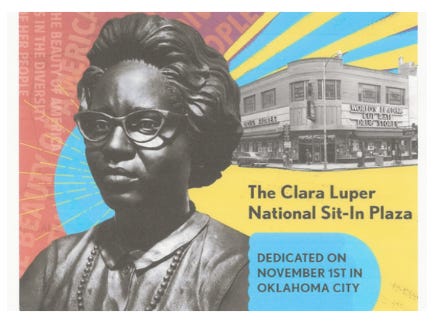
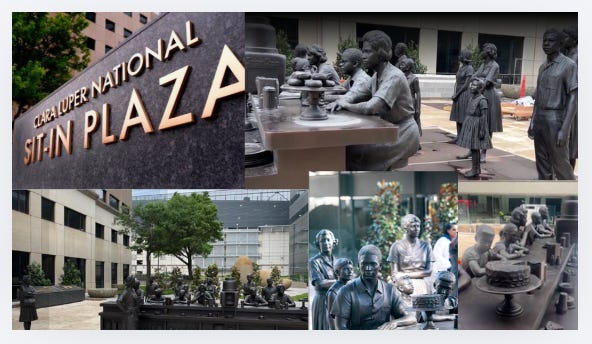
The $3.9 million, bronze, five-ton, fifteen-figure Clara Luper memorial, located at the site of the Katz Drug store, at the corner of Robinson and Main, along the Clara Luper Corridor, a two-mile-long streetscape in Oklahoma City, features the sixteen-foot-long lunch counter. Clara Luper stands to the side, still watchful. The massive still-life invites onlookers to imagine themselves there, among the order pads, sugar shakers, donuts and the likenesses of participants, many of whom are still alive. Working with Oklahoma artist LaQuincey Reed, it is among the firm’s most collaborative endeavors.
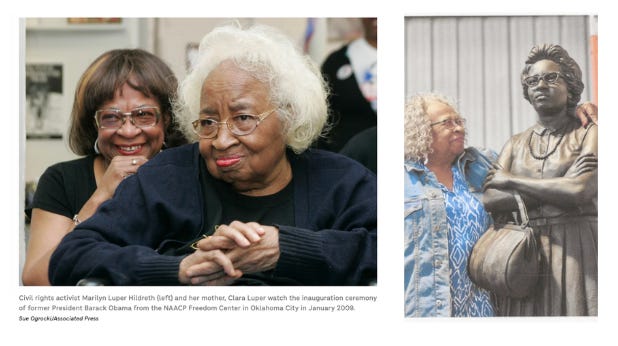
The Clara Luper National Sit-In Plaza was dedicated on November 1, 2025. A huge crowd applauded ten of the original “Sit-inners.” Speakers included Luper’s daughter Marilyn and Republican mayor David Holt, at 38 then youngest mayor ever elected to a city that size in 2018, who is committed to diversity initiatives. Luper and another Sit-inner led a powerful a capella sing-along of freedom anthems. The Dunjee High School chorus, the Langston University Concert Choir, the Spencer Elementary School Honor Choir and a jazz quartet from the OKC Philharmonic and performed.
Tinasha LaRaye read her original poem, “13 Cokes and a Side of Freedom.” (Text available only on the author’s social media, including the highlighted video.)
The project began with a charette at the Oklahoma Historical Society with the remaining Sit-inners, Pastor Lee Cooper, state leader John Kennedy, and Marilyn Luper Hildreth. When asked if they were comfortable working with “two white Jewish boys from New York,” the replied “Yes!” The project has become the most meaningful and powerful IES projects, in a half-century record of recreating memory and history.
Clara Luper lived long enough to be repeatedly honored with awards, citations, degrees and inductions. A US Post Office, a public school administrative building, many scholarships, the University of Oklahoma Department of African and American Studies, and the OKC Civil Rights Center bear her name.
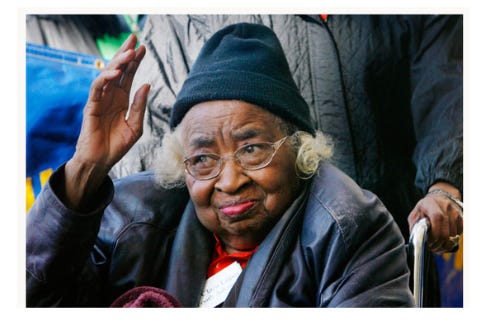
Clara Shepard Luper died in June 2011, survived by her three children, five grandchildren, eight greatgrands and one great-great-grandchild. She had dedicated her life to racial and gender equality. “My biggest job now,” she told the Associated Press in 2006, “is making white people understand that back history is white history. We cannot separate the two.”
Clara Luper was another passionate, fearless, hidden figure who is part of our country’s diverse and complicated past.
SOURCES
Photo credits: public domain unless noted. Headshot: http://digital.library.okstate.edu/encyclopedia/entries/L/LU005.html
Clara Luper, Behold These Walls (Jim Wire, 1979).
Dennis Hevisi, “Clara Luper, A Leader in Civil Right Sit-Ins, Dies at 88,” New York Times (June 11, 2011), https://www.nytimes.com/2011/06/12/us/12luper.html?smid=em-share
“Clara Luper Obituary,” https://www.legacy.com/legacy/notable-deaths/clara-luper
Emma Brown, “Okla. Civil Rights Activist, Who Led One of the First Sit-In Protests, Dies at 88,” Washington Post (June 13 2011), https://www.washingtonpost.com/local/obituaries/okla-civil-rights-activist-clara-luper-who-led-one-of-first-sit-in-protests-dies-at-88
“The Remarkable Mother Luper: Clara Luper: Civil Rights Pioneer, 1923-2011,” The Blue Grass Special (June 8, 2011), https://www.thebluegrassspecial.com/archive/2011/june2011/clara-luper-feature-obit.html
Alfred L. Brophy, “Guinn v. Oklahoma (1915),” The Encyclopedia of Oklahoma History and Culture (January 15, 2010), https://www.okhistory.org/publications/enc/entry?entry=GU001.
Brenda Mitchell-Powell, Public in Name Only: The 1939 Alexandria Library Sit-In Demonstration (University of Massachusetts Press, 2022).
Greensboro sit-in, in Elisabeth Griffith, Formidable: American Women and the Fight for Equality, 1920-2020 (Pegasus, 2022).
“Calvin Luper Interview,” Southern Oral History Program, (May 24, 2011), Smithsonian Institution’s National Museum of African American History & Culture and the Library of Congress, https://www.crmvet.org/nars/luper2011.pdf
IES Studios, “The Clara Luper Sit-In Plaza: Oklahoma City Sculpture Commemoration,” brochure, 2025.
https://www.pbs.org/video/clara-luper-national-sit-in-plaza-5ir0pu/
YouTube video,
Zoe Elrod, “Sit-in Site in OKC Now Honors Civil Rights Icon Clara Luper,” Oklahoma City Free Press (November 2, 2025), https://freepressokc.com/sit-in-site-in-okc-now-honors-civil-rights-icon-clara-luper/
No posts
Comments
Nothing yet. Say the first thing.
Sign in to join the conversation.