
Many of us are feeling uncertain right now.
AI is changing so quickly that it can be difficult to understand what is happening, what will happen next, and how our work and skills may change.
If you are feeling this way, it is very normal.
Uncertainty is the feeling that we cannot fully understand, predict, or control what is coming. With AI, we often experience two things at once: we do not have enough information to know what will happen, and many of the decisions that may affect us are outside our control.
That can keep us constantly on alert. We check the news, think about what skills we should learn, wonder what our organizations will do, and try to prepare for a future that is still unclear.
Over time, this takes a lot of energy.
So in Part 2 of Deep Thriving in the Age of AI, I suggested that the most useful question may not be:
How do I stop feeling uncertain?
Instead:
How do I manage the stress and anxiety that come with uncertainty, and keep moving forward while things are still unclear?
Watch the seminar: When the Future Feels Uncertain
One of the most useful starting points is simple:
Control what you can control.
We cannot control the entire direction of AI. We may not be able to control what our organization decides, how quickly our profession changes, or whether a particular role will still exist several years from now.
But there is almost always a smaller part that we can influence.
For me, that means starting a small new project where I can develop new skills and work on a topic that is personally meaningful to me. We can also learn something. We can build a skill. We can start a project. We can talk with someone who has useful experience. We can build relationships and create new options.
The goal is to pull some of our energy back from what we cannot change and put it into the places where we still have agency.
This does not guarantee the future. But it can help us feel less stuck and more prepared.
During the seminar, we worked through a simple five-step exercise:
Name what is uncertain.
Identify the specific worry that is taking up the most attention.Notice your reaction.
What do you usually feel, think, or do when this worry comes up?Separate what you can control from what you cannot.
Try to be as concrete as possible.Act where you have influence, and let go for now where you do not.
Look up one useful piece of information. Try one skill or action. Talk with one person who can help or offer perspective. For the part you truly cannot control, practice saying: I will deal with it when it actually happens.Protect your well-being.
Connect with someone, rest, get outside, spend time with family or friends, learn something new, or simply return your attention to the present moment.
The point is not to respond perfectly. It is to understand our natural reactions and gradually add strategies that help us over the longer term.
Some responses, such as avoiding the problem or repeatedly venting, may give us quick relief but leave the source of stress unchanged. At the same time, distraction is not always bad. When something is genuinely outside our control, intentionally turning our attention toward something restorative can be a healthy way to protect our energy.
When our stress becomes very high, it becomes harder to think broadly, consider different perspectives, and make flexible decisions.
This is why caring for our well-being is not separate from adapting to AI.
It is part of adapting well.
When we have enough calm and psychological space, we are better able to see what is actually within our control, make decisions, and sometimes even begin to see uncertainty differently.
A change that initially feels only threatening may eventually also become an opportunity to learn, create something new, or reconsider what we want.
We do not need to force ourselves to see uncertainty positively when we are overwhelmed.
Let’s lower the stress first. Regain some control. Then give yourself room to see what else may be possible.
You do not need to work through every uncertainty in your life.
Choose one first.
I suggest you use the worksheet to identify what is worrying you, notice your response, separate what is within and outside your control, and choose one small action.
5-Step Worksheet
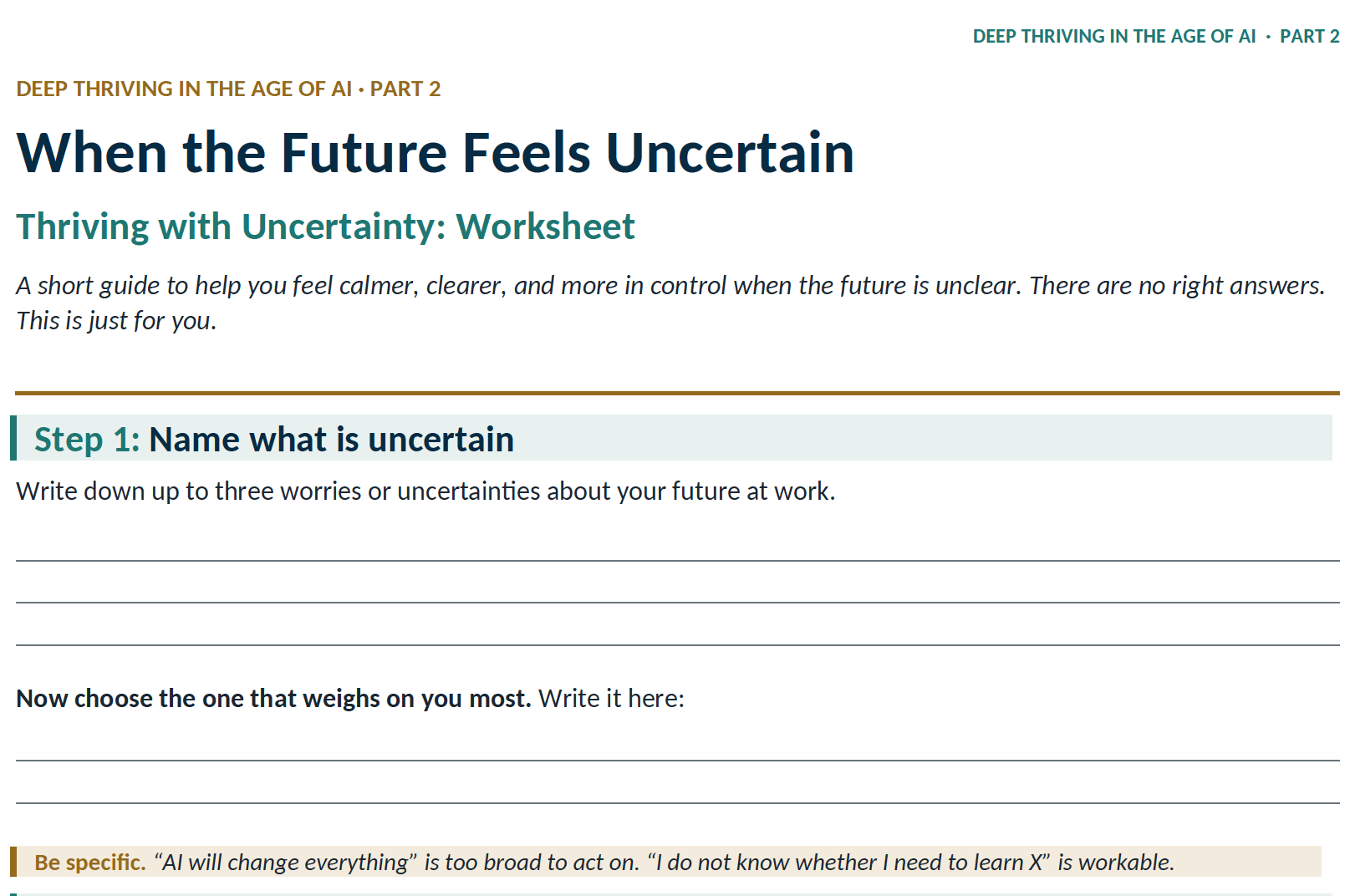
I would especially appreciate it if I could hear how this exercise works for you. What was helpful? What felt unclear? Is there a step you would change or add?
Please reply to this post or leave a comment after you try it. Your feedback will help me continue improving these practical tools.
I also shared a short AI Thrive / Challenge Questionnaire to help you reflect on whether AI is currently supporting or straining different parts of your work and well-being.
The uncertainty around AI is unlikely to disappear quickly.
We are in a long stretch.
That is why I think deep thriving requires us to protect our energy, pace ourselves, and strengthen the human capacities that help us remain grounded and keep growing over time.
We do not need the future to be completely clear in order to feel more steady today.
In the next Deep Thriving in the Age of AI seminar, we will turn to another important human strength: creativity.
AI can help us generate ideas and create things more quickly. But how can we also continue strengthening our own ability to imagine, explore, and create?
We will look at current research and practical strategies for using AI in ways that expand rather than narrow our creative potential.
Learn more and register for the next seminar
I would be delighted to have you join us!
_________________________________________________________
Footnote: Declaration of Generative AI in the Article Preparation Process
During the preparation of this work, I used generative AI to assist with grammar, clarity, and stylistic editing of draft text. I carefully reviewed, verified, and revised all AI-assisted content to ensure accuracy and take full responsibility for the content of the published article.
No posts
Comments
Nothing yet. Say the first thing.
Sign in to join the conversation.