
Read part one: Representing Them: How Shri Thanedar Became Hindu Nationalism's Main Man in Congress
Shri Thanedar has never needed anyone’s money. He put five million dollars of his own into his first run for Congress before a single donor gave him a dime, and he has put in nearly fourteen million more since. What he needed was everything money does not buy, and the movement that gave him that asked for very little in return.
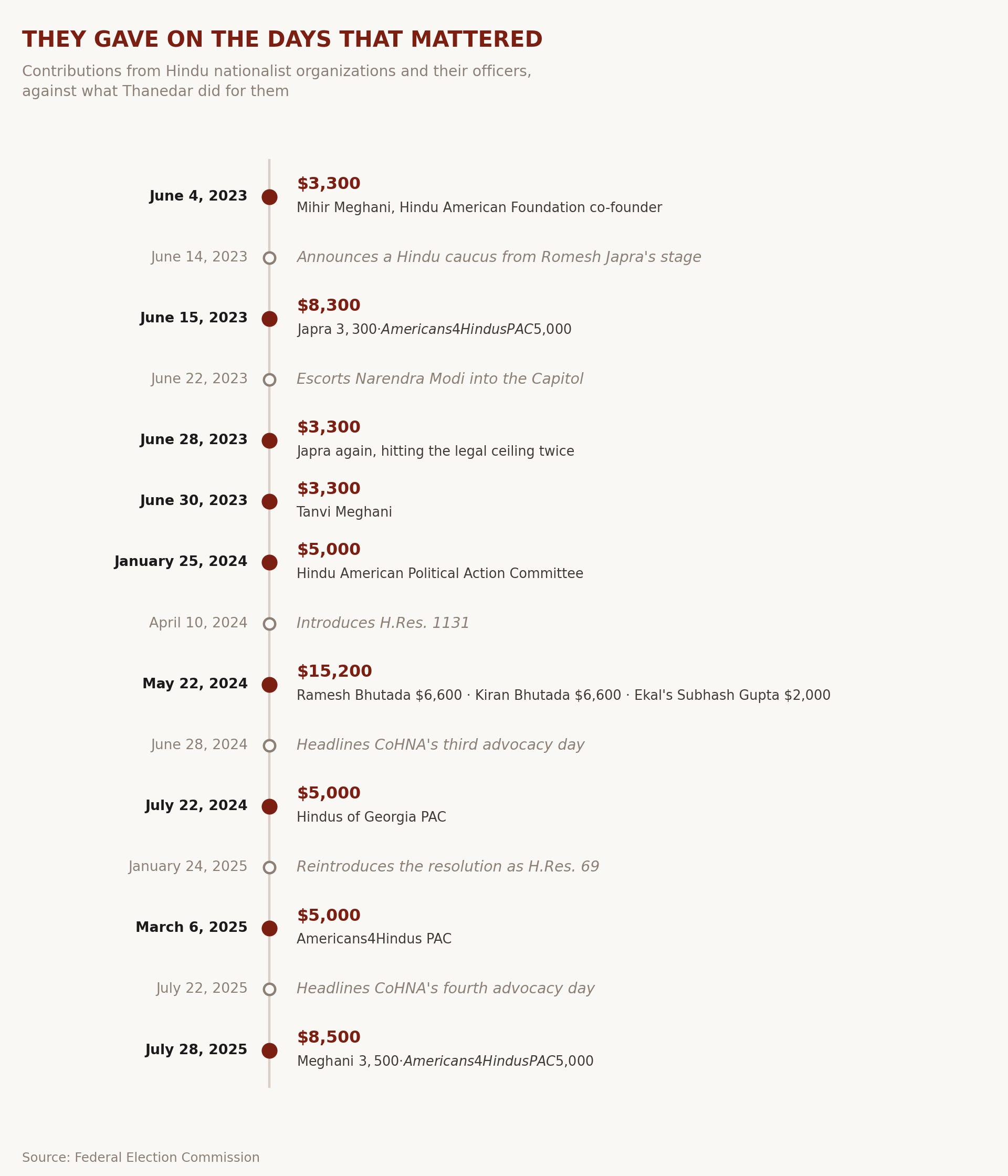
On June 14, 2023, Thanedar took a stage on Capitol Hill and announced that he would form a Hindu caucus in Congress. The summit had been convened by Romesh Japra, a California physician who runs a political action committee called Americans4Hindus, which Political Research Associates, a research group that tracks the American right, describes as Hindu nationalist. The next day Japra wrote Thanedar’s campaign a personal check for $3,300, and Americans4Hindus wrote another for $5,000. Thirteen days after that, six days after Thanedar escorted Narendra Modi down the aisle of the House to the rostrum of a joint session — the same Indian prime minister the United States had once barred from the country over a massacre of Muslims in Gujarat — Japra wrote a second personal check for $3,300.
Federal law capped what one person could give a candidate that cycle at $3,300 per election. Japra had given the ceiling twice, once for the primary and once for the general.
He was not alone, and the people who joined him came from a single world. The RSS is not only an ideology, it is an institution — the one the US Commission on International Religious Freedom asked Washington to sanction last year — and it keeps a working apparatus in the United States: a branch of its own, an arm of its religious wing, a foundation that funds its schools back in India. Around that apparatus sits a second layer, of advocacy groups and political action committees founded and run by people who came up inside it, speaking the language of American civil rights. Shri Thanedar’s donors come from both.
The largest of them is Bharat Barai, an oncologist in Indiana who organized Modi’s 2014 rally at Madison Square Garden and has hosted him personally. Barai has given Thanedar $12,800 across nine contributions, more than any other individual in the network, and unlike the rest he has given steadily rather than in bursts.
Mihir Meghani, who co-founded the Hindu American Foundation, the advocacy group Political Research Associates credits with recasting Hindu nationalism as a matter of American minority rights, gave the maximum in June 2023 and the maximum again in July 2025, and his wife gave the maximum in between.
On a single day in May 2024, three more gave from the same Houston suburb. Ramesh Bhutada, for years the vice president of the Hindu Swayamsevak Sangh, the RSS’s American branch, gave $6,600, the ceiling for the primary and the general paid at once. His wife Kiran, who helped found the youth camp run by the Vishwa Hindu Parishad of America, the American arm of the RSS’s religious wing, gave $6,600 the same day. And Subhash Gupta, president of the Ekal Vidyalaya Foundation, which funds the movement’s schools across India’s tribal belt, gave $2,000.
Narsimha Koppula, a joint president of the same organization Bhutada helps run, gave $6,600 from Virginia.
Americans4Hindus, Japra’s PAC, has given $5,000 three times. The Hindu American Political Action Committee, run by the Hindu American Foundation’s leadership, gave $5,000. Hindus of Georgia PAC, founded by the vice president of the Coalition of Hindus of North America, gave $5,000.
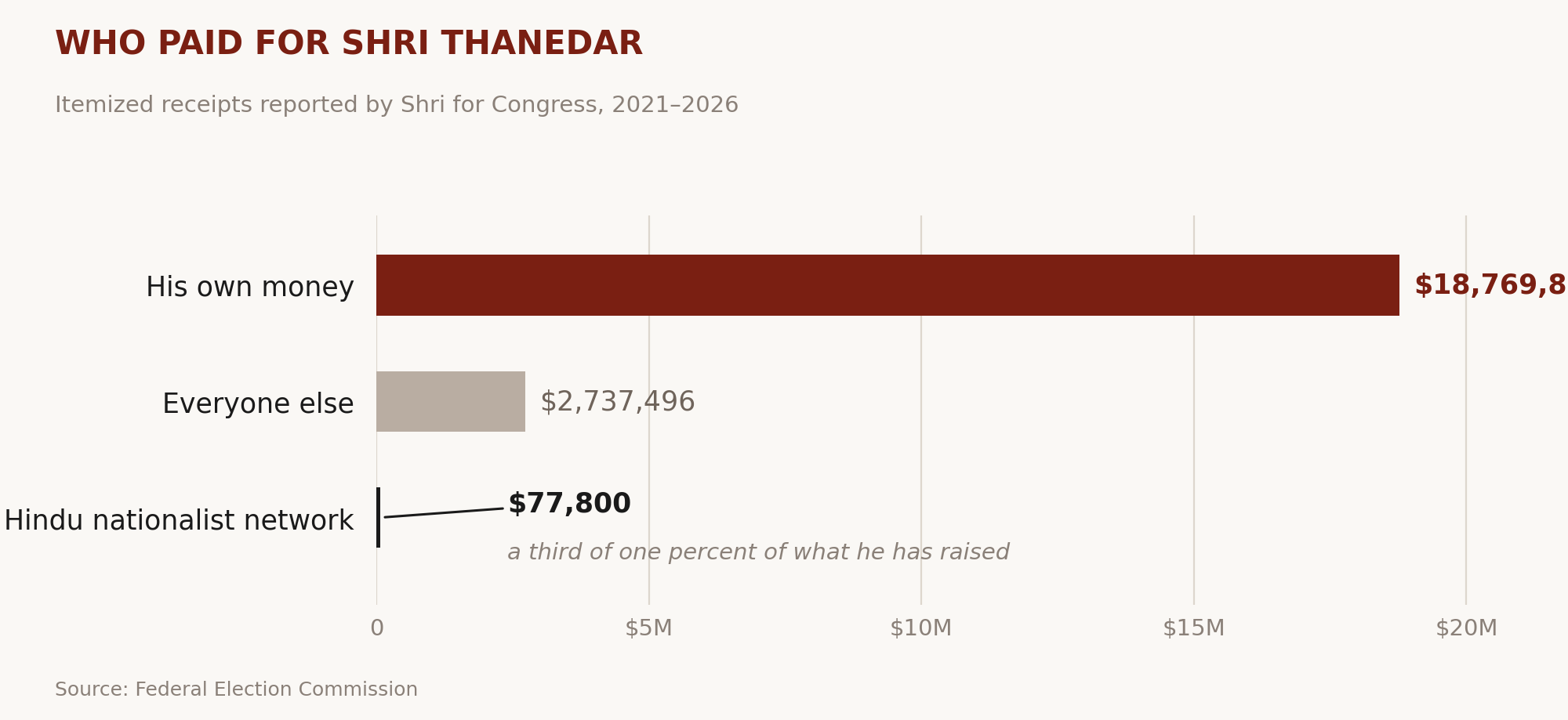
Altogether the organizations and officers of the American Hindu nationalist network have given Shri Thanedar $77,800, against the $21.6 million his committee has raised. It is a third of one percent. Had none of it ever arrived, nothing about any of his campaigns would have been different, and everyone who wrote those checks knew it. They gave to the ceiling anyway, on the days that mattered, because the money was never the transaction. It was the signature on one.
The rest of the ledger is almost entirely Thanedar himself.
Of the $21.6 million his committee reports, $18.8 million came from the candidate — eighty-seven percent of it, arriving in tranches of one and two and five million dollars. Most of that was not a gift. He lent it, and the campaign owes it back, so that by the end of 2025 it carried $11.5 million in debt to him personally, a figure first reported by The Intercept.
Of the money that came from anyone else, and setting aside what arrived through fundraising platforms that report their own address rather than the donor’s, fewer than one dollar in six is traceably from Michigan.
Strip out his own money and what remains is a congressman from Detroit whose donors are in Washington, Massachusetts, Illinois, California, and Texas, and only marginally in the city he represents. Roughly one dollar in seventy of Shri Thanedar’s campaign money has come from the people who elected him.
He arrived in Congress with nothing else, either.
He won the 2022 primary with twenty-eight percent of the vote, outspending a field of Black candidates who divided the rest between them, and in doing so ended nearly seventy years of Black representation in a majority-Black district. He did it on nearly $5.2 million of his own. Beyond that, Crain’s Detroit reported at the time, he had taken exactly two contributions: $5,000 from the Indian American Impact Fund and $300 from a family member.
That is a man who won a seat in the United States Congress without a single meaningful donor.
The Metro Detroit chapter of the Democratic Socialists of America, which he had joined on entering politics, voted 144 to 15 to expel him fifteen months later. The city’s political infrastructure was not his, and never had been.
What that adds up to is not a profile. It is a vacancy — a seat in Congress held by a man with no party behind him, no donor base beneath him, and no organization in his district that answered to him or that he answered to.
His money had solved exactly one of his problems. It bought the office and left him alone inside it.
Campaign finance is worth reading because it tells you who a candidate could not have won without. That is the ordinary shape of the thing, and Thanedar’s ledger has no such person in it. He could have won without every one of these donors, and without all of them together several times over, and the men and women who wrote those checks were not confused on the point. They know what a congressional race costs. They know what he had already spent.
What he actually got was everything a self-funded man cannot buy, and everything he did not have.
It is tempting to explain this by heritage, and the movement would prefer that you did. A Hindu congressman, a Hindu organization, a natural constituency finding its natural champion — the story tells itself, and it is the story these groups tell about every politician they touch. It is also wrong. Most Hindu Americans have no relationship to the RSS or its American arms, and the diaspora’s largest political organizations are not Sangh organizations at all.
What made the Sangh’s network the natural home for Shri Thanedar was not that he is Hindu. It was that nobody else was offering.
Consider what he was in 2023. A freshman with no party behind him, expelled from the only political organization he had ever joined, holding a seat the establishment had wanted for someone else, in a city whose political machinery had never been his. He had money and nothing else — no field program, no volunteers, no press that cared, no bloc of colleagues, no cause with a constituency attached.
Whatever he was going to become, somebody was going to have to furnish him with it.
The Sangh’s American network was, at that moment, the best-organized and most national political apparatus available to an unaffiliated Indian American in Congress. It had chapters across the country, a fundraising base running into the tens of millions, political action committees, a friendly press, and a legislative agenda already drafted and waiting for a sponsor. It had spent two decades building the machinery a man in Thanedar’s position needed, and what it wanted in return was the one thing he had, which was a seat.
He did not drift into it, either. He told an interviewer for Jewish Currents that he had approached the Hindu groups himself, sat down with their policy people, and come away resolved to represent them as strongly as he could in Congress. The vacancy was structural. Filling it was a decision.
A political party, stripped to its function, supplies three things to the people who belong to it. A constituency. Coverage. And colleagues, so that no one has to stand alone on anything. Thanedar had none of the three, and within two years of the caucus announcement he had all of them.
The constituency came first, and it had a quality Detroit could never have offered him, which is that it was somewhere else. A congressman’s base is normally the thing that constrains him, because it sits in his district and can take the seat back. Thanedar’s new constituency was in Sugar Land and Fremont and Marietta and Munster, motivated by events in another country, and structurally incapable of holding him to account for anything he did or failed to do at home. That is the pattern the money describes: Barai gives from Indiana, Meghani and Japra from California, the Bhutadas and Gupta from Texas, Hindus of Georgia PAC from a suburb of Atlanta.
When the Metro Detroit chapter of the Democratic Socialists of America threw him out over Modi in September 2023, it cost him nothing, because the people who mattered to him now had never been in Metro Detroit.
Then the coverage. The diaspora press — indica, New India Abroad, NRI Pulse, Diya TV, the wire copy that runs in a dozen papers on two continents — reported his resolution as a milestone for Hindu Americans and went on reporting him that way through everything that followed, and his own congressional website reposts that coverage under the heading In the News.
The relationship runs both directions. In March 2025 he flew to Tysons Corner, Virginia, to headline the launch party of a South Asian newspaper, telling the room that he usually gets the hell out of Washington the moment the votes are done but had made an exception. It is a communications operation of a kind money cannot buy, because what it sells is not advertising. It is the appearance of a man beloved by a community, printed in the community’s own newspapers.
And last, the colleagues. When Thanedar first introduced his Hinduphobia resolution in April 2024 it drew twenty-three cosponsors. When he reintroduced it as H.Res. 69 on January 24, 2025, sixteen members signed on the same day — Republicans and Democrats, from Texas and Pennsylvania and California and New York — and by June of this year it carried thirty-two.
On the thirtieth of that month he stood in the Rayburn House Office Building at the Coalition of Hindus of North America’s fifth advocacy day alongside six other members of Congress, three of them from Georgia, Republicans beside Democrats. The freshman who could not hold the confidence of a Detroit socialist chapter now appeared, in photographs distributed by press release, as the convener of a bipartisan coalition.
None of that appears in a campaign finance report. All of it is worth more than $77,800.
If this were a story about Hindu nationalism alone, it would end there. It does not, because the same thing has happened to Shri Thanedar twice.
In the Michigan legislature he co-sponsored a resolution describing Israel as an apartheid state and calling for its aid to be cut off. Then he went on a trip underwritten by an affiliate of the pro-Israel lobby, and came back one of the firmest defenders of Israel in the chamber. The political action committee of the American Israel Public Affairs Committee has since given his campaign $169,147 across a hundred and fifty-three contributions, more than double everything the entire Hindu nationalist network has given him, and by The Intercept’s accounting two-thirds of the money he raised in the last quarter of 2025 came through AIPAC’s bundling operation, with fewer than a quarter of those donors living in Michigan.
That is the same arrangement, running twice, and its repetition is what makes it legible. A man with a conviction acquires allies. A man with a vacancy acquires whoever arrives, and he will keep acquiring them, because the condition that made him available in 2023 has not changed and cannot be changed by money he already has. He remains a congressman with no party, no local base, and no organization of his own, holding a seat that two national movements now furnish between them.
What the Sangh’s network understood, and understood early, is that this was not a man who needed persuading.
He needed occupying.
They did not buy a congressman. Nobody bought Shri Thanedar, and the record is unambiguous on the point — he arrived with more money than any of them could have given him and he has spent it freely since.
What they did was fill a hole.
He had a seat and nothing to do with it. They had a program and nobody to carry it. Out of that arrangement came a caucus, a resolution, an escort down the aisle of the House for a prime minister his own government had once barred from the country, and a national constituency that will still be there when Detroit is done with him.
The $77,800 was never the price of any of that. It was the paperwork.
Which leaves the question of what, exactly, the movement got in return, and the answer is sitting in the Congressional Record under the number H.Res. 69 — a resolution that Thanedar says he wrote himself.
Read part one: Representing Them: How Shri Thanedar Became Hindu Nationalism’s Main Man in Congress.
Comments
Nothing yet. Say the first thing.
Sign in to join the conversation.