
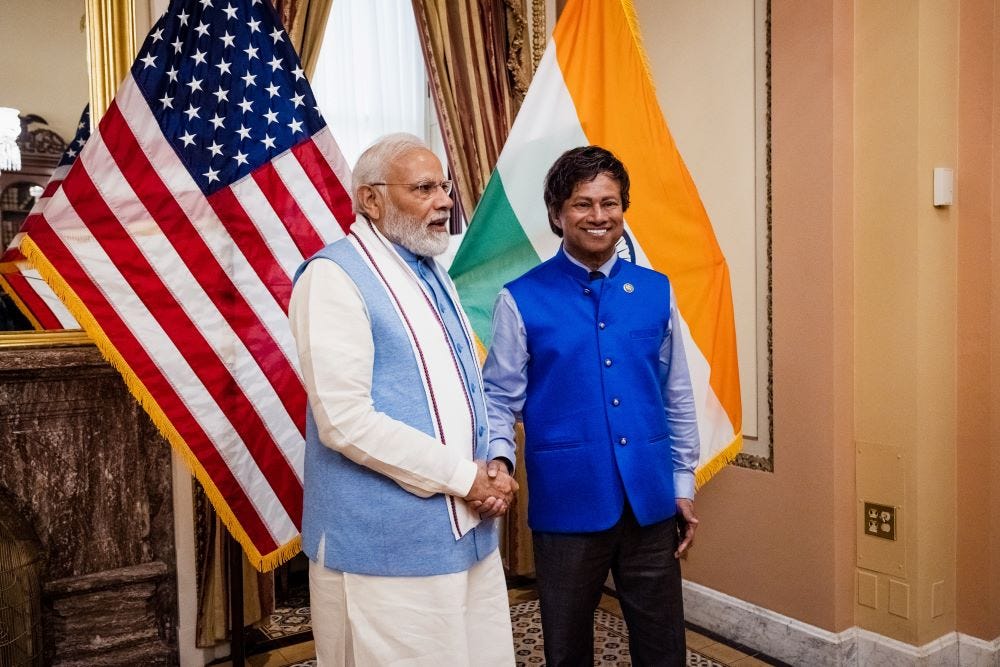
Shri Thanedar tells his story often, and it is a good one. He left India with little, built a fortune in America, and entered politics in Detroit as a progressive Democrat, an immigrant who calls his adopted country a nation of immigrants and its diversity a strength. What the story leaves out is the movement he has spent four years serving from his seat in Congress, a Hindu nationalist project that, in the country he left, builds its power on the fear and the killing of Muslims.
On June 22, 2023, Thanedar walked Narendra Modi down the aisle of the United States House of Representatives toward the rostrum of a joint session of Congress. Two days earlier he had welcomed the visit at a press conference on the Capitol steps, and that evening he took his place at the state dinner held in Modi’s honor.
He called escorting Modi a “distinct pleasure.”
The man he walked to the rostrum is the only person ever denied entry to the United States under the clause of American immigration law that bars foreign officials responsible for “particularly severe violations of religious freedom.” The visa was refused in 2005, over Modi’s record as chief minister of Gujarat, where, by Human Rights Watch’s count, the communal violence of 2002 killed at least 2,000 Muslims.
In the four years since, Thanedar flew to Delhi with a congressional delegation to hear Modi speak, announced a Hindu caucus from the stage of a Hindu nationalist summit, backed India’s airstrikes on Pakistan, and addressed, by video, a convention of Modi’s party on American soil.
He is the movement’s man in Washington, and he has said so himself.
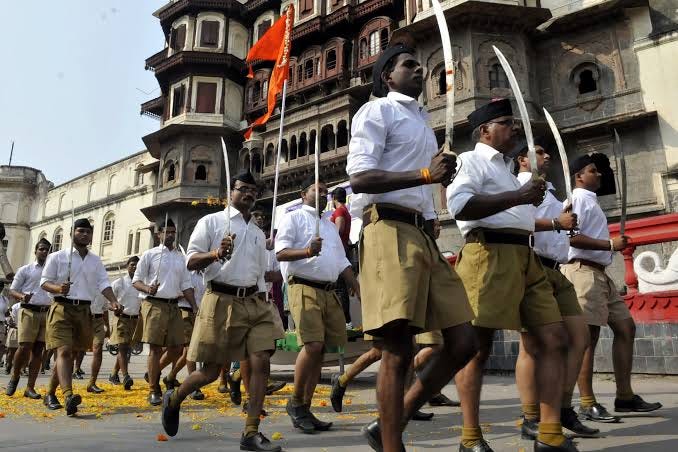
Modi came up through the Rashtriya Swayamsevak Sangh, the Hindu nationalist organization founded in 1925. The Congressional Research Service, the nonpartisan research arm of Congress, calls him a self-avowed Hindu nationalist and a lifelong member of it.
In the spring of 2002, while he governed Gujarat, mobs moved through Muslim neighborhoods for weeks as his government stood accused of holding the police back. Three years later the United States shut its door to him, denying him a diplomatic visa and revoking the tourist visa he already held, under the religious-freedom clause of a 1998 law. No one else, before or since, has been barred from the country under it.
The bar did not survive his rise. Modi became prime minister in 2014, protocol swept it aside, and by 2023 he was addressing Congress a second time with Thanedar at his elbow. But the record that produced the bar did not go anywhere, and neither did the movement that produced Modi.
In March 2026, the US Commission on International Religious Freedom recommended, for the first time in its history, that the American government sanction the RSS itself.
That movement runs a set of organizations in the United States, and the researchers who study it treat them as branches of one tree. The Overseas Friends of the BJP is the American wing of Modi’s party, registered with the Justice Department as a foreign agent. The Vishwa Hindu Parishad of America is the US arm of the VHP, which the Congressional Research Service lists among the groups implicated in the 2002 violence, and it runs the advocacy shops that press Congress on the BJP’s behalf. The Coalition of Hindus of North America (CoHNA), placed by Political Research Associates in the same network, has fought American bills that would outlaw caste discrimination.
Different names, one project. These are the groups whose stages Thanedar has stood on, and whose priorities he has carried into Congress.
The escort, taken alone, could pass for a courtesy. Thanedar’s website framed the role as one “requested by United States Congressional leadership,” the passive phrasing of a man describing an assignment rather than a choice. But a member of Congress takes no one’s orders, and the honor of walking a visiting head of government to the rostrum is sought, not assigned.
Thanedar sought it. He called his own press conference to welcome the visit two days early, and told a reporter it was a “great honour” to escort Modi to his “historic” address.
The beginning came earlier that same month. On June 14, 2023, eight days before the escort, Thanedar took the stage of the Americans for Hindus summit on Capitol Hill and announced that he would form a Hindu caucus in Congress. The summit was convened by Romesh Japra, whose political action committee Political Research Associates describes as Hindu nationalist, and the delegates who rose to applaud him included the co-founders of the Hindu American Foundation and the president of the VHP of America.
He launched the caucus that September.
In August, weeks after the escort, he flew to India with a bipartisan congressional delegation for Modi’s Independence Day address, meeting ministers and executives in Mumbai, Hyderabad, and New Delhi. In the two years that followed, the pattern held and thickened. He sat for interviews with the movement’s advocacy groups, headlined the Coalition of Hindus of North America’s advocacy day on Capitol Hill, and lent his weight to its fight against caste-discrimination bans.
When a Hindu nationalist political action committee run by the leadership of the Hindu American Foundation endorsed him, its own citation credited him with “engaging in discussions with PM Modi” on medicine, energy, and supply chains.
The alignment did not stay ceremonial. In May 2025, when India launched airstrikes into Pakistan after a massacre of tourists in Kashmir, Thanedar declared them justified. “India has the right to defend itself after what happened in Pahalgam,” he said. “Terrorists were targeting Hindus.”
A month later he sent a video message to the national convention of the Overseas Friends of the BJP. “Events like this,” he told the delegates, “strengthen the cultural and political bridge between India and the United States.”
Then a reporter for Jewish Currents asked him how his signature legislation, a resolution condemning what it called “Hinduphobia,” had come to be. He had approached the Hindu groups himself, he said, had “a very meaningful discussion with their policy people,” and came away resolved “to represent them as strongly as I can in the US Congress.”
The pluralist from Detroit had named his constituency.
The people around Thanedar understood what the escort meant before he would name it himself, and the first to act were his own.
On September 17, 2023, the Metro Detroit chapter of the Democratic Socialists of America, the group he had joined on entering politics, voted 144 to 15 to expel him. The expulsion, a chapter spokesperson said, was “due to his support of the far right, violent, Islamophobic Modi regime in India.” His views, the spokesperson added, “are not—and have never been—representative of Detroit DSA.”
His own political home had thrown him out for escorting Modi.
He was not the only one who noticed. When he launched his caucus, a coalition of South Asian groups — Hindus for Human Rights, the Sikh Coalition, Emgage, the Indian American Muslim Council — warned that it spoke for a narrow slice of the community while claiming to represent all of it. Rashida Tlaib, whose district borders his, boycotted Modi’s address. Pramila Jayapal and Chris Van Hollen led a letter urging President Biden to press Modi on his human rights record, the very questions Thanedar would not raise.
In Detroit, a Muslim businessman named Quaid Saifee, who had given a thousand dollars to Thanedar’s re-election, asked for the money back once he learned the congressman was a champion of Modi.
Then came the tell. On October 11, 2023, Thanedar announced he was leaving the DSA — not over Modi, which he did not mention, but over the group’s response to the October 7 Hamas attack. It was a clean story, and it was not the true one: the chapter had expelled him three weeks earlier, over Modi, and had called his renunciation a “selfish distraction.”
The subject changed. The maneuver did not.
Thanedar’s liberalism at home and his service to Hindu nationalism abroad are not a contradiction. They are two halves of one strategy, and the scholars who study Hindutva have described it for years. Hindutva — the ideology of Hindu supremacy that drives Modi’s politics — advances in the United States by borrowing the American language of pluralism and minority rights, presenting a movement that persecutes minorities in India as a threatened minority in need of protection in America.
Political Research Associates traces the move to the Hindu American Foundation’s own co-founder, Mihir Meghani, who placed Hindutva inside the frame of American multiculturalism and recast it as a matter of Hindu civil rights. The “Hinduphobia” resolution is that strategy written into federal language.
When Jewish Currents audited the foundation’s own list of 161 “Hinduphobia” incidents, it found that three out of four did not meet the foundation’s own definition, and that some were nothing more than criticism of Hindu nationalism. The term itself, Hindus for Human Rights notes, was popularized by Hindu nationalist groups to blur that very line, so that opposing Modi becomes indistinguishable from hating Hindus.
That Thanedar would carry such a measure is not, on his record, a matter of conviction. His own Michigan colleagues, and reporting in HuffPost, describe a politician whose beliefs move when moving is useful. In the state legislature he co-sponsored a resolution branding Israel an apartheid state and calling to cut off its aid, then, after a trip paid for by an affiliate of the pro-Israel lobby, remade himself into one of the chamber’s firmest defenders of Israel.
The conversion runs on the same track twice.
None of this requires that Thanedar dislike Muslims, and he does not appear to. In March 2026 he moved to censure Representative Andy Ogles for saying that “Muslims don’t belong in American society,” calling the words un-American and a danger that would “incite hatred against millions of Muslim Americans.”
He tells the story of the immigrant who arrived with almost nothing, defends birthright citizenship as personal, and calls America a country of immigrants made strong by its diversity. Every word of that record is real.
It is also the cover. The credentials of the pluralist are what let the movement’s man work in the open.
Ogles cost him nothing.
Censuring a backbencher for open bigotry is free, and it burnishes the brand. The Muslims of Gujarat and Kashmir, of the lynching videos and the citizenship law that can leave them stateless, would cost him a great deal, because defending them would mean saying something about Modi. About them, not a word.
What he does instead is invert the frame, over and over. Graffiti reading “Modi is a terrorist” on California temples, a fire set by Sikh separatists at the Indian consulate in San Francisco, a man tearing an Indian flag outside a Texas city hall — each, in Thanedar’s telling, is proof of anti-Hindu or anti-Indian hate, an attack on the Indian state or on Modi recast as an attack on a people. Hindutva’s central move, that to oppose Hindu nationalism is to hate Hindus, he performs on American soil in his own voice.
The graffiti Thanedar held up was the same kind the Jewish Currents audit had taken apart. Temple walls sprayed with “Modi is a terrorist” beside calls for a Sikh homeland, the audit found, belonged to Sikh separatists’ quarrel with the Indian state, not to any hatred of a religion.
His proof of Hinduphobia was the audit’s example of what Hinduphobia was not.
In December 2023, the Justice Department unsealed an indictment alleging that an Indian government official had directed a plot to murder a Sikh American, Gurpatwant Singh Pannun, on United States soil. Thanedar was one of five Indian American lawmakers briefed on the case. Their joint statement called the allegations “deeply concerning,” then welcomed the Indian government’s announcement of its own committee of enquiry into the plot its own official stood accused of directing, and stressed the importance of not damaging a “very consequential” partnership.
Two of the signers have long records of pressing Modi’s government. Thanedar has none.
Asked whether the accused could be trusted to investigate itself, he raised no objection.
For all he has said in praise of Modi, in defense of the Hindu community, and against the enemies he says it faces, there is a subject on which Thanedar has never been heard. He has said nothing about the 2002 killings in Gujarat, the RSS the American religious-freedom commission now wants sanctioned, the citizenship law that sorts Indians by faith, or the revocation of Kashmir’s autonomy.
He found his voice over graffiti on a temple wall and has kept it, without a single exception, on the persecution that graffiti was answering.
On June 30, in a corridor of the Rayburn House Office Building outside CoHNA’s national advocacy day, Thanedar was asked on camera whether he had written House Resolution 69. Yes, he said.
Asked whether he had written it or CoHNA had written it for him, he said, “No, I wrote it.”
Asked to define Hinduphobia, the word at the heart of his own bill, in his own words, he said nothing.
Asked where he stood on the RSS and its violence against religious minorities, he turned and walked.
By the elevators, as he left, he was asked again. Why would he not answer questions about the RSS? What was his tie to Modi? How did he feel about Modi’s violence against India’s minorities?
He kept walking.
He built a caucus and wrote a law to shield the Hindu right from criticism, and he did it as the representative of a district where the people that movement targets are his own constituents. Where the money came from, and how the law was written, are what follow.
Congressman Shri Thanedar walks away from questions about his association with Modi and the RSS. June 30, 2026. Rayburn House Office Building.
Comments
Nothing yet. Say the first thing.
Sign in to join the conversation.