
Briefly:
Since I’ve been writing about music, labor, and politics, people do tend to pose the question of “what is to be done” about the cascading problems in the music industry. One thing you could do is contact your representative(s) and encourage them to support/co-sponsor Rep. Deborah Ross’s recently reintroduced “Protect Working Musicians Act,” which would allow independent artists to band together and collectively negotiate with large streaming platforms and AI developers. (Currently, musicians are prevented by antitrust law from coordinating, say, a mass pulling of catalogs from streaming, which would be considered the actions of an illegal cartel—the Ross bill would affirm that right.)
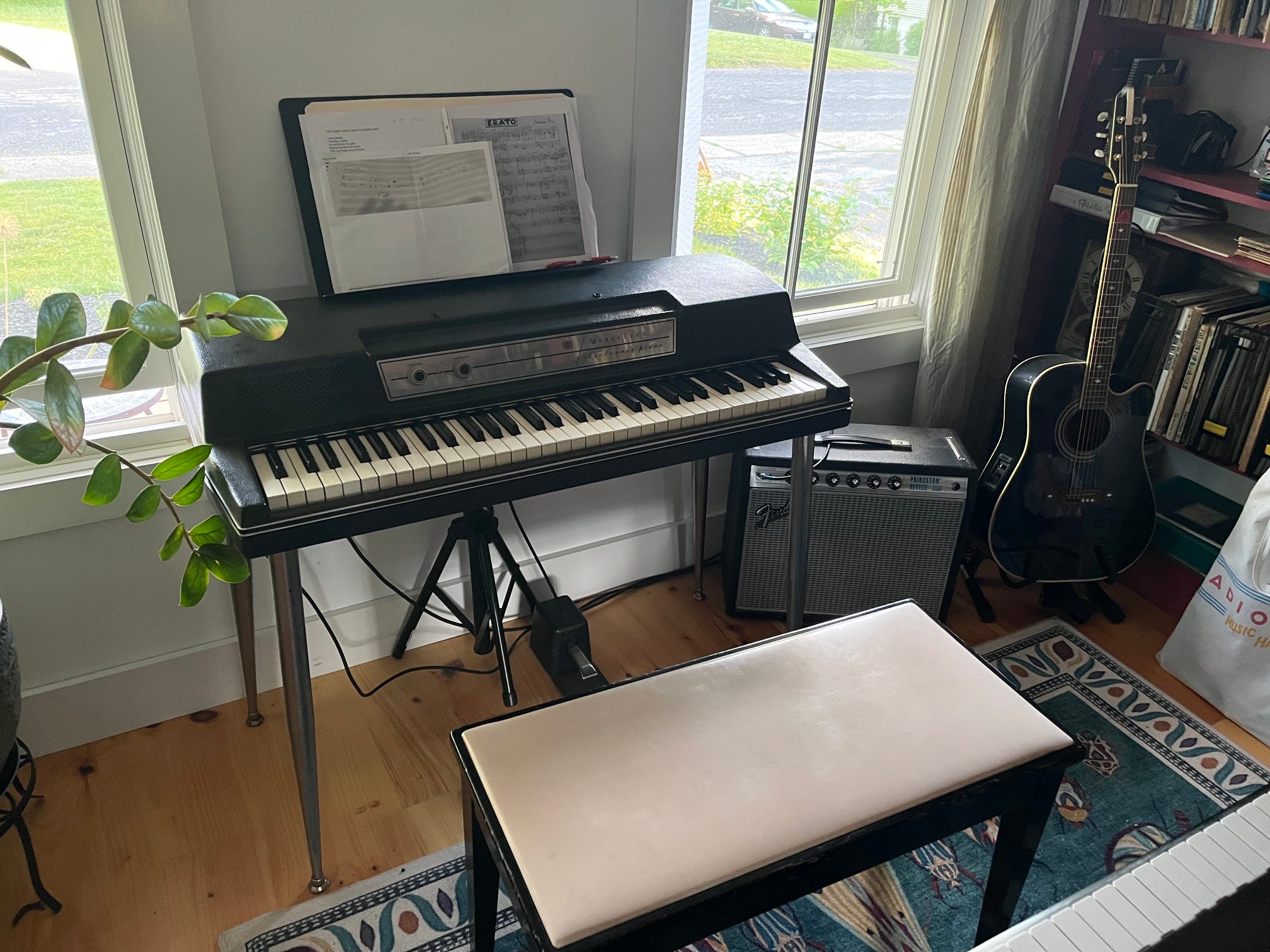
In other news, I played on the new Sincere Engineer album Probable Claws, out now—and I used the proceeds to buy the Wurlitzer I’ve been writing about.
To pick up where I left off last time:
You may have seen the tweet riffing on Yamaha—

—but Wurlitzer has almost as picaresque, and considerably more carnivalesque, a history. You could write a history of American culture and industry, from the immigrant boom after Reconstruction, through the Midwestern industrial age, organized crime, mechanical reproduction, the rise and fall of silent film, changes in commercial design, and corporate consolidation, through the lens of the Wurlitzer company’s independent history from the 1850s through the 1980s. Their iconic jukeboxes’ logo/mascot was nicknamed “Johnny One-Note”—
—but their history is anything but: a family business of hard-nosed immigrant businessmen, intent on the quality of their core business but more than open to side hustles and the opportunities offered by automation and technological advance. (I recommend to those interested Mark Palkovic’s Wurlitzer of Cincinnati: The Name That Means Music To Millions, from which the following is largely sourced—quotes and photos are from Palkovic.)
The patriarch and founder was one Rudolph Wurlitzer, who left Saxony in 1853 as a 21-year-old, a disgruntled and disinherited second son, and passed through a familiar series of immigrant foot-finding—as a grocer’s assistant in Hoboken and a brief and unsatisfactory period in Philadelphia, before taking root in the German stronghold of Cincinnati. He worked in dry goods, then banking, then the import and export of ginseng, furs, gemstones. But the Wurlitzer family (writes Palkovic) “[had] been identified with making or dealing in musical instruments…for 350 years,” going back to the lute maker Johannes Wurlitzer (b. 1628), and Rudolph quickly established himself as a go-between connecting the instrument makers of Germany with the growing market in the Midwest.
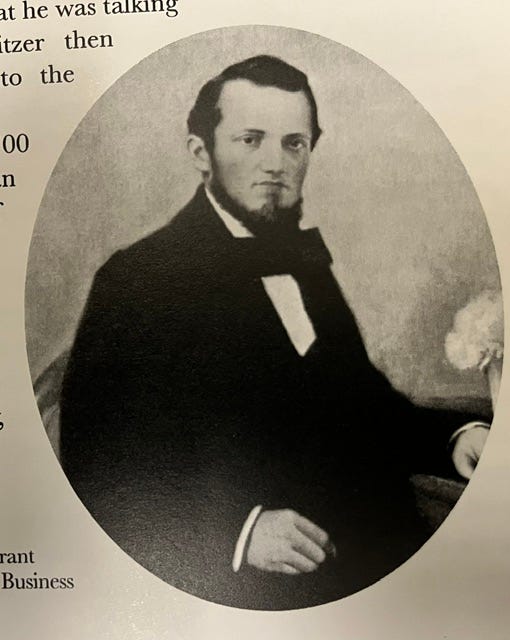
The Civil War gave Wurlitzer (who was soon joined in America by two of his brothers) an opportunity to move into manufacturing of drums and other military band instruments, and they opened their first storefront in Cincinnati.
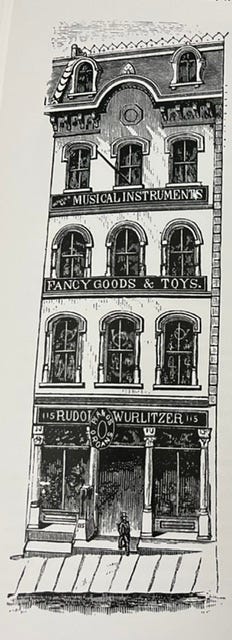
Early on, the Wurlitzer company showed an interest in not just instruments in bulk, but toys, music boxes, and other automated or semi-automated novelties and contraptions: barrel organs pre-programmed with music-box style pinned cylinders, and an “automatic pianist” driven by a crank and punch-cards. While Rudolph’s son Rudolph developed a side-line as an expert in high-end violins (at one point, the company owned “the largest number of Stradivari violins..of any firm in America”), their bread and butter was always populist. The elder Rudolph and his hard-driving son Howard saw the opportunity in the coin-operated instruments that presaged the jukebox in bringing automated music to dancehalls, boardwalks, bars, and bordellos, and invested heavily in “coin pianos” and orchestrions—more elaborate player-piano-like contraptions which added violins, woodwinds, xylophones, and percussion to the mechanism.
(An early Wurlitzer catalogue also included “[a]n odd group of mechanical musical instruments, which…included musical decanters, pitchers, beer mugs, family albums and a mechanical majolica beer jug.”)
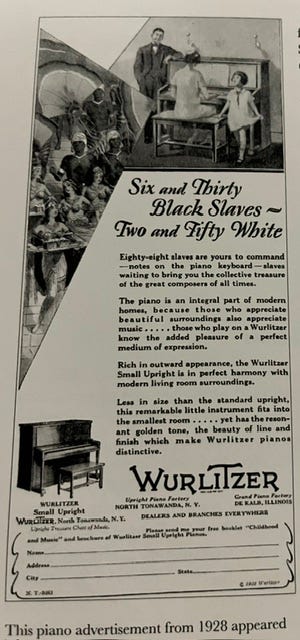
Another half-forgotten side hustle was, briefly, the manufacture of (apparently quite high quality) harps—and self-playing “Automatic Harps.” These were the occasion for a convenient piece of glad-handing and self-dealing in 1911, when police ordered the destruction of all musical instruments in San Francisco’s red light district—with the exception, it transpired, of the Automatic Harps, a salesman of which duly and efficiently appeared bearing “references from important politicians,” and sold out the company’s leftover stock.
The Wurlitzers, though, were savvy enough to see the end of the clattering, steampunk nickelodeon era coming, and divested themselves of their player piano business at a tidy million-dollar profit well in time to pivot to investments in phonographs, partnering with Victor. (They did dabble, unsuccessfully, in refrigerators and radios, and used their expertise in wood cabinetry for the pianos and orchestrions to manufacture cabinetry for other companies; as well as ammunition boxes during WWI.)
Alongside their automated products, though, the Wurlitzers had become major players in the organ business, combining their loud, paper-roll driven band organs (for roller skating rinks) with their complicated PianOrchestra orchestrion to create fantastic “one man orchestras” to accompany the new silent films: the largest included “a piano, 196 pipes, a xylophone, orchestra bells, chimes, drums and many sound effects, such as fire gong, auto horn, automobile exhaust, Chinese cymbal, bird whistle, cowbell, wind, waves, telegraph key, crackling flames and horse’s hooves.” All this was a precursor to the immense “Mighty Wurlitzer” theater organs which remain one of their signature products, a partnership with a charismatic, eccentric English inventor named Robert Hope-Jones, whose innovations in electronic organ technology were repeatedly undercut by his idiosyncratic behavior and unfortunate tendency to get caught in compromising demonstrations of homosexuality.
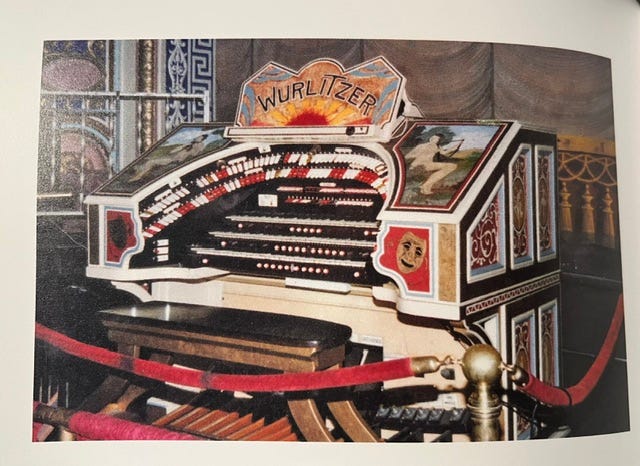
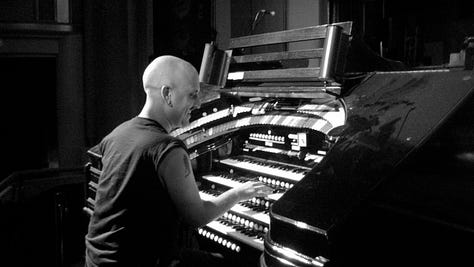
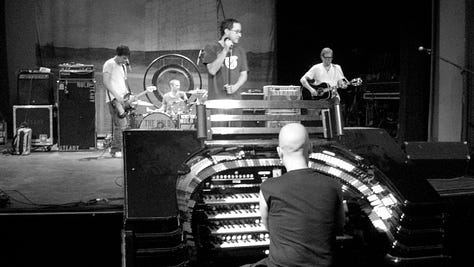
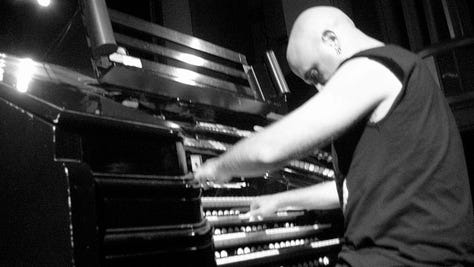
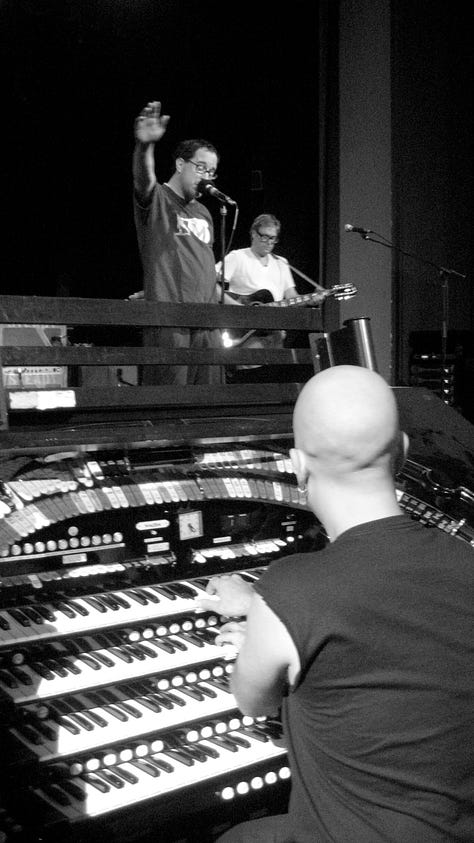
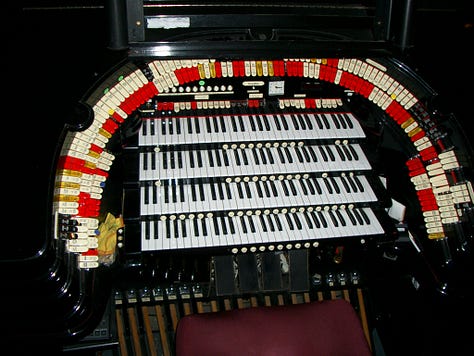
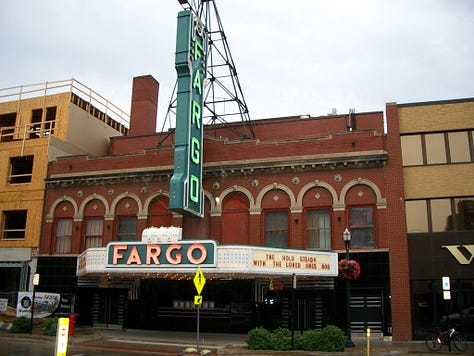
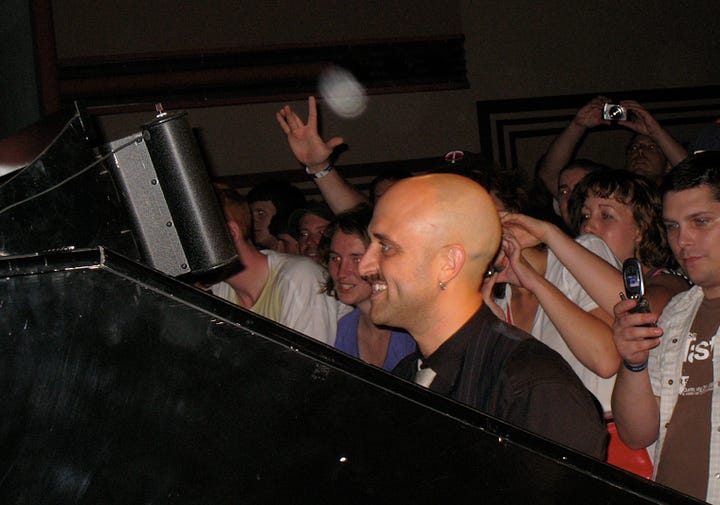
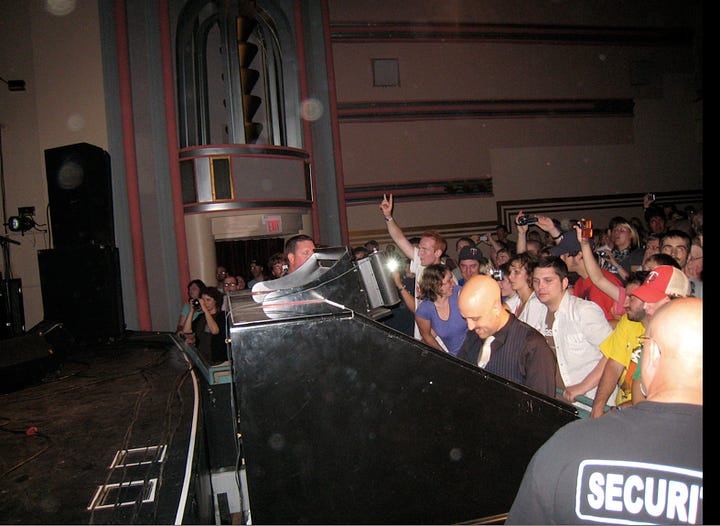
While the advent of talking pictures put the theater organ business to bed, over 100 Wurlitzer theater organs remain in service in America, including one at Radio City Music Hall. I got a chance to play the 1926 Wurlitzer at the Fargo Theater in July 2008 on a Hold Steady tour; the organ is mounted on hydraulics so I could rise from the pit to open the encore with “Both Crosses.”
But the company deftly pivoted once again, to their iconic jukeboxes—their innards heir to the coin-operated mechanical marvels of their player pianos and orchestrions and their colorful “bubble tubes” descendant from the gaudy, baroque decorations of the theater organs. (Its inventor Homer Capehart, bought out and hired by Wurlitzer, left the company and became a McCarthyite U.S. Senator from Indiana.)
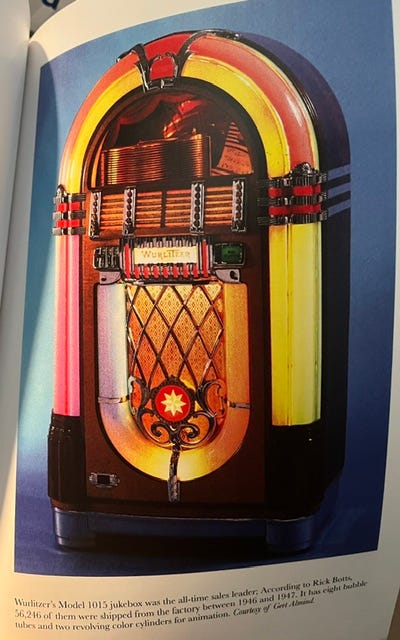
(The jukebox business was also an opportunity for the Wurlitzers to flex their longstanding connections in the sometimes unsavory world of coin-operated entertainment: a 1943 Billboard article openly announced their partnership with Meyer Lansky as “Wurlitzer’s new distributor in New York, New Jersey and Connecticut.” “We didn’t like force,” said one Wurlitzer executive, “but we had to sell jukeboxes.” While the last Wurlitzer jukebox was made in 2013, the Deutsche Wurlitzer company moved seamlessly into vending machines.)
The lively, colorful history of the Wurlitzers stretched from the coin-operated novelties of the 19th-century demimonde to the plastic-and-neon modernism of the 1950s and beyond, and made time for excursions into appliances (washing machines, refrigerators), electric guitars, even an early synthesizer. The company held, from 1935 to 1945, the exclusive rights to Skee-Ball. They developed a top-secret battery for military use, which was later licensed for pacemakers; as well as a WWII flying bomb nicknamed “the Bat.”
They even have a footnote in the history of electronic music as producers of “the first widely available, commercially produced drum machine”—1959’s Side Man, a piece of cabinetry with some pre-programmed beats, meant to bolt onto and accompany solo organs.
In all of this, the electric pianos are the reason for my telling, but also arguably the Wurlitzer product which remains the most alive in the culture. The theater organs are merely an icon of nostalgia for the 1920s; the jukeboxes for the ‘40s and ‘50s. The electric pianos are most associated with popular music of the 1950s–70s, but are familiar from the omnipresence of those recordings, and from their reproduction in keyboards and software synthesizers. If you say “Wurlitzer” (or, more familiarly, “Wurly”) to a musician in 2026, they will assume you mean a Wurlitzer 200 electric piano.
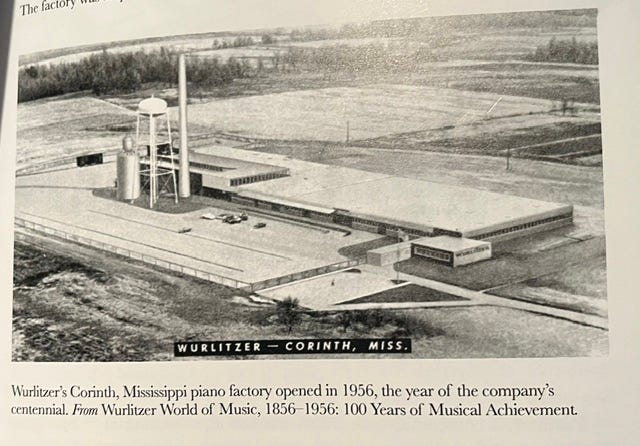
Funnily enough, the electric pianos are almost literally an afterthought—three paragraphs toward the end of the book—in the Palkovic history. The pianos (and the Side Man drum machine) were produced, starting in the 1950s, at the company’s new facility in Corinth, MS—perhaps an undervalued site for popular music pilgrimage. (My instrument, manufactured in 1971, would seem to have originated in a later factory in Logan, UT.)
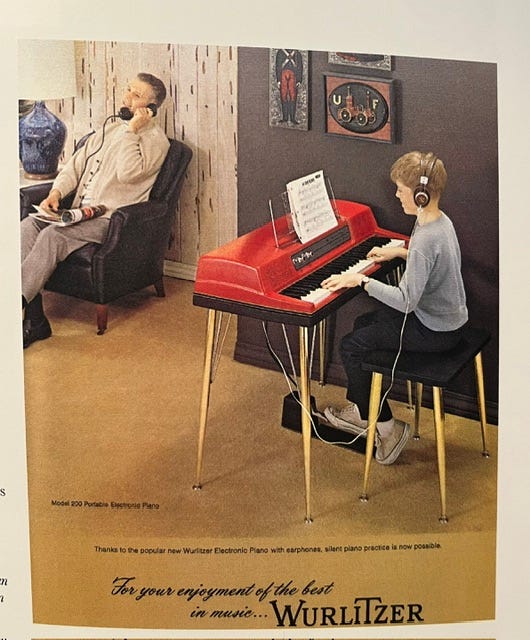
The company apparently envisioned the electric pianos as primarily useful for pedagogy: a brochure noted that “such unique features as ear phones and volume control creat[es] an instrument perfectly suited for classroom and studio training [and] holds special appeal for children.” The addition of a headphone jack might be argued to have “special appeal” for parents:
Additionally, they sold a “Music Laboratory” which could connect a teacher’s unit to up to 48 students which the teacher could listen to and address (via headset mic) individually:
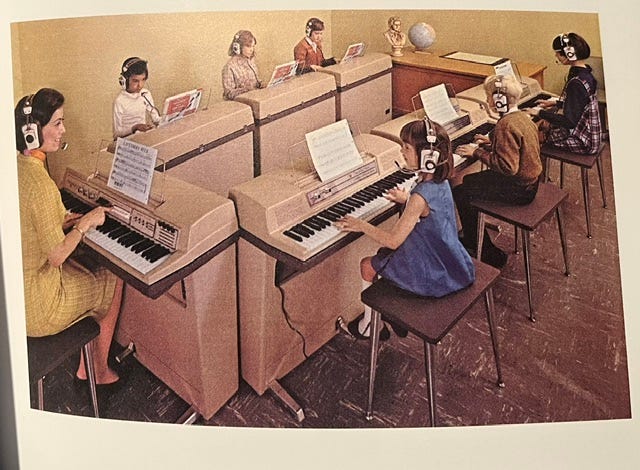
Eventually, the teaching unit even included a “visualizer,” in which the teacher’s playing could appear, via triggered lights, on a mock-keyboard and/or as notation on a staff:
The rise of digital synthesizers in the 1980s spelled the end of the Wurlitzer piano business, and in 1985 the company—no longer a family business, and no longer nimble enough to execute one more pivot—was bought by Baldwin Pianos (though Wurlitzer kept making, for some reason, pool tables); which itself was acquired by Gibson Guitars in 2001.
So there it is. A company that whose life spans—from just before the Civil War to just about the end of the Cold War—the rise and fall of America as a hustling, manufacturing nation; and, not coincidentally, the development of the American popular music industry from calliopes and player pianos through silent film organs, jukeboxes, to the advent of the drum machine. A story worthy of Twain (a family acquaintance, and an early investor in electronic organs) and Melville.
Comments
Nothing yet. Say the first thing.
Sign in to join the conversation.