
An excerpt from a larger article I’m working on, in which I did some crude research to try to confirm an anecdotal sense—that multi-person groups (whether as creative collaboration or performers) are thinner on the ground.
The governing maxim of American independent music in the 1980s and beyond was DIY: “do it yourself.” While artists and bands might uncomfortably straddle concurrent identities as defiantly uncommercial while also bootstrapping and entrepreneurial, that slogan belied the idealistic, collectivist nature of the project on the level of the “scene,” as projects like Maximum Rocknroll’s Book Your Own Fuckin’ Life and other zines delineated a nationwide underground of effectively volunteer and not-for-profit venues and distribution networks.
The message from the tech giants who aim to dominate music creation and distribution in the 21st century is also DIY—but this time they really mean just yourself. The technological nudging towards increasingly solipsistic consumption of music has been a constant since the advent of recorded and broadcast music: the wax cylinder, disc, and radio moved listening from the public space into the home; the small portable record players of the 1950s moved it into the bedroom; headphones isolated the listener from their family; 1979’s Sony Walkman isolated them from the world as they moved through it with an individualized soundtrack.
Similarly, music producers have been increasingly incentivized to pursue solitary creation. The adoption of technologies like the overdub, then the drum machine and the synthesizer, and the 1983 introduction of the MIDI (Musical Instrument Digital Interface) standard which allowed them to be programmed in unison, allowed producers to make records with fewer musicians playing simultaneously, then with fewer musicians. (The reactions of the various musicians’ unions against these technologies underscores this practical effect.) The expansion of digital audio recording and editing interfaces like ProTools (which debuted in 1991) to include software synthesizers, audio effects, AI-generated drums, et cetera.—their transformation into complete “digital audio workstations” (DAWs)—combined with increasingly affordable and ubiquitous laptop and smartphone technology to make available, effectively, professional recording studios in the bedroom of an average middle-class teenager. (In the case of GarageBand, the DAW comes bundled with the laptop.)
The result can be seen in the disappearance from the pop music aristocracy of that signature structural unit of 20th-century popular music: the band—that is, a self-organizing, self-contained, but multi-person unit of creative collaboration. One might counter, those home genres of the band—jazz, then rock—had, after roughly fifty years of pop dominance each, simply reached the end of their natural lifespans, and handed cultural primacy first to hip-hop, then to global pop.
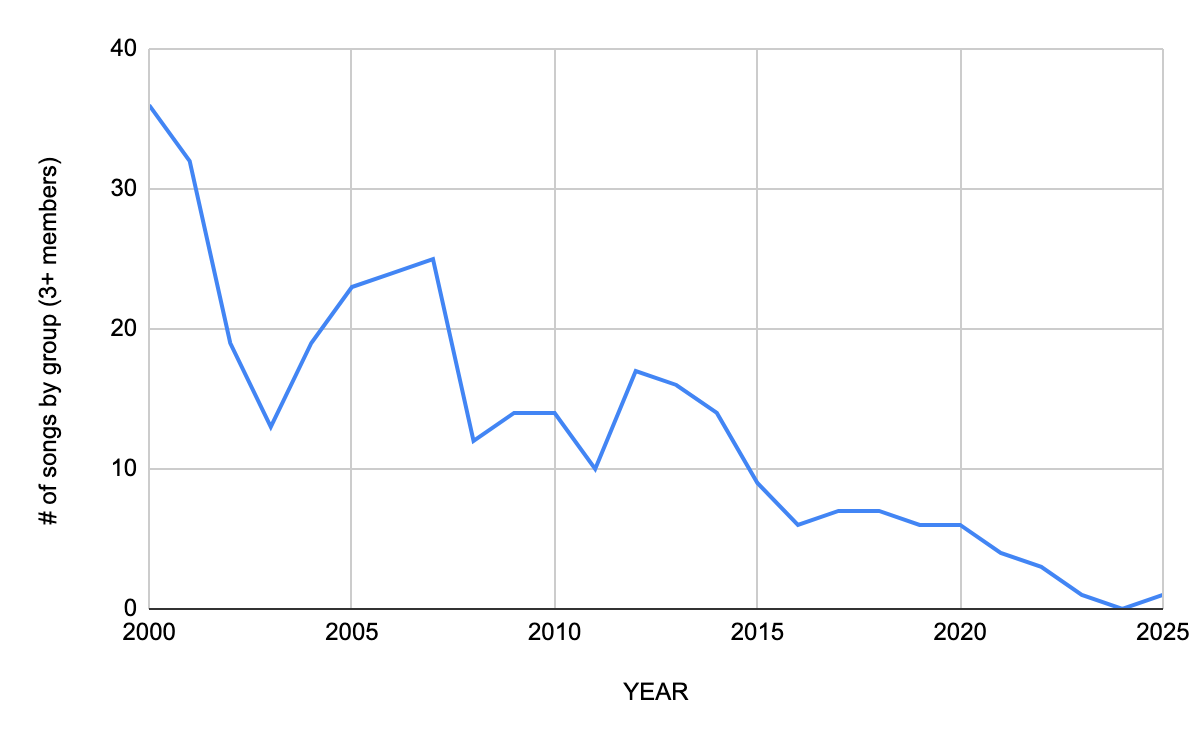
But the mere optics of high-profile group music-making are also disappearing. It’s a crude metric, but the number of songs in the Billboard end-of-year Top 100—that is, the most visible model for pop success—in which the named artist is a group of three or more primary members (per Wikipedia) has, since 2000, plummeted—since 2015, to the single digits. (“Groups” here include not just “bands” in the conventional sense, but also collective acts like BTS and Pussycat Dolls.) In 2023 (Old Dominion) and 2025 (The Marias) there were just one; in 2024, zero. The American pop charts in the past ten years have become the domain, almost exclusively, of solo acts.
GROUPS IN THE END-OF-YEAR BILLBOARD TOP 100
Put yourself in the Nike Pandas of a contemporary young person who wants to make music, who would once have bought a guitar and recruited some friends to form a garage band. At one time, that desire would force them to overcome the significant logistical, financial, and interpersonal hurdles that goal requires: to find a practice space, to acquire instruments, to rent a van, to load and unload the van; to find other people who play complementary instruments, to get along with those people, to find common aesthetics with those people, to find a time when everyone can get together and hash out those aesthetics and those relationships. Compare that prospect to the alternative: to open a laptop, open GarageBand, put on headphones, make a track yourself, upload it to DistroKid, and have it on Spotify within hours. Why involve anyone else?
Comments
Nothing yet. Say the first thing.
Sign in to join the conversation.