
Update: as of 4/1, the text of the review I criticize here has been changed to remove the overlapping language; I’ve been assured that this was a result of human failing, not AI; so I’ll revert to my initial verdict of “pretty sloppy.”
(Hat tip to Barry Dolan for the post title)
I’m a fan of the band Gladie, so I was happy to see they got a good review for their new album on Pitchfork. (And hate to drag them into this! Not their problem! Go listen to No Need To Be Lonely!). When songwriter Augusta Koch posted appreciatively (“Very grateful for the people who took the time to listen and write about this record. I know music journalism is going about as good as the music industry which ehhhh… not great lol I deeply appreciate it”) about the Paste review, I clicked on that, too. Something about the way producer Jeff Rosenstock’s contribution was described rang a bell:
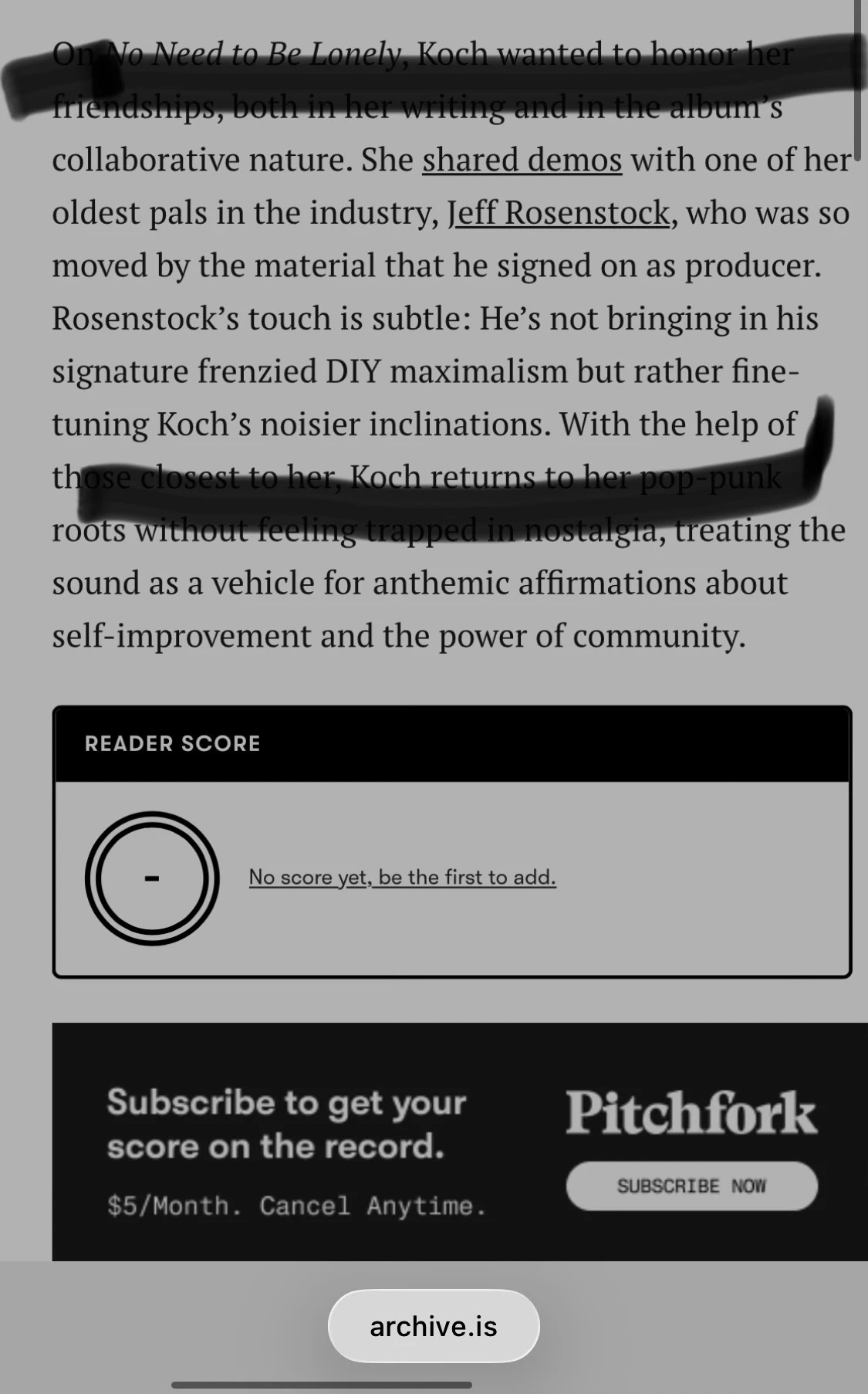
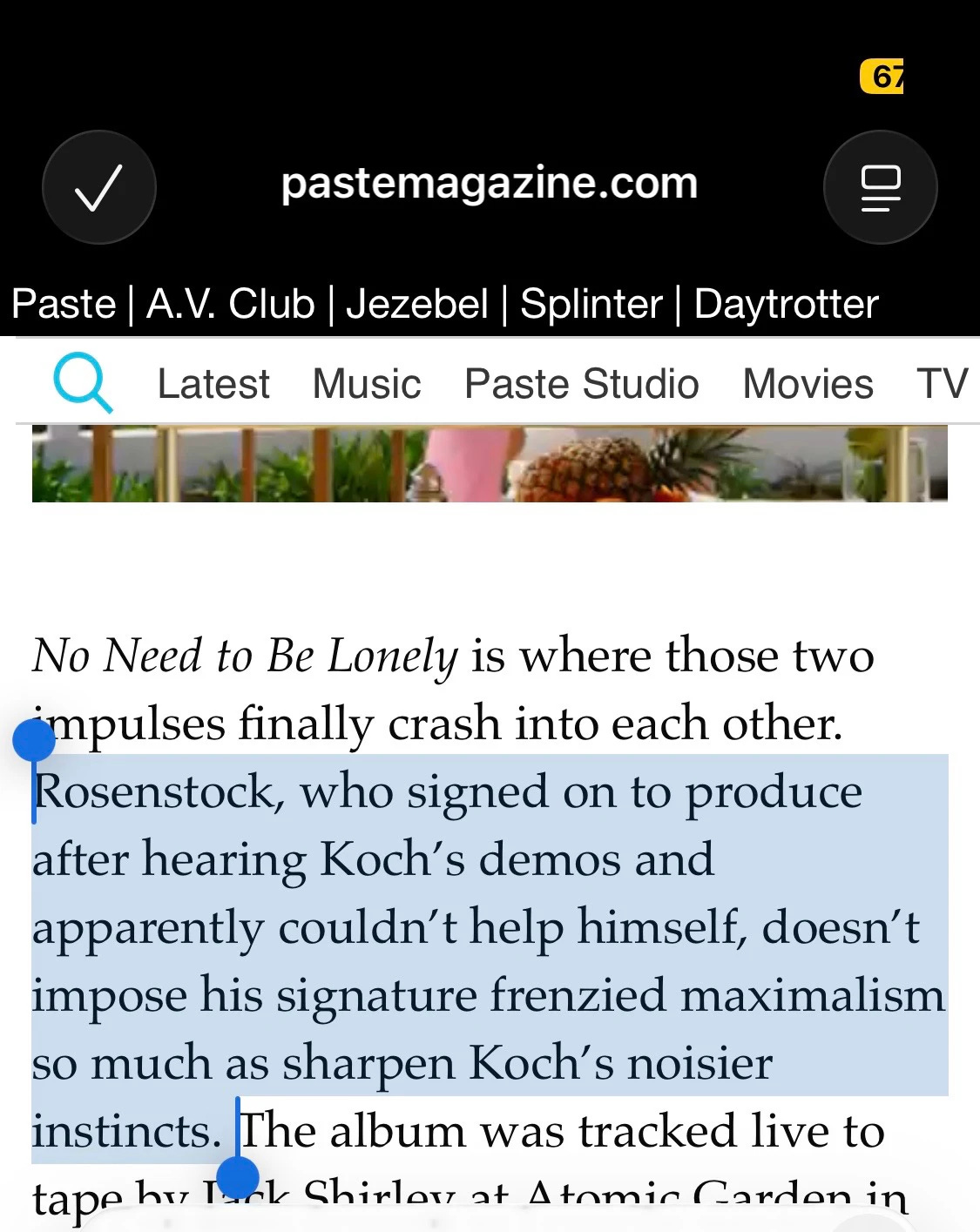
Now look. I’m not naive. I know many outlets briefly rephrase the press release, if not outright copy-and-paste it. (Though if the answer is that both Paste and Pitchfork were doing this, that’s embarrassing for both of them.) I know that pop music reviews are not reliably the home of conscientious, good-faith writers who show signs of having read widely beyond other music reviews. I was a gleeful consumer of the tendentious, mean-spirited—but usually not wrong!—reviewer-of-reviews site Ripfork (now defunct).
But as teacher of writing, and music, and writing about music, I’m also someone who is invested in the idea that music is an unusually fluid vector for really superb writing. (For what it’s worth, a college student would fail a paper, and probably be reported for academic integrity violation or negligence, for this sort of thing—my own institution specifically cites “Plagiarism (including material or ideas from sources, including—but not limited to—generative AI…or online sources, without a citation and/or quotation marks around any borrowed words); [or] claiming another’s work or a modification of another’s work as one’s own.”) As a maker and releaser of music, I’m invested in the idea that there be an ecosystem of writers willing and able to respond with some level of intellectual and artistic engagement. As both, I’m sympathetic to the cries of anguish every time a review outlet downsizes or shutters.
But surely that means the outlets which remain shoulder an extra burden! (The offending Paste review is, additionally, reprinted at the AV Club—a legacy brand, if I understand correctly, now owned by Paste.)
I posted these side-by-side screenshots on Bluesky with the caption, “Not trying to call anyone out here but this is pretty sloppy.” But I suppose I do want to call someone out, since I can’t seem to let this one go. I think it’s fair to say I’m offended by it!
As I was drafting this, news started making the rounds that “The New York Times has cut ties with a freelancer after the paper discovered he used AI to help write a book review that inadvertently incorporated elements of a Guardian review on the same title.” The passage in question is also a mild paraphrase of a previous review (screenshots courtesy Lincoln Michel on Bluesky):
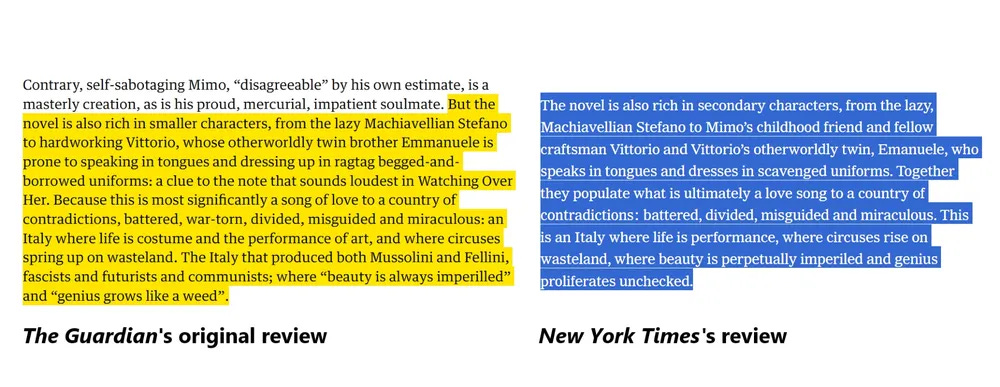
I have to assume that’s what happened here as well [UPDATE: or not; though either path ends up at the same result]—except that the author of record isn’t a freelancer, but the associate editor of the place, third on the masthead!
I don’t know the author. I looked at some other of their recent reviews and compared them against competitors’ reviews, and this doesn’t seem to be an obvious pattern. I don’t, though, think it’s a simple matter of awkward rewording of, or inspiration from, the press release. (For an example of that lazy but extremely common misdemeanor: compare what I would imagine is the “album narrative” from the press release, on the booking agent’s website, which says “the band was able to rely on the strength and energy of Rosenstock to help sharpen the blade on the keen edge of each track"” to Paste’s “Rosenstock, who signed on to produce after hearing Koch’s demos and apparently couldn’t help himself, doesn’t impose his signature frenzied maximalism so much as sharpen Koch’s noisier instinct” to this review elsewhere: “Rosenstock’s fingerprints can be found in the production through the sharpness of each instrument…These stories are at their sharpest when,” etc.)
The similarity between Pitchfork’s “Across two albums and several EPs, Koch has shied away from her punk roots, favoring a more stripped-back singer-songwriter approach” and Paste’s “The first two records, while genuinely very good, lived in a somewhat quieter register, more singer-songwriter than punk...” can be excused as a similar narration of a career. But the same take on the same lyrics on the same song? Pitchfork:
Koch again touches on the importance of friendship in the unwaveringly optimistic “Future Spring.” To complement its lyrics about uplifting others and reminding them of their worth, she brings in some of her closest friends—including Rosenstock and Schimelfenig, former Cayetana bandmates Allegra Anka and Kelly Olsen, former Chumped singer Anika Pyle, and Saintseneca’s Caeleigh Featherstone. They deliver the chorus as a warm welcome: ““Hey, you’re invited/And we’re glad you’re here.”
Paste:
“Future Spring” leans into the notion of community even harder, with a chorus of friends backing Koch up as she sings “Hey, you’re invited, and we’re glad you’re here.”
I don’t know, people! What are we doing here, if we’re invested in any way in defending against the idea that writing about music is replaceable by AI summary or press-release paraphrase—as many unemployed writers, and colleagues of unemployed writers, are—if the editors who still have jobs at the publications that still exist aren’t making the case for myriad critical perspectives on a work, instead of undermining it?
Comments
Nothing yet. Say the first thing.
Sign in to join the conversation.