
Written by producers Brent Maher (later of Judds fame) and Randy Goodrum, “A Lesson In Leavin’” (1979) was Dottie West’s first #1 country solo track (it’s made me dive into her catalog over the years, and I regret to say I haven’t really found the hidden gems I was hoping for). But more than that, it’s the sound of a rhythm section—in a city better known for workmanlike two-beat timekeeping—having a really, really good time.
The drummer is the late Nashville legend (that’s him on “Jolene”) Kenny Malone. Malone’s Allmusic bio highlights his jazzier interests—he was in “the only modern jazz group in town” with future Nashville Local 257 president and AFM international VP Dave Pomeroy, and worked with the progressive likes of Bela Fleck and Edgar Meyer in the ‘90s. “He was well known for asking for a lyric sheet instead of a chord chart,” said Pomeroy. From his NYTimes obit: “…the guitarist Eugene Chadbourne elaborated on [Mr. Malone’s] philosophy, writing, “He is the drummer who, upon hearing that a song’s lyrics described a woman slitting a man’s throat, told the producer to hang tough a moment while he fetched a different cymbal from his van, one that had just the right ‘scream’ for the job.”
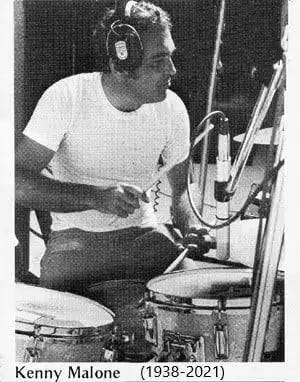
He reportedly thought of “Lesson in Leavin’” as a “Paul Simon type of groove” (I’m guessing the reference here is to Steve Gadd’s famous shuffle on “Fifty Ways To Leave Your Lover”). Malone was known for his hand percussion (as on Dobie Gray’s “Drift Away”), but I don’t hear evidence of that here—except for the tight handclaps that double the snare on two and four. (I ripped this beat for the last minute of this song from my last solo record.) The detail I really notice in Malone’s part is the half-open hi-hat on the “uh” of 4 (the final sixteenth note) that he does at the end of each bar of the intro, then every other bar in the first eight bars the vocal is in. Then it doesn’t appear again (with one—maybe accidental?—exception at 1:12) until the drum/vocal breakdown at 2:05 and stays in until the end. A nice piece of drum arranging.
A couple of other things to notice: West doubling herself in unison on the choruses, contrasted with the solo vocal in the choruses. The keyboard orchestration: Rhodes on the first verse; piano joins for the prechorus and chorus; and a Clavinet sneaks in to give the chords some bite on the second chorus (you can hear it by 1:15)—but it really gets a chance to do more canonic bass work in the breakdown at 2:15. A bunch of standard but always-works arrangement moves—prechorus, drum-and-vocal breakdown, up-a-step final chorus. Maher and Goodrum point out that the lyrics change, even as the rhyme doesn’t, in the choruses each time around—OK, sure.
But this track is really about bassist Jack Williams. It’s a little tricky to sort out a CV for Williams, who occasionally served as a horn and string arranger. He’s definitely the Jack Williams who was in the Nashville fusion-jazz groups The Grab Bag and Direct Flight with Malone and Goodrum. He’s the John C. Williams with a songwriting credit on Direct Flight’s off-kilter “Odakove”:
(I have to assume he’s not the same Jack Williams who played bass in a group called The Fall Guys and who “work[ed] steadily for decades as a composer, arranger, multi-instrumentalist and singer while living almost anonymously in Lakeland [FL] for the last two decades of his life”?
Williams, who died in August at age 72, was a co-founder of the touring band the Original Fall Guys, later known as the Fall Guys and A Gal. In high demand as an arranger, William worked with the likes of Bill Allred’s Jazz Band, The Impressions, Jim Stafford and Pam Tillis…“Had he gone to Hollywood, he would have been another Quincy Jones,” [bandmate Don] Rieck said. Williams, a Delaware native, studied at the Philadelphia Conservatory of Music, where he trained under Vincent Persichetti, a renowned composer who also taught at the Juilliard School in New York. He graduated in 1964…Rieck added that Williams was capable of writing music while sitting at a desk, rather than at a piano, and could compose in noisy settings….Williams drew up restrained but sophisticated charts for horn sections, Rieck said, in the manner later popularized by Chicago and Earth Wind and Fire.
Doesn’t sound like a budding fusioneer on The Fall Guys recordings, but who knows.)
Presumably he’s one of these fellows on the back of the Grab Bag record:
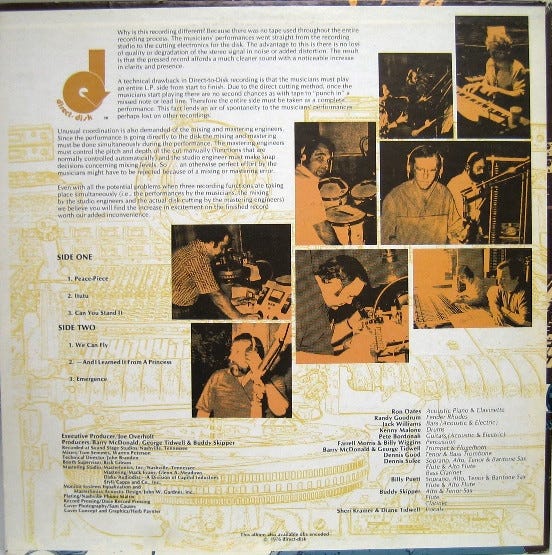
In any case, he is cooking on the Dottie track, busier than most non-Motown session players could get away with (helps, I suppose, if your bandmate is the producer).
But check this out (without even getting into the octave-leaping, effortless-sounding melodic content of his part): Williams demarcates each section in turn by never repeating the same rhythmic pattern:
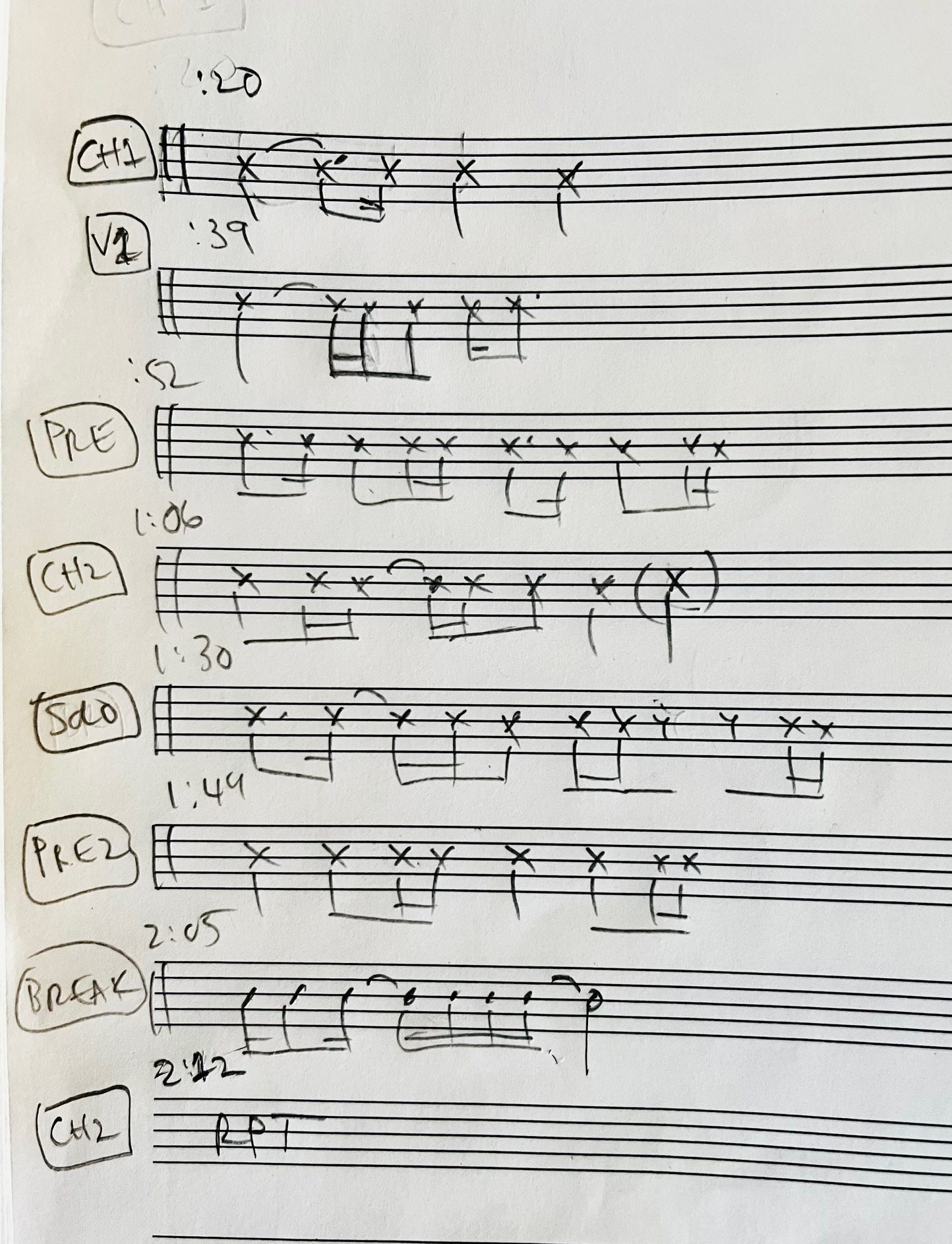
It’s not until the out-chorus, at 2:12, that he returns to the CH2 pattern for the repeat and fade-out. Otherwise—if funk is syncopation, and syncopation is finding different subdivisions of the sixteenth note to accent, Williams is giving us fresh funk for each new section of the form.
Great stuff. Anyone who knows more about Jack Williams, let me know.
Comments
Nothing yet. Say the first thing.
Sign in to join the conversation.