
I first heard the phrase “causal closure” from online discussions, where I gathered it involved the standard model of physics, energy conservation laws, neurons firing in a brain, and an omniscient demon capable of predicting everything there is to know from “fundamental physics”, whatever that is. To me that’s like saying, “Everything there is to know about the Mona Lisa can be discovered just by doing a chemical analysis of its paint.” It seems like something would be missing, though. Something like…the Mona Lisa. As Philip Goff pointed out in a recent post:
“…the question of whether the laws of physics are deterministic has no bearing on the question of whether the universe as a whole is deterministic, and hence no bearing on the question of whether or not we have free will.”
Exactly. Physics isn’t the study of everything, so it can’t tell us everything there is to know. Why isn’t this just obvious to everyone, though? Well, maybe I should try putting on my physicalist hat. Hang on, it’ll take me a minute to dig it out of the basement of my soul…
Okay I’m back. A physicalist might say: “Physics, by dealing with the fundamental constituents of reality, gives us a predictable, unified picture of what’s out there. If you have everything you need to build a car, you can build a car. If you have all the universe parts, you have a universe, at least in principle. Nothing more is needed.” And so we have causal completeness:
When you trace the causal history of any physical effect—that is, of anything physical that has a cause—you will never need to appeal to anything non-physical.
If after putting the universe together we found some extra screws lying around, I can see why that wouldn’t be too good. But does physics have all the universe parts (in principle)—and if so, does that mean the special sciences are just extra screws lying around? More importantly, do the purely physical parts add up to complete knowledge of the universe?
From here on out I’ll just assume causal closure pertains to fundamental physics, since that seems to be what most people mean.
Some try to use causal closure as an argument against all non-physicalist positions. I would advise against it. Here’s a distillation: “If the nonphysical can be causally efficacious, then there should be physical effects that can’t be explained by physics, some violation of physical laws or energy conservation. Since science observes no such violations, the nonphysical must be epiphenomenal (and so might as well not exist).”
This seems to assume the nonphysical must show up supernaturally to disrupt a purely physical chain of events. Leaving aside the fact that I reject causal closure, it’s hard to see how miraculous or supernatural phenomena, if such were to exist, could possibly show up in mathematical equations or physical laws. What if Kant was right that our experience of the objective world must be causally law abiding? Or to put it in a less subjective way, what if being causally law abiding lies at the very heart of what it means for something to belong to objective reality? I find this plausible. If this is the case and if nonphysical means “not law abiding”, then by definition the nonphysical could never enter into a unified, objective world, and so science would never detect it.1
But if we take “nonphysical” to mean immaterial, not spatially located, then science has already detected the nonphysical. Once upon a time materialists considered immaterial entities to be either ideas in our heads or supernatural, but now much of what is considered physical is immaterial. Gravity, forces, fields, photons2—these intangibles, which once seemed pretty spooky, are now longstanding members of Club Physics. Science has no problem with the immaterial interacting with the material—why is there so little fanfare over this? No longer having to worry about incompatible substances might’ve given philosophers license to return to interaction dualism, one would think, but the majority continue to find the position repugnant. Why?
Because causal closure.
Today’s philosophers are by and large impressively scientifically informed, but they have yet to let go of 17th century mechanistic causation. The analytic philosophy of mind mainstream has so thoroughly internalized the belief that being scientific means eliminating teleological explanations, along with formal and final causes, that efficient “dominoes falling in a line” causation is the only kind they think of. But the reduction to efficient causation depended on a materialistic conception of nature which no longer applies.
This narrow conception of causation is so pervasive in philosophy of mind, even the “anti-physicalist” is expected to swallow causal closure like a champ, never mind that it’s intended to be an argument in favor of physicalism. Rejecting closure gets a rather breezy dismissal from the SEP page on physicalism:
“A more searching response is to reject the very idea of causal closure on the grounds, perhaps, that (as Bertrand Russell (1917) famously argued) causation plays no role in a mature portrayal of the world. Once again, however, the promise of this response is more imagined than real. While it is true that many sciences do not explicitly use the notion of causation, it is extremely unlikely that they do not imply that various causal claims are true.”
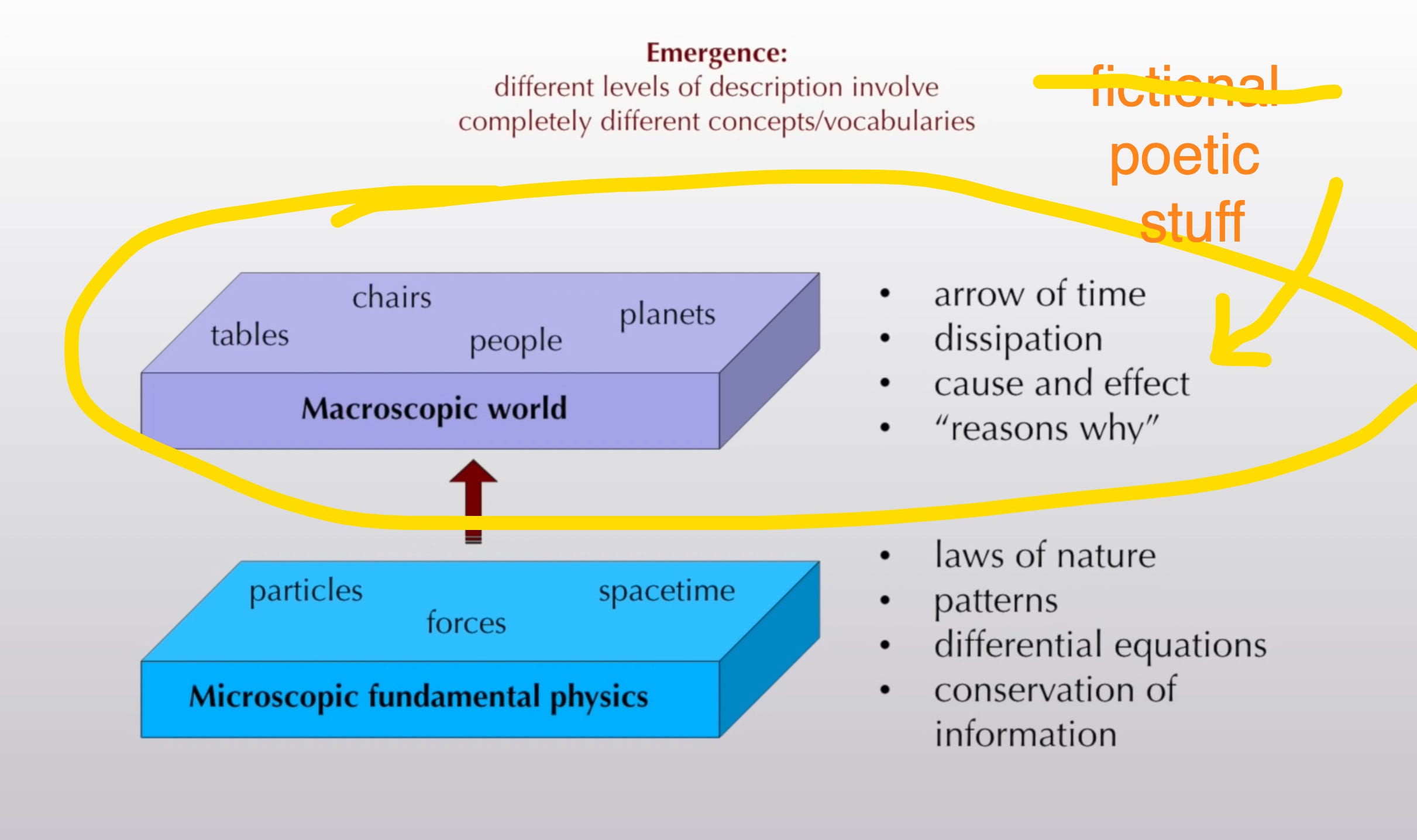
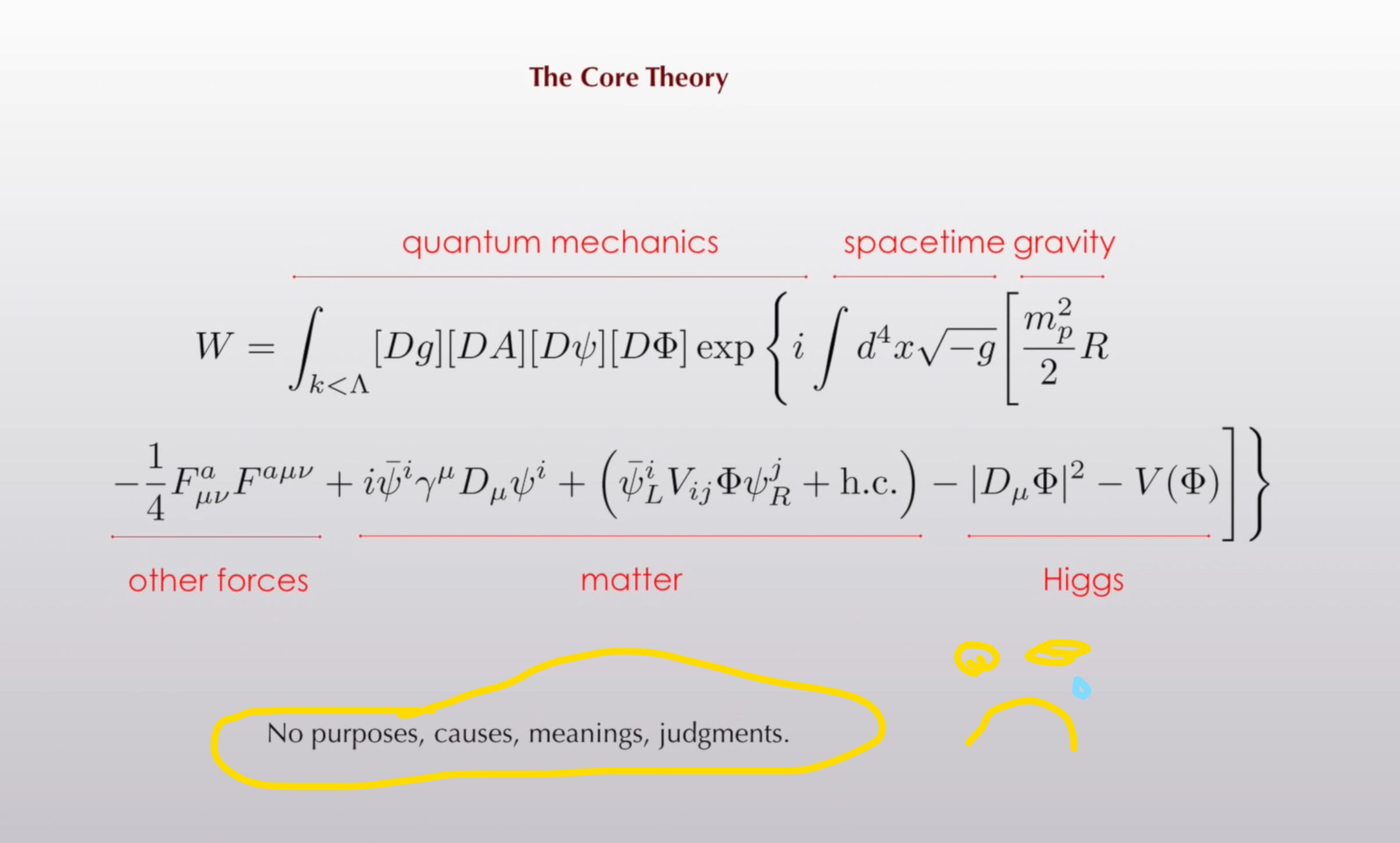
But wait a minute. Physicist Sean Carroll has argued that at the level of fundamental physics, there are no causes and effects, only events conforming to time-symmetric laws. If the direction of time doesn’t matter for the laws of physics, then efficient causation simply has no bearing on fundamental reality.
Supernatural phenomena DO NOT break the laws of physics!
He also thinks the laws don’t govern the way events unfold; we invented the laws to describe nature, but they don’t hold with necessity. This suggests there’s no causal glue, not even necessary laws, linking events from one moment to the next, and so no causal closure being described by science at the level of fundamental physics. If he’s right that physics doesn’t deal with causes, it wouldn’t be “extremely unlikely” that physics doesn’t imply anything about causality. (And yet, inexplicably, Carroll himself frequently deploys the causal closure argument against anti-physicalists.)
Maybe Carroll’s wrong. I’m not a scientist, so I can’t speak to the issue of whether physics deals with causes. But I can say causal closure is a metaphysical thesis, not a scientific one. No science experiment could establish causal closure. Scientists might use closure as a methodological assumption, but it’s an assumption, not an independently established truth.
But is causal closure worth believing in? I don’t think so. I don’t think functionalists should either.
It’s clear why non-physicalists would reject causal closure, but closure creates serious problems for certain physicalists as well; in particular, non-reductive physicalists and functionalists.
The core of functionalism is multiple realizability, the idea that it’s the functional role that matters, not necessarily what something is made of. A mind processes information whether it’s implemented in neurons or silicon. A mousetrap’s function is catching mice; it doesn’t matter whether the trap is made out of gold or steel, so long as it works. The functional role is supposed to be both real and causal.
This simplified version of Jaegwon Kim’s popular exclusion argument explains the problem:
Causal closure: Every physical event has a sufficient physical cause.
Exclusion: A single physical event cannot have more than one complete, sufficient cause at the same time.3
Conclusion: Nonphysical events can only cause physical events if nonphysical events are themselves physical.
Sufficient causation is efficient causation, it seems to me, given the importance of time. Functionalists will want to avoid both:
epiphenomenalism: the mental is completely dependent for its existence on the physical, but doesn’t influence the physical
AND
overdetermination: a violation of “exclusion” (see above), where a single physical event has more than one sufficient cause at the same time.4
Given the exclusion argument, the possibilities for functionalists aren’t exactly endless. One option is to identify functions straightforwardly with their physical components, the way water just is H2O. But then multiple realizability collapses and it’s not clear what the functions, qua functions, are doing. If we say wetness is H20, wetness can’t be realized in H2O2 (hydrogen peroxide)…but surely other substances besides water can be wet.
Kim’s solution is to reduce the higher levels to fundamental physics. He supports local reductionism where you get a different reduction for every particular, and maybe even for every moment in time for the same particular. But again, this leaves me wondering what it is that’s being multiply realized.
Another solution is the causal inheritance principle: mental properties “borrow” or “inherit” their causal powers from the physical states that realize them.
“On some versions of the inheritance solution, what the higher-level mental property derives from its physical realizer is some weaker or “lower-grade” form of causal relevance…Now in general we don’t think that wholes causally compete with, or are excluded by, their parts. When Gus steps on Lilian’s toe, his foot’s causing Lilian discomfort doesn’t exclude Gus’s causing her discomfort. Both Gus and his foot coexist as causes, without competition and, we might add, without overdetermination….An advantage of such a view is that it accords a derived form of relevance to mental properties, but in a way that respects both the priority of physical causation embodied in Completeness as well as the principle of No Overdetermination.”5
If the function “inherits” causal powers from the level of fundamental physics, maybe this is like saying wetness “inherits” the powers of H2O. We no longer need to say wetness is H2O; H2O2 can be wet too.
But it seems to me if Gus’ toe is the kind of thing that can be explained by fundamental physics while the rest of him isn’t, his toe does all the work. If not, not. Stipulating a whole-part relationship doesn’t change the causal situation by making it sound weird.
If we have a golden mousetrap and a steel mousetrap, then what carries the causal load has nothing to do with the function of catching mice and everything to do with what the mousetraps are made of.6 If reduction is to be taken seriously, functions—and multiple realizability—can only be poetry.7 If you take causal efficacy to be what makes something real, you should be suspicious of what reductionism implies. If physical causation is always sufficient, why do functions have to reduce rather than simply disappear?
Philosophers have tried various escapes, but I'm not convinced they work. Austere physicalist, Liam Graham, gives us a clearer picture of what causal closure entails:
“Reductionism preserves the reality of high-level features. It seems to let you keep your intuitions about the reality of the things that compose your world. There’s an immediate problem with this. The most convincing definition of reality is having causal power. Yet if you are a reductionist, you accept physical causal closure. If higher levels have no causal power, they cannot be real. We are back to eliminativism.”
“A reductionist cannot avoid being an eliminativist. You can’t stop everything slipping down to the lowest level. You can’t avoid seeing that only the lowest level is real. This means that the only possible physicalism is an austere physicalism. It is either that or a belief in the supernatural…Everything is fully described by fundamental physics or whatever future theory may supersede it… Other ways of describing the world are artefacts of our cognitive limitations. This includes the special sciences, commonsense models of the world, ordinary objects, ourselves and other creatures. They may be useful approximations. They may be unavoidable given our cognitive structure. But they are illusions in the sense they have no causal power.”8
On Boltzmanns Brain blog, he says:
“Life emerging from lifeless stuff already has a whiff of magic. I’d tell this story firstly by pointing out that “life” is an arbitrary conceptual distinction which only exists in the minds of humans.”
I have to admire Liam Graham for his courage. I almost kind of like austere physicalism for its brutal boldness. I find myself drawn to it in the same way I’m drawn to a photo negative. But in the end, I think values are real, not mere shadows in my mind.
But it’s not just “mental properties” that closure collapses. If nothing can do anything outside of fundamental physics and doing stuff is what makes something real, there’s no room for functional roles. If you want functions to actually play a causal role, I think you’ll have to reject causal closure—or weaken or expand closure to the point that it’s not doing much of anything. It seems worth asking whether the thesis is doing functionalism any favors.
Here’s what I think proponents of the closure thesis want it to mean.
To say we never need to appeal to the non-physical is to say of Socrates’s death that it’s sufficiently explained by his drinking hemlock poison. We don’t need to hear about Socrates’ reasons for deciding to stay in prison rather than escaping when he had the chance. We don’t need to consider what would have been the case had Socrates decided to escape.
“When a counterfactual is true, there should be something in the world that makes it true…the worry is that once we look at the truthmakers in the mental case, the threat of epiphenomenalism crops up again. Although the effect counterfactually depends on the mental property, this is only because the mental property depends on a physical property doing the real work. The mental property looks like a freeloader.” 2
I’ll repeat the above in ordinary language: Reasons are just ideas in our heads, not things out in the world doing real causal work. Reasons, ideas, values, beliefs, all of these are freeloaders.
If so, then what about math? The laws of physics? Are they freeloaders too? The laws aren’t physical objects pushing things around…so they must be freeloading ‘mental properties’ too. But if they’re not real and causal, then what could physics explain except the insides of our minds?
Recently Disagreeable Me and I nearly broke the Substack comments feature while discussing these topics. I found it interesting that he openly endorses mathematical Platonism, since I hardly ever hear of it. I suppose people don’t like that dirty word—Plato. God forbid.
The funny thing is, for Plato, mathematical entities were most definitely causally efficacious. Whereas mathematical Platonism sees ideas as causally impotent, even if they’re not solely in the human mind. If what makes something real is having causal power, I think something like Plato’s more robust formal causation will be necessary to bring organization, structure, patterns, and certainly information,9 back to life.
Heisenberg, in a remarkable essay on Plato and modern physics, argued that the revolution of 20th century physics, which awakened to fields, forces, and quantum states, actually brought science closer to Platonic formalism than to Democritean materialism.
“For Plato, in contrast to Democritus, the smallest particles were not unchangeable or indestructible; they could be reduced to triangles, and out of triangles built up again. The triangles themselves would no longer be matter, for they would have no spatial extension. Thus, at the end of this series of material concepts we encounter something which is no longer material but simply a mathematical form—or, if you prefer, an intellectual construction. The ultimate root concept capable of rendering the world intelligible was for Plato the mathematical pattern, the picture, the idea.”
I have to wonder whether the Timaeus, with its purely mathematical vision of physical reality bottoming out in an almost unthinkable matrix of “errant” causation, influenced Heisenberg’s scientific thinking.
The standard story is that modern science rejected teleology, that it swept away Aristotle's formal and final causes in favor of clean, mechanistic efficient causation. But I think it’s better to say science presupposes teleology, otherwise it wouldn’t get off the ground. Evolutionary biology is incomprehensible without some notion of survival as the end game of natural selection. Medicine literally couldn't function—diagnose diseases or direct treatment—without health as its target, without understanding of how organs function relative to the whole organism. The cardiologist knows not only how the heart pumps blood, but what pumping blood is for, and that the patient's flourishing is the context that makes the heart’s work intelligible. Purpose, function, ideas—these are keeping everything running like mechanistic clockwork. Causal closure, stated carefully, may be methodologically useful, even true in a narrow domain. But as a complete picture of reality, and as an argument against any form of non-physicalism, it reaches too far.
We rejected purposes in nature only when we thought they might lead to supernatural religious implications, but teleology need not be supernatural. We think purposes are clouds inside our heads, but they have a way of putting on funny disguises and escaping into the world. Anyway, we’d sure as hell miss them if they were gone. That’s causal power if you ask me.
Functionalism seeks a general structure or Real Pattern under which various physical instantiations can be united, but it remains under the thumb of a restrictive causal structure imposed on it by bizarre notions of what makes physicalism physicalism, notions that reflect outdated materialism. Functionalists who are looking for functioning functions might consider opening their minds to the more realistic causal realities that science supposedly left behind. Plato called these forms.10
And of course there’s always Aristotle. You’ll have to talk to Joseph Rahi about that.
Am I missing something? What do you think about causal closure? Are you a functionalist with a non-word-salad solution to the exclusion problem? Leave a comment!
Heisenberg, FROM PLATO TO MAX PLANCK ←READ THIS.
An interesting Aristotelian:
To get full access to my published books and posts, upgrade your subscription. Find out more. You can customize which bits of this newsletter you receive by visiting your account.

Thanks for supporting my niche literary endeavors and off-beat philosophical speculations. Cheers!
—Tina Lee Forsee
Of course, you can disagree, but then Hume’s problem of induction will still have to be addressed. From what I can tell, philosophers mainly try to bypass the problem in favor of weaker forms of rationalism than Kant’s. This only makes causal closure look more and more like an unsolvable metaphysical assumption rather than an empirically verifiable one.
Thanks Marco Masi for teaching me that a “photon” is immaterial. :)
The Principle of Causal Exclusion: “No single event can have more than one sufficient cause occurring at any given time—unless it is a genuine case of causal overdetermination” (Kim, 2005, 42).
Though for some reason we can safely ignore two deadly bullets arriving at someone’s skull at the same time because bullets are physical.
Gold would presumably act differently at a molecular level than steel, which threatens multiple realizability. But going further down into fundamental physics doesn’t help this situation. At the most fundamental level functions might be the same, but they wouldn’t be distinct enough to be recognizable as functions.
I’m thinking of Sean Carroll’s invented phrase “poetic naturalism”.
Not all physicalists love computationalism. They might prefer a more Aristotelean approach on causation, whereas computationalists might prefer Platonism.
Plato had two forms of causation: formal and, for lack of a better word, physical. (He called it Necessity, Errant Cause, plus Khora or Space…he would never let you box him in with terminology!). Aristotle, as you probably know, had four causes. Colin McGinn is apparently eager to one-up Aristotle.
Comments
Nothing yet. Say the first thing.
Sign in to join the conversation.