
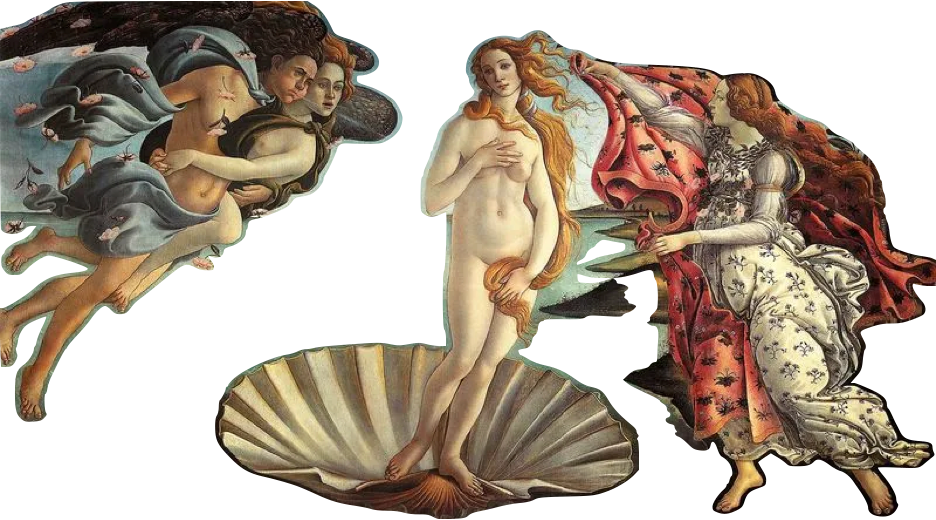
HESIOD’S (c. 750 BC) Theogony is a muthos (myth) that recounts the genealogy of the gods and the beginning of the world, but nobody cares about gods begatting each other so I’ll skip that part.
A primordial Chaos (some random abyss) gives birth to Earth, Tartarus (the region below), and Eros (also the region below). From the random abyss of Chaos comes the ordered world of our ordinary experience, which we can now measure and predict with science. But since Hesiod lived back in the day when people didn’t know very much, he thought the world was run by petty gods who didn’t care about us except when we gave them bones and scraps of meat, the stuff we normally throw out after dinner. They liked the smell or something, the gods did.
THALES of Miletus (c. 624 BC) rejected muthos in favor of logos—this is how those who don’t “get” poetry came to be known as “philosophers”. For Thales, the archē (origin) couldn’t be an abyss. How can everything come from an abyss? Isn’t that like everything coming from nothing? Everything had to come from…everything. What was everything, deep down?
Water. Even things that aren’t water are water. You, your computer, the Sahara desert—all of it, he thought, was really just water.
One day he jumped into a well so he could splash around in Being Itself. No, he did not fall into the well while looking up at the stars! Anyway, so what if he did? He got the last laugh by buying up all the olive presses dirt cheap and renting them out during the olive harvest. He made every one of those yahoos who’d laughed at him pay through the nose.
His belief that all our knowledge comes from seeing and touching things like water is called “empiricism”. This kicked off the long verbal dispute known today as “Western philosophy”.

ANAXIMANDER (c. 610 BC) didn’t think the first principle could be water. Water is too definite. Being had to be indefinite. So he called Being “The Indefinite”. Because he believed knowledge comes from imaginary ideas, we call him a “rationalist”. He said, “The indefinite is that from which beings come to be, and into which they come to perish according to necessity. For they pay a penalty and reparation to each other for their injustice and according to the order of time.”
In other words, you have to pay a penalty for being alive for any length of time. That punishment is the death sentence, which dissolves you in the indefinite soup of Being.
ANAXIMENES (c. 586 BC, empiricist) thought “The Indefinite” just seemed too…poetic. He wanted his archē to be something substantial. Something tangible, touchable. Air seemed to fit the bill.
XENOPHANES (c. 570 BC, rationalist) criticized the Greek gods for being too much like us. God, he thought, must have telekinetic powers. “But without labor he shakes all things by the thought of his mind.” But God’s powers were limited, since he couldn’t move himself just by thinking about it. “Always in the same place (God) remains, moving not at all.”
Later on, Aristotle changed God’s name to “The Unmoved Mover” to disguise the fact that he stole Xenophanes’ ideas.
PYTHAGORAS (c. 570 BC, rationalist) never wrote anything, preferring instead to let his followers do that for him. They said he said “All is number” and called the first principle “The One”. But for some reason he didn’t think “one” was a number. So he believed the book of nature was written in the language of mathematics, but his went: “In the beginning there was two, three, four…”
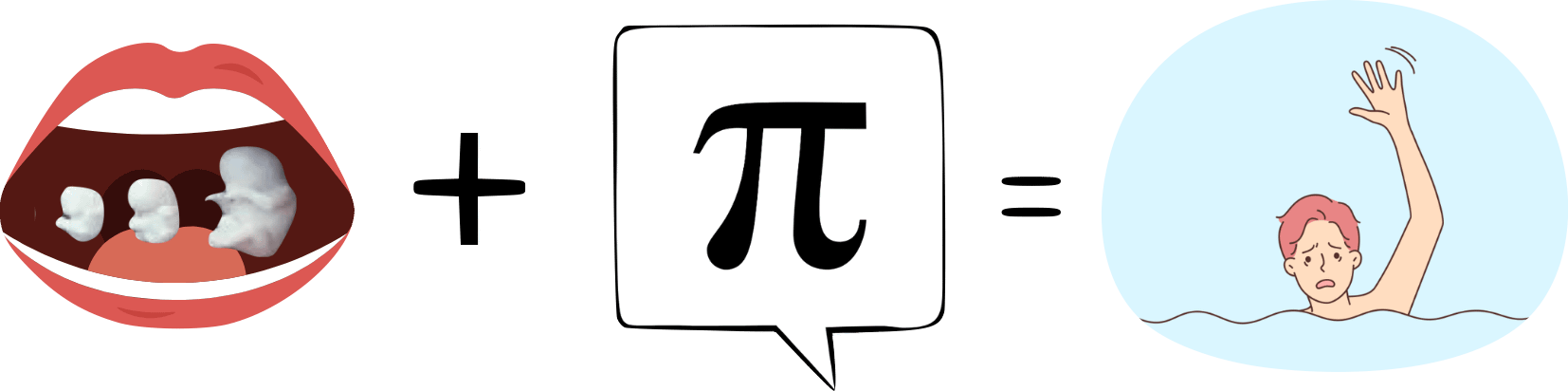
The Pythagoreans were a mystery cult. They banned the eating of beings, including reincarnated beings like beans. And if you spilled the beans about irrational numbers, the math mafia would drown you at sea.
HERACLITUS (c. 535 BC, empiricist) eliminated Being, so Nietzsche liked him. Heraclitus believed everything is always disappearing super fast. The reason you don’t notice anything amiss is because every time something pops out of existence, at that very moment an almost-identical thing pops into existence to take its place. That’s why he said, “Into the same river it is not possible to step twice.”
PARMENIDES (c. 515 BC, rationalist) argued that Being must be eternal, changeless, and one. Nietzsche didn’t like him at all, which is why thinking about Being fell out of favor and remains unpopular today. With the notable exception of the 42nd President of the United States, hardly anyone asks what the meaning of the word “is” is anymore.
For Parmenides, Being is an unimaginable idea in your mind, and only It is real; everything you see and touch is an illusion. Not because things like rivers are always popping in and out of existence, as Heraclitus had claimed, but because time itself is always popping in and out of existence.
He also said Nonbeing doesn’t exist, not even as an unimaginable idea in your mind. That’s because you can’t say “Nonbeing exists” without contradicting yourself. He was pretty serious about following the law of non-contradiction, even though, strictly speaking, the law of non-contradiction doesn’t really exist. Only Being exists!
ANAXAGORAS (c. 500 BC, materialist pretending to be a rationalist) said, “The Greeks incorrectly believe that there is coming to be and perishing, for nothing comes to be, nor does it perish, but from things that are they are mixed together and are separated apart. Thus it would be correct to call coming to be “being mixed together”, and perishing “being separated apart”. When Socrates heard this he was like, “I thought you said you were gonna tell me how everything’s caused by Mind!”
DEMOCRITUS (c. 460 BC, materialist-atomist) thought Being was made up of uncuttable stuff too small to see called “atoms”. To believe in atoms, you must throw all your doxa, the Greek word for “folk psychology”, out the window. Basically he was an eliminative materialist, or someone who thinks the mind isn’t real because “its power of producing movement is due to the smallness of its parts.” He thought atoms move through a void, and that’s all anything really is. As for ethics, he was a hedonist, meaning you should just do whatever you want. But then he said you should pursue the intellectual life, so he contradicted himself.
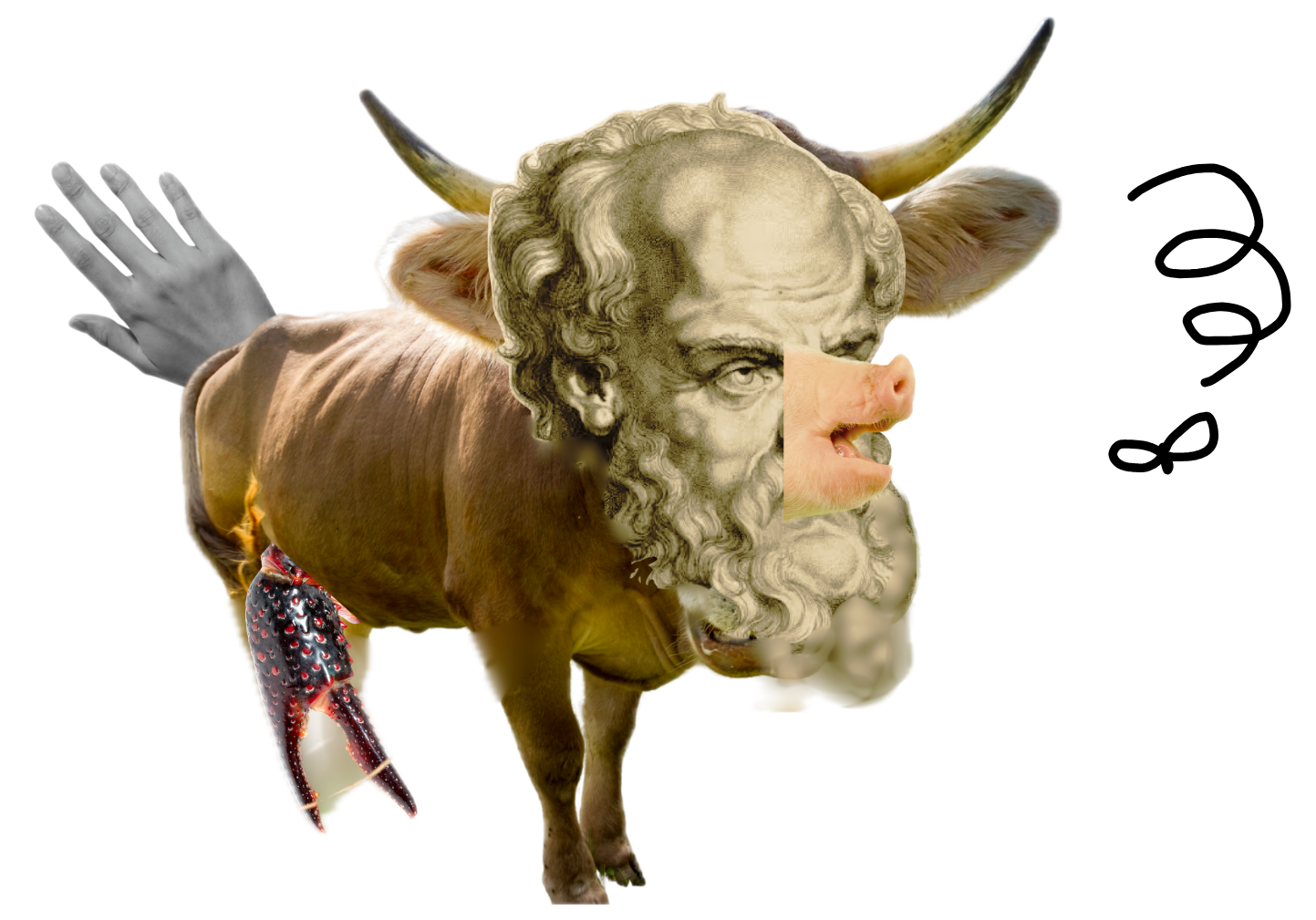
EMPEDOCLES (c. 494, evolutionist) divided Being into earth, air, water, and fire, which combine randomly to form “many neckless faces” and “arms wandering naked, bereft of shoulders” and “eyes roaming alone, in need of foreheads”, which combine randomly to make up…us! Well, eventually. First evolution had to make a lot of useless creatures “partly from men and partly from women, fitted with shadowy genitals” or with ‘faces and chests of both sides”.
Empedocles was way ahead of his time in figuring out how natural selection kills off “man-faced ox-progeny” so we don’t have to look at them.
OTHER NATURAL PHILOSOPHERS: There were others, but most were just students stealing their teacher’s ideas. I left Zeno off for being too paradoxical.
SOCRATES (c. 470 BC, The Gadfly) was jealous of his predecessors. He wanted to be a famous philosopher so bad, but writing didn’t come naturally to him. What little he managed to come up with just sounded so…contrived. Most of the time he found himself staring blankly into an empty sandbox.
One day he said enough is enough. He kicked off his overpriced Birkenstocks, slapped some dirt on his toga, and went over to the agora to do the “dialectic” with passersby. Day after day he used his new arguing method to get the hardworking citizens of Athens to fork over their pocket change as quickly as possible. Over the years he made quite a lot of money, but rather than using it to buy boring necessities for his wife and children, he spent every last obol on papyrus scrolls, as many as he could get his hands on.
At first he scratched out everyone’s names and replaced them with his own (unless all they said was “yes, certainly” or “no, of course not”), but when that proved too cumbersome he decided to tear these works into itty bitty pieces, which he then tossed into the wind thinking that was that.
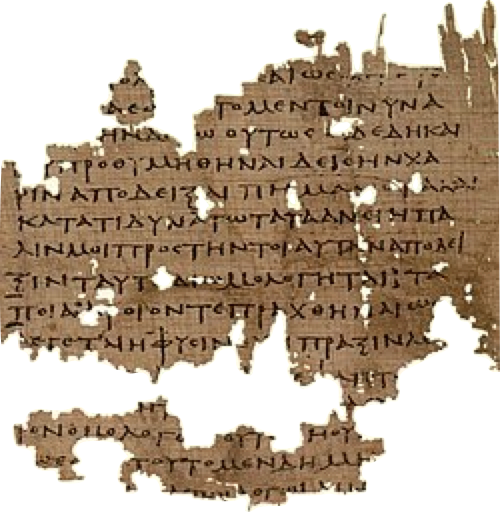
Some of the scraps got picked up by scholars and are what we today call “Pre-Socratic fragments”. Some flew into the Mediterranean Sea, never to be heard from again. But those that survived longed to be reunited with each other. After many years of blindly flapping about Athens, they slowly came together, scrap by scrap, and after many, many years of gluing themselves together into various meaningless configurations they eventually formed what we now call Plato’s Republic, Plato’s Symposium, Plato’s Timaeus…
“Plato” is just what scholars agreed to put in the place where the author’s name usually goes.
Did Tina have too much fun on Canva?
To get full access to my published books and posts, upgrade your subscription. Find out more. You can customize which bits of this newsletter you receive by visiting your account.

Thanks for supporting my niche literary endeavors and off-beat philosophical speculations. Cheers!
—Tina Lee Forsee
Comments
Nothing yet. Say the first thing.
Sign in to join the conversation.