

This is the first entry in the new Southern Nights series which documents the emerging industrial geography of the US South, with a particular focus on trends in the Southeast, and the role played by international capital backflows from East Asia in the region’s ongoing economic boom. (The name of the series is taken from the Allen Toussaint song shared below, made famous by Glen Campbell’s subsequent cover.) While doing research on Chinese firms’ investment in Tanzania for Hellworld, I soon discovered that the bulk of Chinese outbound investment through the 2010s was focused not on developmental megaprojects across the Global South but instead on mergers and acquisitions in the wealthy countries, intended to both acquire key sources of IP and to enter into higher-value consumer markets otherwise protected by regulatory barriers. This then redirected my attention back toward industrial and demographic dynamics in the US.
At the time, I had begun looking into Chinese investment in the US but never used the material in either my dissertation or the book, aside from a few asides. Moreover, as I saw how complex and diversified chains of capital from Asia were deployed in East Africa (irreducible to oversimplified stories of “China in Africa”), I also realized that similar chains were operating in the US itself, with particularly important roles played by capital from South Korea, Japan, Taiwan, and, increasingly, the Gulf States and Israel. As in East Africa, I found that the influence of Chinese firms was substantially less important than was portrayed in the media, especially relative to investment from these other locales. For the most part, Chinese firms have focused on major acquisitions (as in the Smithfield case I describe in the Introduction to Hellworld) rather than the sort of greenfield investment in plant and equipment made by Japanese and South Korean auto firms or Taiwanese chip manufacturers. Finally, in a telling turn of events, I myself was compelled by the vicissitudes of the job market to personally join the wave of in-migrants to the US South in search of work and, after relocating to the Nashville area, have found myself well-positioned to study these very trends.
The goal of this first post is simply to set the stage for the series as a whole, describing some of the major trends in migration and investment across the Southeast, all of which will be detailed on more focused posts in the future. Though this first entry zooms in on the Nashville area, where I am now based, it also briefly touches on a range of other areas, with particular note given to Huntsville and Decatur, which are emerging hubs in the Alabama manufacturing complex. Similar to my Social Materialism series, Southern Nights will be hybrid in nature, with posts paywalled for the first month and then made open access afterwards. This gives paying subscribers a free preview of the post as a thank you for their support while also making sure it remains widely accessible to all over the long term. Finally, if you or someone you know is employed in any relevant industries across the US South, please let me know, as I am looking for interviewees. As usual, please note that these blog posts are basically just running notes and drafts, not completed articles, and are only lightly edited for typos.
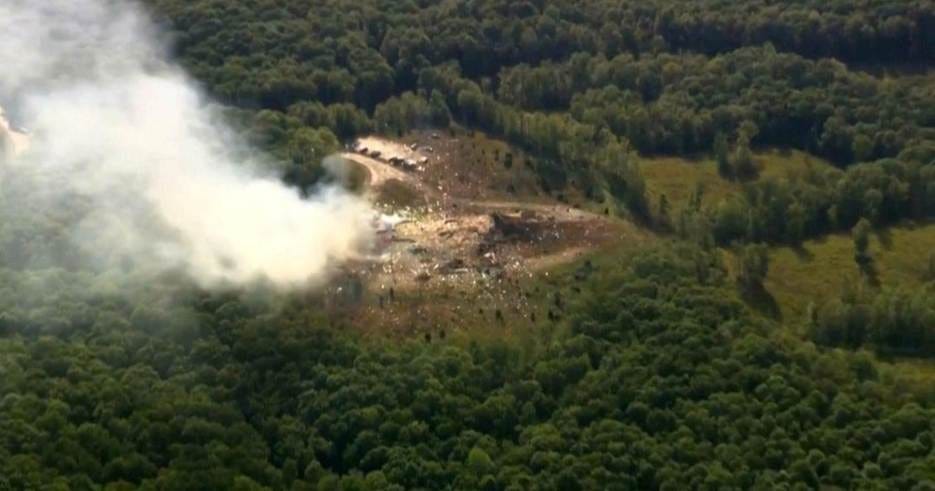
The ground shook and a black cloud rose in Bucksnort, an unincorporated area about an hour west of Nashville. Serving mostly as a rural satellite for the exurb of Dickson, one of the few direct employers in the area was Accurate Energetic Systems (AES), a minor military-industrial subcontractor that produced high explosives for the Department of Defense. The facility had suffered a minor explosion in 2014, and OSHA inspections in 2019 had found that the firm failed to give employees proper protective equipment. The same inspection also found high concentrations of cyclonite on basically all surfaces in the facility, including the breakroom. Two workers had already suffered seizures due to extended exposure to the chemicals. Similarly, workers reported regular safety violations such as “being told to step in and perform jobs they weren’t trained for, safety protocols like keeping floors wet to prevent an explosion being ignored, and explosive material left lying on the plant floor among trash.”[1] Now, the place where the factory sat is a blackened crater. Sixteen workers died and seven were injured in 2025 explosion, when a spark on the ground floor led to a chain reaction that ignited 24,000 pounds of explosives across the factory as management sough to ramp up production to fulfill a $120 million defense contract – one of many such contracts linked to sharp increases in military spending in the 2020s. The resulting explosion was equivalent to 11.8 tons of TNT.
Over the following months, Tennessee’s state-level OSHA led an investigation. Ultimately, they “cited the company for nearly 100 violations and proposed more than $3.1 million in penalties — the largest in state history,” but nonetheless a laughable sum, amounting to less than 3% of the contract that the workers died rushing to fulfill. To add insult to injury, the official response to the tragedy from AES was to provide “families with a barbecue food truck, a T-shirt featuring their loved one’s image, and a $50 Walmart gift card.”[2] Moreover, the larger plant remained operational, with the company calling workers back Monday morning for their shifts at other buildings on the complex. Without any sort of union or community-level organization, injured workers and the family members of the dead have had little recourse and have been forced to rely on a wrongful death lawsuit that seeks to shut the facility down by seeking $150 million in damages – though it remains unclear how much financial damage this would actually do to the firm, which is private and does not disclose its capitalization.
Only a few months earlier, a different explosion had occurred on the other side of the Nashville metropolitan complex, in the northeastern outer-ring suburb of Gallatin. Unlike the AES explosion, however, the Gallatin disaster was not industrial. Instead, a gas leak in a greenfield housing development saw a new-build home explode when the inspector arrived to make sure everything was up to code. Miraculously, the inspector survived. But the incident drew attention to the shoddy construction work going up across the sprawling new suburban developments in the greater Nashville metro area as well as the nearly-inexistent investments in infrastructure. While Tennessee itself ranked as the 9th-fastest growing state in the country between 2020 and 2025, with 5.8% population growth, the suburban and exurban ring around Nashville saw even stronger growth. This growth was driven by a push-pull dynamic where new investment drew record levels of new migrants from other US states and other countries while housing costs rose rapidly in a central city that had largely been demolished to make way for new high rises, entertainment strips largely serving tourists, and office towers for the healthcare and tech industries, and revamped state government offices. As in other rapidly-growing cities in the US, this resulted in a now-familiar triad: inner city gentrification, suburbanization of poverty, and the emergence of new clusters of tech capital both downtown and in select wealthy suburbs.

Gallatin had seen its population skyrocket by 22.8% between 2020 and 2025 (adding 10,217 new residents), while neighboring Lebanon had seen staggering growth of 38.8% (14,917), with similar trends in nearby Mount Juliet (14.9%), White House (37.3%) and Oakland (20.6%). Other areas that saw similar growth were southern outer ring suburbs like Thompson’s Station (27.2%), Spring Hill (21%), Columbia (20.3%,), and Smyrna (19.2%), as well as second-tier cities within the larger metro such as Clarksville (13.2%) and Murfreesboro (12%), alongside their affiliated suburban centers such as Shelbyville (11.1%). In fact, looking through a list of the fastest-growing municipalities in Tennessee, one can immediately see the spatial concentration of this growth in the Nashville area. Only Oak Ridge, near Knoxville, shows up on a list of the top ten fastest growing municipalities with a population over 20,000:
And the spatial concentration becomes particularly visible when viewed on a map. Note the relatively moderate growth (0 – 6%) in Davidson county in Middle Tennessee, which is where Nashville’s downtown core is located, relative to Sumner County (where Gallatin is located, standing out on the map), Wilson County (where Lebanon and Mt. Juliet are located, also standing out), Williamson and Maury Counties (Thompson’s Station, Spring Hill, Columbia) and especially Montgomery County (Clarksville) and Rutherford County (Murfreesboro). Though growth across most counties in the state has been high, including rural areas, and strong urban growth clusters also exist outside Oak Ridge and Chattanooga, the average growth rate in the state as a whole is also drawn down by systematic population loss in nearly all the areas in West Tennessee bordering the Mississippi:
Underlying these trends is a widespread relocation of domestic industry, as well as new foreign direct investment. Lebanon, Gallatin, and Moun Juliet, for example, are sited near major logistics complexes for companies like Amazon, FedEx, Starbucks, Firestone, and Gap, as well as factories for firms like Berretta (firearms) and GKN Hoeganaes (metal powders). Similarly, the cluster of suburbs to the south of Nashville such as Smyrna and Spring Hill are sited near even larger logistics complexes as well as major auto factories for GM and Nissan. Middle Tennessee is also becoming a major center for inbound FDI from East Asia. In addition to the Nissan plant in Smyrna, Quanta Computer (Taiwan) owns a large complex in La Vergne, and Xxentria (also Taiwan) opened a metal composite factory in Mt. Pleasant in 2025. Ultium Cells, a joint venture between LG (S. Korea) and GM opened a battery plant in Spring Hill in 2024 to serve GM demand, initially facing difficulties when EV subsidies decline, only to then ramp up production in 2026 to serve growing demand from the AI sector.
Meanwhile, 2025 also saw the largest investment project in the state’s history announced. Named “Project Crucible,” the $7.4 billion investment will see Korea Zinc acquire the (extremely toxic) Nystar zinc smelter in Clarksville which will be expanded into a state-of-the-art non-ferrous metal refinery, building out an enormous 160 acre industrial complex and reviving the zinc mine in neighboring Gordonsville. The deal was secured in part through political patronage since it is designed to “secure critical minerals” for US supply chains, and was therefore awarded expansive tax breaks, development grants, and purpose-built infrastructural investments by Governor Bill Lee, a close Trump ally. The project follows a similar investment in Clarksville by another South Korean firm, LG Chem, which built a battery materials plant with similar national security supply chain funding under the Biden administration. Similarly, South Korean Hankook Tire began expanding production at its Clarksville tire factory in 2023.

As new manufacturing and logistics facilities open across the region, suburbs like Antioch and Gallatin have been transformed from classic postwar, majority-white “middle class” suburbs to high-poverty, hyperdiverse working class neighborhoods, drawing both new migrants (domestic and international) as well as those priced out of the gentrifying urban core. At the same time, the urban core itself is being restructured as a major site for white collar work and Vegas-style recreation. In addition to established large employers-and-real-estate-developers like Vanderbilt University, major Fortune 500 firms have also announced their relocation to the area, with a new HQ being planned by Oracle as an anchor property for the larger East Bank Development scheme. Similarly, Starbucks plans a major relocation to the area in the next few years. All of these deals have been supported with the usual tax breaks and local government grants. In other cases, state support is even more explicit, as when the Tennessee government intervened to force through an unpopular tunnel deal led by Elon Musk’s Boring Company to connect downtown Nashville with the airport. After many years of failing to build an adequate subway system for the multi-million population metro area, Nashville will soon have an overpriced, extremely inefficient one-way, Tesla-only route mostly serving tourists.
Nor is Tennessee an exception. Nearly identical trends can be observed across the US South, which has seen record population growth over the past twenty years driven by an influx of new investments, all of which have only accelerated in the 2020s. As defined by the Census, the South (including Texas) saw roughly 6% population growth between 2020 and 2025, compared to 1.9% in the West, 1.1% in the Midwest, and a mere 0.7% in the Northeast. But this growth wasn’t evenly distributed across the South. Instead, it was concentrated in three distinct megaregions: the Texas Triangle and its extended constellation in Oklahoma and Western Arkansas, the upland Southeast, and Florida. Tennessee’s 5.8% population growth in the 2020s accounted for around 400,000 new residents. In percentage terms, it was just above that seen in Georgia (5.5%) but quite a bit lower than the roughly 8% growth rates seen in Texas, Florida, and South Carolina, as well as the 7.2% seen in North Carolina. But it was well above the 2.2% in neighboring Kentucky, 2.9% in Virginia, and 3.3% in Alabama. In absolute terms, however, the largest states of Texas and Florida gained the most, with 2.6 and 1.9 million, respectively.
Nonetheless, this growth has not been distributed evenly. Again, in Tennessee we see consistent population loss in historically black counties along the Mississippi. But that’s also a pattern repeated throughout the region, where the poorest areas all see systematic population loss, ranging from a high of -1.54% in West Virginia to more modest rates in Louisiana (-0.85%) and Mississippi (-0.24%), comparable to those seen in the major outmigration states hosting the country’s largest cities: New York (-0.98%), Illinois (-0.73%), and California (-0.46%). Though this includes poor, predominantly white areas across Appalachia, as is evidenced by the West Virginia case, the trend is most prominent across the historic black belt. With a few key exceptions, such as Atlanta, most of the majority-black cities in the region have seen population declines alongside ongoing diversification. Similarly, many majority-black rural counties have continued to see population outflows, particularly of black population, continuing a trend visible since the Great Migration. While the trend has been accompanied by rising shares of black population across the country, it has also resulted in a systematic whitening of states such as Kentucky and Tennessee, which once had substantial black population across both rural and urban areas:
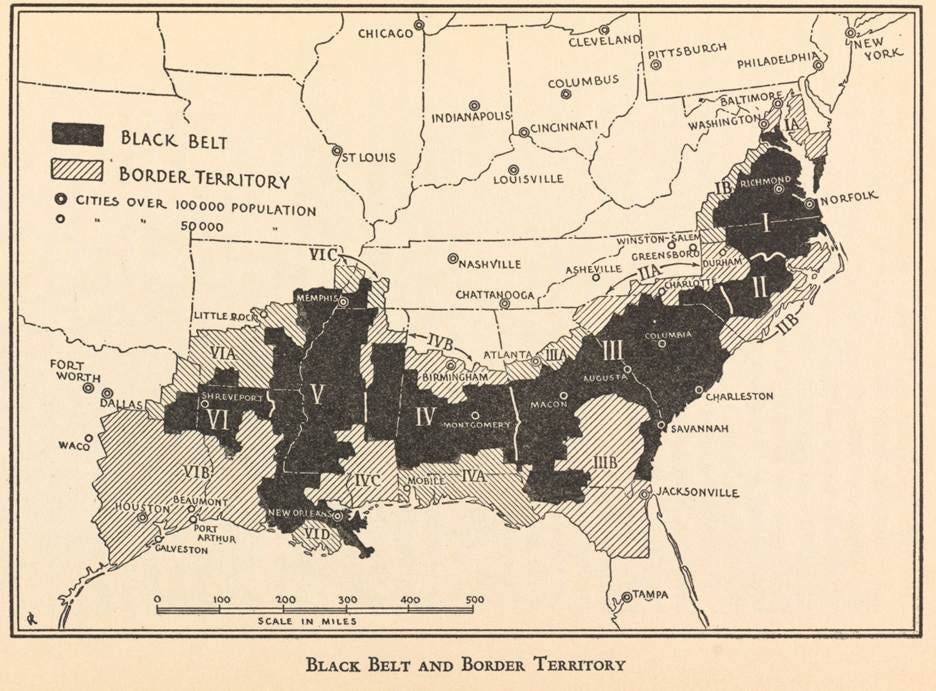
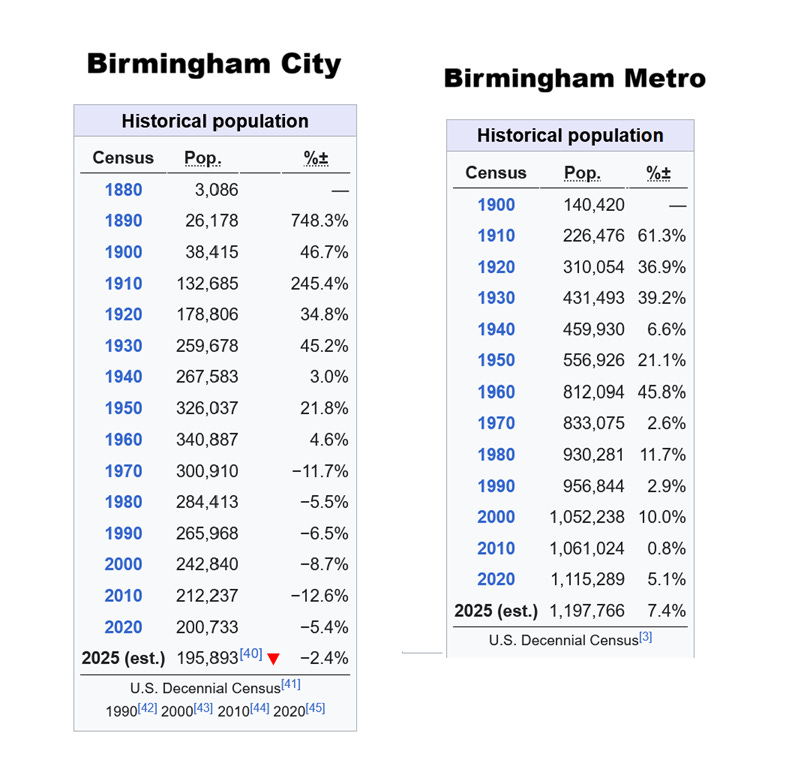
While recent migratory shifts have in a certain sense reversed the trends of the Great Migration, the new pools of in-migrants have been more diverse and core cities within the South have failed to make the kind of gains seen in places like Atlanta, Charlotte, or Nashville. Moreover, these cities have been marked by more classic dynamics of population loss in the central city, even while they have seen some – albeit often more subdued – growth in their overall metro areas. For example, Birmingham, AL, has seen continuous population loss in its central city since deindustrialization began in the 1970s, resulting in a rising share of black population despite declines in absolute number of black residents:
Trends are similar in Jackson, MS, and New Orleans, LA, with relative stagnation in places like Montgomery, AL and Baton Rouge, LA. While some smaller cities in the historic black belt such as college town Tuscaloosa, AL have seen gains, these gains have been accompanied by both falling white and black populations, accompanied by rising Asian and “Mixed Race or Multiracial” population (this latter trend likely due to recent Census questionnaire reforms). Meanwhile, compare the trends in Birmingham to those in Huntsville to the north, which has seen migration and investment dynamics similar to those of Nashville and Atlanta:
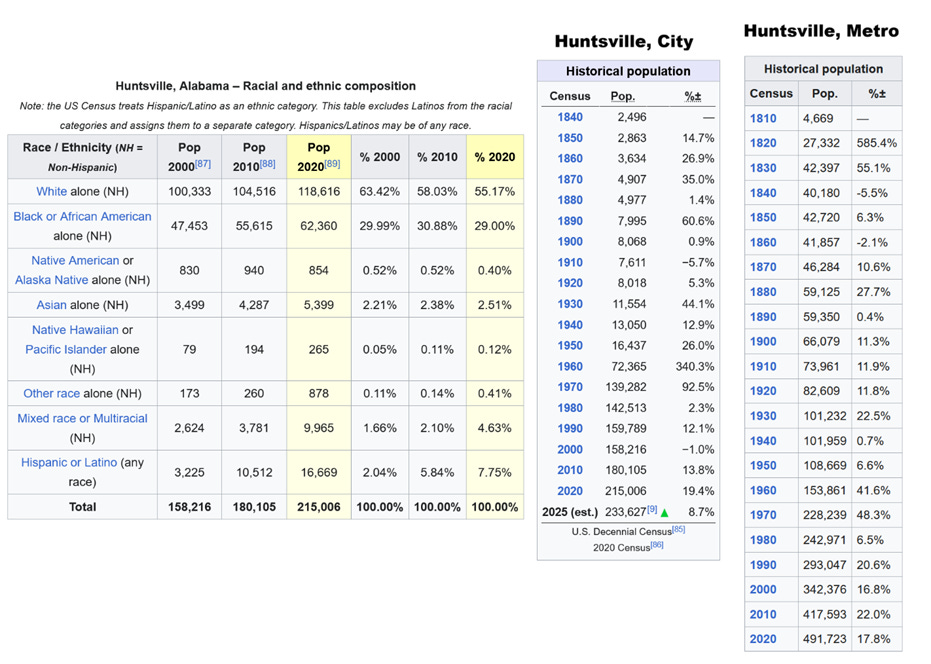
As in Nashville, the trends in Huntsville have been driven by a surge in new investment, including major investment in the auto sector via Toyota and the emergence of a local biotech cluster. Unlike Nashville, however, the Huntsville boom has been more firmly rooted in the city’s military-industrial history. Huntsville was the main hub for relocated Nazi rocket scientists pardoned and mobilized by the US government to assist in the Cold War. Led by war criminal Wernher von Braun, nearly 200 such scientists were relocated to the area through Project Paperclip, working on foundational technologies for NASA and thereby forming the basis of the postwar aeronautics industry. The present boom in Huntsville is also linked to similar trends in nearby Decatur, which has seen a series of expansions in its GE Appliances plant after the subsidiary was purchased by Chinese company Haier – one expansion in 2018, one in 2026. Similarly, the Goodyear plant in Decatur was sold to South Korean firm Hyosung in 2007. Hyosung also owns a plant co-sited with its US headquarters in Memphis, which recently announced a major expansion.
Obviously, the role of capital backflows from East Asia has been crucial to these trends, alongside more limited flows of investment from Europe, as in the Chattanooga Volkswagen plant, which saw the largest labor victory in the South in decades. Similarly, despite extensive job promises, many of the largest investment drives have focused on modernizing plants to use more heavily mechanized production processes as well as expanding logistics infrastructure, much of which is relatively automated. This certainly brings employment, driving the migration patterns we see in each of these Southeastern cities. But it also brings substantially less employment than might be expected, with most of the local economic benefits therefore advertised as following from indirect employment. In the Korea Zinc project, for example, the relatively high-paying technician and low-level engineering jobs are advertised heavily, with an emphasis on the fact that these new technical strata of the local labor force will be pouring those incomes back into the Clarksville economy through their personal consumption spending. That’s certainly part of what has occurred in Nashville, as new waves of tech, insurance, government, and education sector professionals have purchased houses at a premium and poured their paychecks into overpriced restaurants and mediocre bars – all of which then incentivizes further corporate speculation on real estate projects, which is the true driver of inflating asset values in the city.
These developmental trends have had even more devastating effects on the region’s ecology. Alabama, host to the river system known as “America’s Amazon” and one of the states with the highest level of biodiversity in the country, is now seeing entire rivers dry up due to industrial overuse and records record levels of species loss. Similarly, across Tennessee, sensitive wetlands and some of the few remaining native grasslands are being aggressively paved over to make way for droll housing complexes in suburban and exurban cities like Gallatin, where ecological collapse combines with infrastructure strain to produce an increasingly unlivable built environment. Overall, however, data on this industrial boom and its ecological consequences is often lacking, while more comprehensive and qualitative documentation of these developmental shifts appears to be nearly non-existent. The data that does exist tends to be fragmented or sector-specific. One of the major goals of this series is to annotate my own research into this industrial boom in the South as a whole, with a particular focus on the Southeast. As part of this, I’ll be listing out and compiling different bits of data from various sources and attempting to narrate a more cohesive picture of both the emerging industrial geography of the region and the graph of international capital helping to drive it. In addition, I hope to give a more qualitative impression of some of these trends through photo essays, interviews, and narration of the region’s longer-running political-economic history.
[1] Stacey Cameron, “Family of AES explosion victim speaks out, alleging reckless safety failures as lawsuit seeks to shut plant down”, WSM4, 03 May 2026. <https://www.wsmv.com/2026/05/03/family-aes-explosion-victim-speaks-out-alleging-reckless-safety-failures-lawsuit-seeks-shut-plant-down/>
[2] ibid
No posts
Comments
Nothing yet. Say the first thing.
Sign in to join the conversation.