
Your heart might be fine with five cups. In this economy, is your nervous system?
Coffee and I go back a long way, and not just as a beverage I happen to love. When I went off to college my then girlfriend’s mother gave me a percolator as a good luck gift. A dozen or so years ago I published Coffee Chat News, an eNewsletter sponsored by Dunkin’, I starred in three of their TV commercials, and I’ve done battle on TODAY about whether to store coffee in the fridge (the answer is no, you should store in a cool dark place in an airtight container).

For decades, the guidance on coffee has zig-zagged from being good for you, to almost having a warning label. Now the American Heart Association has weighed in with a scientific statement in Circulation, chaired by Dr. Gregory Marcus of UCSF, saying up to five cups a day (about 400 milligrams of caffeine) is safe for most adults and may actually lower the risk of heart failure, stroke, and coronary disease, provided you’re not loading it with sugar and cream. Texas A&M researchers found that compounds like chlorogenic acid bind to a receptor called NR4A1 that helps regulate the body’s stress and inflammation response.
But as with most food science, here’s the part most people don’t read. How you brew matters. The cardiovascular upside applies to paper-filtered drip coffee and instant coffee, the only two methods where cafestol, the compound in coffee oils that raises LDL, gets trapped or processed out. Everything else, French press, espresso, Turkish coffee, and yes, my college percolator, lets that oil straight through. If cholesterol’s a concern, a basic paper-filtered drip machine or a jar of instant is doing more for you than any of the hipper brewing rituals.
The food industry is always chasing the next “this is now good for you” story, and I’ll tell you what nobody is saying out loud: 400 milligrams of caffeine is still 400 milligrams of caffeine! Our heart might handle it fine. Our nervous system is a different story.
Think about where we are right now. People are anxious about their jobs and anxious about their grocery bills. They are anxious about the Iran War. I’ve written before about the K-shaped economy and the Polycrisis Shopper, you know that person walking the aisles doing mental math on every purchase because the whole world feels unstable. The last thing, in my opinion, that we need right now not is a society that needs an extra jolt of jitters and a racing pulse layered on top of what’s already keeping them up at night.
So sure, the AHA is right that your heart can probably take five cups. But “safe for your heart” and “good for how you actually feel and function” aren’t the same. The coffee industry and frankly, some of the health coverage, is going to blur that line because “coffee is fine, drink up” is a much easier headline.
The coffee aisle should promote filtered and instant coffee that’s cold brew concentrates, ready-to-drink filtered options, all the options that lets you say “heart-healthy”. But watch for a countertrend: decaf and half-caf blends, lower-caffeine functional beverages, adaptogen-forward drinks aimed at people who want the ritual without the buzz.
The AHA did real, careful work here, and I’m not knocking the science. Five cups won’t hurt your heart, and it might even help it. But our heart isn’t the only organ in our bodies. At a time when everybody’s nerves are already frayed, I’m not sure piling on the caffeine is the wellness win the headlines are making it out to be. Coffee is never just about the coffee; it’s about the ritual. Drink your coffee and enjoy! Just maybe we don’t need five cups to get through the day.
I spent a few teenage summers behind a McDonald’s register and later worked my way up from the kitchen to assistant manager at a Howard Johnson’s restaurant just off the Garden State Parkway. In all those years, I never once watched a customer pull out a credit card to pay for a burger and fries. And now that’s all I see!
Unfortunately that has become today’s reality. It’s the finding buried in a Washington Post analysis published this week by Michelle Singletary, drawing on new Urban Institute survey data. Nearly a third of buy now pay later users (BNPL), 29 percent, say they’ve used it for groceries, more than double the 14 percent who said so two years ago, and among Gen Z that number climbs to 38 percent according to Lending Tree. Federal Reserve estimates put BNPL originations at nearly $157 billion in 2025, up from $116 billion the year before, according to CNBC’s reporting on the Fed data.
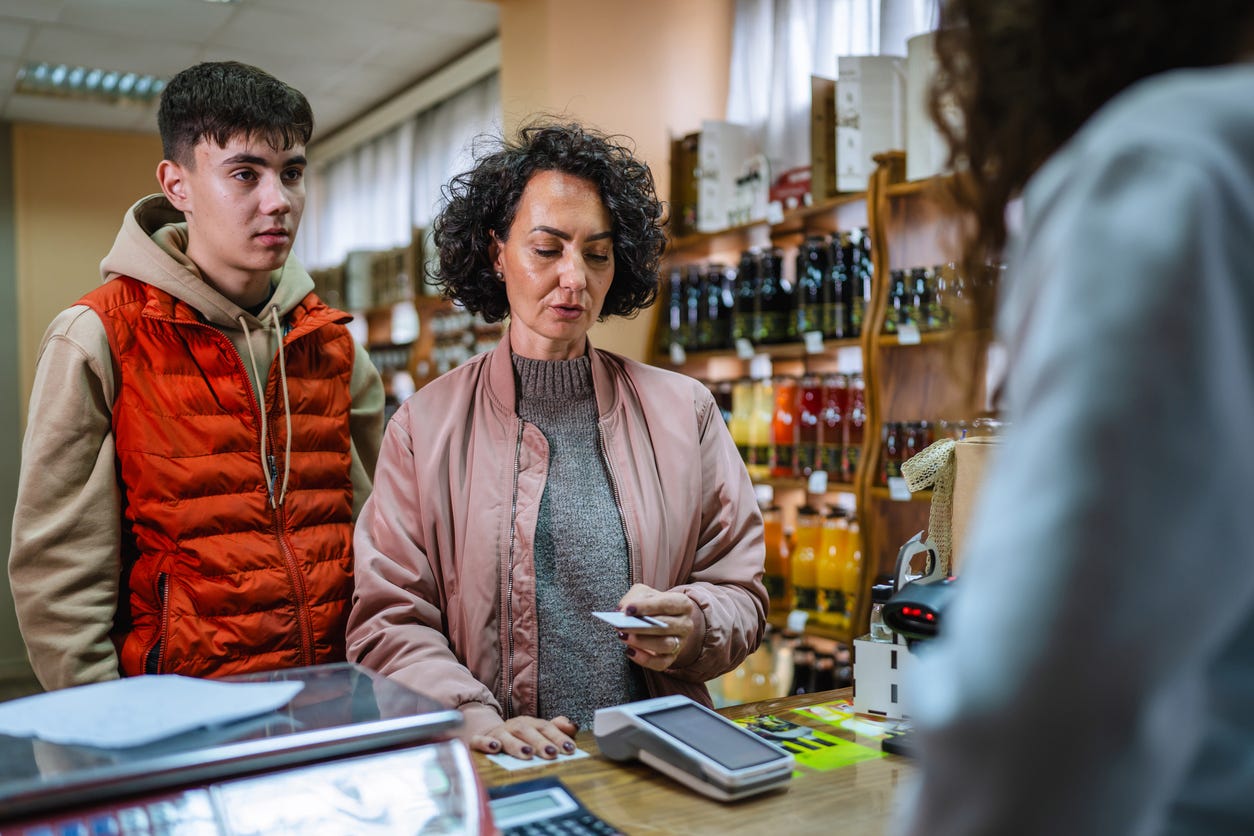
Financing a car is one thing. Financing this week’s groceries is a different because there’s no next month where the bill is paid off. We eat and buy our groceries every day. Nearly half of BNPL users, 47 percent, made a late payment in the past year, and more than half say they wouldn’t be able to make ends meet without this financing per LendingTree’s most recent survey.
Here’s what every grocer need to know: the strain isn’t confined to lower-income households. The same Urban Institute data shows high-income working adults running into the same repayment trouble when they charge groceries. That’s the K-shaped economy exhibiting two very different experiences of the same grocery aisle, and this time the debt is showing up on both branches of the K.
Nearly 1 in 5 working-age adults dipped into long-term savings just to keep the fridge stocked. About 1 in 10 borrowers used Buy Now, Pay Later specifically for food. And 5.2% turned to payday loans; you know, the kind where a $15 fee on every $100 borrowed sounds manageable until you annualize it into triple-digit interest. People aren’t being reckless with money. They’re triaging.
Let’s do the arithmetic. The average interest rate on credit card accounts that are actually carrying a balance sat at 22.15% in the second quarter of this year, per LendingTree’s tracking of Federal Reserve data. A $3,112 grocery balance, which is half of the average American household’s annual food-at-home spend, at that interest rate on minimum payments only, and you’re looking at nearly 20 years to pay it off. Including about $5,000 in interest along the way, according to Bankrate’s own payoff math.
Even a shopper who’s disciplined enough to clear the balance within a year or two isn’t off the hook. Amortize that same rate over 12 months and you’ve added roughly 12% to the real cost of the grocery cart. Stretch it to 24 months and it’s closer to 25%. That’s a fifth to a quarter more for the identical groceries.
This is the Fifth Force of food inflation meeting the Great Decoupling head-on. Food-at-home prices are still climbing, up 2.7% year over year, with fruits and vegetables up 5.3%, per the Bureau of Labor Statistics . Add to that, more than 4.5 million people have come off SNAP benefits nationwide since last summer’s federal overhaul tightened eligibility and work requirements.
Supermarkets sit closer to this crisis than any lender does, and they have real levers to pull:
● Partner with local credit unions on 0%-interest or low-interest grocery installment programs the way some retailers already do for appliances and furniture but sized for a $150 weekly cart instead of a refrigerator.
● Expand Double Up Food Bucks-style matching at checkout so SNAP dollars stretch further on produce, cutting the gap that pushes families toward a card in the first place.
● Build real budgeting tools into loyalty apps including a running cart total and a plain-language “this is what you’ll owe if you finance it” nudge.
● Protect the private label aisle and make the savings visible with clear unit pricing and side-by-side cost comparisons.
● Rethink in-store Buy Now, Pay Later partnerships, a retailer that profits from a customer’s inability to pay for food outright should think hard about what that means for shopper loyalty.
● Publish where the money’s going, retailers who can show shoppers exactly how shrinkflation, tariffs, or supply costs move a price build trust that a silent price hike never will.
Groceries aren’t supposed to be a loan product. When a third of working adults are financing food and a chunk of them can’t pay it back, that’s not a personal finance footnote, it’s a signal about the health of the entire consumer economy retailers depend on. The stores that figure out how to help shoppers with real payment flexibility, real price transparency, and real partnerships with lenders who aren’t predatory will be rewarded with loyalty. Buy now, pay later isn’t inherently bad, but it needs guardrails.
Comments
Nothing yet. Say the first thing.
Sign in to join the conversation.