
My goal is to hopefully launch an educational movement.
One that has the potential to help students regardless of their neurodiversity or position in life. It is an educational movement that I am hoping that you will join, even if you are not an educator or even if you are a person who sees themselves as having little to no neurodiversity.
Realize this is not an aggressive movement. It is not a political movement.
It is a developmental movement. It is a movement that has been occurring for a very long time and by hook or crook has been passed down between generations. It is a movement that is naturally developing, but slowly, and now risks being left behind and lost to a world overwhelmed by its increasing technological advancement.

The parabolic doubling and redoubling of technological advancements we have been living through has led us to a historically unique inflection point. A place where the very thinking skills that are key to accessing the world of technological wonders AI unlocks are ironically the same kind of thinking skills these AI systems could stunt. We, in a sense, have created a problem in our own learning. We have done this by technologically solving what could ostensibly be called the most intractable problem in education history, which is the delivery of high-quality educable information.
This historically has been an intractable problem in education. One of information and its dispersal. But there are other problems that can impact learning that are less glamorous than the problems of information delivery, and these are problems of self-regulation and achievement. Problems that, despite being seen as less intractable than the information problem, are nevertheless unresolved in education, and particularly unresolved for those identified as having learning disabilities of one sort or another.
In fact, it has begun to be suggested that new AI technology will be replacing teachers — as the computer will be able to provide students with hours of drill-and-kill-style lessons and never get tired. While a human teacher with their emotions and life history ripe with potential traumas may, at times, struggle to stay positive during prolonged exposure to a frustrated student’s repeated mistakes and obvious inattention. Computers, on the other hand, will never tire; they can be programmed to stay positive and not get upset by inattention. They offer a hope of creating perfect learning interfaces and possibly even environments that can control the variables needed to modify the behaviors that are presently overwhelming classrooms across the country and world.
This is because humans, every human, is now in a position where they can be provided the tools necessary to learn an unlimited amount of knowledge. These tools are computational devices that are being built into so many products, particularly our phones, which have quickly become the center of our worlds. Allowing everyone to carry around a bottomless library of knowledge. But knowledge is not the full story when talking about human intelligence. In fact, knowledge is the weak half of the human intelligence equation.
The other key component of human intelligence is called regulation. Regulation has to do with the control and coordination of ideas into behavior. You can actually build a very strong case that regulation is all that so called IQ tests actually test for. When you take an intelligence test, for example, what is actually being tested is not your knowledge of certain tasks or ideas, but your regulatory ability to express behaviors that suggest knowledge in those few areas. Areas that at best are believed to communicate, or signal, specific kinds of comprehension.
We don’t actually measure intelligence; we measure traits we believe are positive and correlate with that belief. For this reason, there is no way to rule out that a demonstration of intelligence on these tests is anything more than learned behavior. We can even imagine mindless zombies scoring as highly intelligent even though they are functioning similarly to John Searle’s China Room thought experiment. In fact, we are generally told by the creators of these AIs to really think of them as little more than highly intelligent zombies. And though I may be mixing my metaphors a bit here, this incredibly complex problem of information dispersal in education, that we have solved with AI, represents, in my view, the easy problem of education.
The hard problem of education involves regulation. Using that knowledge. Creating something worthwhile with what you know. As AI has been asserting itself more and more in the educational space, solving that information dispersal more and more widely, the more the hard problem of educational regulation rears its head.
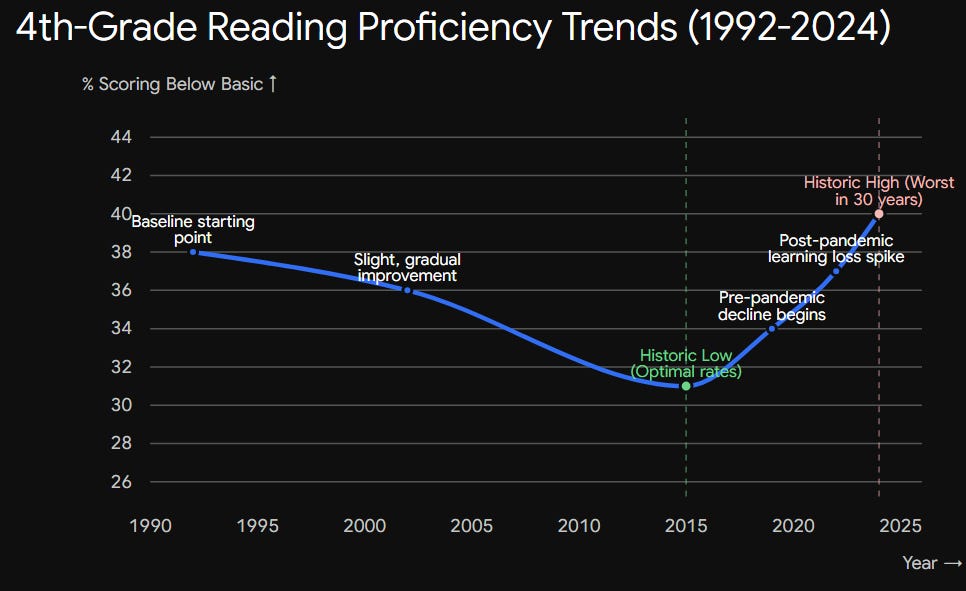
According to the National Assessment of Educational Progress (NAEP), widely known as The Nation's Report Card the number of 4th grade students scoring below basic proficiency started to go down in the 90s, and reached a historic low in 2015. However, from that point until today the number of students scoring below proficiency has started to skyrocket upward, putting us presently at roughly the highest level of below-proficiency readers in 30 years. Some researchers like Jon Haidt have started sounding the alarm against these technologies because this rapid rise in poor readers roughly correlates with the relative market saturation of smartphones and tablets.
But how can it be? These are the very devices that have made wide knowledge distribution possible, shouldn’t we be seeing an uptick in performance? I would suggest to you that we are seeing the hard problem of education rearing its head in these statistics. As we have solved the knowledge problem, we have neglected the regulation problem, and as a result, what we are seeing is more and more students struggling to regulate their learning behavior.
Stay tuned for part 2 of this series on the Hard Problem of Education: Self-Regulation

Comments
Nothing yet. Say the first thing.
Sign in to join the conversation.