
After hemming and hawing about how to write the introduction paragraph to this idea, I decided I would save you a button press and just lead with the fact that this essay was written with AI assistance. If you hit the button it will tell you that X% of this was AI-generated (actually, if you’d like to do an experiment with me, run this through the AI checker and put in the comments how much was determined to be AI I want to see how consistent the program is). In fact, I did not even come up with the big idea for this piece on my own it was actually triggered by a Note I saw from The Drey Dossier.
However, I would suggest to you that the ideas and perspective you are going to read here are uniquely my own, drawn from my own experience as a human with a language based learning disability. I thought through the ideas, argued, shaped, and rewrote them in my own voice, but a machine helped. As a machine has been helping me with my writing since 1989.
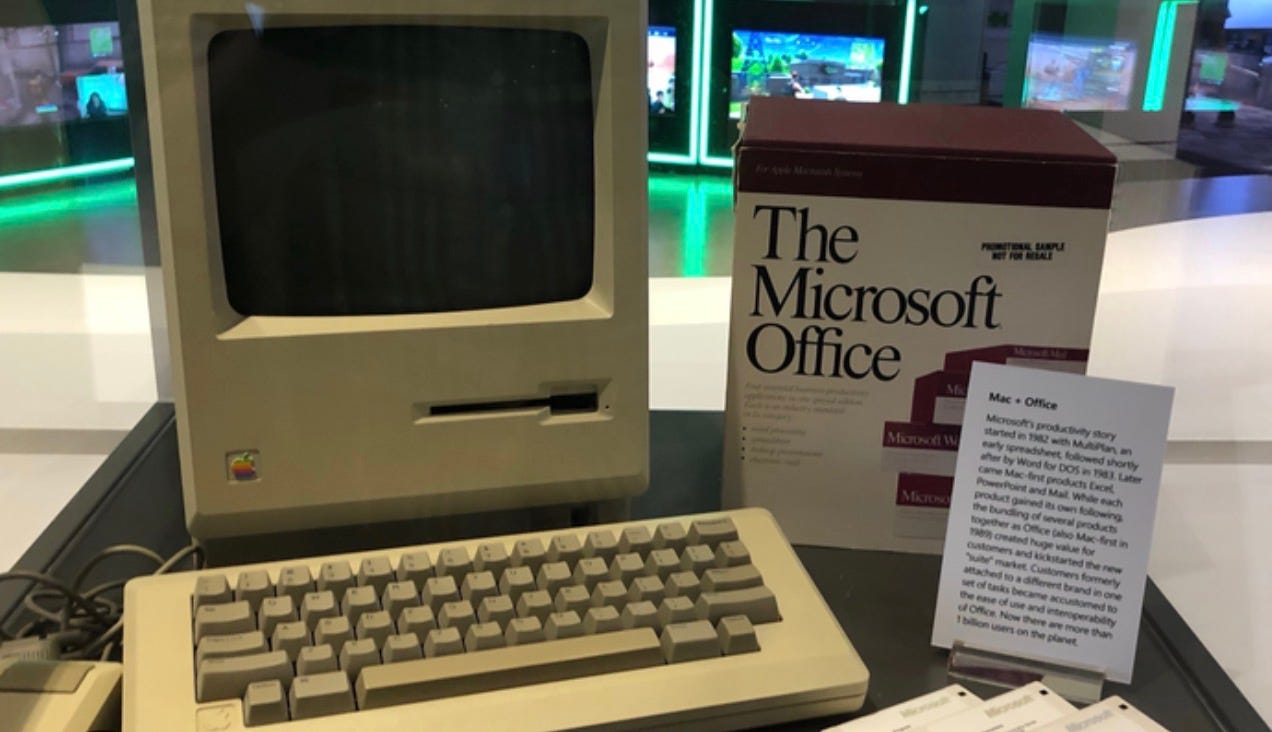
My original set up back in 1989
Back then it wasn’t called artificial intelligence. It was called Microsoft Word and it did something that simultaneously changed my life, and set me into conflict with some people. Before Word I did not write. I drew. The most I ever wrote were song lyrics for my band, and even then I was the only person who could really read them. Though it was never written into an IEP, I probably could have been diagnosed with dysgraphia at this time.
But thanks to Word and word processing generally, no one had to see my labored handwriting. Though I really could not spell on my own, I could pick correct words out of line up if I got close. Before Word, to edit, I was told to rewrite the whole thing, which I guess for people without a language processing difference works, but for me it didn’t. Just writing the draft took an exhausting amount of time. Often more than what was allotted for the whole assignment, and because of a fun quirk of how I experience language, this process literally produced new mistakes that were not in the original. Why would I want to do that again??? Microsoft Word fixed the spelling, the grammar, and saved edits so I could better meet writing deadlines and actually think about what I was doing. I got into College strictly because I was lucky enough to have been born at a time and in a place where I had access to this new technology, making it possible to get over a bar to entry that would have historically excluded someone like me.

The Word logo as I remember it
However, at the time the technology was new. Very few people I knew were using it, and yes, I was told by some I was cheating. The case they made was that people were not seeing my “real” writing ability, which was true from one perspective. But the truth for me was when I started using word processing in my writing, what I found was actually the opposite.
Word processing was not masking my writing, it masked the mechanics. It helped get the writing into a state where you, the reader, could read and appreciate it. What it did was unmask my writing because now you could actually read what I was thinking and understand what I was actually trying to say.
It also unmasked the language police for what they were.
Before word processing, I thought everyone was just really concerned with my writing. I did not realize there were these people, and sometimes they would even self-identify as the language police. These were people who offered criticisms, but not because they wanted to see you succeed. They actually could care less about you, or what you were saying. It was how you said it, and how giving criticism made them feel. And these were often the same people who would get up in arms about sloppy handwriting, only now they were getting up in arms about fonts. It became clear to me that these kinds of people were simply hunting for something to complain about.
This is why finding people who will really sit with you to actually help you develop your writing with you is so important. When you find those people you want to keep them in your life. Really use their support. Don’t let the language police get too much of a hold of you, or you will miss the point of writing, and likely come to hate it.

Double Orange Day Lilly from my garden
Now I feel like I am seeing history repeat itself around this issue with AI. The language police are having to readjust their target. It is getting tough for them because AI fixes all of the problems they are used to complaining about, potentially forcing them to engage with the actual ideas being written about.
Substack’s decision to put in an AI detector, powered by an AI (Not even a human) is a huge win for the language police on this platform. Now, they will always have a comfort button to run to when confronted with controversial ideas. Something to signal their disgust without engaging with the ideas.
But for people with language-based processing differences, particularly those that most benefit from these technologies, this decision will have a biasing effect. The knock-off effect of this change will be to marginalize those whose neurodiversity causes them to process language differently. These are individuals that struggle to be clear or have some odd quirk in their presentation, essentially those whose voices have most often been disregarded historically will now sadly be able to address those quirks with the help of an AI support, but then have that very support lead their ideas to be downgraded by a separate AI design to detect the use of AI…
The very tool that has enabled their expanded self expression is also the tool that will accuse them of cheating. Insinuating that their ideas are somehow less authentic. Relegating them to a spot that those of us with language processing problems seem to always have our ideas placed, be it caused by a lisp, a stutter or auditory processing difference.
The whole process will create a new label to separate the writers who use AI and those who don’t. These labels will carry a verdict even when no penalty is attached to them. This will encourage the development of a kind of ‘gotcha’ behavior that is rampant on other similar social media styled platforms. It will unwittingly undermine the reason people joined this platform and will destroy the vibe of encouragement and support that keeps people here.
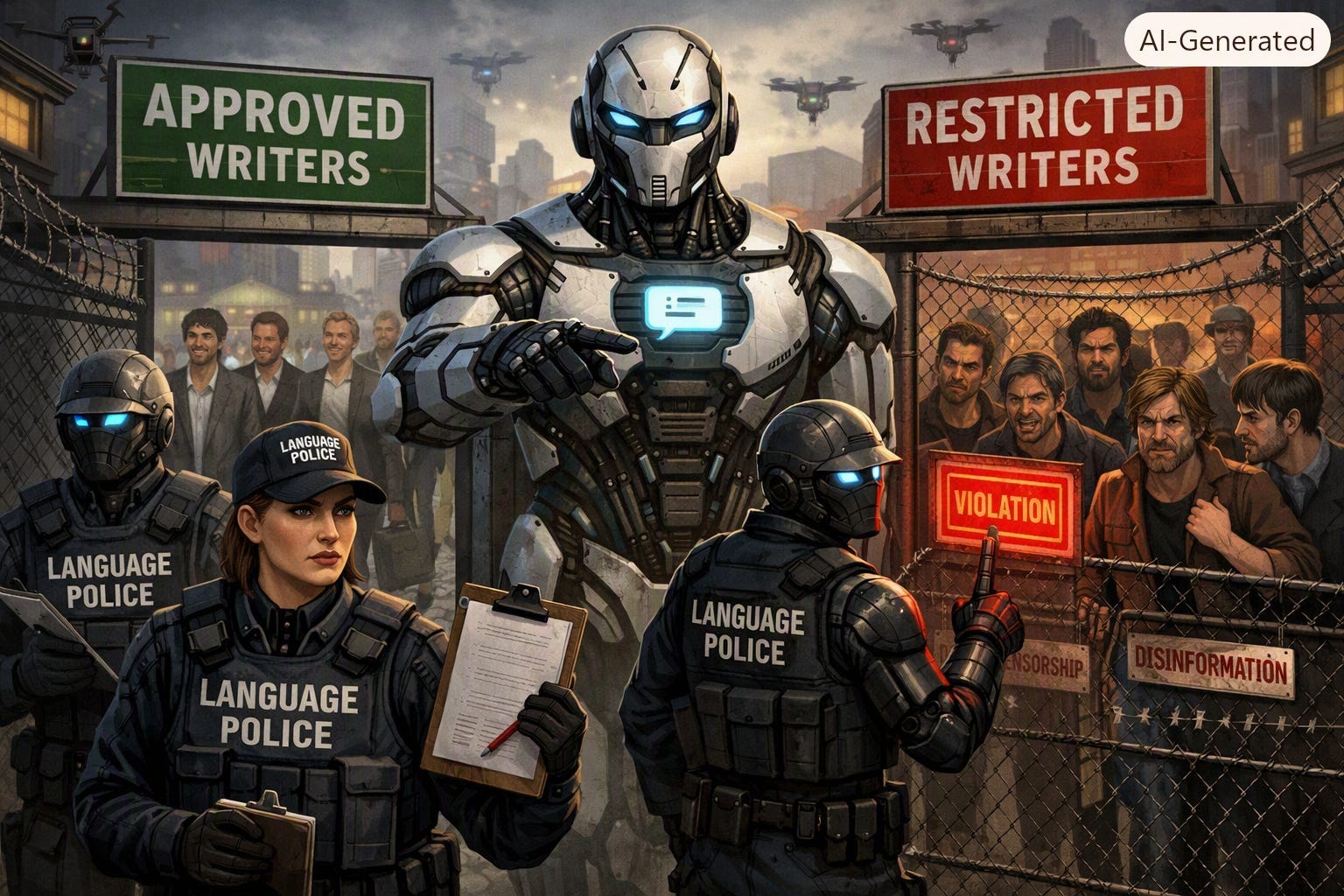
AI Generated picture of: The language police have joined forces with the robot AI to segregate the writers of Substack into two classes
Personally, I feel like we should be shaping the platform to support how active expressive minds actually work. We think better with certain tools, and writing is a tool. So are mechanisms like pencils, note books and computers. But we can also perform better with unexpected supports like that person across the table who finishes our sentence and unwittingly hands the idea back to us slightly better. I feel like this is how the Notes feature works sometimes.
We also think with the shape of the room. It could be the walk we take, the argument we had, or the editor who cuts the paragraph we were too in love with to cut ourselves. Our ideas come from the world we are apart of. This isn’t my new fresh idea. This comes from what I know about the theory of extended mind, but you don’t need the theory. You live it. If you think about it. You have never once produced a finished thought entirely on your own, devoid of outside influences, with no tool and no world outside of you touching it. Nobody has. Thought does not work like that.
We don’t blink at the other tools that close the kind of gap AI does for certain conditions. For example, nobody asks a wheelchair user what percentage of their arrival was self-powered. Nobody runs a scan on text-to-speech and reports how much of the reading was “really” done by the reader. A ramp is not a confession. A hearing aid is not a lie. These are the ordinary, dignified mechanics of access, and we long ago decided that using them takes nothing away from the person who does.
But when the assistive tool is a language model, we’ve quietly agreed to treat it differently. Suddenly it’s a shortcut, a cheat, a substitute for the self rather than a bridge to it. And these detectors are known to misfire most on writing that is precise, structured, clinical, and controlled. Which is to say: the exact register that those of us who learn differently are taught to produce our writing in order to be taken seriously. We spend years sanding down our prose so it won’t be dismissed. We assimilate. We learn the acceptable shape. And then the machine reads that hard-won discipline as evidence that no human was home. Ironically creating a situation where the writer who worked hardest to be believed gets flagged as the fraud.
What I’m asking for, and what I’m not
I’m not asking Substack to delete the tool. Transparency about AI has a real place, and readers are right to want to know what they’re paying for. Wholesale AI slop is a real problem, and I’m not pretending it isn’t.
What I’m asking is that we get the object of judgment right. Judge the WHOLE idea, not just one piece that played a role in its construction. Ask whether a thing is true, useful, honest, alive and not whether it passed through a machine on its way to you. The AI percentage tells you nothing about whether the thought was worth having. Those are different questions, and collapsing them is the error.
And I’m asking us to consider what a “second class” of writer would cost us. If the presence of assistance becomes a stain, then the people most likely to be stained are the ones who most needed the assistance to be heard at all. That’s not a neutral filter. It’s a filter that runs backward down the exact grooves of who already gets doubted.
Whole, not partial
I run a Substack called Live Whole, and I didn’t use AI to pick that name. However, it was the use of an AI as a research tool that ultimately convinced me that this other AI I was using for spelling (yes, you Grammarly) was actually wrong when it was always trying to tell me I was spelling the word wholistic wrong. So how would an AI scanner evaluate that? Because well I feel confident saying Wholistic is my word, I developed much of my confidence in it from working with an AI to learn about the history of the world Holistic, which was the way the computer and several humans have told me I should be spelt.
I hope Substack will reconsider how it is framing AI. I hope how I have written my thoughts about these issues resonates, because I really do feel they are important, which is why I used AI to smooth out the mistakes that would distract you. Realize, I am not defending slop. I am fairly confident that people will be able to distinguish between slop and the real ideas people are trying to communicate that deserve engagement and understanding. But how a platform structures this experience will support or diminish that. I feel like Substack has really done a great job building a platform that supports human expression, and yes, it is weird that part of that support is artificial, but I would suggest to you that the written word itself is an artificial construct we made to support our expression. Let’s focus on that. Let’s focus on how to support expression using a platform like this, and model it on the things those people in your real life do that support your work and personal growth.
---
Written with AI assistance, disclosed on purpose. If the scan comes back with a percentage, read it as an illustration, not a verdict — and then decide for yourself whether anything above was worth your time.

Comments
Nothing yet. Say the first thing.
Sign in to join the conversation.