
Welcome to Phase Reading, our monthly format where we explore a global trend in politics, technology, economy and society—or all of these together, when we want to follow the longer threads behind the news. Have a look at our latest piece and our latest interview.
We come back from the summer break at full speed, with our second piece this week. This time, we weigh in on the debate over the occupational effects of artificial intelligence and the new wave of automation that is, allegedly, taking the US by storm, and the rest of the world a little less so. We believe there is an important debate to be had on this topic, involving several aspects of technological development and its impact on social change. We also think the current debate, at least in its common form, is distorted by the self-narrative the AI industry is hammering into public discourse.
We operate on the assumption: “don’t believe the hype.” Following this principle, we present a deep dive on how technologies usually spread, to what extent they change society, and whether AI will be any different. To conclude, we put forward a few questions to think through the challenges raised by AI, and identify the considerations we believe should be prioritised in the public discourse.
We are always looking for emerging trends, local developments, research, industrial shifts, and overlooked dynamics.
If you work on these issues, or track them closely, get in touch.
Reach out by email or direct message.
Jump to the specific section:
This may very well be the title of one of the many opinion pieces published over the last few years to address the prospect of a permanent underclass caused by the rise of AI. Instead, it is the title of a section in The Rise of the Network Society, a 1996 book by Manuel Castells examining the emergence of information technology (IT) as a general-purpose technology that was going to impact work organisation and society more broadly. Thirty years later, we can safely conclude that society has not become jobless1.
Anxiety for mass unemployment caused by automation is as old as capitalism. In The Great Transformation, Karl Polanyi covered in great detail a similar debate that took place in Britain in the early nineteenth century, when an astonishing increase in wealth brought about by the Industrial Revolution led nonetheless to a dramatic rise in unemployment and underemployment.
Automation disrupted social order and displaced jobs in large numbers as fluctuations in demand drove large-scale migration back and forth between industrial centres and the countryside. However, disruption was by no means permanent, as is obvious to anybody living in Western Europe, North America or any other high-income country.
Keynes, too, reflected on technological unemployment in 1930. He concluded that it was “only a temporary phase of maladjustment”, and that the consequence of automation would instead be a reduction in working hours.
However, Keynes was being too optimistic (or pessimistic, if you think people should work more), predicting “three-hour shifts or a fifteen-hour week”. In fact, the number of annual working hours per person in the US has reduced much less dramatically, from 2,022 h in 1950 to 1,789 hours in 2023, according to Federal Reserve Economic Data (FRED).
The reduction has been much more pronounced in other advanced economies. Germany, with a stunning reduction from 2,427 hours in 1950 to 1,335 hours in 2023, is likely the most striking case. And yet, an average of 34 working hours per week is still far from Keynes’ fifteen.
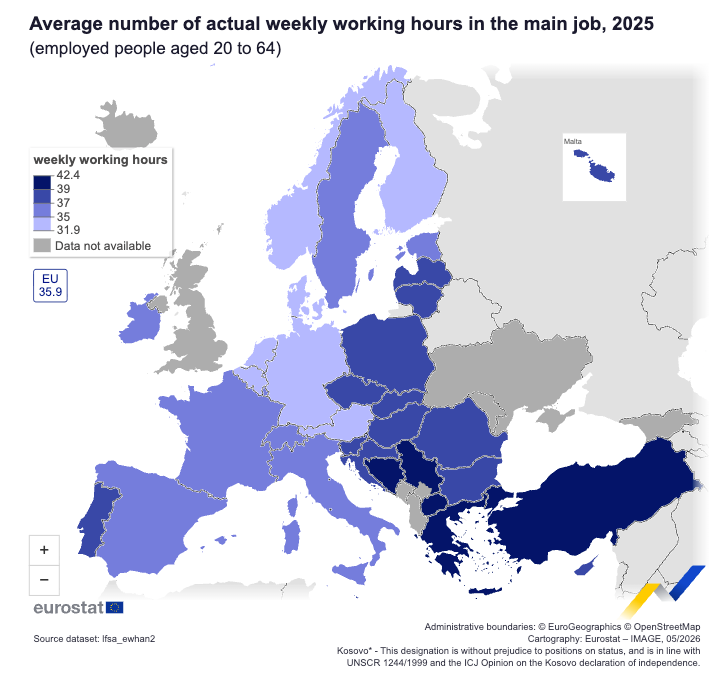
The fact is: employment does not disappear. Rather, as productivity in a sector increases, employment shifts towards new activities, often hard or impossible to imagine before the technology driving the automation is adopted in practice. Assembly-line workers did not exist in 1780, on the brink of the Industrial Revolution, and perhaps not until Fordism, and in 1930 there were no software engineers.
There are several historical cases of sectors that were transformed and largely automated by new technology without causing social apocalypse, although these transformations were certainly traumatic for those whose jobs were automated away.
Let me just give two examples. The first one is from Northern Italy, where I grew up and which I am personally familiar with. Milan and Turin were the main industrial centres in Italy before being hit by the same deindustrialisation process that has affected roughly all of Western Europe and North America.
In Milan, there were 820,000 employees in manufacturing, 53% of the working population. In 2025, this number had shrunk to 390,000, only 23% of the working population. I found very similar numbers for Turin, where manufacturing employment shrank from 490,000, 55% of the workforce, to 205,000, just 28% of the workforce, a massive 53% drop.
Over the same period, China was undergoing a different process, shifting from an agrarian economy to perhaps the most heavily industrialised economy in history. In 1970, China’s agricultural employment stood at 278.11 million people, 80% of all workers and 33.5% of the total population. In 2025, despite China’s population increasing from 830 million to 1.4 billion, employment in agriculture had dropped to 161.3 million people, only 22% of total employment and 11.5% of the total population.
What these examples suggest is that technological evolution can certainly prompt dramatic transformation in the workforce. Just as certainly, nobody could argue that such transformations have created a permanent underclass. On the contrary, they have often been a sign of rapid economic modernisation.
Grasp the material reality behind the news cycle.
Subscribe to phase:shift to see the signal behind the noise.
Among boosters and detractors alike, the story goes that AI has immense disruptive potential, larger even than the Industrial Revolution. The unprecedented capabilities - carrying out research, writing and reviewing code, making presentations, suggesting ideas, translating, thinking - will enable AI models to train ever better versions of themselves, accelerating the rate of improvement up to the point where AI becomes truly superhuman and completely autonomous, a stage called Artificial General Intelligence, or AGI. This will boost productivity so much that many workers will soon be made unnecessary.
We have seen that similar anxieties are far from new, which should give us pause. Admittedly, past trends are not predictive of future events, but there are good reasons to think AI will follow a similar pattern.
First of all, while the pace individual adoption has been sensationally fast, business adoption has been much slower. According to a Gallup survey, 52% of employees in the USA use AI for work, 46% according to FRED data, while 15% use it daily. In the rest of the world, adoption rates are lower but following a similar growth pattern. However, according to Census Bureau data, company use in the US has been hovering around 17-20% in 2026, and it is not seeing the same surge as individual adoption.
To be sure, the companies adopting AI are disproportionately large firms, which account for a greater share of employment, but the point here is that adoption is driven by individual workers who are trying to increase their own productivity, rather than by companies reorganising their internal workflows.
This is exactly what McKinsey observed in a recent report:
Most companies are using AI to accelerate existing activities while leaving the underlying operating model, including governance, teams, and capabilities, largely unchanged.
Of course, adoption has been unequal across sectors and countries. Perhaps unsurprisingly, the tech sector is the most impacted by AI. Computer, engineering, and science are the only occupational group where more than half of AI use at work comes from employer-provided plans, according to a July 2026 Epoch AI/Ipsos survey. In every other sector, including management, workers rely mostly on individual plans, often free (this will be important later, too).
With these data, we could imagine some short-term job disruption in the tech sector. But that is still a long way from the emergence of a vast, permanent underclass. After all, unemployment figures are very close to historical lows in many countries.
One can still imagine a sudden explosion of AI-driven unemployment, if only slightly further in the future. I am sceptical this could ever happen. If AI really happened to destroy jobs in large numbers, creating a permanent underclass, that population would very obviously lack the ability to spend money. If a large portion of society is going to be permanently unemployed, who is going to buy the deluge of products that self-training AI models and tireless robots would flood the market with?
Companies, unable to sell their products, would go bankrupt. This, by itself, would slow down or even stop the race to AGI altogether. Investments would slow down; the race to build more compute, more data centres, more and better robots, more durable batteries would all but stop. Rather than self-fulfilling, the prophecy is self-destructing.
It is not without reason that widespread AI adoption by companies remains limited. Current models still have clear limitations, despite the honestly amazing advances of the last few years—blatant hallucinations are basically gone, and models have become much better at providing context for checking their claims.
Let me give an example from my personal experience. I use AI often to check grammar and spelling, or to clean up convoluted sentences that unfortunately come up more often than I would like as a non-native English speaker. Today I gave GPT 5.6-Sol a sentence to check. I asked: can it be improved? Not a well-reasoned prompt, but it was a 6-word sentence, and I reckoned that could do. As it turns out, it could not. The model told me: “If you change it like this, it will be better. But if you leave it as it is, it will be even better!” A clear contradiction in less than 30 words.
Do not get me wrong. I have no intention of adding to the vibrant “embarrassing AI failures” literature. It was not a real problem. I could decide for myself in a second, and of course, a better prompt would have produced a better answer. My point is that this is clearly not superhuman intelligence. It is, in fact, subhuman intelligence with superhuman access to knowledge.
This type of behaviour goes beyond silly mistakes. When we talk about AI, we generally refer to Large Language Models (LLMs). These are the models we all can access through ChatGPT, Claude, Gemini, DeepSeek and so on. They work by predicting the most likely next token (a small chunk of text or image or what have you) from the preceding context, using statistical patterns learned from gigantic amounts of information, basically the whole internet and more. They operate within a context window, which is the amount of text LLMs are able to consider to formulate their predictions while “talking” with users. As a conversation approaches the length of the context window, models tend to become dumber and dumber.
This model dementia (not my definition) causes AI agents, which execute especially long and sophisticated tasks, to make fatal mistakes in roughly 80% of cases. Like for smaller problems, there are ways to fix this,2 but again, this is far from superhuman intelligence and a long way from AGI. Models will surely improve and make fewer and smaller mistakes. Two years ago, agents barely existed, and now they account for a proportionally larger share of tokens than normal chat use—OpenAI has found that 63% of tokens in organisational use are consumed in agentic coding.
However, this increases costs and reduces the need for replacing human workers, as does the persistent need for human supervision. It also reduces the profit prospects of AI companies, which is important in other ways, as we will see.
If you know someone in research, policy, academia, or industry who could use our work, share phase:shift with them.
Be part of the early network.
Several people working in the AI space have argued that the LLM paradigm does not provide a path to AGI. AI lab CEOs would obviously disagree, but critiques mainly revolve around the fact that LLMs develop skills more than actual intelligence, which makes them poorly suited to act in and interact with the physical world.
Personally, I find Rodney Brooks’ analysis most interesting. Brooks has worked in artificial intelligence and robotics since the 1970s and is CTO at Robust AI, a company developing AI-powered robots. Interestingly, in 2018 he laid out a few predictions about AI and related technologies, such as autonomous driving and robotics, which were at the time widely considered pessimistic but turned out to be mostly optimistic.
Brooks makes two arguments that are relevant to our discussion.
The first one is that technology requires decades of deployment at scale, usually more than 50 years, before its transformative effects on society can be fully realised. The argument is sound, as it takes into account mechanisms of technology diffusion, physical constraints on scaling hardware supply, and the time required to adapt infrastructure as well as business and social organisation to new technologies.
It is also very well documented. I myself began with the remarkably similar hype surrounding the spread of IT. Brooks points to several technologies that transformed society but took roughly a human lifetime to become widespread, including railways, commercial aviation, household electrification, and, closer to our own experience, solar power, a technology that has been available since the 1950s but is just now becoming widespread.
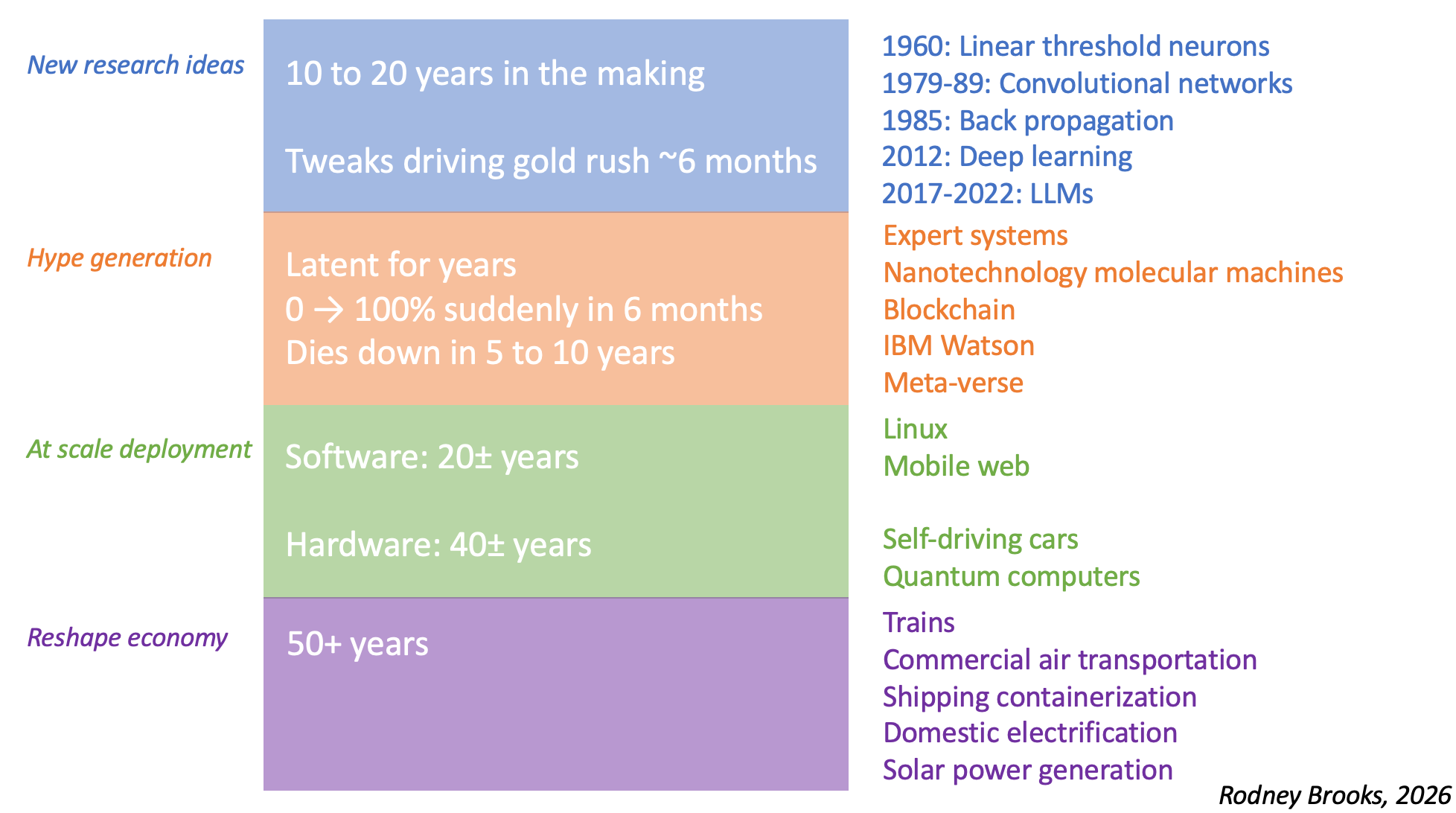
The second argument was proposed by Brooks in his blog post A Better Lesson. In that post, Brooks questioned the assumption that “over the 70 year history of AI, more computation and less built in knowledge has always won out as the best way to build Artificial Intelligence systems”.
However, this requires a constant increase in the available computing power (compute). The material basis of compute is semiconductor chips. Without going into the technical details, semiconductor development has long followed a few scaling laws, most notably Moore’s law and Dennard scaling. According to Moore’s law, the number of transistors that can be packed into a given area—roughly speaking, the amount of computing power available per unit area—doubles every 18 months. Dennard scaling, in turn, states that power density remains constant throughout this process of miniaturisation. Dennard scaling broke down around 2006, while Moore’s law began to slow between 2010 and 2015, due to miniaturisation reaching its physical limits.
Brooks argued, very convincingly, that because these scaling laws underpinning the constant growth of compute are breaking down, improving performance must necessarily come at the cost of greater energy consumption, parallelism, hardware specialisation, or cooling.
Contrary to many others, this argument does not make negative claims about LLMs’ capabilities. Many have argued LLMs will never be able to do something, only to see LLMs do exactly that one or two years later. Instead, it says: what are the compute and cost to achieve that task? Is this cost sustainable? Something that should always be weighed against human ingenuity.
New AI models are indeed being developed at the cost of ever-growing computational demands. In a white paper with EPRI, Epoch AI calculated that “power demands for frontier training runs have historically grown at a rate of 2.2× per year, with the largest runs now exceeding 100 MW”, driven by frontier models that have been growing 4-5× per year.
Even considering increased energy efficiency and longer training times, the growth rate implies power demand for frontier training runs of 4-16 GW in 2030. This is for a single training run.
The growth of electricity demand for AI-related data centres is indeed having an impact on total energy demand. Last year, the International Energy Agency (IEA) estimated almost 500 TWh3 of global data-centre electricity demand in 2025, set to grow to 1100 TWh in 2030 and 1300 TWh in 2034.
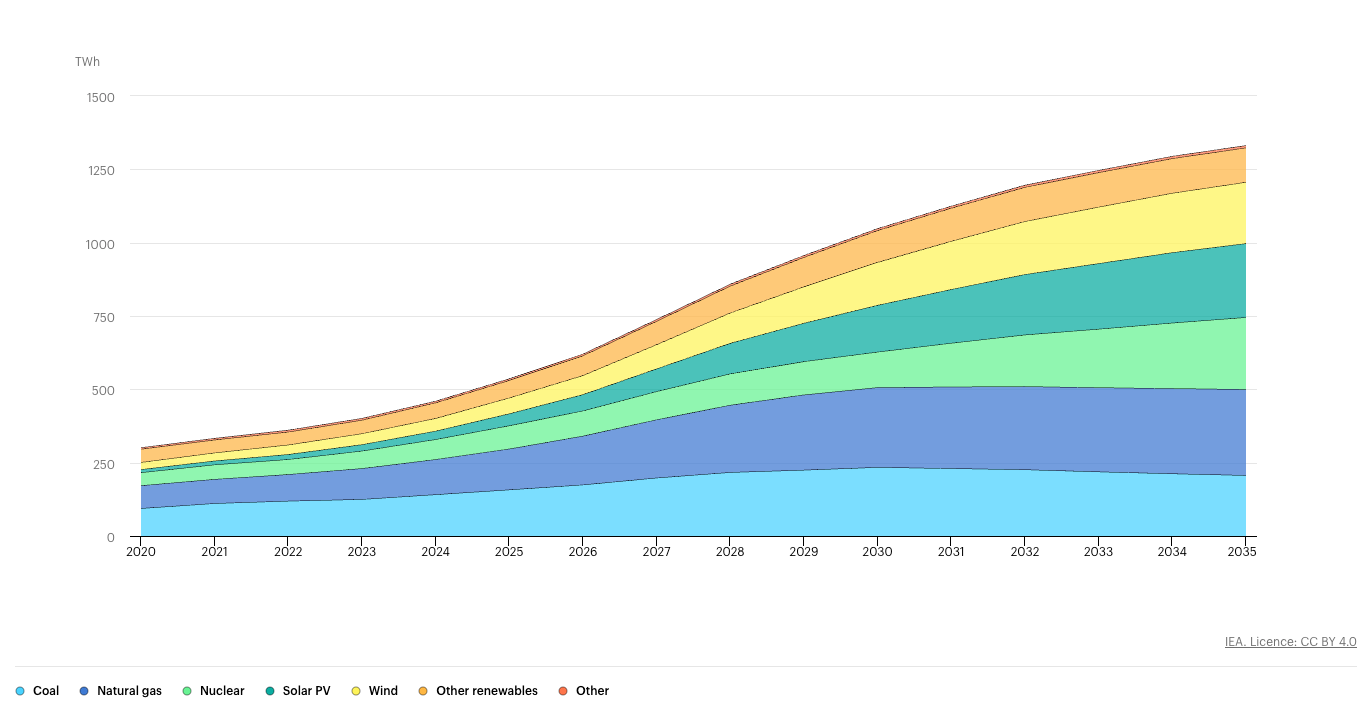
Compared to global demand, 28,600 TWh in 2025, the data centre share is relatively small. However, 1) it is growing more rapidly than global electricity demand, 17% per year vs 3%, 2) it is especially relevant in the United States, where most compute (i.e., data centres) is being built, with a figure close to 50% of global demand in 2025.
Indeed, the more recent report from the Lawrence Berkeley National Laboratory (LBNL) estimated a much larger electricity demand growth for data centres in the US than the 1-year-old IEA report, with 649 TWh vs the IEA’s ~475 TWh.
In the US, data centres’ electricity demand has grown from 192 TWh in 2024 to 234 TWh in 2025, a 42 TWh increase that is worth half of the total growth from 4110 TWh to 4195 TWh.
I did some napkin math: in 2025 the grid added 53 GW of capacity, most of which is solar and batteries, which, with a capacity factor of 0.25—the amount of capacity that can actually be delivered—is equivalent to nearly 60 TWh, more than enough to absorb all data-centre demand and more. Including smaller capacity from wind and gas, total US demand growth was covered comfortably by capacity growth.
In 2026 and 2027, however, the EIA (the US Energy Information Agency, not the IEA) forecasts total demand increases of 73 TWh and 123 TWh. Demand from data centres, according to LBNL figures, will increase by 66 TWh in 2026, 90% of the total, and 80 TWh in 2027, 65% of the total.
This, against generation growth of 77.7 TWh and 130 TWh. This means that:
Generation growth is going to be only barely higher than demand
Demand growth is largely driven by data centres.
This has various consequences for the electric grid’s ability to absorb more compute.
The main consequence is not so much that the grid becomes unable to accommodate growing data-centre demand: as we have seen, growth in electricity generation is expected to exceed both the increase in data-centre demand and overall demand growth each year. Rather, with little spare generation capacity, any delay in bringing new power capacity online could also slow down data centre construction.
This is even more evident at the local level. Because demand growth is geographically uneven, the electric grid can become unable to accommodate rising loads, or at least be pushed to its limits. PJM Interconnection, the largest power grid operator in the US, serving 67 million people across the Mid-Atlantic region, is facing precisely this situation because of the high concentration of data centres in Virginia.
Already in July this year, PJM was forced to activate load-management measures and obtain a federal emergency order allowing it to curtail demand from data centres equipped with backup generation. PJM openly acknowledges that demand is growing faster than its capacity and currently does not expect to have enough spare capacity to ensure reliable operation at peak load from 2027/28 onward.
Starting in 2029/30, PJM Interconnection has proposed that new large loads, including data centres, that do not bring new generation capacity onto the grid should have their power supply curtailed when the system is under stress. The pace of compute expansion is therefore physically constrained by how quickly new generation capacity can be deployed, while the need to bring additional capacity online alongside new data centres also raises costs.
There is another unpleasant consequence for local communities. The imbalance between demand and capacity growth can lead to a significant price increase. When local electricity demand is high, not all the power needed to meet it can be brought in from elsewhere on the grid. Some must be sourced from within the affected area. If local supply is limited, the price of securing electricity rises. Indeed, in the first half of 2026, PJM paid around $270/MW per day across its whole system, but $440/MW per day in Virginia, certainly one reason for the backlash against data centres.
It is worth highlighting that the Trump administration has made it harder to build renewable projects, which make up the vast majority of new electricity generation projects. The administration blocked more than 4 GW of wind capacity, 3 GW of which were planned for 2027/28 in the very Mid-Atlantic region most impacted by data centres. This is equivalent to more or less 13-14 TWh, considering a 0.35-0.4 capacity factor.
Connect the local and the global, the technical and the political, the event to the system.
Subscribe to phase:shift: grasp reality, so you can change it.
The massive compute demand requires investments. Massive investments.
Capital expenditure (capex) by hyperscalers, the companies developing this network of data centres to provide compute and cloud services, has increased sharply since the launch of ChatGPT at the end of 2022. The progression is nothing short of mind-blowing: $154bn in 2023, $240bn in 2024, $411bn in 2025, and an incredible $791bn in 2026.
The figure for 2026 would equal 2.5% of the entire US GDP, one of the largest waves of investments in history, on par with other major infrastructural drives, such as the dot-com bubble, which reached 2.2% of the US GDP. Investments are set to grow even faster between now and 2030, with figures ranging from $3tn (Morgan Stanley) to $5-8tn (McKinsey).
What is even more incredible is that these investments are driven by a handful of companies: Google (technically Alphabet), Amazon, Meta, Microsoft and Oracle. This is also the reason why many people have been wondering whether this is a financial bubble or not. The sudden increase in capex bears the hallmarks of a bubble, but the hyperscalers, with the exception of Oracle, are possibly the largest companies in history, with massive cash flow. Until mid-2025, Amazon, Meta, Google and Microsoft could finance almost all their investments only through their cash flow.
However, this changed at the end of 2025. With a capex/cash flow ratio rising from 40% in 2020 to almost 100% in 2025, hyperscalers started borrowing money, raising $200bn in debt, $150bn of which was just in the last quarter. This had grown to $400bn by July 2026, according to The Economist. This is small compared to hyperscalers’ revenues, but, by mid-2026, hyperscalers started reporting zero or negative cash flow. Remarkably, Google reported its first quarter with negative cash flow since going public in 2004.
A great analysis by Stijn Van Nieuwerburgh explains how data centres are getting financed. Debt has expanded because the required capital is too large for hyperscalers to finance it entirely on their own. Besides, debt is being pushed outside the hyperscalers’ balance sheets. This is usually done through a special purpose vehicle (SPV), a legally separate company created to own and finance a specific data centre project, while isolating its assets and liabilities from those of the firms behind it.
The hyperscaler involved in the project commits to using the facility under a long-term lease. Because hyperscalers have excellent credit ratings, this contract gives the SPV a highly predictable stream of future income, against which it can borrow the money needed to build the data centre. The project debt therefore sits with the SPV instead of appearing as ordinary corporate debt on the hyperscaler’s balance sheet. The SPV is the legal borrower, but lenders are willing to provide so much capital because the debt is underpinned by secure hyperscaler cash flow.
This is when securitisation occurs: claims on the hyperscaler’s payments can be packaged and sold to other investors, allowing the original lenders to free up capital and finance further projects. This expands the amount of credit available to the sector, but also spreads the exposure across banks, private-credit funds and other investors. As ownership, debt and contractual guarantees are split across different entities, the financing mechanisms become opaque, making it hard to track where risk sits.
This structure also enables very high leverage at the project level, that is, a very high ratio of debt to the project’s total value. In such cases, because only a relatively small amount of equity backs the debt, even a modest fall in the project’s value or cash flows can wipe out that equity and begin imposing losses on creditors.
Van Nieuwerburgh’s analysis shows that, because hyperscalers still have huge revenue streams and debt is relatively modest relative to revenues, investments should not be considered speculative yet. Securitised debt, in particular, does not exceed $45bn. However, high leverage and opaque risk distribution could compound the risks associated with uncertain revenue growth.
The Economist calculated that $2.5tn of annual revenues would be necessary to cover this enormous AI capex. However, all the available estimates put that number between $150bn and $220bn, one order of magnitude too small. Consistent with this dynamic, credit default swaps—essentially insurance against default—on hyperscalers have climbed in recent months.
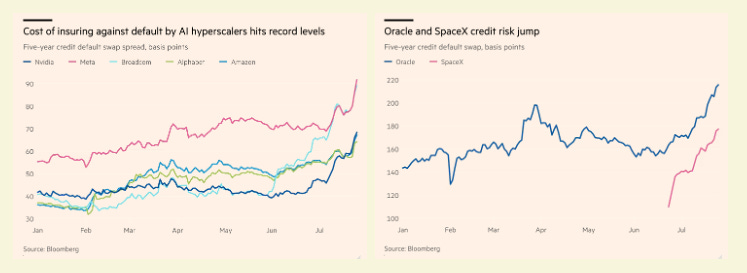
Energy constraints and political opposition to data centres are playing into this dynamic, slowing down compute development and making it harder to finish projects and generate the actual income needed to turn investment into profit.
If the AI investment cycle turned out to be a bubble, a financial crash would put the brakes on the breakneck pace of development we have witnessed in the last few years. It is likely that AI’s transformative potential would still be realised eventually, but at a much slower pace, in line with historical patterns of automation and technological development.
After this deep dive, it should be clear that here at phase:shift we believe there are more productive questions than: “Will we all be unemployed in 2040?” The answer to that is probably not. We may have other problems, but their discussion is obscured by the hype-driven discourse about AGI and the permanent underclass, a discourse largely framed within the AI industry itself. That fact alone should give us pause.
Here is an attempt to ask a few questions for a more productive debate about the very real challenges that technological development and disruption pose to society.
Should the AI bubble pop, isn’t a potential financial crisis a more direct threat to employment than AGI? Other major infrastructural and technological pushes of the past have followed a similar boom-and-bust pattern, like the railway and the internet. All of them later recovered slowly but surely, and all caused a surge in unemployment at the bust stage. Monitoring of financial distress is underreported outside a few specialist outlets, and it is by no means a significant part of the policy discourse. Despite everyone knowing AI could be a bubble, there are no safeguards in place. What the international impact could be is also underinvestigated.
What does an AI financial crisis mean for the tech sector and government intervention? An AI bust could send anything from ripples to shockwaves across the financial systems. In the worst-case scenario, both hedge funds and hyperscalers could go bankrupt. This poses other important questions about government intervention: the government would likely have to intervene, but how it would do so is key. It could impose conditions on hyperscalers in distress, restructuring the sector and saving jobs and infrastructure, or it could bail them out.
What will the effect be on debt and growth? As others have also argued, the entire difference between growing America and stagnant Europe may boil down to how well AI performs. According to some analyses, AI is indeed driving most of the US growth. If the wave of investments dies out, leaving trillions in debt, government intervention will likely affect the federal debt as well. High debt is already eroding trust in the dollar. A further massive debt increase could contribute to undermining the dollar system. This is likely the mechanism through which a crisis brewed in America could spread worldwide.
Shouldn’t the infrastructural build-up take into account legitimate concerns among communities afraid of impoverishment? Reading the literature on hostility towards data centres and the tech sector reveals that, besides fear for higher bills and impact on the landscape, the main reason people distrust or even loathe data centres is that they bring Big Money into their neighbourhood, corrupt local government, and risk leaving behind impoverished communities through public infrastructure investments that saddle towns and counties with heavy debt. There is a fantastic reportage by Jasmine Sun that everyone interested in the matter should read. Incidentally, political opposition to data centres might help pop the bubble by blocking investments and making commitments impossible to meet.
Bubble or not, how should we think about technological unemployment? A temporary rise in unemployment is a genuine concern, even though I believe one for a little later in the future. As I highlighted at the beginning, technological revolutions and waves of automation have absolutely created massive disruptions to employment. In areas where deindustrialisation hit hardest, this is still visible with significant underemployment and low incomes. A good question is how society can put the mechanisms in place to retrain pre-AI workers for the post-AI job market. How can society avoid having hundreds of thousands or even millions of people suffering for years, unable to find a job, a modern equivalent of 19th-century Britain’s lumpenproletariat?
How do we electrify the economy if new capacity can barely sustain the data-centre build-up? One of the most important trends of our time is electrification. This is necessary because it is the only way we know to decarbonise the economy without falling into energy poverty. If 65% or more of new electricity generation is absorbed by data centres, this effort becomes a Herculean task. Unprecedentedly hot summers, droughts, extreme weather, and natural disasters are already showing us the consequences of not meeting decarbonisation targets, and will do so even more in the future.
My questions are not rhetorical. I am not saying any of this will happen with any certainty. I am saying these are better questions to consider. I really wish we could think more about concrete issues and less about hypothetical fin du monde scenarios that end up fuelling dynamics nobody signed up for.
Interestingly, Castells concluded that society would not become jobless, nor would it become dominated by remote work. In passing, I cannot recommend the book - and the trilogy it is part of - more.
Adversarial reviews are a good way. The idea is that just refreshing the context window allows the model to find mistakes and correct them. This can, in turn, be automated with additional sub-agents doing exactly this.
A kilowatt-hour (kWh) is simply a kilowatt (kW) multiplied by one hour. Megawatt-hours (MWh), gigawatt-hours (GWh), and terawatt-hours (TWh) are, respectively, a thousand kWh, a million kWh, and a billion kWh.
Comments
Nothing yet. Say the first thing.
Sign in to join the conversation.