
Good morning (afternoon, evening), this is the 47th edition of Critical Points, our roundup of key links and stories designed to help you navigate the current economic, political, technological, and social landscape.
If you find our content valuable, consider liking, restacking, or sharing our posts. It really helps support our work. We’d also love to hear from you: leave a comment to help us understand what topics matter most to you and how we can cover them better.
This week, we come back from our two-week summer break to talk about how old rules are losing their ability to bring order to the international system. Diplomacy, sanctions, trade, multilateral institutions and security guarantees are becoming more contingent and politicised. At the centre of this, the United States’ role is changing from a relatively predictable guarantor of that order to a power that more openly pursues its own interests through trade, diplomacy and alliances. We selected three examples to illustrate that:
We are always looking for emerging trends, local developments, research, industrial shifts, and overlooked dynamics.
If you work on these issues, or track them closely, get in touch.
Reach out by email or direct message.
🙅♂️ Following the unilateral appointment of a new ambassador to Brazil and protests from the Brazilian government, the United States revoked the visa of the Brazilian ambassador.
⚫ The move also follows Brazil’s decision to deny visas to two U.S. government officials, who had planned to meet Flávio Bolsonaro, son of the former president, as part of a campaign aimed at influencing the Brazilian electoral process.
🦅 In a similar move last year, at the Munich Security Conference, U.S. Vice President JD Vance endorsed European far‑right political forces. Likewise, several conservative candidates in Latin America have received support from the U.S. government.
🛃 In recent months, the United States has imposed tariffs on Brazil, a move welcomed by the Brazilian far-right, and officially designated Brazilian criminal groups as terrorist organisations.
😧 A measure of this kind against an ambassador by the U.S. government would be without precedent since 1849.
The US administration’s strategy of openly attempting to influence electoral processes in other countries is further eroding norms of diplomacy and international relations. From the arbitrary use of tariffs to exert economic and political pressure, to disregard for established protocol in the appointment of senior diplomatic officials and the treatment of foreign diplomats, the United States is undermining the rules that have governed international relations between states since the end of World War II. A similar pattern was already evident in Vice President JD Vance’s open support for the German neo-Nazi party AfD ahead of the 2025 federal election, and in the administration’s increasingly direct interventions in British domestic politics.
📌 The news reported by the BBC and the Associated Press, citing the reasons given by US representatives for their visit – which relate to monitoring and the integrity of the electoral process, despite Brazil having one of the most secure voting systems in the world.
📌 The same story as reported by NBC; in contrast to the BBC’s account, here the dispute is said to have been triggered by the unilateral appointment of the new US ambassador to Brazil, in defiance of the diplomatic tradition of seeking informal approval from the host country.
📌 As explained on an official Brazilian website, the voting machines used feature biometric scanning, which prevents people from voting on behalf of others, thereby limiting attempts at electoral fraud.
📌 Vice-President JD Vance’s speech at the Munich conference in February 2025.
📌 Lula’s reactions following the US government’s decision to designate two Brazilian criminal gangs as terrorist organisations.
📌 In early 2026, the German Institute for Global and Area Studies published this analysis about tariff negotiations between Trump and Lula, on the backdrop of broader economic relations between the US and Brazil.
Grasp the material reality behind the news cycle.
Subscribe to phase:shift to see the signal behind the noise.
👀 In recent months, the United States has moved away from its traditional diplomatic posture in the Horn of Africa, taking a more openly favourable stance towards actors viewed by critics as destabilising forces in the region.
🚢 First, Washington ended the arms embargo on Ethiopia that had been in place since 2021, when the Tigray War broke out.
⚔️ Although the conflict officially ended in 2022, several key issues remain unresolved, fuelling renewed tensions between the federal government and regional authorities, against the backdrop of clashes involving ethnic militias and growing tensions between Ethiopia and both Eritrea and Somalia.
🇪🇹 Ethiopia has also become increasingly involved in the Sudanese conflict, aligning itself more closely with the RSF.
🇸🇩 The United States has meanwhile imposed sanctions on the Sudanese army, which is fighting the RSF. Although some of its members and associates have been sanctioned individually, the RSF itself is not subject to sanctions as an organisation.
🇹🇩 At the end of July, Washington reportedly urged Chad to withdraw from the International Criminal Court (ICC), a move that would indirectly benefit the RSF, which has received logistical support from the United Arab Emirates through Chadian territory.
At the international level, the United States is moving away from its traditional role as a “neutral” power mediating between competing local interests. Instead, it is increasingly taking an active role in the emerging multipolar landscape, openly siding with the RSF in the Sudanese civil war. Within this conflict, an alignment between the UAE, Israel, the RSF, and the Ethiopian government appears to be taking shape with Trump’s approval. At the local level, this is shifting the boundaries of what is considered politically acceptable, from Israel’s recognition of Somaliland and Ethiopia’s claims to sea access at the expense of its neighbours to the UAE’s well-documented support for the RSF’s mass atrocities in Darfur, which “bear the hallmarks of genocide” according to the UN and the ICC. This paves the way for further actions to erode the multilateral order by middle powers with regional ambitions of power projection.
📌 On 20 July, the US imposed new sanctions against the Sudanese Armed Forces for the use of chemical weapons (chlorine gas) in September 2024. Hemetti, the head of the RSF, as well as several senior officers within the militia, are subject to sanctions for crimes linked to the siege of El-Fasher in 2025.
📌 The Sudanese Armed Forces (SAF) have been designated by the US as a terrorist organisation; the rival RSF militia has not been subject to sanctions as an organisation, but only certain individuals within it have been targeted. This has sparked a heated debate in Sudan and amongst the Sudanese diaspora.
📌 Following the drone attack on Khartoum airport, the Sudanese military government recalled its ambassador from Ethiopia. In response, the Ethiopian government accused the Sudanese military of supporting TPLF rebels in Tigray.
📌 On 27 July, Chad announced its withdrawal from the International Criminal Court at the request of the US, just as the ICC is nearing a verdict on the Darfur genocide and is examining the links between the Chadian government and the RSF militias as part of its investigation into crimes against humanity committed by the latter during the conflict in Sudan.
📌 Against this backdrop, the Gulf states’ reorientation of their diplomatic strategies is having a considerable impact on the balance of power across much of the African continent. We discussed this in our Critical Point #24.
📌 The US administration is also strongly hostile towards Somalia, and in recent years the US has drawn closer to the self-proclaimed Republic of Somaliland. When Israel recognised it in December, sparking international concern, the US came to Israel’s defence.
📌 Meanwhile, on 9 July, the European Parliament voted by an overwhelming majority (476 to 28) to designate the RSF as a terrorist organisation, imposing restrictions on imports of gold and other minerals from Sudan.
📌 The IEP analysis published in the Global Peace Index report describes the tensions in the Horn of Africa as part of a single political, diplomatic and military crisis.
If you know someone in research, policy, academia, or industry who could use our work, share phase:shift with them.
Be part of the early network.
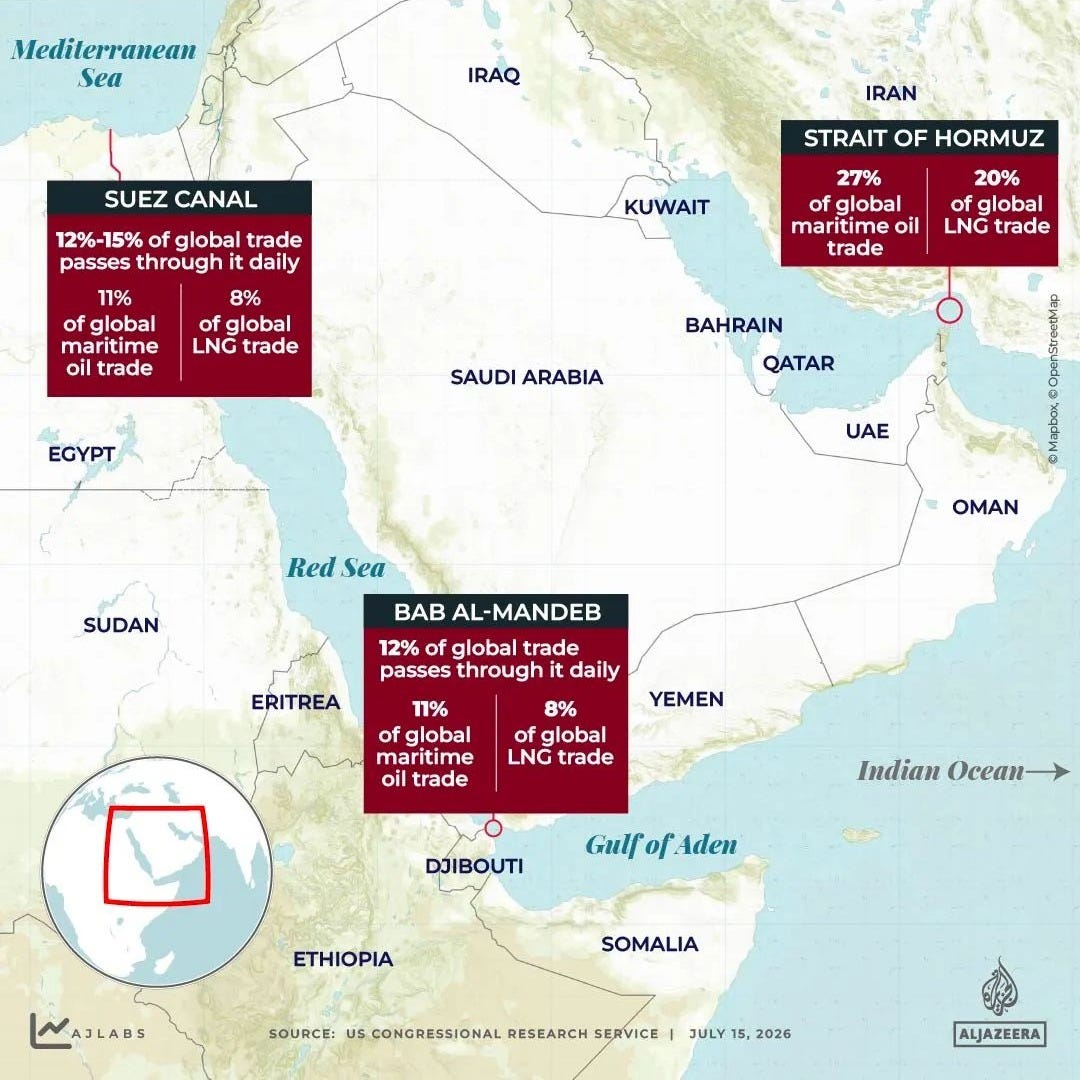
🇸🇦 On 30 July, Saudi Arabia announced an international coalition to safeguard maritime security in the Red Sea, particularly in the Bab al‑Mandeb Strait, through which around 12% of global trade passes.
⚔️ The decision follows the resumption of hostilities between Yemen’s rival factions, including attacks carried out the previous week by the Houthis, backed by Tehran, against Saudi oil tankers and other energy infrastructure.
↩️ With the war in Iran and the closure of the Strait of Hormuz, Saudi Arabia now exports 70% of its pre‑war oil production through Bab al‑Mandeb, primarily to Asian markets.
🤝 The coalition is reported to have attracted 13 member countries so far, including the Gulf states (except the UAE and Oman), the Red Sea states (except Eritrea), and other countries with close ties to Saudi Arabia, including Nigeria, Pakistan, Bangladesh, and Turkey.
🛡️ In early August, the Mecca Defence Pact between Saudi Arabia, Turkey, and Pakistan was also formally confirmed, extending Pakistan’s nuclear deterrent umbrella to the other two countries.
The announcement reflects a broader shift in the security architecture of the Middle East. For decades, the United States acted as the main guarantor of maritime security in the region. The creation of a Saudi-led coalition suggests that such a role is losing credibility, while regional powers increasingly see the need to develop their own security arrangements. With the Strait of Hormuz disrupted by conflict, Saudi Arabia has become more reliant on another chokepoint, Bab el-Mandeb: traffic has been rerouted rather than diversified. This raises the strategic stakes of the conflict in Yemen and gives Yemeni forces more strategic leverage. These new conditions create strong incentives to invest in naval capabilities, military cooperation, and regional security arrangements. If the coalition ultimately succeeds in deterring attacks without becoming directly involved in the wider network of regional conflicts, it could become a permanent security structure in the Red Sea, sustaining further militarisation of one of the world’s most important trade routes.
📌 An excellent report by The Horizon Brief, though it has the limitation of viewing the Houthi attacks as being directly orchestrated by Iran’s IRGC to further their strategy of putting pressure on the global oil market. This overlooks the agency of Yemeni forces.
📌 The US reaction to the attacks on the two oil tankers that had breached the ‘naval blockade’ against Saudi Arabia announced by the Yemeni group.
📌 A summary of the energy situation in the Red Sea following the attacks launched by the Houthis
📌 For years, the United Arab Emirates has pursued a diplomatic and military strategy aimed at gaining control of the Red Sea. This strategy has seen both advances and setbacks over the past year, with Israel’s recognition of Somaliland on the one hand, and the defeat of UAE-backed forces in Yemen on the other. In parallel, the recent defence agreement between Turkey, Saudi Arabia, and Pakistan is part of a broader realignment across the Middle East, involving several African countries as well.
📌 The Maritime Coalition results from the challenges experienced by Saudi Arabia since the closure of the Strait of Hormuz. Back in April, our Phase Reading piece analysed the potential global consequences of a permanent closure:
Beyond Hormuz: Energy Poverty or a Solar Era?
·
Apr 24
Welcome to our third Phase Reading, our monthly format where we explore a global trend in politics, technology, economy and society - or all of these together, when we want to follow the longer threads behind the news. This week we explore the potential consequences of the closure of the Strait of Hormuz.
Comments
Nothing yet. Say the first thing.
Sign in to join the conversation.