
Good morning (afternoon, evening), this is the 40th edition of Critical Points, our roundup of key links and stories designed to help you navigate the current economic, political, technological, and social landscape.
If you find our content valuable, consider liking, restacking, or sharing our posts. It really helps support our work. We’d also love to hear from you: leave a comment to help us understand what topics matter most to you and how we can cover them better.
This week we focus on three technologies associated with the energy transition, reflecting different views of how the transition could unfold. Their prospects vary significantly depending on the technological and political context in which they are deployed. Some are relatively mature, easier to implement, and therefore more likely to scale successfully. Others face substantial barriers, requiring the development of entirely new infrastructure, and would hardly meet their emission targets.
We are always looking for emerging trends, local developments, research, industrial shifts, and overlooked dynamics.
If you work on these issues, or track them closely, get in touch.
Reach out by email or direct message.
🔋 Sodium‑ion batteries operate on a mechanism similar to lithium‑ion batteries, with sodium replacing lithium as the key element.
⬆️ Sodium is around 1,000 times more abundant in the Earth’s crust than lithium, enabling sodium‑ion batteries to potentially reach cost parity with lithium batteries even before large‑scale commercial deployment.
⚡ However, their widespread adoption, particularly in electric vehicles, has been limited by their lower energy density, which stems from the different chemical properties of sodium compared with lithium.
🗼 At the grid level, this limitation is less significant. In China, large‑scale installations are already under development, including projects with capacities of 100 MW and 200 MWh, equivalent to around two hours of operation at full capacity.
📉 With broader deployment, production costs are expected to decline further. A study by LUT University (Finland) estimates future costs of $13–26 per MWh by 2050, compared with a current level of around $80 per MWh.
⬇️ Sodium‑ion batteries are also considered a “drop‑in” technology: they can be integrated into existing manufacturing processes and infrastructure used for lithium‑ion batteries, reducing the need for new industrial capacity and lowering barriers to entry.
The commercial development of a new battery technology increases the scope for the electrification of the economy. Sodium is over a thousand times more abundant than lithium in the Earth’s crust, where it accounts for around 2.3 per cent, and is therefore easier and cheaper to extract. Its larger atomic size reduces energy density, but recent technological progress has brought performance to a level compatible with commercial use.
Sodium‑ion batteries could lower barriers to entry across the energy storage value chain. Lithium, cobalt, and nickel supply chains are geographically concentrated and politically exposed; sodium is widely available and harder to monopolise. This favours countries with weaker access to critical minerals or limited capital. Conversely, countries heavily invested in lithium‑based supply chains, such as Australia, Chile, or the DRC, may face asset devaluation risks if sodium achieves cost leadership in stationary storage. The same divergence, not necessarily in the form of an open conflict, could emerge within states, between actors tied to the lithium ecosystem, such as specialised mining companies and manufacturers, and actors that may favour sodium-ion solutions, such as energy utilities and grid operators.
Technological development will play a decisive role in this competition. If improvements continue, sodium‑ion batteries may become the default option for grid storage, where weight and volume are secondary constraints. Lithium-tied actors would then be likely to accelerate lithium innovation to preserve performance advantages, and to shape regulation and subsidies to favour existing technologies. Governments may actively support or hinder adoption depending on their position in global supply chains. In this sense, beyond expanding the technological toolkit of the energy transition, sodium‑ion batteries redistribute the geopolitical and industrial stakes behind it.
📌 The development of sodium batteries:
https://www.ess-news.com/2026/01/09/sodium-ion-battery-cells-already-near-lithium-ion-cost-parity-set-to-get-cheaper/
📌 Sodium makes up 2.3% of the Earth’s crust, making it the sixth most abundant element, whilst lithium accounts for just 0.002%:
https://en.wikipedia.org/wiki/Abundance_of_elements_in_Earth%27s_crust
📌 The first grid-scale sodium-ion battery facility, with a capacity of 100 MW and 200 MWh:
https://www.ess-news.com/2024/07/02/worlds-largest-sodium-ion-battery-goes-into-operation/
📌 In February 2026, Changan Automobile, a Chinese car manufacturer, and CATL, a battery manufacturer, announced the first mass-produced electric vehicle with sodium-ion batteries, which is set to be launched in the third quarter of 2026:
https://www.catl.com/en/news/6720.html
Connect the local and the global, the technical and the political, the event to the system.
Subscribe to phase:shift: grasp reality, so you can change it.
🔋 Changan Automobile, one of China’s largest state‑owned car manufacturers, has announced plans to begin testing vehicles equipped with solid‑state batteries by the autumn of 2026.
🚗 Solid‑state batteries offer improved safety compared with conventional lithium‑ion batteries and are expected to deliver driving ranges of up to 1,500 km, according to company claims.
🥇 In February 2026, Changan also unveiled its first vehicle powered by sodium‑ion batteries, with a range of around 350 km, and is working with CATL to develop solid‑state sodium batteries, combining two emerging technologies.
👀 Dongfeng Motors, another major Chinese manufacturer, has announced similar testing programmes, claiming a range of 1,000 km using a hybrid solid‑liquid battery rather than a fully solid‑state design.
🗓 A number of other automakers are also advancing solid‑state battery technologies and aim to begin mass production between 2027 and 2030. These include SAIC Motor, GAC Group, CATL and BYD in China, and Volkswagen, Mercedes, Toyota and Nissan internationally. Notably, in September 2025, Mercedes reported a test drive of an EQS prototype covering 1,200 km without recharging.
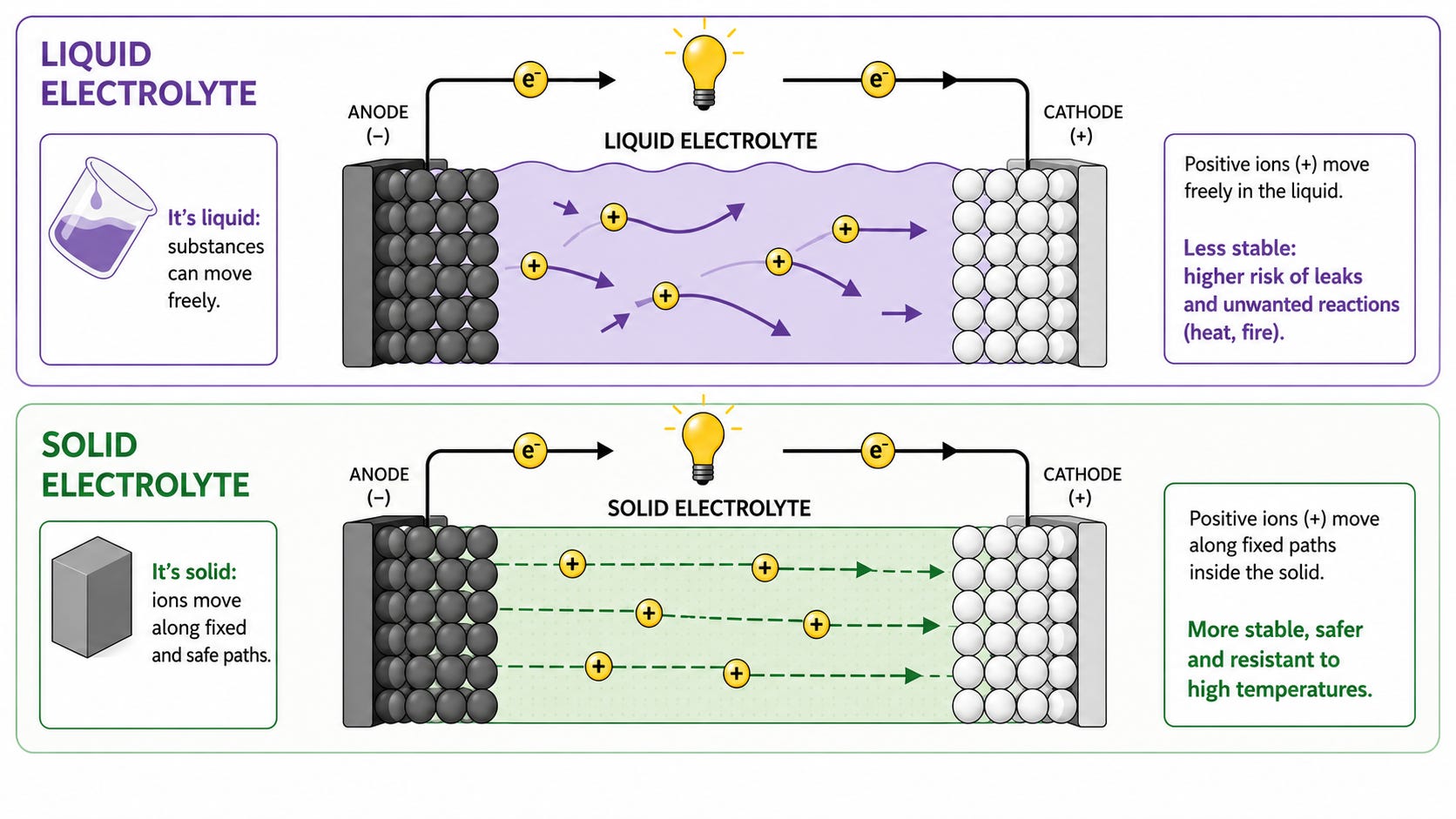
In a conventional battery, lithium ions move through a liquid electrolyte; a solid electrolyte makes the cell less subject to leakage and thus less flammable and safer. Allowing for higher energy densities for the same weight and volume, solid-state batteries also improve vehicle range and charging speed. This could accelerate the shift from combustion-engine vehicles to electric vehicles by reducing some of the main practical barriers to mass adoption. The introduction of solid-state batteries for passenger vehicles marks a significant innovation that enhances Chinese manufacturers’ competitive advantage in the electric car market, whilst other Chinese manufacturers, as well as European and Japanese manufacturers, are expected to follow suit with their own models towards the end of the decade. Reducing costs, improving efficiency and safety are key factors in determining who will dominate the market in the next decade.
📌 The first announcements regarding the launch of electric cars with solid-state batteries. The battery announced by Changan is said to have an energy density of 400 Wh/kg. Safety is said to have improved by 70%, though it has not been specified according to which metric. The solid-state sodium battery developed with CATL is said to have an energy density of 175 Wh/kg. The one developed by Dongfeng Motors is said to have a density of 350 Wh/kg.
https://electrek.co/2026/02/24/solid-state-ev-batteries-debut-in-china-nearing-1000-miles-range/
📌 The Mercedes test model that travelled 1,200 km on a solid-state battery without ever recharging:
https://group.mercedes-benz.com/technology/e-mobility/electric-drive/eqs-solid-state-battery.html
📌 Nissan aims to bring its models to market in 2028:
https://apnews.com/article/f22e11fd26c1c4533d798644fbf06163
📌 Stellantis has a 400 Wh battery that charges from 15% to 90% in 18 minutes, but it is still at the prototype stage:
https://www.theverge.com/news/654768/stellantis-solid-state-batteries-charge-speed-temperature-factorial
📌 Volkswagen has signed an agreement to purchase solid-state batteries from QuantumScape but has not announced a date for the planned launch of the models:
https://www.volkswagengroup.it/en/media/press-releases/powerco-and-quantumscape-announce-landmark-agreement-to-industrialize-solid-state-batteries
📌 An analysis by economist Richard Katz on why Toyota, the world’s largest car manufacturer, is vulnerable to Chinese competition and risks losing its leading position, having neglected the electric vehicle market:
If you know someone in research, policy, academia, or industry who could use our work, share phase:shift with them.
Be part of the early network.
Special thanks to Tommaso Ciurnelli for his contribution.
🇯🇵🇿🇦 In early May, Japan and South Africa opened discussions to strengthen cooperation on the energy transition.
🤝 Under the proposed framework, Japan would secure access to critical raw materials, offer a yen‑denominated sovereign loan to finance South Africa’s transition, and promote the deployment of its “co‑firing” technology.
📉 South Africa, which is Africa’s largest emitter of greenhouse gases, would adopt this technology, which aims to reduce emissions without phasing out coal, by generating electricity through burning a mixture of coal and ammonia.
🌱 The ammonia would be produced through the Coega Green Ammonia Project, which seeks to scale up production using renewable hydrogen and nitrogen, with a target of over 1 million tonnes annually by 2029, largely for export to Europe and Asia.
⚠️ However, the approach faces significant constraints. The production of low‑carbon hydrogen and ammonia is highly energy‑intensive and requires substantial infrastructure, while such hydrogen currently accounts for less than 1% of global output. Moreover, the effectiveness of co‑firing in delivering meaningful emissions reductions remains debated, raising questions about the overall environmental impact of the strategy.
For Tokyo, the agreement is strategic on several levels: it exports ammonia coal co-firing technology – presented by Japan as a key tool to tackle climate change – secures future supplies of South African green ammonia and critical materials, and strengthens its presence in Africa, a continent where China is playing an increasingly prominent role. However, it is unlikely that this project will be successfully implemented. Every stage of it requires a great deal of energy and, even if it comes from renewables, it makes less sense than simply adopting renewable technologies, which are cheaper and would eliminate rather than merely reduce carbon emissions. In addition, co-firing poses environmental risks, and this specific framework adds a layer of supply chain dependency, both significant obstacles in the current political landscape.
📌 The meeting between Japanese and South African ministers as reported by the Japanese Ministry of Foreign Affairs
https://www.mofa.go.jp/afr/af2/za/pageite_000001_01631.html
📌 Data on South African emissions
https://www.iea.org/countries/south-africa/emissions
📌 Japan-South Africa negotiations
https://www.bloomberg.com/news/articles/2026-05-05/japan-offers-energy-loan-ammonia-technology-to-south-africa
📌 The co-firing technology explained by the New York Times and by the IEA.
📌 Ammonia coal co-firing is considered to be key to Japan's strategy to tackle climate change. JERA, Japan’s biggest power generator, is on track to achieve 20% ammonia co-firing at a unit of its Hekinan thermal power station by the end of 2029, marking the world's first commercial use of ammonia as a fuel. JERA has secured a 15-year government subsidy to cover the cost difference between ammonia and coal. It aims to start importing ammonia from a planned U.S. production facility.
http://archive.today/RnCcx
📌 Ammonia is produced by combining nitrogen and hydrogen. Several types are produced: grey ammonia, produced using fossil gas or coal; blue ammonia, produced using the CCS (carbon capture and storage) process, which has lower emissions; and, finally, green ammonia, produced entirely using renewable energy.
https://www.e3g.org/news/explained-why-ammonia-co-firing-with-coal-in-southeast-asia-is-a-risky-approach/
📌 Among other limitations of ammonia coal co-firing, the process has environmental impacts as it releases nitrogen oxides, contributing to severe air pollution. The storage of ammonia is also linked to environmental risks, because of potential toxic leaks. Here is a fact sheet on ammonia-associated risks:
https://www.cleanegroup.org/wp-content/uploads/Green-Ammonia-Fact-Sheet.pdf
📌 The South African project for producing ammonia using renewable energy
👉 https://www.reuters.com/sustainability/south-africas-58-billion-hive-project-aims-lead-low-cost-ammonia-output-2025-06-12/
👉 https://www.hiveenergy.co.uk/clean-futures/green-hydrogen/coega-green-ammonia-project
📌 Low-emission hydrogen production accounts for just 1% of global production.
https://www.iea.org/reports/global-hydrogen-review-2025
Comments
Nothing yet. Say the first thing.
Sign in to join the conversation.