
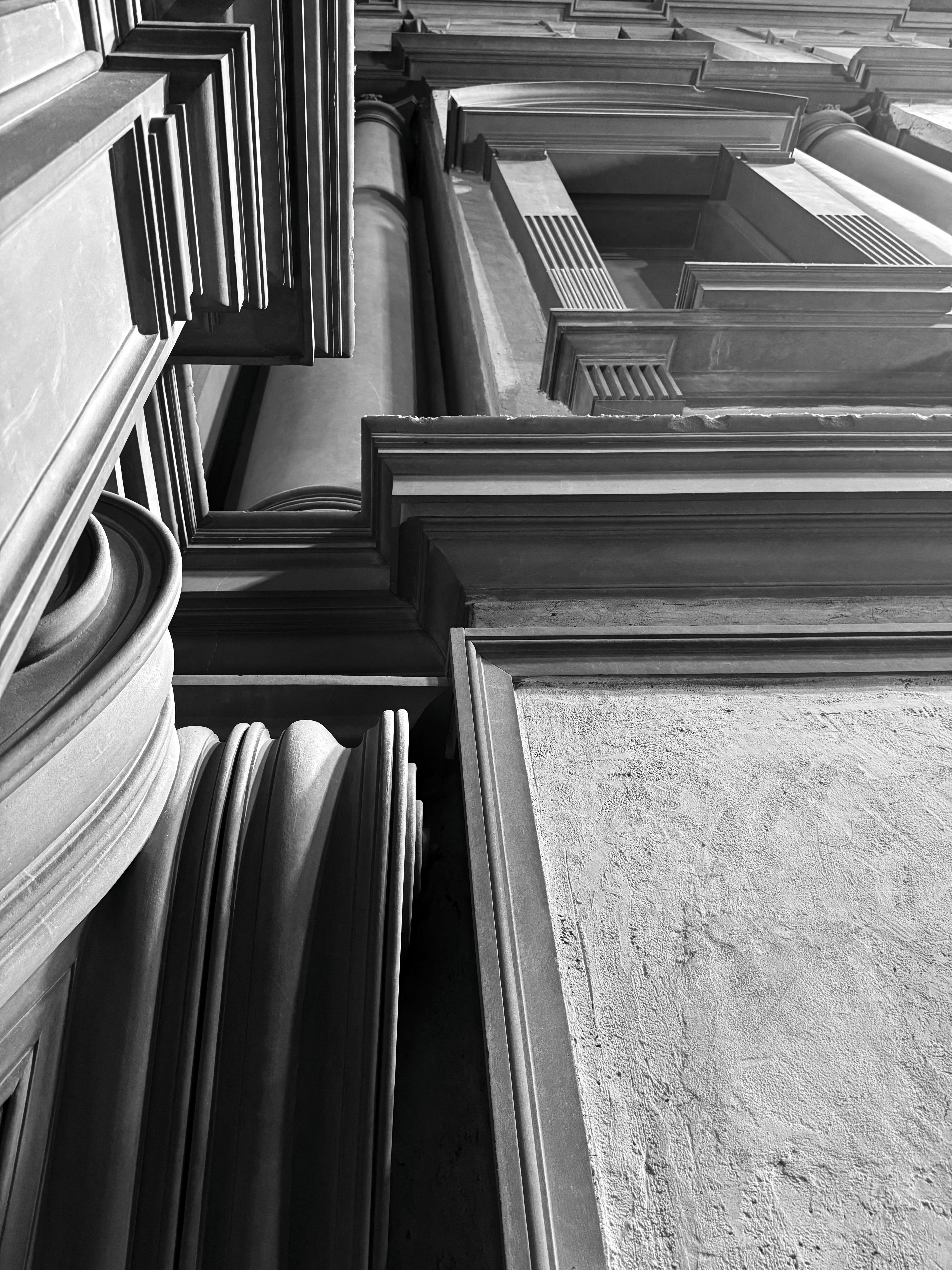
When I’m in Florence I usually end up walking past the Basilica di San Lorenzo, mainly because its another way around the obvious touristic bottleneck in the historic center of the city. Nonetheless when I reach San Lorenzo I make sure to stop outside Michelangelo’s Laurentian Library (Biblioteca Medicea Laurenziana) which has its tiny entrance wedged to one side of the Basilica. I normally check to see if the entrance to the Laurentian Library is open, because its always worth a quick visit.
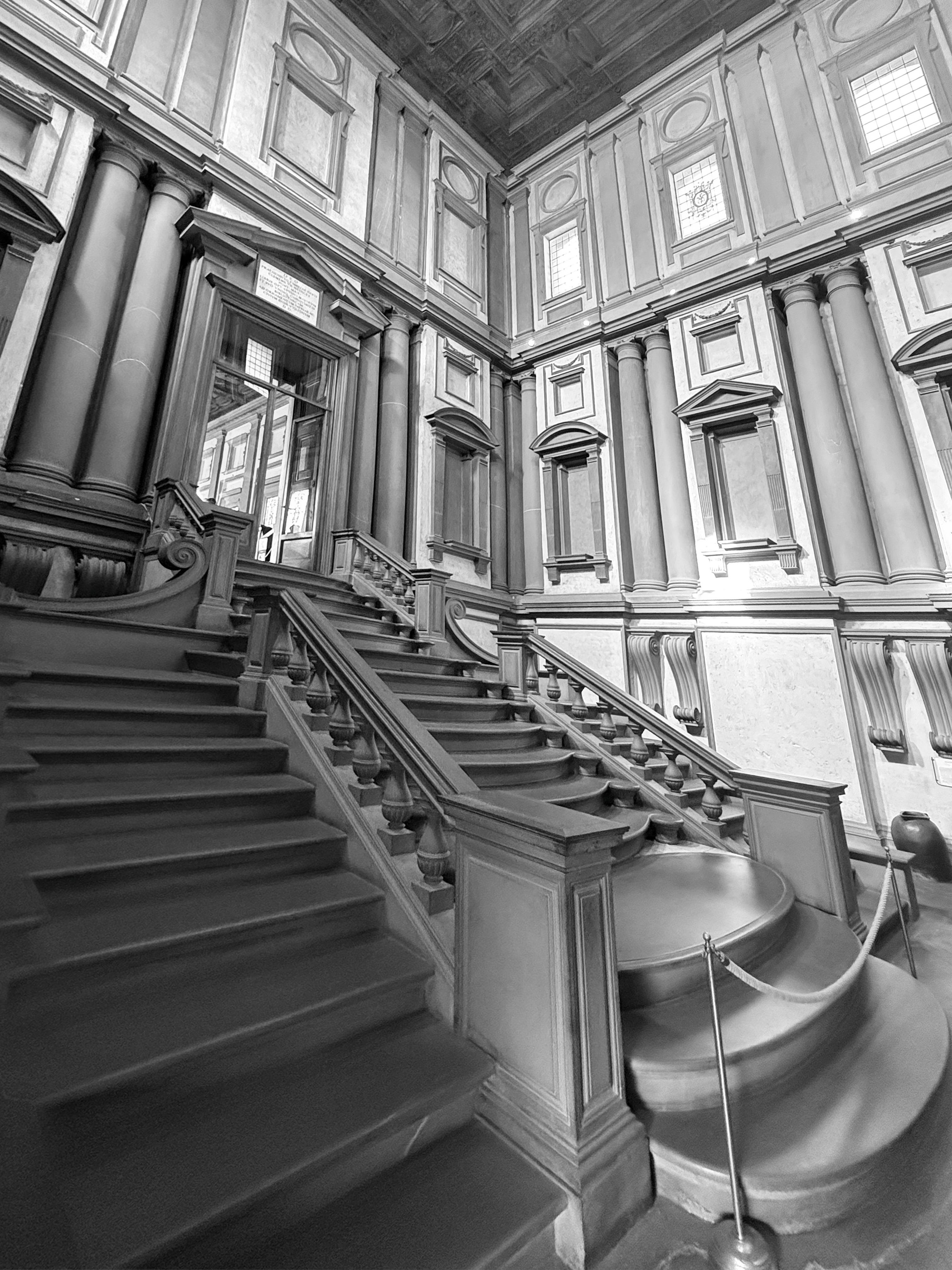
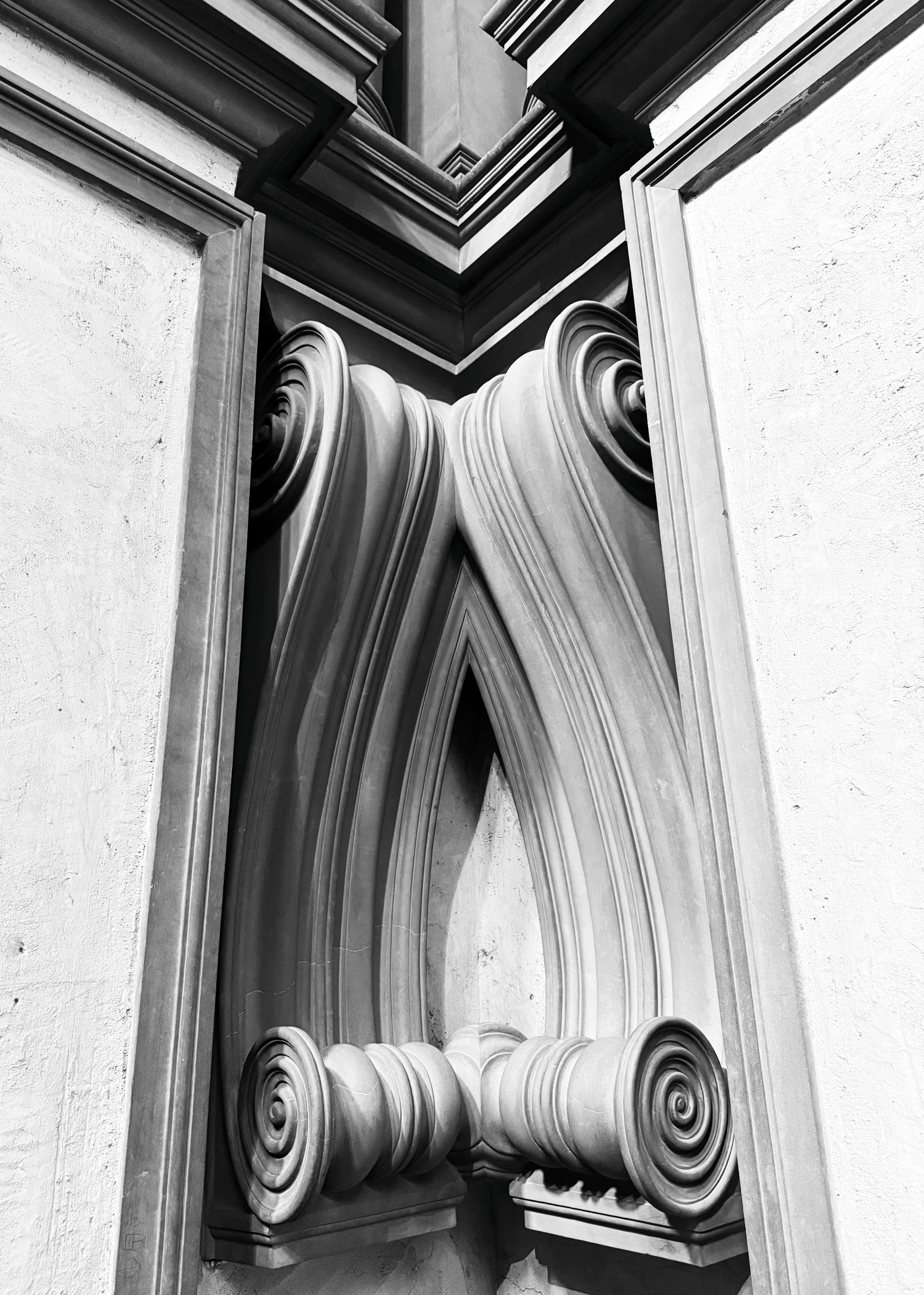
All you need to do is walk through the side entrance—unfortunately most people will need to buy a ticket— walk past the garden courtyard and take the staircase up one flight, where there is a discreet set of doors opening into the Laurentian Library. The Library, but principally the Library’s vestibule, is as far as I am concerned Michelangelo’s most brilliant masterpiece. The antechamber is an architectural fantasy turned inside out, where the formal building elements, columns, capitals, fluted pilasters, freezes, window cornices, pediments are all facing inward and intentionally rendered out of scale and proportion. To further build on this sense of uncanniness, the vestibule is held in perpetual penumbra.
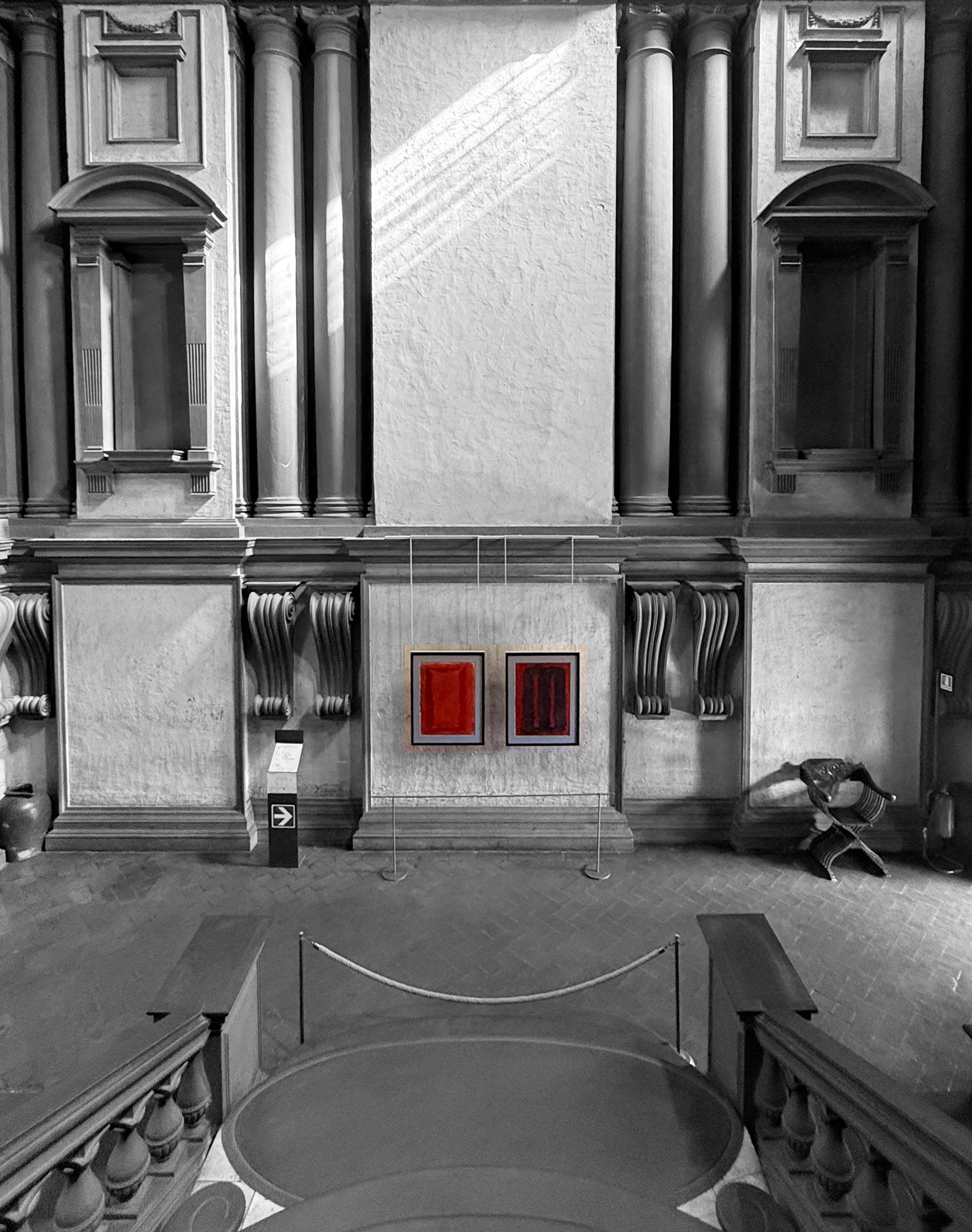
Adding to this tense spatial composition is the presence of a cascading central staircase far too large for the vestibule itself, making the whole place feel downright claustrophobic. Michelangelo succeeds in manipulating the perception of the interior so much so that the central convex staircase with its two flanking rows of steps are really the only inhabitable elements in this densely arranged architectural volume.
What drew me back to the Laurentian Library this time around is the Mark Rothko exhibition now on view at the Palazzo Strozzi, Rothko in Florence. The exhibition features over 70 works by the Latvian born American artist, and though it’s not a full blown retrospective, the show nonetheless offers a golden opportunity to see lots and lots of Rothkos. The curators, Christopher Rothko and Elena Geuna, have pulled together a pretty comprehensive collection of Rothko works that begin with the artist’s earliest figurative experiments and include some of his last immense canvasses.
For me, the most compelling move that distinguishes the show is the curatorial decision to create two satellite installations, one at the Laurentian Library, the other at the San Marco Museum. Their argument is that Rothko cited these two places as critical to developing his particular approach to painting. As far as I am concerned, the Laurentian Library was all the bait I needed to go back into Michelangelo’s opera, and to try to figure out what Rothko was thinking .
Rothko’s works are regularly described as being “sublime,” or “haunting” or even “terrifying.” I remembered, however, when Rem Koolhaas placed his daughter Charlie’s photo essay of Michelangelo’s Laurentian Library on a prominent wall inside the Arsenale in the Architecture Biennale in Venice back in 2014. That was the year Koolhaas was its director. According to Charlie, her father considered Michelangelo’s vestibule to be of “brutal beauty,” * an opinion not uncommon among both art and architectural critics.
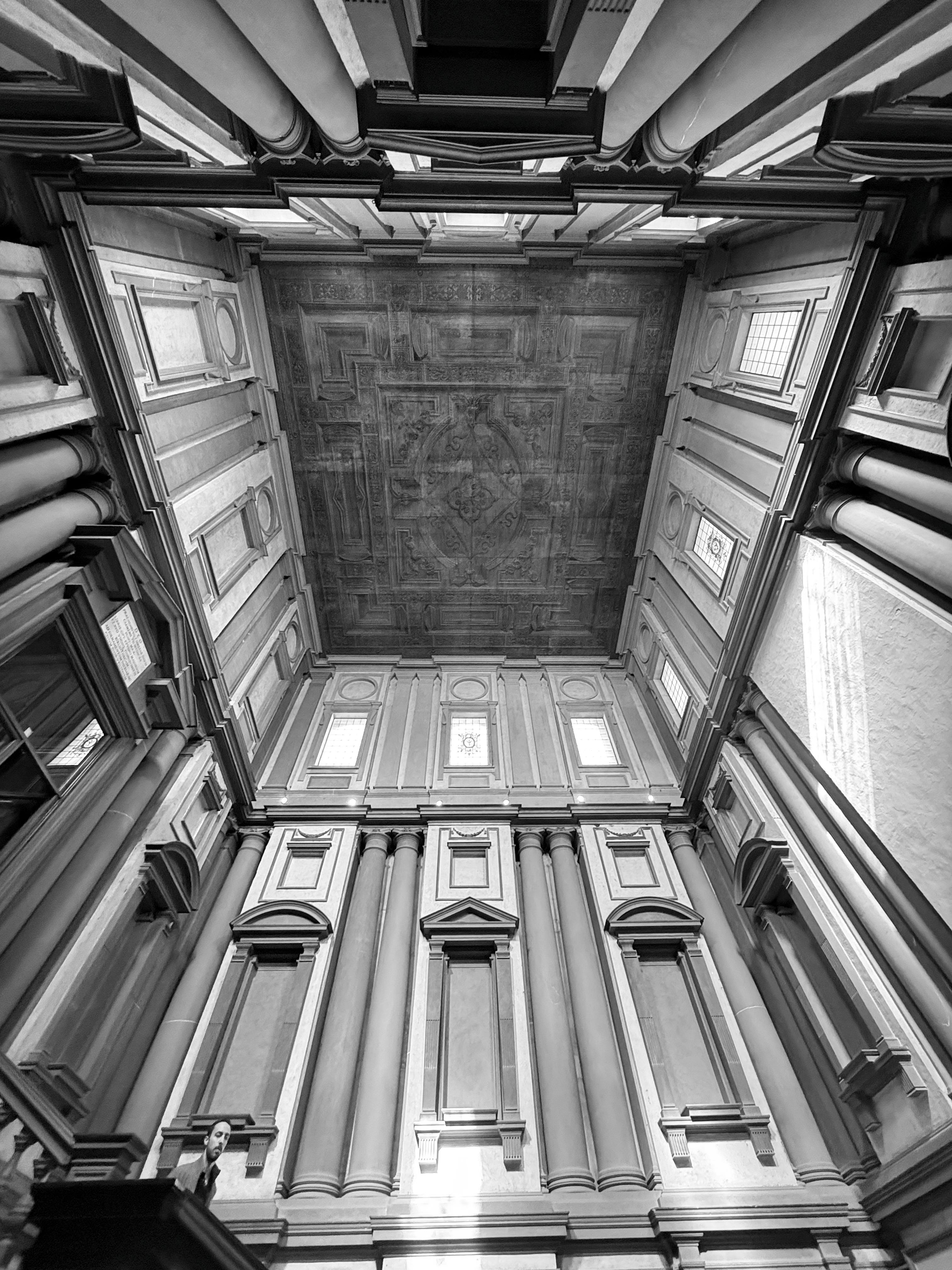
I find Rothko’s connection to the Laurentian Library to be indeed truly revelatory, its as if the two minds, Rothko’s and Michelangelo’s were brought together in some kind of atemporal mind meld. When you enter the Vestibule, even though the two Rothko watercolors hanging facing the stairs are diminutive in size, the effect nonetheless is more than convincing. You can sense Rothko’s emotional reaction when faced with the room’s absolute dominance. Rothko’s one quote that lords over his exhibition: “A painting is not a picture of an experience; it is an experience,” surely references the visceral power of presence.
Here in the Laurentian Library two creative geniuses from two entirely different epochs confront their deepest desires and fears. And what emerges, for either one of them, is shear sublime wonder.
* The wall with Charlie Koolhaas’ photo essay was located right in front of a restoration of one of Superstudio’s most haunting works, The Wife of Lot, which was itself exhibited for the first time at the Venice Biennale in 1978. Things have a way of going around and around.
Note: I would like to acknowledge Paola Giaconia and Marco Brizzi for their kind invitation to Kent State in Florence, which gave me the opportunity to spend a productive day in the city.
No posts
Comments
Nothing yet. Say the first thing.
Sign in to join the conversation.