
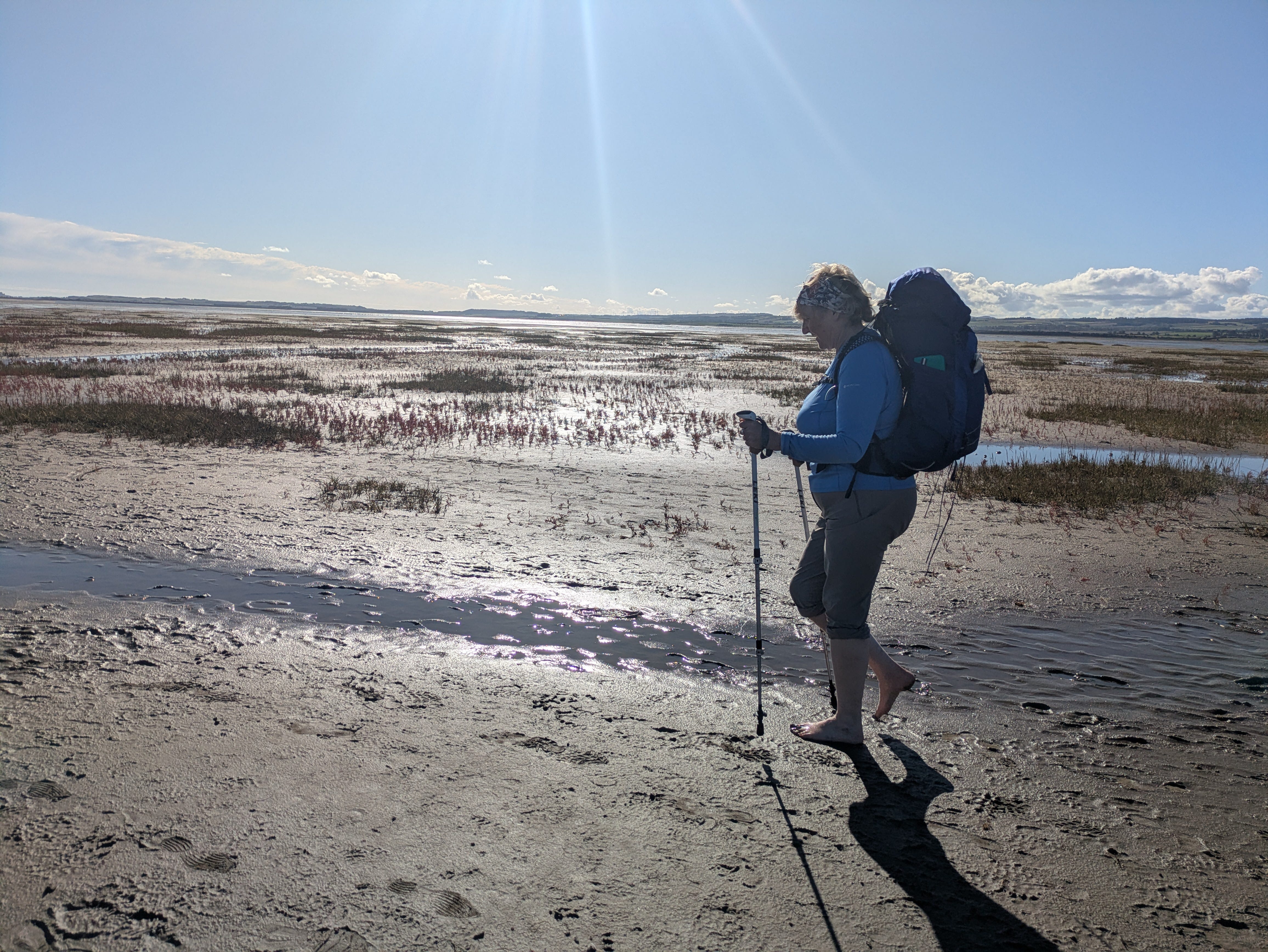
My friend and writing companion Helen Sieroda wrote this piece as she struggled to say something about the pilgrimage she undertook along the St Cuthbert’s Way from Melrose in the Scottish Borders to Holy Island (Lindisfarne), with her son Lyndon as companion. I think this piece is particularly of interest for Learning How Land Speaks, as I have found it difficult to induce participants on co-operative inquiries like Living Waters to offer writing of their experience for a more public audience. I think Helen captures something of the challenge and frustration of finding the right words and expressions for the mysteries that may arise on pilgrimage.
Helen had written earlier about the beginning of her pilgrimage (which had been delayed first by pandemic and lockdown and then by hip surgery)
I didn’t yet know it, but to walk St Cuthbert’s Way is to enter an in-between place, a threshold between identities, where time and terrain don’t want to follow straight lines, but curve, meander and spiral back on themselves. Lindisfarne itself is liminal space, the island of tides, opening and closing as the causeway emerges from the sea, only to disappear again below waves. Always between full and empty. The identity of the Island is both fluid and solid, and in this way the journey’s end folds itself into the beginning shaping the Way.
She followed this with
There’s this feeling, that arrives like a gift, on a long walk. The feeling of hitting your stride. It rises from the ground, up through the rhythm of feet covering miles, the easy swing of hips, of breath breathing you. Everything flows together, it’s a kind of grace, bringing quiet, alive, exuberant joy. The heart brightens and lightens, the mind clears and roams free. Yes, yes, this is what human bodies were built for.
But now she develops these earlier notes, frustration set in. Now she writes:
I’ve lost my car key. Looked everywhere.
Bags. Shelves. Floor. Pockets.
Too many pockets.
I remember clearly when I last used it, I moved the car so I could deal with weeds in front of the house. That was last week. Tuesday, I think. I’m frustrated, so much time going into finding a lost key.
At the same time as my key search, I’ve been searching for words to describe something that does not want to be worded: moments between events, easy to miss or skim past; pauses that hold everything together; the spaces that make sense of things. I don’t know. My attempts to focus only drive it, whatever it is, away.
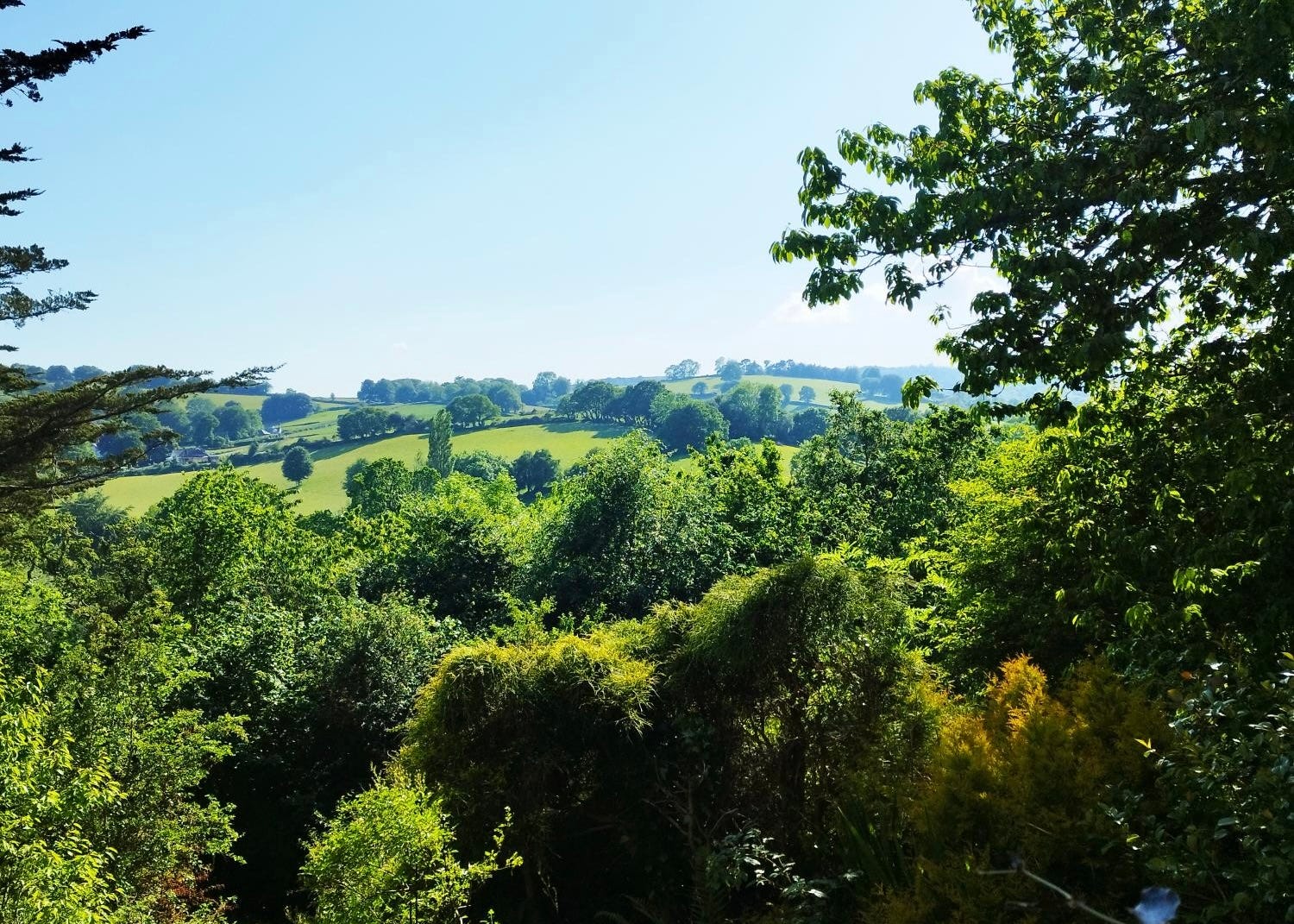
I lift my eyes from the page, drawn out, towards hazel and willow swaying in the breeze. Soft new leaves catch the light, tremble and flutter. Branches move and stop and move again. The sun breaks through, scatters and glints through shadows. On the horizon, the moor and the illusion of stillness. Above grey clouds, white clouds, dark and bright and fast. A glimpse of blue. Movement. Still and not still. I gaze. My mind drifts.
And somehow, I am gone.
Not lost. Something dissolves. Simply gone. Moving with what moves. Drifting. Thoughts rise to the surface and dissolve. Rise and drift and dissolve. Over and over.
The open hills, fields, moors a spring-green sea. Light rolls across leafy waves. And rolling with all this, robin song.
Away with the fairies. I know this drifting, mind-wandering way of being well, but long ago I learned to squeeze it into a box labelled ‘laziness’, or ‘daydreaming’ and scold myself if it escaped. A sickly child, I’d gaze for hours out of the window towards the broad back of Cheviot Hills on the horizon. Away with the fairies. In summer the long grass in the field opposite our house would roll in golden waves. Away with the fairies. All through May I’d follow the sunset as it inched along the living room wall, week by week travelling further, until it reached the opposite wall, and then after mid-summer begin its retreat. Away with the fairies.
These moments of gazing, of drifting resist words. They don’t want to be captured. It’s easy to write over them with words like ‘irrelevant’ or ‘lazy’. This isn’t a practice like mindfulness or meditation, which hold to presence or reach for stillness. This is something else, no deliberate focus, no attempt to control the mind, no endpoint or destination. No question and no answer. This is gazing, not looking. Attentive but with such a broad unfocussed quality it hardly passes as attention - as in ‘paying attention’. It’s not laziness, not really, just letting go and opening to receiving what is there.
I’m writing about walking St Cuthbert’s Way and can’t find the words. But this is what stays, this is what arises: moments and their passing; transient threshold moments where whatever usually lies between seer and seen, me and ‘all this’, simply dissolves. Where time doesn’t stop, it just goes somewhere else.
Pauses, glimpses. The tenderness that arises in the face of beauty, knowing it will not last. There isn’t an answer, no keys to be found, no pockets hiding treasures, no hidden meaning to be uncovered.
Everything unfinished, unanswered and unresolved. Moments that will never come again.
Comments
Nothing yet. Say the first thing.
Sign in to join the conversation.