

Lately, I’ve been reflecting on the kinds of representation of the player in games: in our games too, the player is most often represented as a kind of “hero(ine)”, even if not in tone (like in Football Drama or Roller Drama), anyway through the spectrum of agency that is available to the player through their representation.
In (para)historical games, the centrality of the player and their portrayal as a hero(ine) is even more universal, and more explicitly supportive and in line with the standard self-centred, conquer-and-exploit worldview— the so-called “non political” one 😂
In Becoming Saint I mitigated the hero(ine)-centric model in two ways:
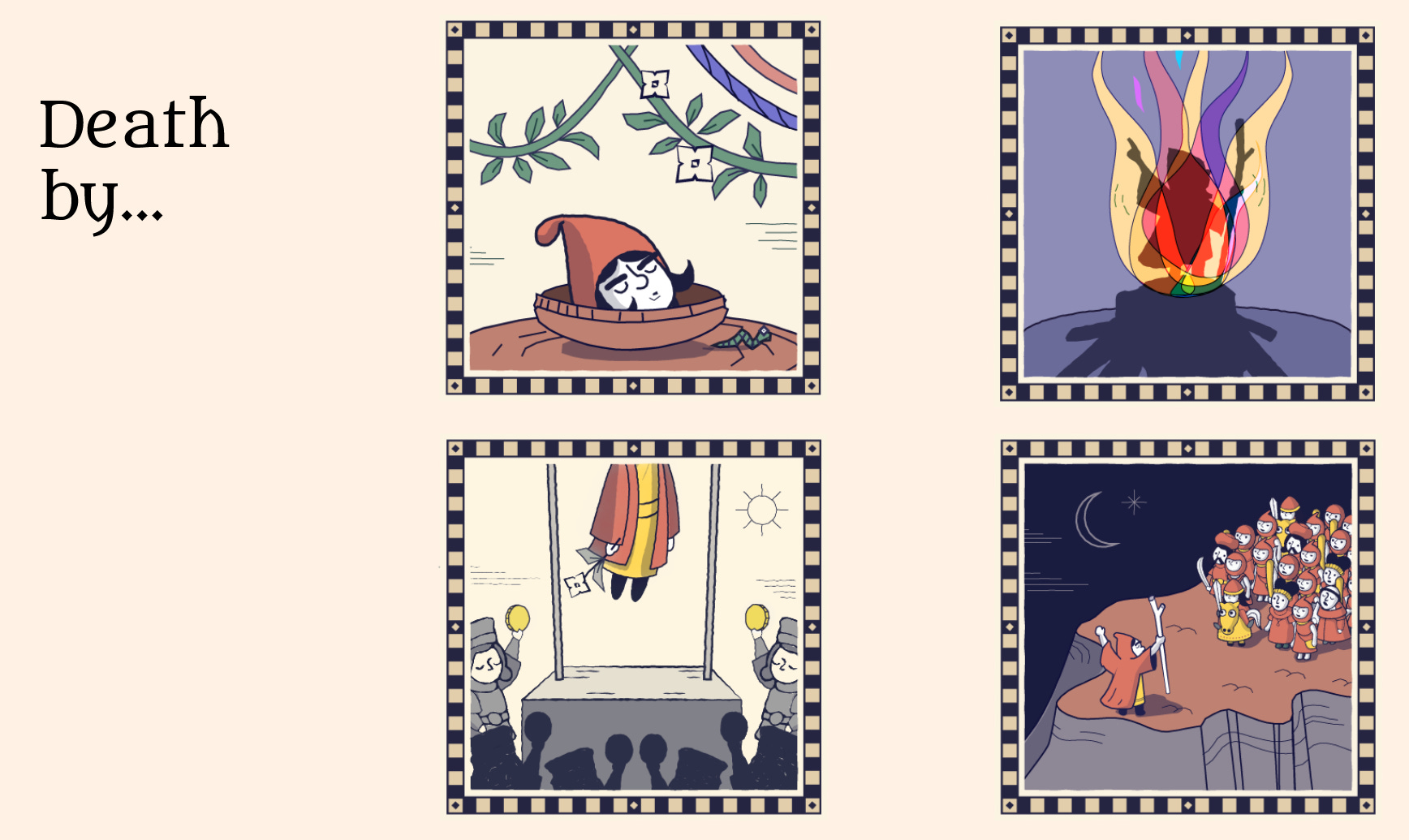
By thinking of you leading the heretic movement through a “temporary delegation”, that can be revoked any time by your followers, either by leaving your movement or, when your behaviour is generally reputed as treason, by throwing you down a cliff:

(Notice perhaps interestingly that the only character dying in Becoming Saint is the player 😅)
By giving followers genuine autonomy: people join and leave the movement at any time by their own “free will”, according to your evolving religious and political choices.
But I am experimenting with a further evolution in Open Lab’s next narrative/tactical/medieval game about the Ciompi’s revolt, by removing the player representation in game entirely and making the “will of the revolt” be wholly determined by those who join it.
Of course, players’ interaction cannot be avoided, but thematising it and semi-consequently breaking the fourth wall also leads to very interesting interaction and narrative design choices.
There are games where the presence and character of the player becomes directly part of the narrative, as in The Stanley Parable; or consider Inscryption, where a small playable board is immersed in an explorable meta space of a different quality.
Removing direct representations of the player or even just limiting their power in-game also opens up different possibilities concerning winning and losing. In the case of Becoming Saint, you always lose — and you never lose, because we shifted the focus of the game from conquering - while alive - to turning saint - while dead.
Similarly, in the upcoming game, the revolutionary movement continues even if the player loses control of it, because of losing the trust of the revolutionaries!
I will be talking about this and other themes (in Italian) soon at the IVPRO event in Trieste, Friday, October 31st, see the full program here.
A little self-promotional space: in Open Lab we currently have an open production slot and are available for new collaborations. If you need a high-quality and yet very cost-effective partner for your applied or commercial game, just write to us. We cover the full development flow from concept research to platform deployment and commercial asset support.
Write to games@open-lab.com. Cheers!
No posts
Comments
Nothing yet. Say the first thing.
Sign in to join the conversation.