
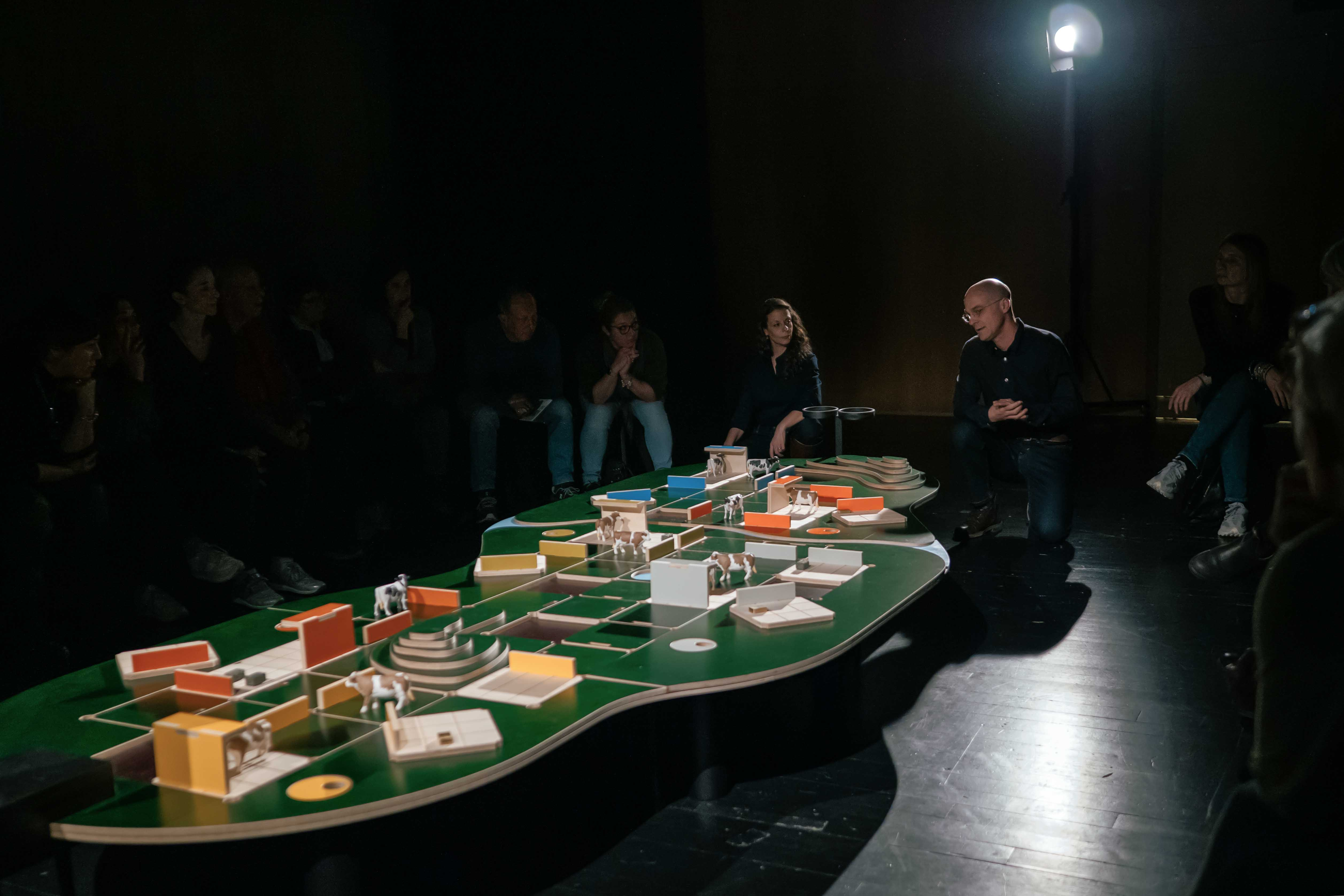
The game is a performance event created by Trickster-p, with whom I collaborated during the entire development as game designer. As a project, it investigates the relationship between performance, game and society.
The creative journey leading to the creation of "The game" was characterised by the constant contribution of game design in identifying precise sets of game rules, mechanics for combining elements, and systems for generating overall effects. Throughout this process, I brought my experience as a game designer for video games and board games, but collaboration with the Trickster-p duo and other team members has always encompassed all dimensions of defining the performative device.
In the evolutionary or defining process of "The game," I contributed in one of the early iterations with a "monstrous" game proposal with various inspirations, all linked to the previously focused theme of economic and market distortions regulating contemporary society.
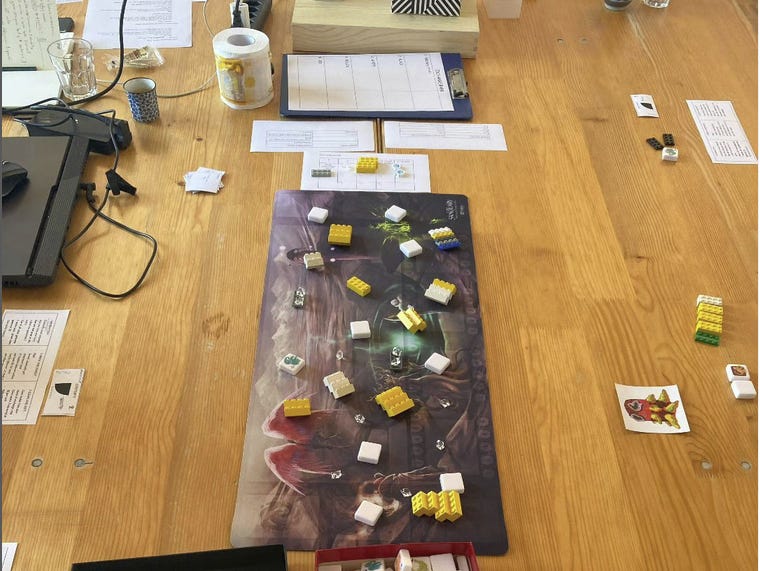
After testing the prototype, drawing inspiration from elements, discarding almost everything, it was simply one of several proposals put forward during iterations. This illustrates Trickster-p's method as collective: placing the central theme at the heart of development dynamics and working concretely and iteratively on drafts, proposals, and solutions.
The team has thus produced various prototypes over time: these have been tested, played, and discussed, selecting ideas and inspirations from each, with an evolutionary approach to design, maintaining focus on the theme thanks to the clear guidance of Cristina Galbiati. In the process’ evolution, roles have continuously reversed: from game designer, I became a player of solutions proposed by others, discussing themes, interpretations, simplifications, and possible unexpected consequences; and the same for all team members, to the point that it would be difficult for me to identify my contribution as a single game designer to the final project. Particularly in the most focused phase, the direct contribution in game design and prototypes by Ilija Luginbühl was what led to completing the project. As he noted, for dramaturgical effect, we had to sometimes “break” the mechanics, as intended in classical board games.
One of the reasons for the quality of Trickster-p's work lies in these frequent prototype iterations and their verification. Within the development of this work, the group itself grows in experience in parallel with the evolution of the performance. The exchange of roles allows for defining the work by integrating all components diegetically with continuous connections to dramaturgical conduct.
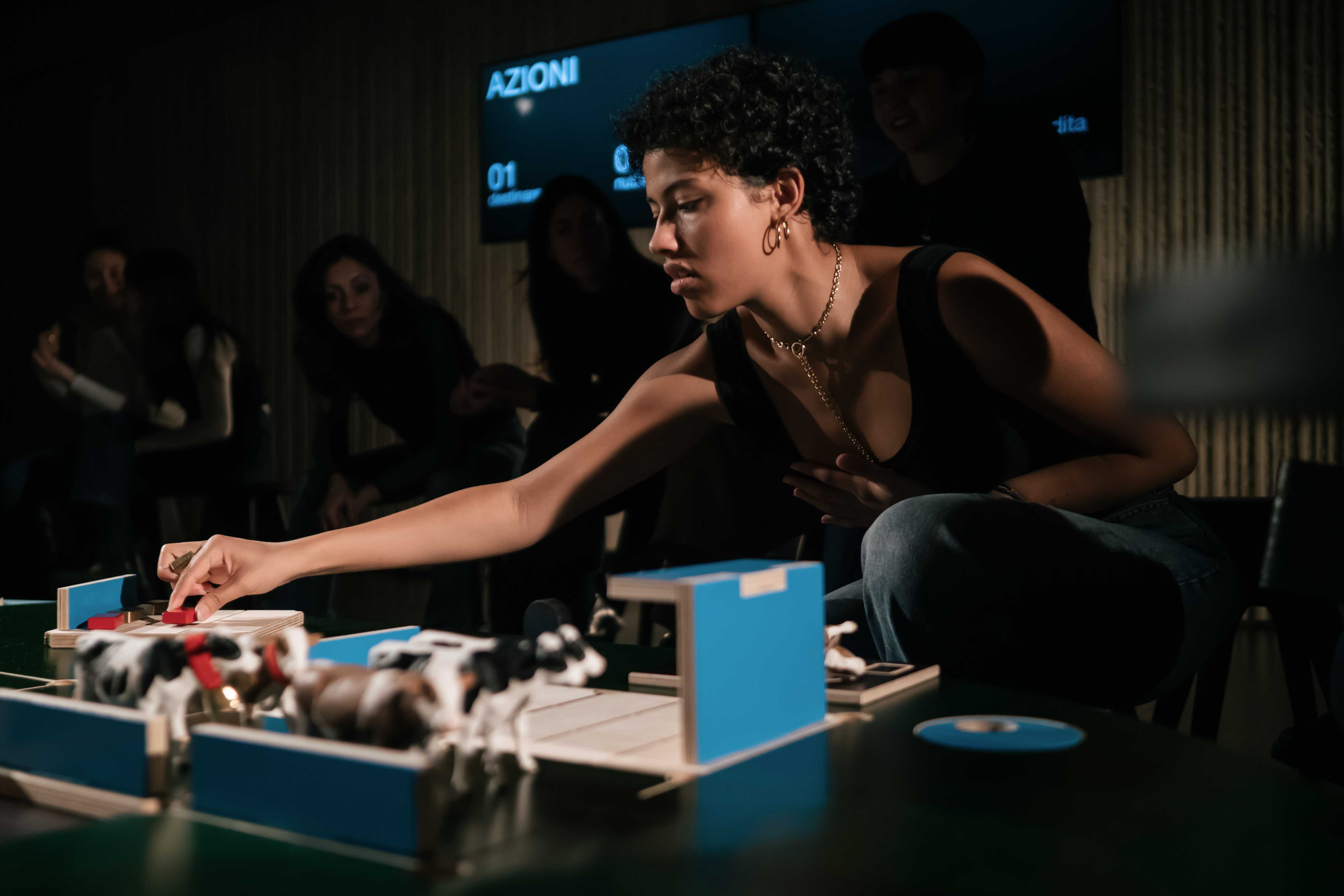
In selecting the technical themes of game design, the group balanced the creation of mechanics allowing for the creation of diversified models, with constraints given by performance themes, player desires, and finally the need to make the game accessible to a wide spectrum of participants, not always familiar with the implicit rituals of board games. All this was collectively managed by the project team, not by me or the individual designer: a common experience was developed, also thanks to the previous performance "Eutopia" which had already pivoted on a board game.
All this research sedimented from the point of view of game design into a gameplay of 12 turns, with a seemingly simple set of evolving rules for managing farms, fields, and "treasures" played by six groups (each of 3-4 people); these rules generate a wide range of scenarios and experiences: each "farm" has its own story and brings out an economic model in relation to the general evolutionary state of the world. As always with rule systems, the combinatorial space generated by a few principles can be vast.
The elegant, minimalist, and evocative style typical of Trickster-p's production influences all dimensions of the game, even the logical flows of the mechanics. Given the multiple dimensions involved in a medium that combines board games, performance, and group interaction, extreme design attention to the player's role is required: this should be able to carry forward the experience in all conditions or circumstances that may arise in different groups of players. In this sense, continuous and iterative interaction between dramaturgical writing, mechanics design, and interaction object design is necessary and unfolds in an improvement process when inserted into series of test sessions, as indeed was done for "The game." Working by combining different media means experimenting with unknown fields and languages through a complex machinery, so the result is never entirely predictable and requires numerous cycles of testing and feedback.
The performative device resulting in "The game" is undoubtedly original and more complex than what was experienced in Trickster-p's previous production "Eutopia," which too combines performance and board game.
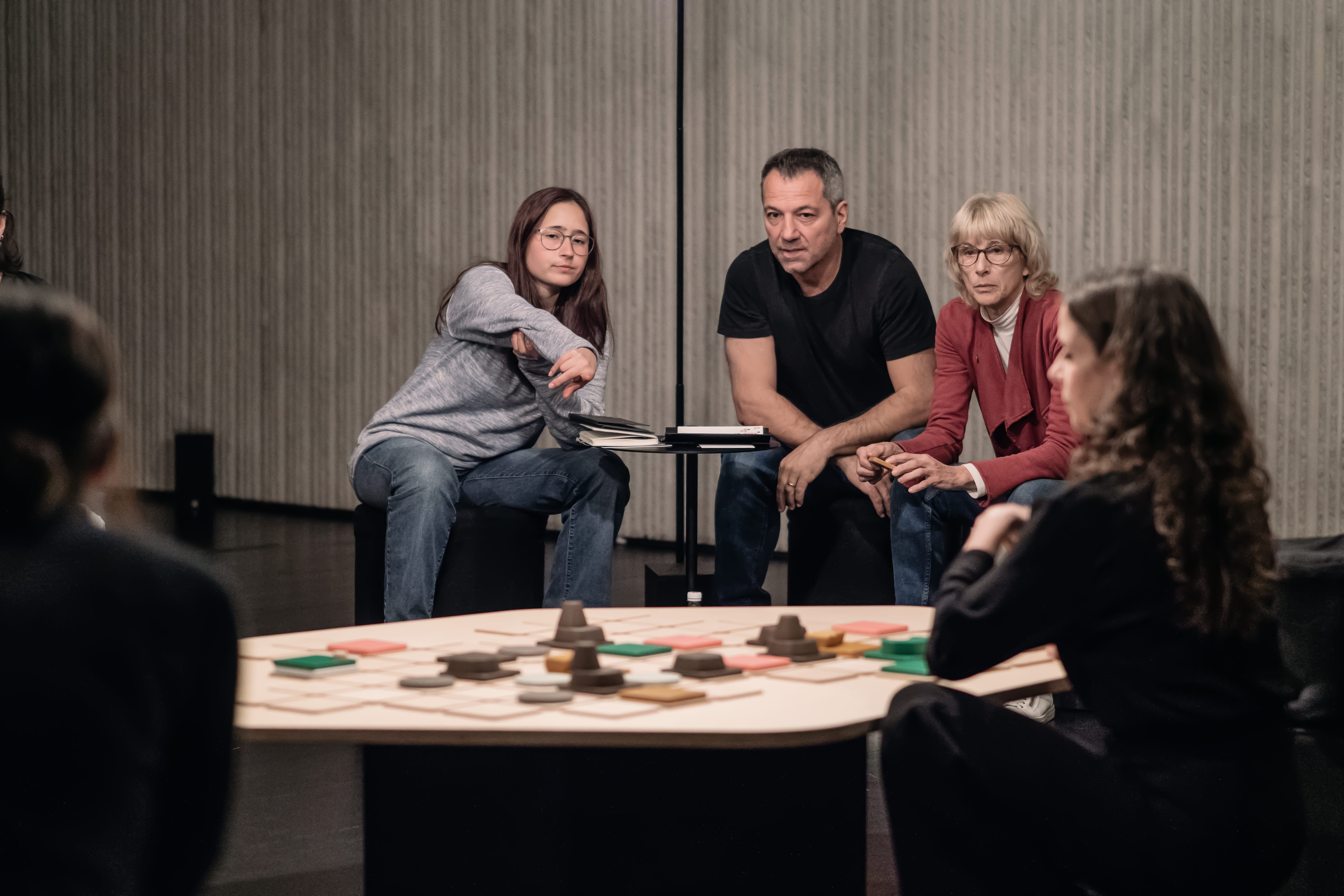
The experience, both with "Eutopia" and with "The game," was an opportunity to experiment with the application of game and narrative design techniques to an unusual medium for a game designer, and therefore an extraordinary opportunity for learning and exchanging experiences, also thanks to a collective work model that considers the quality of the player's experience central to research. I became familiar with contemporary theatre’s critical tools, terminology and roles, which is a rich source of inspiration for game design. I believe this research demonstrates the fertility of applying game design even in a performative context.
The project’s official home page and site with the schedule of performances: https://www.trickster-p.ch/en/projects/the-game.
I thank Elena Viani for substantial feedback on the first draft of this writing.
No posts
Comments
Nothing yet. Say the first thing.
Sign in to join the conversation.