
Team,
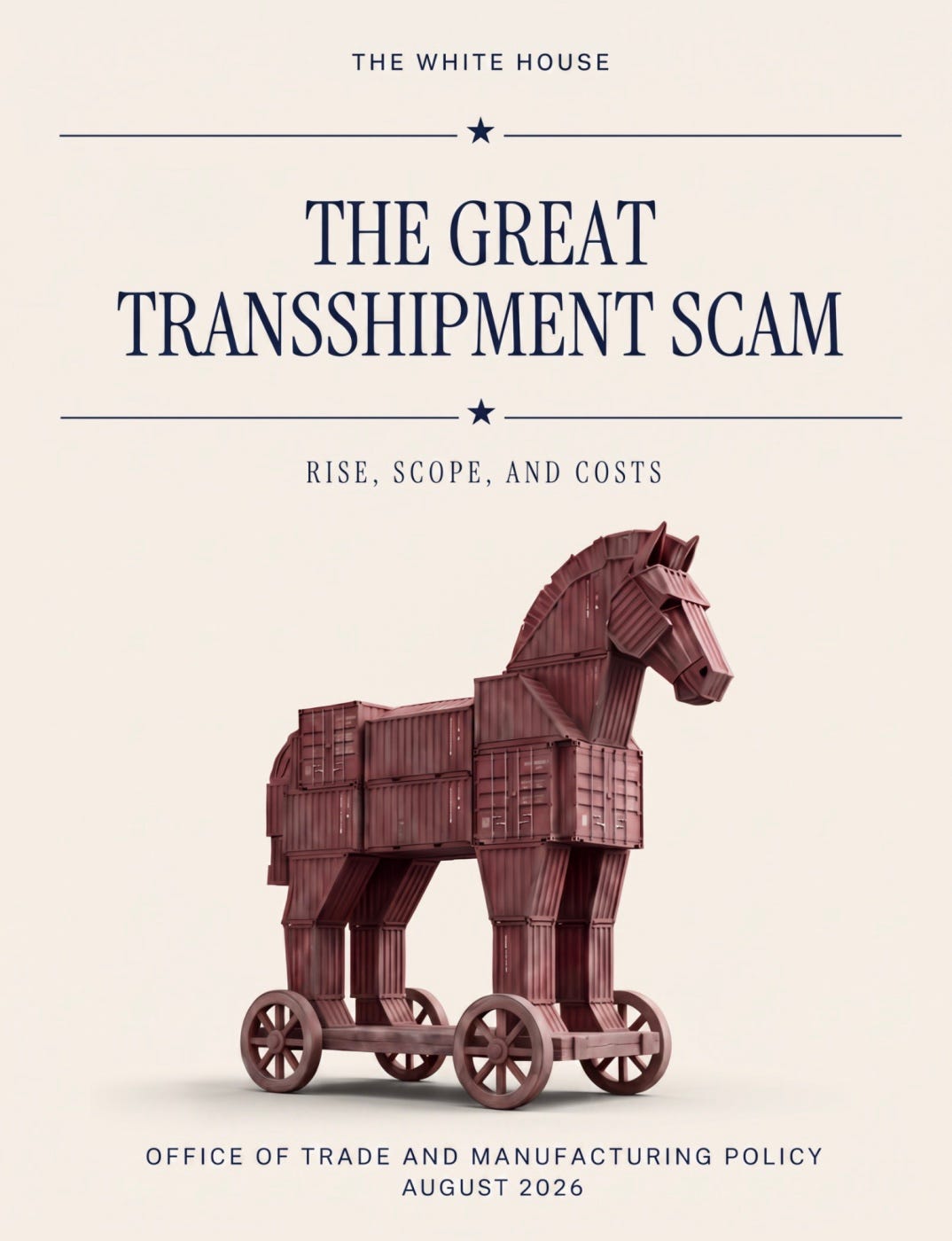
This is my presentation, broadcast by C-SPAN, announcing the publication of my new Great Transshipment Scam report.
During the statement, I walk through the report, which is published on the White House website.
My presentation starts with the observation that every country in the world is allowed to cheat us under the World Trade Organization rules.
That should blow your mind to begin with.
The rules of the WTO allow other countries of the world to charge us higher tariffs and erect higher non-tariff barriers, and up until President Trump stood up for the United States and the American people with reciprocal tariffs, we hadn’t done anything about it.
I was with the Boss throughout the first term, from Day One to the last day. Around the middle of the first term, we put in place Section 301 tariffs on China to defend America against China’s predatory practices, its dumping, its intellectual property theft, its currency manipulation, and its state subsidies.
China is the worst of the worst in terms of predatory trade practices.
We put in place the tariffs, and they have done very well in protecting American workers and American factories. But China immediately began devising schemes to evade the tariffs through transshipment.
As I document in the Great Transshipment Scam report:
From the Great Reallocation to the Great Transshipment Scam
The People’s Republic of China entered the World Trade Organization (WTO) in 2001 with strong support from President Bill Clinton and gained extraordinary access to American markets. Instead of honoring the spirit of its WTO accession commitments, Beijing entrenched a non-market system marked by forced technology transfer, disregard for intellectual property rights, subsidies and industrial policies that create systemic overcapacity and overproduction, deeply embedded market-access barriers, lack of regulatory transparency, and refusal to provide reciprocal treatment to U.S. exports.
Beijing’s mercantilism and surging imports from China across the presidencies of George W. Bush and Barack Obama triggered plant closures, collapsing supply chains, shrinking tax bases, declining labor-force participation, and deteriorating public health across the Midwest, South, and Rust Belt. The result of this massive “China Shock” was the loss of millions of American manufacturing jobs and the hollowing out of large segments of the nation’s industrial and defense base.
On July 6, 2018, President Trump imposed historic tariffs under Section 301 of the Trade Act of 1974 to defend American jobs and factories against Chinese predation, force Beijing to reform its mercantilist system, and reverse this China Shock. These 301 tariffs covered nearly 70 percent of Chinese exports to the U.S. (roughly $370 billion in goods) and marked the first serious challenge in decades to China’s predatory trade model.
While the Trump tariffs significantly reduced the direct U.S. trade deficit with China, Beijing and its exporters quickly adapted to try to mitigate this. Many Chinese products subject to higher tariffs that once moved directly from Chinese ports to the U.S. began to move through lower-tariff countries in a phenomenon known as the Great Reallocation.
China began using these third countries for minor processing, relabeling, repackaging, re-invoicing, or routing changes that created the appearance of a new national origin while leaving the underlying Chinese content largely intact. By routing around the tariffs, China and its state-supported manufacturers and trading firms could push goods into jurisdictions with cheap labor, weak customs oversight, permissive free zones, or preferential U.S. trade access.
Over time, these lower-tariff countries, which number more than 40 today, became the launchpads and hubs of a new evasion architecture: products made largely in China, lightly touched abroad, and exported to America under new identities.
This Great Reallocation represents the creation of a new profit system. Tariff penalties redirected China-linked goods away from direct shipment and toward third-country channels where the gap between high U.S. tariffs on China and lower U.S. tariffs on third countries could be captured, divided, and reinvested. That spread became the financial engine of what would quickly emerge as a global Shadow Transshipment Network.
There are three forms of transshipment. The most obvious is when you have a container full of crates that say “Made in China” on them, and they’ll be shipped by China to a third country like Vietnam or the Philippines and they’ll just fraudulently switch the labels. And because Vietnam, for example, faces a lower U.S. tariff rate than China, China uses Vietnam for tariff arbitrage. They save millions and millions of dollars in tariffs that they would otherwise pay.
An example of this is one I describe in my recent New York Times op-ed, which you can read HERE.
It’s an easy and good read, and I highly encourage you to check it out.
The example is an interesting one that many of us can relate to, especially those who have recliners at home or have family or friends with recliners.
You start with a recliner, which often has motors that move it up and down and run some of the massage functions. And Vietnam actually has real recliner factories where they make the furniture part of the recliner. But what Vietnam also does is import the motors that run the recliners from China.
And in too many cases, when Vietnam ships an alleged “Made in Vietnam” recliner to the United States, on the customs forms they report that the motor was also made in Vietnam when it was not. And we can catch them doing exactly those kinds of things.
The second big way that transshipment takes place is through what I call “screwdriver factories.” That’s where China will literally ship boatloads of parts to a third country, and that third country will have facilities—big buildings that are not real factories—that take those parts and, with a screwdriver and pliers and just a few tools, assemble—not manufacture—the parts into a finished product in a way that doesn’t meet the threshold of what’s called substantial transformation.
These are screwdriver factories for final assembly, which have been constructed and used as fronts for illegal tariff evasion purposes. And the transshipped goods have been sent from these third-country screwdriver factories to the United States and have evaded tariffs.
The third way that transshipment takes place is via free-trade zones in countries like Cambodia, including through Cambodia’s Sihanoukville Special Economic Zone, notorious for its use by China for illegal transshipment of Chinese goods and human rights abuses.
As the Encyclopedia Britannica has taken note, “In 2006 the city [Sihanoukville] became the center of the Sihanoukville Special Economic Zone (SSEZ), a joint venture between the Cambodian and Chinese governments. After the launch of the Belt and Road Initiative (BRI) in 2013, the SSEZ was showcased as a flagship BRI project.”
And the major problem of illegal transshipment from free-trade zones in Cambodia and other third countries was recognized during the first Trump Administration after Section 301 tariffs on China were implemented, as this 2019 Reuters article illustrates.
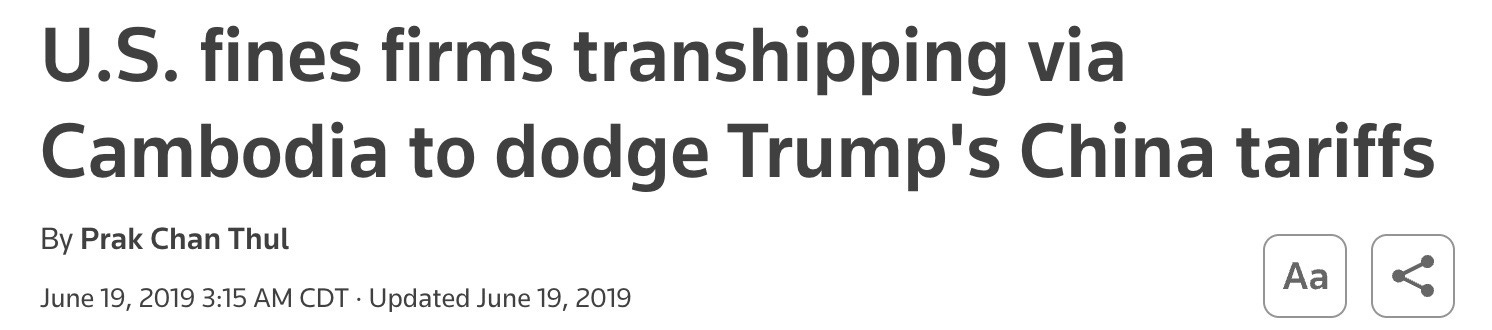
The Reuters article, published in June 2019, reports:
The United States has fined several companies for exporting goods via a Chinese-owned special economic zone in Cambodia in a bid to dodge President Donald Trump’s tariffs on Chinese imports, a U.S. Embassy official told Reuters on Wednesday.
Earlier this month, Vietnam’s customs department said it had also found scores of cases of exporters illegally relabelling Chinese goods as “Made in Vietnam” in order to avoid tariffs imposed as a result of the ongoing U.S.-China trade war.
…China is Cambodia’s biggest aid donor and investor, pouring in billions of dollars in development assistance and loans through the Belt and Road initiative, which aims to bolster land and sea links with Southeast Asia, Central Asia, the Middle East, Europe and Africa.
The Sihanoukville Special Economic Zone (SSEZ), 210 kilometers (130 miles) west of the capital, Phnom Penh, is a Chinese and Cambodian joint venture in the Belt and Road initiative which produces textiles, garments, bags and leather products, according to its website.
…Under a trade agreement that was expanded in 2016, the Generalized System of Preferences (GSP) allows Cambodia to export travel goods such as bags, luggage and accessories, to the United States duty free.
…The $7-billion apparel industry is the largest formal employer in the Southeast Asian country. Cambodia’s economy grew 7.5 percent last year, a four-year high, compared with 7 percent in 2017, helped by rising exports to the United States, the World Bank said in April.
Note in the final paragraph of the preceding excerpt that Reuters refers to the apparel industry as Cambodia’s “largest formal employer.”
Third-country free-trade zones like Sihanoukville in Cambodia specifically provide China with preferential treatment on tariffs, and China goes into these third-country free-trade zones, sets up operations there, and transships products to the United States through them.
In the Great Transshipment Scam report, I obtain estimates of transshipment levels. I look at five different estimates, two from the government and three from the private sector.
And the estimates of annual transshipment flows are astonishing. Conservatively, they’re in the range of $40 billion to $60 billion every year. And the level is more likely $100 billion or higher.
Government estimates were provided by the Council of Economic Advisers and the Department of Commerce.
Outside the government, estimates were from Goldman Sachs, a firm called Altana, and my favorite, a firm called Exiger, an AI-enabled firm that is doing a really good job helping root out a lot of the transshipment.
As I write in the report:
Each [estimate contributor] uses a distinct methodology and dataset, ranging from goods flow analysis to shipment-level tracing, macro-level econometric modeling, and facility-level supply chain mapping. While no single methodology can fully capture a clandestine activity designed to evade detection, the convergence of these five independent analyses provides a data-grounded picture of the scale of the illegal transshipment problem, and a reliable range, drawing from high-level aggregate estimates at the upper bounds and highly granular, product-specific analysis alike.
Below is a summary of the estimates from the Great Transshipment Scam report.
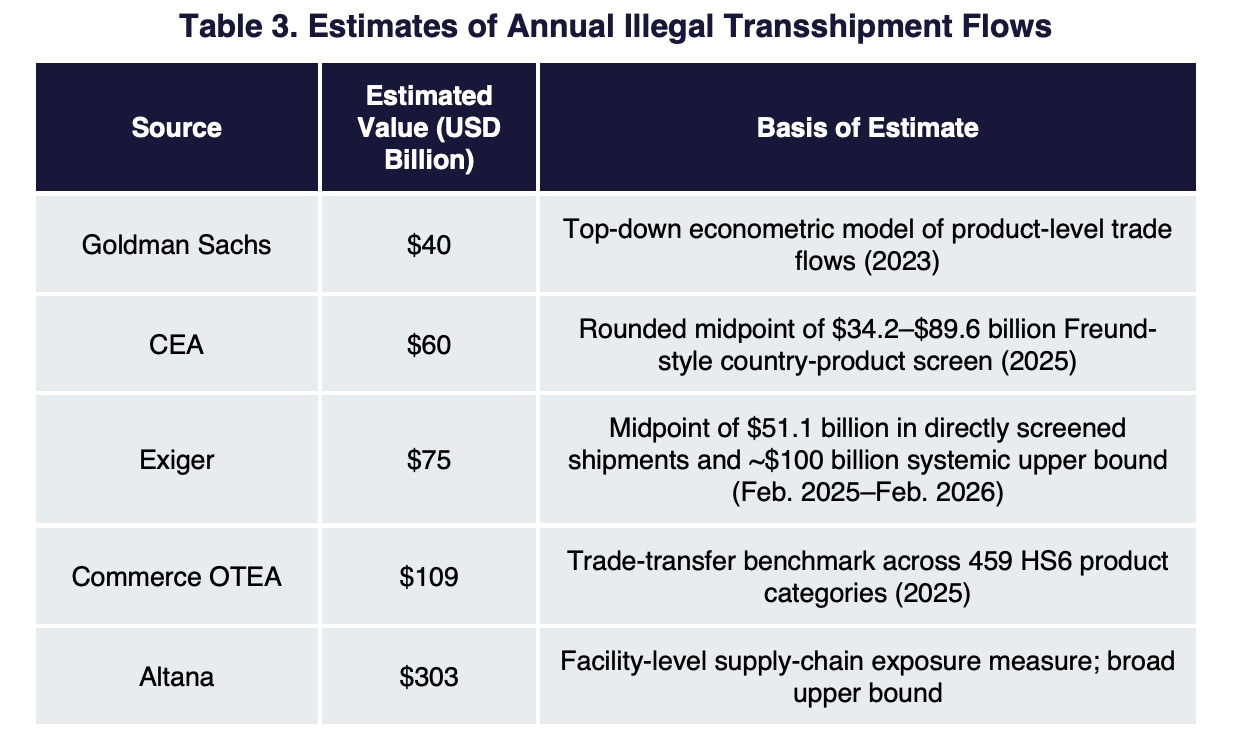
In the Great Transshipment Scam report, we start with the estimates of the annual flow of transshipment. From there, we know what the U.S. tariff rates are on China, for example, and we can compare the higher U.S. tariff rates placed on goods from China versus the lower tariff rates placed on goods from other countries. And it’s that spread that leads to the illegal transshipment arbitrage. And we calculate how much we lose in tariff revenues every year from this.
The base case is about $25 billion lost every year to the Great Transshipment Scam and to the Shadow Transshipment Network of 40-plus countries.
That may sound like an abstract number, but I can tell you it’s enough to—perhaps ironically—fund the entire budget of Customs and Border Protection (CBP). It’s enough to fund the entire budget of the Department of Agriculture. It’s enough to fund the Space Force. This is shown in the table below from the Great Transshipment Scam report.
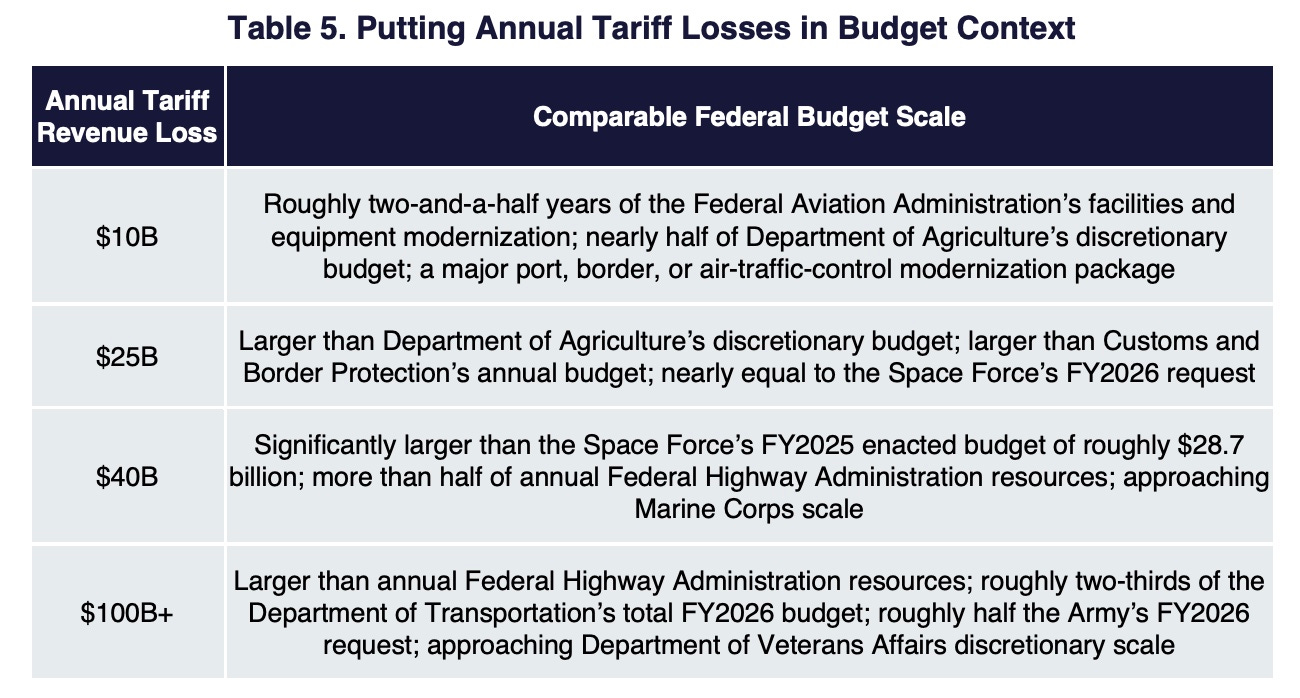
These are big dollars that matter. The Great Transshipment Scam is not merely shifting trade flows. It is draining the U.S. Treasury of funds that could otherwise strengthen the border, rebuild roads and ports, modernize air-traffic control, support farmers and veterans, recapitalize military services, and restore America’s manufacturing and defense industrial base.
And the Great Transshipment Scam doesn’t only affect tariff revenue. It also has a zero-sum effect on American jobs, workers, and our industrial base. I detail this in my Great Transshipment Scam report analysis of what I call the “Ugly Sister City” comparison.
We all know about traditional sister cities. They’re the feel-good ones where a city in Denmark might match up with a city in Minnesota and they have cultural exchanges and things like that.
An Ugly Sister City is formed when you have products that are shipped to Ho Chi Minh City in Vietnam, for example, and then transshipped to the United States.
What I show with the Ugly Sister City comparisons in the Great Transshipment Scam report is how the transshipment of motors, switches, and other products causes Americans producing the same products in Cleveland, Toledo, and cities across America to lose their jobs.
The Great Transshipment Scam report conservatively estimates that 6,000 U.S. jobs are displaced for every $1 billion increase in the trade deficit associated with illegal transshipment.
That’s what’s at stake here.
Featured Ugly Sisters in the Great Transshipment Scam report include Ho Chi Minh City in Vietnam; Guanajuato and Querétaro in Mexico; Pune, Gujarat, and Chennai in India; Gyeonggi in South Korea; Penang and Kulim in Malaysia; Bekasi and Batam in Indonesia; Ayutthaya and Samut Prakan in Thailand; Caucedo and Haina in the Dominican Republic; and Limon and Moín in Costa Rica.
Below is an excerpt from the Ugly Sister Cities section of the Great Transshipment Scam report.
Ugly Sister Cities in a Zero-Sum Game
Moving now from the 30,000-foot macroeconomic view of the Great Transshipment Scam to a factory-floor perspective, a set of “ugly sister city” comparisons show how Chinese transshipment equates to a zero-sum transfer of production from American soil to foreign jurisdictions.
The foreign–U.S. city pairings in Table 7 on the following page reveal the micro-geography of trade diversion: as activity rises in foreign staging points handling China-linked goods, the corresponding American manufacturing corridors come under direct pressure.
These are not sister cities in the cultural sense. They are the “ugly sisters” of modern zero-sum global trade, paired not by civic partnership, but by the logic of American jobs lost to unfair trade.
These ugly sisters are illustrative rather than exhaustive. They cover only a small sample of the countries, product lines, and American industrial corridors affected by the Great Transshipment Scam. Yet each pairing displays the same zero-sum arithmetic. When China-linked goods enter the U.S. through a transshipment hub under a new national identity, American producers in the corresponding product line face lost orders, lower utilization, and reduced employment.
The pairings in Table 7 were developed by matching high-volume illegal transshipment-risk HTS product lines to the corresponding U.S. industrial base. The trade side begins with HTS product categories showing significant China-linked rerouting risk in the CEA, Commerce OTEA, Exiger, and Goldman Sachs analyses. Those product lines are then mapped to corresponding NAICS manufacturing industries using USITC DataWeb and Census trade concordance tools, which translate HTS import categories into domestic industry classifications.
The domestic geography is identified from Census County Business Patterns and BLS Quarterly Census of Employment and Wages data, which report establishments, employment, and payroll by NAICS industry at the county, metro, and state levels. The resulting pairings are therefore not cultural “sister city” relationships. They are product-to-industry matches: foreign corridors handling high-risk China-linked goods are paired with American manufacturing corridors where firms and workers produce the same or closely related products…
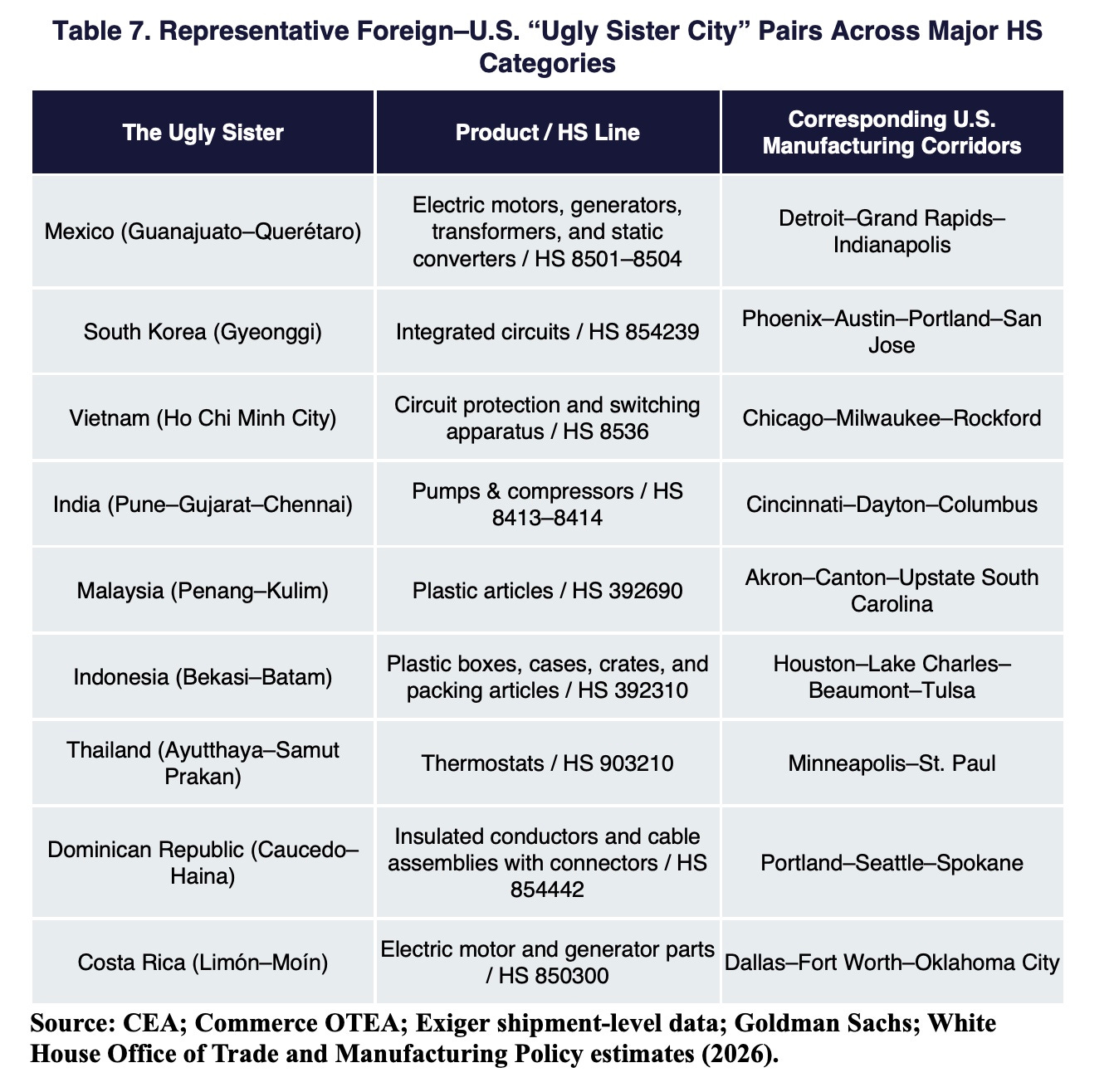
…These examples show how illegal transshipment converts foreign staging points into direct pressure on American manufacturing communities. Electric motors, static converters, integrated circuits, circuit-protection equipment, pumps, compressors, plastic articles, thermostats, cable assemblies, and motor parts all map onto specific U.S. industrial corridors.
As illustrated by these pairings, when China-origin goods enter the U.S. market under new identities, American factories, machine shops, metal fabricators, electronics producers, plastics firms, and logistics workers lose orders that should have stayed at home.
The message of these ugly-sister city snapshots is that tariff evasion is a zero-sum game. America loses when these hubs win. And the longer the system operates unchecked, the harder it becomes to restore lost industrial capacity. Unless addressed with meaningful enforcement, the world’s illegal transshipment hubs will continue to siphon off American manufacturing one product line at a time.
And as I write in the report:
…illegal transshipment is not merely a customs problem. It drains tariff revenues at the border, widens the effective trade deficit, displaces factory and supplier jobs, reduces GDP growth, and erodes the tax base needed to rebuild America’s manufacturing and defense industrial base. These losses accumulate in the industrial geography of the U.S.—in factories, machine shops, logistics networks, and Main Street businesses across America’s manufacturing communities.
Here’s what we’re doing about this.
It’s a three-pronged attack.
President Trump recently signed an executive order, titled “Strengthening Customs Enforcement,” that allows Customs and Border Protection to be much more muscular about cracking down on transshipment and illicit activities. And CBP is doing that as we speak.
The second thing we’re doing, which is truly remarkable, requires a little bit of history.
In the old days, when you were trying to bust exporters for illegal drugs or illegal transshipping and smuggling it came down to humans with green eyeshades and paper forms that were coming from foreign countries. But as the level of trade has increased so much, it’s been like a tsunami, and we simply can’t handle that in real time.
So, what we’re doing is moving to what’s called an artificial intelligence-enabled Detective Border. With the AI-enabled Detective Border, we can now have eyes on every ship and every container at every port around the world getting ready to come to the United States. And at the speed of the Great Transshipment Scam, we can assess the probability that each cargo is transshipped, so that when it arrives at a U.S. port in Baltimore or Los Angeles or anywhere in between, we’re ready to bust them and get the money that they owe America.
Another interesting thing about this is that after we find one shipment from a company that is trying to evade tariffs through transshipment, we can essentially recover related tariff revenues for the whole calendar year. So, this is going to run into the billions.
We’re rapidly scaling this up.
Here’s an excerpt from the AI Detective Border section of the Great Transshipment Scam report.
The AI Detective Border: A Global Warning
At its core, this Detective Border continuously ingests and analyzes global trade data. Algorithms compare declared origins, routing histories, and component content against expected patterns, revealing inconsistencies that no human could catch at scale. The Detective Border amplifies the effectiveness of CBP’s existing risk-based targeting models, directing CBP officers to the highest-probability offenders and multiplying the productivity and precision of every enforcement action.
The Detective Border should help distinguish legitimate foreign direct investment and nearshoring from illicit transshipment. AI-enabled verification should also produce more precise estimates of the value of illicit transshipment.
Artificial intelligence also links the field to the factory. Computer-vision scanners and machine-learning models embedded in port infrastructure now analyze container markings, packaging patterns, and X-ray imaging to detect mismatches between declared and actual cargo. This new, high-tech enforcement layer is designed to ensure that every product’s digital identity matches its physical reality. Goods that once slipped through gaps in paperwork will now face a system designed to identify, track, and intercept them in real time.
The message to the world is simple. The age of untraceable illegal transshipment is over. What once seemed like quiet paperwork maneuvers—relabeling, repackaging, re-invoicing—has become a matter of economic sovereignty and national will.
The United States under President Trump will simply not allow its manufacturing and defense industrial foundation to be hollowed out by trade fraud masquerading as commerce. The same advanced data systems that map global supply chains for industry will now illuminate them for enforcement.
The objective is clear: every bill of lading, shipping manifest, and certificate of origin should pass through an AI-driven net that never sleeps, never tires, and never forgets. Countries that relabel or reroute tariffed goods to evade U.S. law should face immediate interdiction, penalty tariffs, sanctions, and potential loss of market access. Tariff evasion can no longer remain a low-risk, high-profit strategy. It must become a direct path to exclusion.
…CBP’s emerging Detective Border marks the beginning of the end of the Shadow Transshipment Network and the Great Transshipment Scam, and the beginning of a new era of tariff integrity, industrial renewal, and American enforcement that works.
This is a warning to the world.
Higher tariff countries, stop transshipping. We’re going to catch you.
Lower tariff countries, don’t enable this.
The lower tariff countries have a particular warning here because the third portion of our enforcement is at the United States Trade Representative level.
The big picture here is that with President Trump’s reciprocal tariffs that have been imposed on these countries for cheating us, what every country in the world is trying to do now is negotiate a way out of those higher tariffs. And the only way they’re going to do that is by lowering their tariffs and giving us a better deal.
But there’s also an important clause in every one of those trade deals that Jamieson Greer, the U.S. Trade Representative, is negotiating. One of Jamieson Greer’s visionary actions is putting provisions in those reciprocal trade deals that give us the right and the ability to impose penalties on countries if they violate not just the letter of the law when it comes to transshipment, but also the spirit of the law.
We’re cracking down hard.
I encourage you to read the full Great Transshipment Scam report, which you can find HERE.
And you can read my introductory op-ed in the New York Times HERE.
I love reading your comments. Please share this far and wide.
Peter
TRANSCRIPT
ANNOUNCER: We’re going to leave this here and take you live now to the White House where an Administration official is speaking to reporters. You’re watching live coverage.
DR. NAVARRO: —Transshipment Scam. I’ve uncovered more than 40 countries, more than 40 countries are involved in facilitating this Great Transshipment Scam. And every time they get away with it, it’s money that would otherwise go to the U.S. Treasury. It’s jobs that would otherwise be here in America. It’s tax revenues from the growth associated. So, what I’m going to do is just quickly walk you through the report. It’s on the White House site, WhiteHouse.gov, the Great Transshipment Scam. So, the way this starts is with the observation that every country in the world is allowed to cheat us under the World Trade Organization rules. And that should just blow your mind to begin with. The rules of the WTO allow other countries of the world to charge us higher tariffs, erect higher non-tariff barriers, and there’s nothing we can do about it, except for Donald Trump and his reciprocal tariffs program that he’s putting in place.
I was in the first term with the Boss from Day One to the last day. About midterm of the first term, we put in place Section 301 tariffs on China to defend America against their predatory practices, the dumping, the intellectual property theft, the currency manipulation, the state subsidies. They are the worst of the worst in terms of predatory trade practices. We put in place these tariffs. The tariffs have done well, very well, protecting American workers and American factories, but China immediately began devising schemes to evade the tariffs through transshipment. The forms of transshipment are three, with the most obvious is when you have a container full of crates and the crates say “Made in China” on them. And they’ll go to a place like Vietnam or the Philippines and they’ll just switch the label. And because, say, Vietnam has a lower tariff than China, that’s tariff arbitrage. They save like millions and millions of dollars in tariffs they would otherwise have.
And I would refer you also to the New York Times op-ed today on this. That’s an easy read. It’s a good read, and you’ll see. And the example there is kind of interesting. And so, I’ll pay a little homage to the New York Times here. You start with a recliner. Like, a lot of you have recliners at home. You enjoy recliners. You recline, and a motor takes it down and motors run some of the massage stuff and things like that. And Vietnam actually has real recliner factories where they make the furniture part of the recliner. But what Vietnam also does is imports the motors from China to run the recliner. And in too many cases, when Vietnam ships an alleged “Made in Vietnam” recliner to the United States, on the customs forms they report that the motor was also made in Vietnam when it was not. And we can begin to catch them doing exactly those kinds of things.
So, the second big way that transshipment takes place is through what I call screwdriver factories. That’s where China will ship a boatload, literally, of parts over to a country and they’ll have a facility that takes those parts and with a screwdriver and a pliers and just a few tools, they’ll assemble it in a way which doesn’t meet the threshold of what’s called substantial transformation. It’s just a screwdriver factory. And they send it and they evade the tariffs.
And the third way is that some countries like Cambodia have these free-trade zones where they get preferential treatment on tariffs and China goes into them and sends us stuff, and that’s another way they do it. So, what I do in this study is I get the estimates of the level of transshipment. I looked at five different estimates, two government, three private sector. And the estimates of the annual transshipment flows are astonishing. They’re in the range of 40 to 60 billion dollars a year, very conservative. It’s more likely a hundred billion dollars or more. Within the government, it was the Council of Economic Advisers and the Department of Commerce. Outside the government, it was Goldman Sachs, it was a firm called Altana, and my favorite is a firm called Exiger, which is an AI-enabled firm, which is doing a really good job in terms of helping root out a lot of this transshipment. So, here’s the thing. So, we estimate in this report, The Great Transshipment Scam, we start with what the flow is, the annual flow. And then from there, we know what the tariff rates of, say, China are, the high tariff rate versus the lower tariff rates of other countries. And it’s that spread that leads the arbitrage. And we calculate how much tariff revenues that we lose every year. And the base case is about 25 billion dollars lost every year to the Great Transshipment Scam and to the Shadow Transshipment Network of these 40-plus countries. Now, that’s an abstract number, but I can tell you it’s enough to, perhaps ironically, fund the entire budget of Customs and Border Protection. It’s enough to fund the entire budget of the Department of Agriculture. It’s enough to fund the Space Force. And it’s enough to fund half of the entire Army budget. So, these are big dollars that matter. Now, what are we doing to crack down on this scheme? Before I tell you that in the big reveal, I also want to tell you about the job effects. Besides the tariff revenue effects, we do this kind of fun little analysis of what I call the “Ugly Sister City” comparison.
You all know about sister cities, right? They’re the feel-good ones where Denmark matches up with Minneapolis. We have a city in Denmark match up with one in Minnesota and they [have] cultural exchanges and all of this kind of stuff like that. The Ugly Sister City thing is when you have a product that’s transshipped to a city in, say, Vietnam, Ho Chi Minh City, for example. And then it comes here. And what I can show with the Ugly Sister City comparisons is how when the transshipment takes place with a motor or a switch or whatever it is, there’s jobs lost in Cleveland or Toledo or cities all around America. And that’s what’s at stake here.
Now, here’s what we’re doing about this. It’s a three-pronged attack. Last month, just a few weeks ago, in fact, President Trump signed an executive order which allows Customs and Border Protection to be much more muscular about cracking down on transshipment and illicit activities. And CBP is doing that as we speak.
The second thing we’re doing, which is truly remarkable, requires a little bit of history. In the old days, when you’re trying to bust exporters for illegal drugs or illegal transshipping, smuggling, and all of that, it came down to humans with green eyeshades and paper forms that were coming from foreign countries. But as the level of trade has increased so much, it’s been like a tsunami, and we simply can’t handle that in real time. So, what we’re doing is moving to what’s called an AI, an artificial intelligence-enabled. Well, we’re moving to an AI-enabled Detective Border, artificial intelligence-enabled Detective Border, so that now we can have eyes on every ship and every container at every port around the world getting ready to come to us. And at the speed of the scam, we can assess the probability that some of that is transshipped goods, so that when it arrives at the U.S. port, you know, Baltimore or LA or anywhere in between, we’re ready to bust them and get the money that they owe America.
And what’s interesting about this, and I didn’t know this until I began working with CBP closely, is once we find one shipment from a company evading tariffs through transshipment, we can basically recover tariff revenues for the whole calendar year. So, this is going to run into the billions. We’re rapidly scaling this up.
The warning to the world: higher tariff countries, stop doing this. We’re going to catch you. Lower tariff countries, don’t enable this. And the lower tariff countries have a particular warning here because the third portion of our enforcement is at the United States Trade Representative level. The big picture here is that with the Trump tariffs that have been imposed, or the reciprocal tariffs, because these people cheat—make no mistake, they cheat us—what every country in the world is trying to do now is negotiate a way out of those higher tariffs. And the only way they’re going to do it is by lowering their tariffs and giving us a better deal. But—but there’s also an important clause now in every one of those trade deals that Jamieson Greer, the U.S. Trade Representative, is negotiating. And he’s a visionary. Jamieson Greer, the USTR, is the most visionary USTR we’ve ever had. And one of the visions he’s seen is to put in those reciprocal trade deals something that’s never been in trade agreements before. This is the right and the ability to impose penalties, not just if countries violate the letter of the law and transship, but also the spirit of the law. So, we’re cracking down hard.
That’s the Great Transshipment Game. And go to WhiteHouse.gov and you can read all about it. You can also check it out in the op-ed in today’s online edition of the New York Times, and tomorrow it’ll be in the print edition. Thank you for listening. I’ll take a few questions now. Yes, ma’am.
REPORTER: [INAUDIBLE]
DR. NAVARRO: That’s a USTR function, but I don’t have enough fingers on my hands to tell you how many there are. It’s a very, very active negotiation. And I would just—I mean, it’s no secret, either. Just call USTR, they’ll tell you.
REPORTER: [INAUDIBLE]
DR. NAVARRO: No, I—we’ll never have zero tariffs because they cheat us so bad and there’s just so many things embedded. And all we’re trying to do here is level the playing field so that American workers and American businesses compete fairly. And we’re about as far from that as I am from San Diego right now. Okay? Yes, ma’am. Anything? All right. We’re good. Thank you.
Comments
Nothing yet. Say the first thing.
Sign in to join the conversation.