
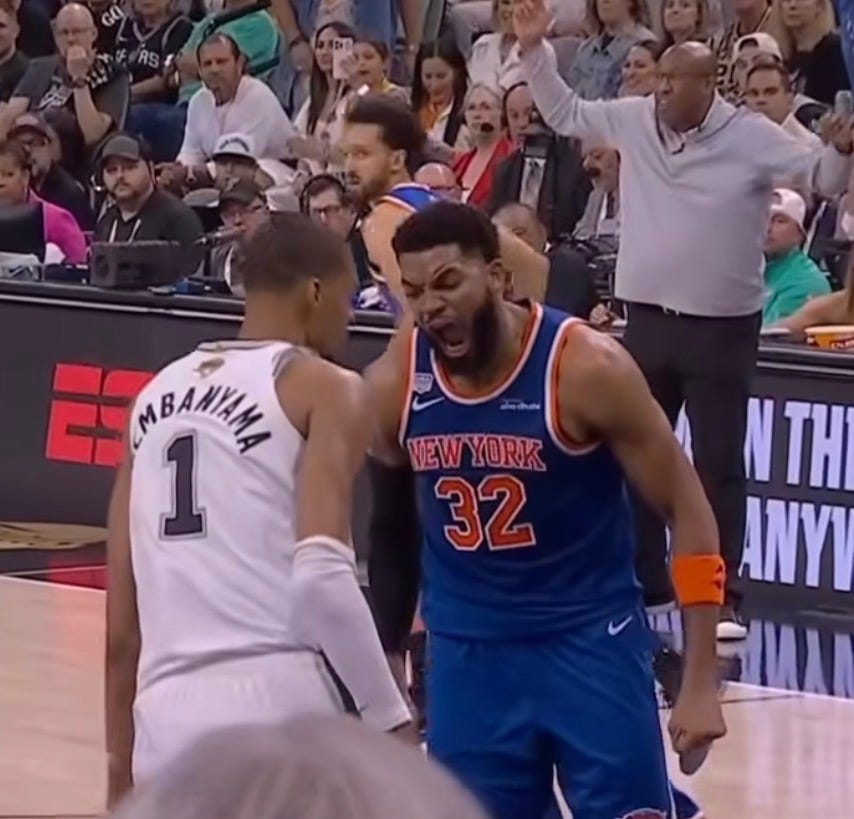
Up 2-0!!
For the first time in fifty-three years, New York is two wins from a basketball championship, and for the first time in roughly as long, New York agrees about something. The Knicks lead the Spurs two games to none, both of them stolen on the road, the kind of start that has produced a champion every prior time it has happened. The city is electric in a way that does not divide it. On Friday night, six and a half thousand people stood outside Madison Square Garden to watch a screen. They did not first sort themselves by borough, income, or party. That is rarer than a 2-0 lead, and more valuable.
Into this, on Monday, walks the President of the United States, courtside, the guest of the team’s owner, the first sitting president ever to attend a Finals game. He has not been to a Knicks game at the Garden in over a decade. He was twenty-six and new to his father’s business the last time this team won a title. He is not coming to watch basketball.
It helps to be precise about what attention actually is, because attention is the thing in play. A shared object of attention is the substrate of a community — it is the closest a city of eight million strangers ever comes to a single nervous system. For three or four nights, the Knicks have given New York a shared reality that asks nothing in return and excludes no one. That is not a small civic good. It may be the only good of its kind we still manufacture.
A man whose entire method is the fracturing of shared reality cannot leave such a thing alone. The fracture is not incidental to him; it is the product. He does not sow chaos because he is careless. He sows it because a population that agrees — even about something as innocent as a jump shot — is a population that is briefly immune to him. Unanimity is his solvent’s opposite. So he arrives to dissolve it, to convert a commons into a stage, to make certain that when the cameras find his seat the building splits cleanly down the middle into the sound he feeds on. The cheer and the boo are the same to him. Either one means the room is finally, properly, about him again.
It would be dishonest to pretend the Knicks are otherwise untouched by politics this spring. The city’s mayor, Zohran Mamdani, is a genuine fan and a gifted one — sitting in the nosebleeds at the conference finals, signing a Comic Sans executive order to repeal children’s bedtimes for the duration of the series, tagging the Sanitation Department to “report a sweep” when the Knicks swept Cleveland. He has also, plainly, harnessed the moment for his politics, cutting ads and lending the wave to candidates he favors. The honest distinction is not that one man is using the Knicks and the other is not. It is the kind of use. Mamdani is channeling a joy that already exists, from inside the tribe, as one of us — and being liked for it. That is precisely the problem the President means to solve.
Because the threat Mamdani poses is not that he is radical. It is that he is loved, and effective, and that the two are visibly connected. So the work on Monday, and after, will be to break that connection: to reach for the oldest flashcards in American politics — socialist, radical, foreign — and recode a popular, competent mayor into something menacing, so that “beloved and effective” can be quietly replaced with “dangerous and strange.” We have already seen the trailer. On the night Mamdani won, the official White House account posted the Knicks’ own logo doctored to read “Trump Is Your President,” then deleted it. The instinct is the tell. Even a city’s basketball team must be annexed; even a stranger’s victory must be made to refer back to him.
This is, in the language of systems, a leverage point: a minimal input — one man, one seat, one hundred twenty minutes — calibrated for maximal effect on the narrative the city tells about itself. It costs him almost nothing. It reorganizes everything. By Monday the Secret Service will have imposed TSA-style screening on fans who saved for a year, a no-bag policy, a redrawn perimeter, all so that one spectator can be a participant.
And that is the final, smallest, most revealing thing. Roughly nineteen million New Yorkers will watch this team try to finish what it started, and all but a handful will do it the way love actually behaves — from couches, from bars, from the street outside the arena, applauding something larger than themselves and asking nothing back. That is what it looks like to care about a thing for its own sake. The grace of the spectator is the willingness to disappear into the event.
He is incapable of it. He cannot watch from afar, cannot let a moment be about someone else, cannot be a fan among fans, because to be moved by something larger than oneself is exactly the faculty he lacks. The justification, stripped of everything, is not love of the team or the city or the game. It is simply: because he can. And the inability to do otherwise is not strength. It is a kind of poverty — the condition of a man who can be stirred only by his own reflection, and who therefore must turn every mirror, including this one, until it shows him his face.
So here is the discipline New York should bring to Monday night. Do not give him the story. The boo is a donation; withhold it. Keep your eyes on the only thing in that building worth watching — Jalen Brunson at the line, the Garden roaring for the team and not the seat, a championship fifty-three years in the waiting now close enough to touch. If it comes this or next week, it will belong to the city that waited for it, not to the man who showed up at the end to be photographed near it.
The Knicks have given New York the one thing this President traffics in and can never manufacture for himself: agreement, freely given, about something good.
Keep it. It’s ours. GO KNICKS!!!
No posts
Comments
Nothing yet. Say the first thing.
Sign in to join the conversation.