
There is a particular kind of comfort that comes from not knowing how a system works. Most Americans pulling up to a pump this week will see a price — $4.16, on average, and falling for a third consecutive week — and draw the natural inference: the worst is behind us. The market seems to agree. Brent crude has retreated from its April high of $138 to the high $80s on reports that a deal to reopen the Strait of Hormuz is near. Calm has returned.
I want to suggest that this calm deserves scrutiny — not because pessimism is a virtue, but because the calm is being purchased, barrel by barrel, from a finite account. And the account is running low. lso, we should not deny all probable outcomes (and weight them as best we can).
Consider what has actually happened since February 28th. The closure of the Strait of Hormuz removed something on the order of ten million barrels per day from a global market that consumes roughly one hundred. This is, by a wide margin, the largest supply disruption in the history of the oil trade — larger than 1973, larger than 1979, larger than the Gulf War. And yet the American consumer has experienced it as a $1.20 increase at the pump, followed by relief. How?
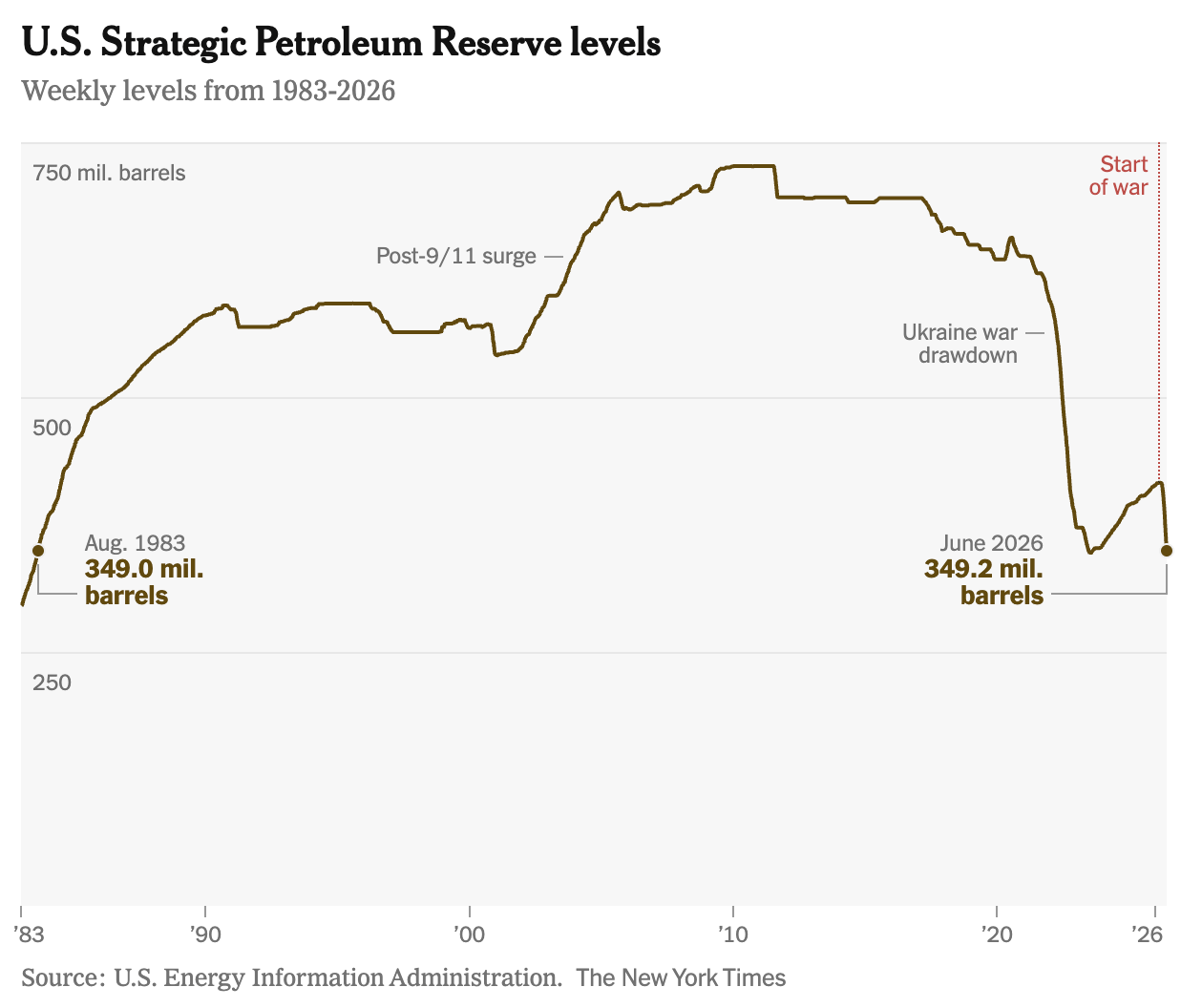
The answer is the Strategic Petroleum Reserve (SPR), and the answer should trouble you. Since the war began, the United States has drained roughly 66 million barrels from the SPR — about nine million per week — in coordination with more than 200 million barrels from allied stockpiles. The reserve now stands near 349 million barrels, its lowest level since 1983. The administration has authorized releases totaling 40 percent of the available stockpile. Industry voices are now saying publicly what the inventory data has whispered for weeks: perhaps 70 million barrels remain above the reserve’s functional operating floor. At the current pace of withdrawal, that is roughly eight to ten weeks of runway.
Every week of apparent normalcy is being financed by an asset that cannot be financed twice.
This is the discipline of distinction at work — the practice, central to how I think about markets, of separating what is temporary from what is structural. The pump price you see today is temporary. The supply deficit beneath it is structural. Global inventories drew at over six million barrels per day last quarter, the steepest draw ever recorded. OECD stocks are on a path to fifty days of forward demand cover by year-end — territory last visited in 2003. None of this is visible at the corner station, because the SPR was designed precisely to make it invisible. The cushion is doing its job. The problem is what happens when the cushion is gone and the mattress is still missing.
So let us do the arithmetic honestly, under the scenario the market is currently choosing not to price: the blockade persists through December.
The textbook relationship between crude and the pump is about 2.4 cents per gallon for every dollar per barrel. But this conflict has already taught us that the textbook understates stress. When Brent averaged $117 in April, the linear math implied a pump price near $4.05; the actual peak was $4.55. The difference was the crack spread — the refiner’s margin — which expands violently when product, not just crude, becomes scarce. Middle distillate cracks reached all-time highs this spring. China suspended fuel exports. Asian refineries cut runs by six million barrels per day for want of feedstock. In a persistent-blockade world, that wedge widens further, because the one institution that has been suppressing it — the U.S. government, selling reserves into the market — exits. Worse than exits: under the exchange structure of this year’s releases, it becomes a buyer, obligated to begin refilling in November, bidding for barrels at precisely the moment winter demand peaks.
Run the scenarios. At $125 Brent, the national average lands near $4.75 — testing, and likely breaking, the June 2022 record. At $150, you are near $5.60, with diesel pushing $7 and distillate inventories breaching the 100-million-barrel floor that signals genuine industrial scarcity. At $200 — the tail that some houses have modeled if the disruption runs through summer — the linear math alone yields $6 gasoline, and the crack premium stops being a premium and becomes rationing by price: $7-plus nationally, $9 in California, spot outages in import-dependent regions, and a national “average” that ceases to describe anyone’s actual experience.
Here it is worth being honest about the offsetting forces, because they are real and they cut in both directions. The first is demand destruction. Expensive oil is its own partial cure: the EIA now expects global demand to fall by over a million barrels per day this year, a 2.3-million-barrel swing from its February outlook. Triple-digit crude compresses Asian consumption, accelerates China’s electric transition, and shrinks American driving. This is why $138 retraced rather than spiraled, and it is why $200 is a tail rather than a base case. The second offset is political. With midterm elections in November, the tolerance in Washington for $6 gasoline is approximately zero. Above $5, expect tax holidays, state suspensions, possibly export restrictions — interventions that suppress the domestic price while deepening the global shortage. The $200 scenario, in other words, probably forces its own resolution: capitulation in the conflict, or intervention so heavy it changes the question.
But notice what these offsets are. Demand destruction is not relief; it is harm taken in a different form — less freight moved, fewer goods made, growth surrendered. Political intervention is not supply; it is the redistribution of scarcity. Neither restores a single barrel to the Strait. The system can change where the pain lands. It cannot, in the persistence scenario, make the pain smaller.
And the pump price, for all its political salience, is the least of it. Gasoline is actually the best-behaved channel of the five through which this shock transmits into the broader price level. Diesel passes through harder and faster, and diesel is not a consumer good — it is the working fluid of the goods economy. Every truckload, every harvest, every container moved repriced upward. The inflation that voters will see at the corner station will understate the inflation moving through the system behind it. That is the malign form of stickiness: not prices that are high, but prices that have seeped into the cost structure and will not leave when the headlines do.
None of this is a prediction that the deal fails. It may well hold - getting to agreement ASAP and calling it a ‘win’ regardless of the terms is the highly likely (and most rational) outcome; markets at $87 are betting heavily that it does. It is, instead, an observation about asymmetry. If the optimists are right, the downside from here is modest — perhaps ten dollars a barrel. If they are wrong, the repricing is forty or fifty, into a market stripped of its buffer, with the state converted from seller to buyer. When the consequences of being wrong are that lopsided, the rational posture is not confidence. It is preparation.
The reserve was built so that Americans would never have to think about the Strait of Hormuz. For fifty years, it worked. The barrels bought us the luxury of inattention. What they cannot buy is more of themselves.
No posts
Comments
Nothing yet. Say the first thing.
Sign in to join the conversation.