
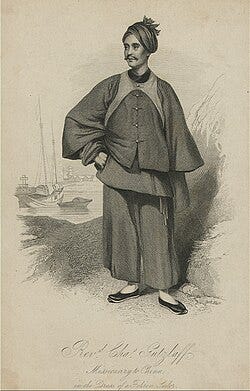
Karl Gutzlaff, early 19th Century Missionary and Translator Dressed in what are described as local clothing.
Greetings!!
Welcome back. Last week I enthusiastically wrote about missionary schools, both in the USA and among Chinese communities in China, Macao, Hong Kong, and what is now Malaysia, and what became of their graduates after they went out into the world with their English language and cross-cultural skills as well as the missionaries themselves. I promised upcoming columns on these fascinating subjects.
But just to clarify, I did not promise that they would come this week or any particular week or what quality of article they would be. And since what I have is a large accumulation of links to web pages, articles, and books that are half examined, half processed and half-categorized in my often rather cluttered mind and equally cluttered computer storage spaces. Many are not properly processed yet. For instance, I just ordered and recieved a used copy of the highly praised book, “The Heathen School, a Story of Hope and Betrayal in the Age of the Republic,” by John Demos, considered THE book to read to get an understand of the Foreign Mission School that existed in Cornwall Connecticut from 1817-1826 and while I have not even opened it yet, it is 325 pages long with 277 of those pages being actual text. I have no idea when I will be able to read it, but it is definitely something I wish to read to really understand stuff in this new gaping Chinese history rabbit hole. Yet for the moment, the fact that I own this valued tome is of no use in producing a column. So this week’s column will be a bit “diminished” from my norm in area of proper fact checking and verification of sources and good citation.
You may recall from last week’s column that one little known aspect of the Foreign Mission School in Cornwall, Connecticut is that while the administrator’s and staff were trying to train missionaries, few of their Chinese graduates became missionaries and one went on to become a translator of Lin Zexu, the high handed, anti-opium official whose actions helped spark off violent attacks from the British navy. (To see what I have written on this the last two weeks, see https://peterhuston.substack.com/p/early-chinese-american-history-and-941?r=as7cl and https://peterhuston.substack.com/p/rambling-thoughts-on-lin-zexu-robert?r=as7cl )
So I am overwhelmed and mentally scattered with that subject, suffering from an excess of good things.
But if you need more on weird early nineteenth century missionary activity in the Southern China region before during and after the opium war, you should enjoy this. Last week, I mentioned an English woman named Mary Wanstall Gützlaff who lived from 1799-1849, dying at age 50 it seems. (As an aside once you really start digging through a lot of these things, it really begins to jump out at you how lucky we are to live in an age where our expected life span is so much longer than people of this time.) I had planned to focus on her, ignoring her husband as much as possible, simply because men tend to get more attention than their wives in history and she does look like a very interesting person. As stated last week, she ran a school for the blind in Macao, one that I believe was located in the same building as Robert Morrison’s later, very influential but also short-lived missionary school. (a subject I will DEFINITELY write more about later, ishl Allah).
And not only that when the school for the blind girls closed she arranged for some of the young. blind Chinese girls to go live in the west where a couple went on to do very interesting things, things that I am still trying to make complete sense of (it seems one blind girl became a missionary and then went back to China in the late nineteenth century and founded a hospital in Shanghai but don’t quote me on that yet. I’m still trying to sort that out, and I want to properly cite and source and verify that subject as there is little on it at least not collected in one place.)
And as I said, I had planned to ignore her husband as much as possible but then I began find out some things about him. So here’s a somewhat scattered initial summary of what I have been reading. Notice I am describing this all as hearsay and “stuff I have read” instead of historical fact because I have not dug in deeply yet. Consider this superficial gossip, but juicy historical gossip. To do this properly, I would want to double check several things, track down what all these sources are and where they came from and what other scholars think of them, and, in short, do actual proper historical research instead of just slopping together a bunch of stuff I read on the internet and regurgitating it. But I guess it’s okay to slap together stuff on the internet and report it at least one week, so here it is, juicy gossip from the early 19th Century southern Chinese coast, and if you wish to see where I got all this unverified, not yet fact checked stuff from I have provided my sources in the footnotes. 1
First, I have learned through starting this column, that the non-Chinese people who lived in Hong Kong in its early days as a British colony, from 1841 onward, were often very, very strange people. Karl Friedrich August Gützlaff ,who lived from 1803 to 1851, was no exception. (Again getting back to that longevity issue, he lived to age 48 or so, making him three years younger and shorter lived than Mary, his second wife. If your wondering, he only lived for about a year with his third wife and she outlived him by many years. The first one passed away. People definitely died earlier in those days especially so if they travelled abroad it seems.)
Born in a place called Pyritz (present-day Pyrzyce), Pomerania, in what is now Germany, Gutzlaff was the son of a tailor who reportedly came to the attention of King Frederick Wilhelm III of Prussia in 1821, was encouraged to attend a German missionary school in Berlin, then spent three more years attending a school in the Netherlands run by the Netherlands Missionary Society,2 and ultimately sent off to “Batavia,” in the Dutch colony in what is now Java, Indonesia, a place with a noticeable Chinese population at the time.
After a few years, during which time he became very proficient in read, writing, and speaking Chinese (Hokkien / Fujian dialect / Southern Min), he left both Java and the employ of the Netherlands Missionary Society and headed off to southern China in 1831 as an independent missionary.
Apparently, while living among Chinese, he often dressed in Chinese style, one source, a non-academic one, says he often dressed in the style of the “boat people.” 3 The so-called “Tanka” or “Boat people,” the homeless Chinese people who spent their lives living on boats as they had no homes on land, are a subject I have written about before and these posts can be found in the archives. 4 This is not entirely unexpected as often Christianity and Christian missionaries around the world find themselves welcome and received by marginalized people and the so-call “Tanka” or “boat people” were definitely a marginalized class of people on the south China coast of the time.
While there, he engaged in several important projects, some of them quite shady. On the positive side, he was heavily engaged in Bible translation and working on the first Protestant translation of the Bible. For context, if one wishes to produce a good quality translation of the Bible into a new language, one should not just pick up the nearest English language Bible you can find and begin translating it into the new language. Any English language Bible is itself a translation and a translation from a translation is less accurate than a translation made from the original document. 5 Therefore, if one wishes, for instance, to translate the Bible into Chinese, you should be familiar with not just Chinese (and the version and dialect of Chinese that you wish to translate the Bible into) but also the original language of the portion of the Bible that you wish to translate, be it Ancient Hebrew, Ancient Greek, Aramaic, or whatever. Apparently, Gutzaff had the ability to do this and knew all the required languages at a high level. Apparently, because I have not dug in and checked as a true historian should when faced with something like this.
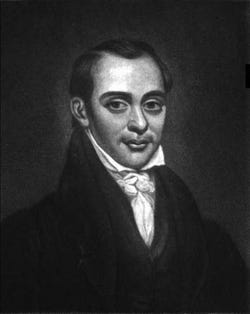
Karl Gutzlaff in European clothes
This week, and I have made this clear already I think, but wish to re-emphasize it, I am having trouble finding what I consider to be reliable, easily verified sources for what I want to write about. but, well, it’s just such cool stuff that I am sharing it anyway, even if it should not be considered proper historical writing, as I am just too eager to share and I have other topics I wish to cover as well .
As is often the case in life, I could do better if I had more time but, and this really is not a good excuse most would say, this is kind of where I am at right now in my research, and this is what I want to share.
But as for my sources, for instance, I am finding things like this, an essay with the heading “1803 — 1851, Charles Gützlaff, A brilliant linguist, careful student of Chinese culture, tireless evangelist, eloquent spokesman for the spiritual needs of China’s unevangelized millions,” which came from something called “Biographical Dictionary of Chinese Christianity” which was created with the aid of something called “The Global China Center” (See https://www.globalchinacenter.org/ ) and which you can find at https://www.bdcconline.net/en/stories/gutzlaff-charles
Here’s a particularly interesting section which I am obviously quoting at length:
First Missionary Activities
The NMS sent him to Batavia (Jakarta), where he met London Missionary Society (LMS) missionary William Medhurst, who mentored him. Impressed with Medhurst’s unusual fluency in Chinese and his practice of combining preaching with the distribution of Scriptures and tracts that he had written, Gutzlaff learned some Chinese and also Malay, and began disseminating Scriptures to the Chinese traders as well as settlers along the coasts of Java, Borneo and the islands around. Along with another LMS missionary, he “became familiar with Chinese customs and dialects, and an itinerant way of life, living like Chinese on their junks.” Broomhall 1.182
Though he had a natural talent for languages, Gutzlaff applied himself to assiduous study, both of the oral and written languages, eventually acquiring facility in spoken “Fujianese, Cantonese, Hakka, and Malay, along with some knowledge of Thai, Japanese, and the language of the Cambodians. He also studied classical Chinese” with a Chinese scholar and learned to write a simple form of the literary style. Most of all, he immersed himself in conversation with ordinary people, charming them with his childlike efforts and willingness to use mistakes to make progress. Lutz 40
He sailed to Siam (Thailand) in 1828. In Bangkok, he found Chinese junks from as far north as Tianjin, the gateway to Beijing. Here, too, Scriptures and Christian literature were eagerly received. Then Gutzlaff went to Malacca, where he temporarily took charge of the LMS work. There he met a well-to-do English girl, a Miss Newell, whom he married in 1829; he was twenty-six. Returning to Bangkok in 1830, they set to work translating the Gospel of Matthew into Thai, and portions of the Bible into Lao and Cambodian. For three years, he traveled among various ports in Southeast Asia where Chinese junks visited seasonally.
His wife and her baby died within a year after their arrival, however, leaving Gutzlaff alone again. He wrote, “I have lost my only sister, a wife rich in love, and an industrious co-worker.” Lutz 49
And later:
A friend, Lin Zhong, invited him to go to China with him and become a naturalized subject by adoption into the clan or family of Kwo (Guo), from the Tung-an district of Fujian – the only way a foreigner could legally travel to, or reside in, the interior. He joined the crew of a junk headed for Tianjin, and “’went Chinese’ in name, clothing, diet, and habits.” Broomhall 1.185 On this first journey, he traveled to Tianjin, where his medical work earned him a warm reception, and then to other ports along the coast, until he finally arrived in Macao. Along the way, he found copies of publications of the Scriptures that he had distributed in Malacca, far to the south.
And I find myself wondering several things. Primary among them being who was “Lin Zhong” (Lin being the most common family name in this part of China) and have no idea at all. I also wish I knew more about the Chinese clan system and adoption into clans and whether this would work as a way to naturalize a foreign person. And as the essay says the plan was to do this, but then it never seems to have happened or probably even been attempted, did Lin Zhong (whoever he, or maybe even she, was) did they mistakenly believe this was possible and learn later that it wasn’t? Or is the essay mistaken? Or was it a viable plan that just wasn’t pursued? I fully admit I have no idea.
And it is unlikely to me that any human being could develop a useful level of ability in that many widely divergent languages, but, then again, I don’t know. Maybe he did.
And while the essay clearly cites its sources, none of them are sources that I am familiar with. The parts that are the most interesting to me seem to come from something called “Hudson Taylor and China's Open Century,” which when I dug deeper I discovered was a seven volume biography of an early British missionary to China named “Hudson Taylor” (lived 1832-1905, active in China from 1853-1900 ) that seems to include extensive information on early, pre-Hudson Taylor missionary activity in China in its early volumes (See https://en.wikipedia.org/wiki/Hudson_Taylor ) and was written by another missionary to China named Alfred James Broomhall (See https://en.wikipedia.org/wiki/Alfred_James_Broomhall ) For the record, I have never heard of either of them.
I have since learned that Hudson Taylor was inspired in some of his ideas, such as the idea that a missionary should “go native” by Karl Gutzlaff’s example although the two never met.
However, having discovered the existence of Hudson Taylor, someone I had never heard of yesterday, it is entertaining to share this portion of Hudson Taylor’s Wikipedia page which if nothing else will justify how easy it is to go down rabbit holes when trying to research these things:
This is from an incident in his life in 1866, much later, over 20 years, than anything we are really discussing here but must be shared just because it’s weird:
Dissension among the missionaries began while on board the ship and continued in China. Taylor stipulated that all the missionaries wear Chinese dress, which included the men shaving their foreheads and wearing a pigtail. The group was called the “Pigtail Tribe” by European residents of Shanghai who found their adoption of Chinese clothing to be ridiculous. Moreover, rumors began to circulate that it was inappropriate for “young unmarried females” to share a home with Taylor. Missionary George Moule advised Taylor to “put a speedy end” to the CIM.
The CIM or “China Inland Mission” was an organization that Taylor founded that encourage the recruitment of foreign missionaries to adopt Chinese customs and take up residence in isolated parts of China, apparently often without proper financial support or plans for their sustenance before doing so, and reportedly without informing British diplomats that they were going to do so ahead of time. As an aside, during the Boxer Uprising in China in 1900, an event that began with members of a Chinese secret society called Yi He Quan ( 義和拳 ) or “the Fists of Harmonious Righteousness” attacking isolated missionaries and seeking to destroy other signs of foreign influence, more members of the CIM died in the in this event, massacred by Chinese, than any other missionary organization. According to the Hudson Taylor Wikipedia page, 58 CIM missionaries and 21 of their children were killed during this conflict.
As for the issues with Taylor and single women, see ( https://christianhistoryinstitute.org/magazine/article/unbecoming-ladies ) for a nice description of the problems there.
But as for this book itself, I do not have access to a copy of the early volumes of this biographical series, and while used copies are surprisingly inexpensive online, not only does it take time to receive and order these things online but it’s tough to imagine having time to read them anytime soon, plus I really do not know what quality the books actually are. So that is not a realistic option.
And as for the Biographical Dictionary of Chinese Christianity, it actually is a group effort with multiple contributors which would imply that the scholarly and academic value of its entries varies widely (kind of like Wikipedia but wikipedia is mutable) (See https://www.bdcconline.net/en/write/guidelines for its writers’ guidelines)
There clearly were severe scandals or questionable actions linked with Karl Gutzlaff.
I know this because an organization called “The Christian History Institute,” another organization that I know nothing about and to do this right should spend about an hour or more doing a background check on before citing, published an essay on their website entitled “THE DARING AND DISGRACE OF CARL GÜTZLAFF.”
(see https://christianhistoryinstitute.org/dailystory/permalink/the-daring-and-disgrace-of-carl-gutzlaff )
So let’s dig into that a bit and see what we can find.
There seem to have been three big sources of scandal in Karl Gutzlaff’s China adventure. They all make juicy gossip, for sure.
The first scandal is that prior to the Opium War, when China was closed to the outside world, there were foreign opium merchants and smugglers, mostly American, British, and other European merchants, who would import opium from India and sell it in China. And they needed translators. And these were some of the few people who Chinese would, in violation of Chinese law, deal with from the outside world. And the smugglers needed translators who they could trust who could speak Chinese and who also understood enough of Chinese customs and culture to avoid unnecessary complications and problems.
And Karl Gutzlaff had several Chinese language Christian missionary texts, many written by himself and published and printed at his own expense with funds he had solicited from foreign donors who wished to encourage his missionary actions, and no way to get them inside China to the people they were intended for.
And thus it came to happen that prior to the opium war, Karl Gutzlaff became an active participant in the illegal smuggling of opium into China. This is apparently established fact agreed upon by all the sources I have encountered. (although it’s worth mentioning, just to re-emphasize, that a month ago I had never as far as I remember ever heard of Karl Gutzlaff. Which is why I am labelling nearly everything I say hear as “gossip” and not verified, solidly sourced history.)
In fact, he seems to have gone so far as to have advocated or stated approval for the notion of a war with China to open it up to trade and missionary activity with the west.
According to Wikipedia, and again, please remember when writing “real historical pieces,” “real historians” do not quote at Wikipedia at length, although some wikipedia pages are quite useful, instead a real historian would bypass wikipedia and go the sources it uses but only after having properly checked their quality, and thus, again, please consider this week’s entire essay to be either “gossip” or “rough early research notes” and not a real piece of historical writing, but here it goes as I do exactly that:
In November 1831, he took up residence in Macau and later in Hong Kong. In 1832, along with East India Company staff Hugh Hamilton Lindsay, Gutzlaff joined a six-month long clandestine reconnaissance by sea that visited Amoy, Fuzhou, Ningbo, Shanghai and the Shandong coast.[11] In late 1833, he acted as naturalist George Bennett’s Cantonese interpreter on his visit to Canton.[12] In these visits to Chinese cities, Gützlaff served as a translator, interpreter, and medical doctor. One of the purposes of these trips was to open China to trade with Britain. While it failed at that, Gützlaff’s book, published in 1834, titled Journal of Three Voyages along the Coast of China in 1831, 1832 and 1833 excited interest in expanding trade with China. Gützlaff’s book furthered the opinion that China, if pressed hard, would yield to demands that trade be allowed.[10][4] He also suggested that violence could be useful to help traders and missionaries achieve their objectives. Gützlaff said, “[W]hen an opponent supports his argument with physical force [the Chinese] can be crouching, gentle, and even kind.” 6
And, alas, having committed the sin of advocating and assisting in the sinful act of making preparations and plans for opium smuggling, Karl Gutzlaff soon fell deeper into disreputable and shameful conduct by then participating in the actual smuggling of opium so long as the drug dealers would let him participate in distributing Bibles and religious tracts as he did.
And thus, I find myself slipping into disreputable behaviors of my own at this point.
First, and, yes, I know I should not do or write this, but, alas, I will, we have the image of an early 19th Century German missionary who is not only hanging out with drug dealers and sailing up and down the China coast but as he does so he often is not only dressed in Chinese style, but in the style of so-called Tanka boat people, probably the lowest of the lowest social classes in that region of China at the time. They were considered so low class that I am using the phrase “so-called Tanka boat people,” because the term “Tanka boat people” to modern Chinese people of the region is something akin to “trailer park, White trash” in our own society. It is considered offensive today. You just don’t say it in southern China because it’s not polite even if it does communicate what you are trying to say and refer to. Which means that not only is this guy dealing drugs outside the law and hanging out with dope smugglers but while he’s doing so, yes, he’s actually doing the early 19th Century equivalent of “dressing ghetto” as he does. Oh my!!
Second, however, having committed that sin, I am going to commit a second one as I slide down the slope into scholarly degeneracy destroying my own reputation in the process, and, yes, I am going to quote Wikipedia at length again. Real historians never, ever do this, but, what the hey, in for a dime, in for a dollar so Here goes:
Gützlaff’s experience and expertise attracted the interest of Scottish traders William Jardine and James Matheson in Canton. Britain had, at the time, a trade deficit with China. The British purchased large quantities of Chinese tea but the Chinese had little interest in purchasing any British products -- except opium which was grown in British India. Jardine and Matheson hired Gützlaff as an interpreter on its opium trading ships clandestinely plying the China coast. They agreed that Gützlaff could distribute Christian literature while on the opium voyages, inspiring the wry comment that while the opium dealers distributed opium off one side of the ship Gützlaff distributed Bibles off the other. Moreover, in addition to the generous, profit-sharing remuneration given Gützlaff, Jardin and Matheson agreed to pay for the publication of Gützlaff’s religious tracts and to purchase medicine imported from Britain for Gützlaff to distribute to the Chinese. Thus, an “opium trading, gun and gospel-carrying vessel” owned by a British company with a missionary as an interpreter began trading up and down the Chinese coast in violation of Chinese law. In the minds of many Chinese the opium trade and Christianity were linked. [14]
To re-emphasize these actions:
According to that “Biographical Dictionary of Chinese Christianity” article:
… the East India Company invited Gutzlaff to serve as interpreter on their ships, with full freedom to distribute Christian literature. Gutzlaff did not approve of the opium trade, but he was a medical missionary. For one thing, opium was accepted in Europe for medicinal uses, and the opium trade had not yet outraged the Western Christian conscience. For another, the opportunity to spread the gospel by any means appealed to Gutzlaff’s overall passion in life, to evangelize the Chinese. He accepted the invitation, and then threw himself into the work, first as interpreter on the EIC merchantman Sylph and then on other ships. His zeal blinded him to the terrible consequences of such compromise.
“EIC” = “East India Company.” No one denies that he did this.
I am going to keep this one short. The Opium War, aka “The First Opium War” as there was a second approximately 20 or 25 years later, lasted from 1839 to 1842. It was a lop-sided war with the British winning and the Chinese losing the bulk of the engagements. Thus reinforcing and making the entire conflict seem rather scandalous and shameful to most people in the world today almost 200 years later. And Karl Gutzlaff, a German, was actively involved in assisting the British with the negotations.
( see https://web.archive.org/web/20210417144133/https://www.gale.com/intl/archives-explored/imperial-china-highlights#2 Some of his original documents and notes, particularly from the period of time which he spent as an advisor and translator to the British, negotiating an end to the opium war, are available online: https://go.gale.com/ps/i.do?p=CFER&u=omni&id=GALE%7CBAWVFU360120917&v=2.1&it=r&sid=CFER&sPage=68&asid=367ce1b9 )
I think this needs little further elaboration.
One result of the Opium War was that the British were given Hong Kong island, then an isolated, uninteresting, mostly rural territory that they were hoping they could eventually develop into something rivalling Macao but under British and Protestant control. And, of course, not only did Hong Kong go on to rival Macao as a trading port, but it ultimately surpassed it. After the Opium War, Karl Gutzafff took up residence in Hong Kong and became a government official there in 1842 where he received a good salary. In 1844, he opened another missionary school there as well, which leads nicely into scandal #3.
If one studies the history of Western Christian missionaries in China, a constant problem was missionaries who were too quick to believe in the sincerity and good intentions of local Chinese who announced they were converting to Christianity.
The temptation for a lonely, desperate missionary far from home to believe he was actually saving souls and leading people to Christ often left them very vulnerable to manipulation from sneaky Chinese who pretended to convert.7
And it seems Karl Gutzlaff fell victim to this problem, this temptation, in a big way.
According to yet another improperly verified, unreliable source that a true historian would merely use except as a jumping off point for true research and not cite on its own, Gutlzaff’s Hong Kong based mission school was named “the China Union.” He would recruit local Chinese, train them as missionaries, provide them with Bibles and literature to distribute, and then send them forth allegedly into the interior of China with instructions to distribute the Bibles and other literature he had given them as well as to send reports back to him on how they were doing with conversions and bringing the local people to Christ. He would then eagerly receive these reports from his missionaries in the field, pass along the information reported in these reports to his network of supporters and financial donors abroad in Europe and elsewhere. They would be impressed by his reports of having reached a great and unprecedented number of people and finding large numbers of converts in China, and respond with donations to encourage this, seeing it as great work. Gutzlaff would use this money to support these missionaries and to buy more Bibles and send the converts out again to reach even more people and, as they say, “save even more souls.” In fact from 1849-1850, Gutzlaff went on a tour of Europe to speak of what he was doing and raise funds. According to one of my sources below, Karl Marx attended one of these talks. (Did he really? No idea. I told you, I am spreading gossip today.)
Alas, it seems it was not that way at all. A large number of his “China Union” students were, reportedly, and this is the word used in the possibly inaccurate sources that I am citing with proper verification, “criminals” and (and, oh isn’t this an ironic problem for a former opium dealer -basically- to have among his recruits?) “opium addicts.” And they had low morals and no real interest in converting anyone anywhere to Christianity. What they were doing, it was discovered, was taking his Bibles and promising to do mission work and then disappearing to someplace where Gutzlaff could not keep tabs on them or track them. (Something much easier to do in 1844 than in 2026, I must add) Then once untracked and unmonitored they would go to the printing house where Gutzlaff purchased his Bibles and sell them back to the printer for partial price. The printer would then accept these, story them for a while, and next time Gutzlaff came to the printer to buy Bibles sell them back to him at full price. Thus making an easy profit off of Gutzlaff and his donors. As for the subsidies to sustain them in their missionary work, these too seem to have been spent by his missionary recruits but obviously not on conducting actual missionary work. In other words, he gave them money to sustain themselves while doing missionary work and it was simply spent, and the Bibles he gave them were sold to the printer who sold them back to him. Oh my! 8
Which would be a pretty big scandal in itself, but to make matters even more scandalous, when word of this started to get out, Karl Gutzlaff reportedly, according to these not so great sources, returned to Hong Kong as soon as possible to put a stop to this, but he did not correct his previous reports and continued to allow his donors to believe that the numbers for converts made and Bibles distributed and so on, were accurate while continuing to use this network and false data to raise funds for his missionary projects.
Thanks for reading Mostly Asian History! This post is public so feel free to share it.
FOOTNOTES
Just as an unrelated side comment, for years the most common English language version of the classic Chinese book “The I Ching” (aka “Yi Jing” or 易經 ) was translated from German, not from the original Chinese. Then again, it must be said, as a divination text some would argue that the original Chinese (classical Chinese) was written to be difficult to completely understand. (See https://en.wikipedia.org/wiki/I_Ching )
This was actually one reason the secret society that was nicknamed “the Boxers” in the 1900 Boxer Rebellion would target missionaries and their converts. Often criminals would pretend to convert and then encourage local missionaries to interfere with the local Chinese justice system on their behalf when in trouble. Obviously not the full reason, but one of many.
No posts
Comments
Nothing yet. Say the first thing.
Sign in to join the conversation.