
Greetings,
The column is a little late today, but that’s because I have been doing good things with it. I returned from Vietnam a little over a month ago, life’s been busy and it’s only this week that I have begun to get ahead of the curve here and write columns ahead of time and will strive to get them tighter and more organized.
Korea’s been in the news this week and therefore this week and next will be on how Korea entered the modern world and emerged from its pre-modern isolation to become part of the modern community of nations, yet somehow become tragically split into two halves as it did so. Yes, I have columns written for both this week and next, and hope to begin producing the political columns again soon too. (I have included a link to a YouTube podcast / video that I think is important but has nothing directly to do with Korea.) There are definitely things I want to say in that realm. Please stick around. And the Chinese American history columns will come again soon, especially as I am doing heavy duty reading on .
If you wish to support this column, an obvious way is to purchase a paid subscription, but if you do not wish to do so or simply cannot (yes, finances are tight for many now) , then it would really mean a lot if you could hit that like button, leave a comment, or share your favorite posts and spread the word. Some of you spend a great deal of time reading the column every week yet never help spread the word or tell me what you think of it.
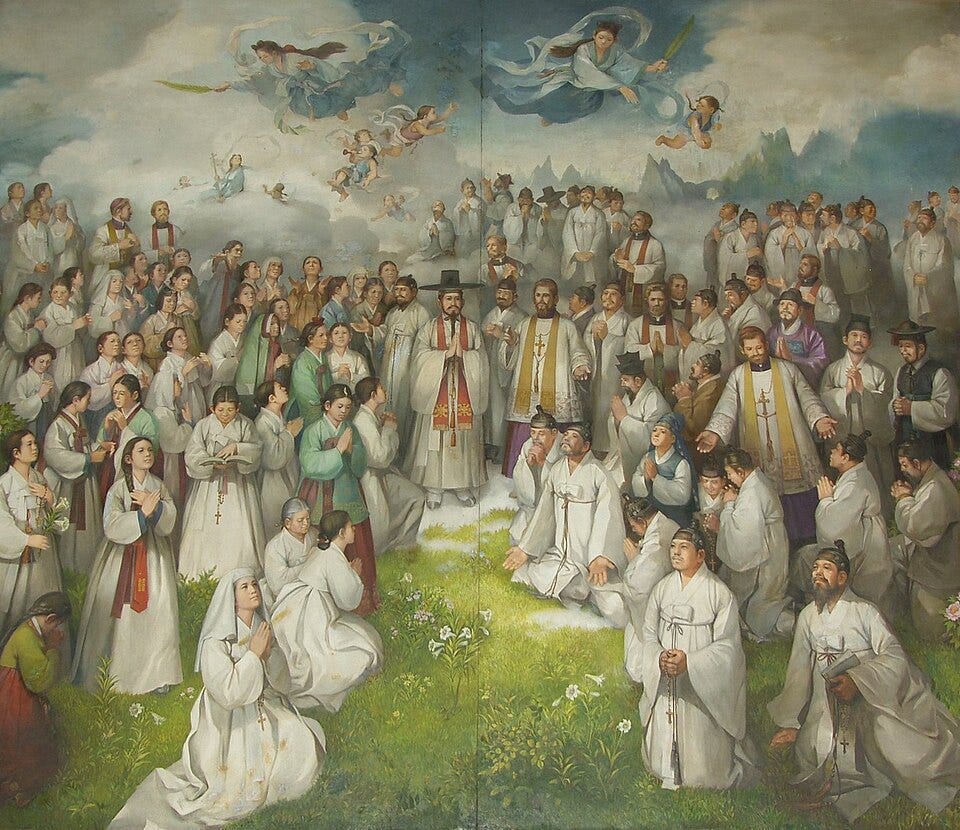
This is a painting of Andrew Kim Taegon, the first Korean ordained Catholic Priest and Martyr. He was ordained in Macao, but returned to his homeland in 1846 to spread the Catholic faith and was martyred less than two months later. He became a Saint and this painting is in a shrine in the Phillipines. See https://en.wikipedia.org/wiki/Andrew_Kim_Taegon
Thanks for reading Mostly Asian History! This post is public so feel free to share it.
Once again, as the annual US-Korea military “wargames” (actual mass training maneuvers) c come up in the news, and we watch as the current President of the US, as is his norm, does the worst possible thing as he praises dictators and insults and antagonizes his allies, tensions and potential tensions between North and South Korea have come up in the news. How did this linguistically and culturally unified peninsula get split in two opposing halves?
Stick around and learn but first a quick introduction to Korea and its people.
For those who might wonder the Korean peninsula, combined north and south, is approximately the size of either the United Kingdom or the lone US state of Minnesota. ( See https://en.wikipedia.org/wiki/Geography_of_Korea )
The Korean people have been linked culturally with their Chinese neighbors for two thousand years since the time of the Han Dynasty (basically 220BC to 225AD although it gets complicated) but have remained culturally distinct in many ways including a language that is grammatically and phonetically extremely different from Chinese despite the adoption and inclusion of many Chinese words and Chinese institutions. ( For more on Korean culture and history see https://en.wikipedia.org/wiki/Timeline_of_Korean_history )
As will become obvious in this essay, one interesting aspect of Korean and South Korean culture is that among the East Asian nations it has the highest percentage of Christians, both Protestant and Roman Catholic. The presence of Catholic Koreans in Korea started centuries ago and, as will be described in this essay, has been a significant factor in much of its modern history. 1
As I mentioned a couple weeks ago, when writing about Asian history for an audience of non-specialists most of whom have little or no previous background in your chosen subject, an important question is how far back in time does one need to go to provide context and initiate understanding. There’s an arbitrariness to this, and often there are multiple possible answers, each backed up by different arguments, but in this case. I am going to begin in the mid to early nineteenth century. This way we can start by explaining how an ancient, feudal monarchy whose rulers, like many, attempted to deal with the rise of the West and the era of Colonial Imperialism by cutting off their own nation and isolating it from the outside world, instead recognized the need to open their nation and interact with the outside world. So our story begin the nineteenth century approximately two hundred or so years ago.
Now someone might point out that this is a time period discussed in a large portions of my columns. This period of history fascinates me, because this is the point in time when Asia, like much or most of the non-Western world, found its cultures and traditions under assault from outside influences and really had to grapple with Western Expansion and Colonialism. It’s a fascinating period of history, and it is also a good place to begin looking if you seek to understand the origins of many modern problems in the world. (For a quick overview of Western Expansion and Colonialism, please see my column: https://peterhuston.substack.com/p/western-expansion-and-colonialism?r=as7cl )
During this period, a period where foreign merchants and missionaries, backed up by force of arms, travelled the globe, seeking entry to non-Western nations in the hopes of spreading their ideas, products, and influence, the then unified nation of Korea initially responded to the threat of Western encroachment, the same way its neighbors, China and Japan did. Its rulers mandated a complete lack of contact or interaction between its citizens and the West. Like China and Japan and other nations, it imposed a policy of isolationism between itself and the outside world.
During this time, however, the so-called “Hermit Kingdom,” did make attempts to monitor what was happening with news from abroad particularly events in China, but also events in Japan, but the more they saw, the more they realized that interacting with Europeans brought trouble.
Of course, trying to close off one’s nation to the outside world rarely works well or for very long, and problems arose as the leadership of Korea tried to reduce or eliminate outside ideas and influence. Here, I will just quickly survey three of the biggest such problems.
One obstacle to Korea’s rulers efforts to isolate the nation and prevent contact with the outside world, was the presence and growth of Roman Catholicism and Roman Catholic converts in Korea. These converts valued contact with the outside Catholic establishment and priests ordained by the Vatican and were wiling take great risks to have such contact.
And determining when Catholicism first came to Korea is, like so many things in history, definitional. In the 16th Century, Catholic missionaries came to China. 2Among the earliest was Matteo Ricci, a Jesuit with great depth in several areas of Western knowledge and who went on to develop great understanding and respect for Chinese culture and civilization. Ricci earned the respect of many Chinese people and the Emperor himself. 3 Largely because of Ricci and others like him, there was a strong interest in Catholicism and “Western learning” in China during the 16th and 17th Century and the religion developed a strong core of believers there, prior to the schism with the Vatican over ancestor worship. And it is known that some of the Korean intellectuals in China of the time, also became believers or students of Catholic teachings and brought them home to Korea when they returned.
Therefore, when Yi Sŭnghun, an 18th Century Korean diplomat, 4 was sent to Beijing, China in the 18th Century, a Roman Catholic acquaintance name Yi Pyŏk 5 encouraged him to make contact with the Catholics there. Yi Sanghun became baptized and returned to Korea as an enthusiastic Catholic in 1784 and began to convert others. It’s interesting that he did so, and and did so without any foreign influence or missionaries involved.
For those who wonder, it seems that while the Chinese emperors had expelled all foreign missionaries from China following the Pope’s decision in the 17th Century to not allow Chinese Catholics to leave offerings to their ancestors, 6 they had allowed the practicing of Catholicism so long as Chinese Catholics followed the recommendations of Matteo Ricci, a Jesuit, who had believed that the rites of making ancestral offerings was and should be compatible with Catholicism, and ignored the recommendations of the Pope and the Dominican priests who condemned the practice. 7 Therefore throughout this period, some Koreans who visited China were not just exposed by accident and coincidence to Roman Catholic teaching and theology but many consciously sought out such contacts among both Chinese converts and foreign missionaries and thought of it as an important part of acquiring “Western learning.”
As background, leaving offerings for one’s ancestors and so-called “ancestor worship” was an important part of Chinese culture and the ritual life of Chinese families. While Matteo Ricci and the Jesuits did not see a conflict between this practice and Cahtolic doctrine, later missionaries, largely members of the Dominican order, disagreed, argued their views, and ultimately the Pope in Rome ruled that Chinese Catholics should not leave offerings to their ancestors.\
While it falls within the realm of speculation on my part and not sharing of proven academically proven historical fact, I can’t help wondering about parallels between the way many American, European, and Western intellectuals seek out and enjoy studying and learning about Buddhism and other Asian religious traditions, enjoying the fascinating concepts and deep thoughts and perspectives they find this way, unaware of the fact that what they are being exposed to, while generally authentic, is also far removed from the more simplified, superstitious version of these teachings often practiced daily by the less educated, more numerous population of the region.
For more on the history of Roman Catholicism in Korea, i have shared several links below at the end of this week’s column.
During this period, the Korean nation was run by a royal court structured very similarly and inspired by the traditional courts of China. Like the Chinese court of the time, the important people all had several names, and were also often referred to by title, despite that many had multiple titles as well. For the purposes of this column, I am going to refer to each by a single title without elaboration, and if you, the reader, should pursue further research into them, please follow my links and familiarize yourself thoroughly with the different ways in which each individual you are learning about can be referred to so that you don’t get overly confused as to who is who. And don’t forget that for both Chinese and Korean history, it’s not uncommon to find the same name spelled different ways so be on the look out for that too.
Also, as I discussed a bit in my columns on the Dowager Empress Cixi, a woman who ruled China for several years through her role as the mother of one heir to the throne and the adopted mother of two other subsequent heirs to the throne, 8Korea also followed a practice where if the heir to the throne was too young to actually rule, then their parent ruled in their stead until they came of age.
Which meant that from 1864 to 1873, Korea was ruled by a man known as Daewongun, 9 who was the father of the later ruler Gojang, 10 who was born in 1852 and while officially designated as ruler or king of Korea from 1864 to 1919, actually functioned in a decision making capacity only from 1874 until 1907. Prior to 1874, as stated, he was considered too young to make decisions and from 1907 until his death in 1919, the Japanese had taken away his decision making authority and capability but let him remain in office as the official king of the nation
And Daegwon did his best to follow a strict policy of isolationism, and one big challenge to this policy of strict isolationism were the actions of Korean Catholics who would seek contact with Catholics from outside of Korea and, even worse, in violation of the law invite in foreign priests who were ordained by the Vatican. These priests would then spread the gospel and seek converts. Many of these foreign Catholic priests were French.
In response to the issues with the Korean Catholics and the foreign priests who operated in violation of the law in Korea, Daewongun began persecuting Catholics in his nation, killing them en masse. While this was not the first persecution of Catholics in Korea, 11 it was widespread and violent. Thousands of Korean Catholics were executed, the sources I use say eight thousand of them, and several foreign priests most of them French. The sources I use seem contradictory, one giving the number 9 and another 12 French priests killed, but there may well be an explanation for that. 12
Regardless, French priests were killed, as well as thousands of Korean Catholics. The French government was outraged and sent a “punitive” expedition with several ships to Korea to, basically, kill people at random and blow things up in order to demonstrate to the Koreans that they were quite able to do so and that they were very upset with Korea for doing this. 13
Here’s a few fascinating links to articles I found while writing that deal with the history of Roman Catholicism in Asia. Much of the history of Roman Catholicism in the region focuses on Macao, the former Portuguese administered enclave and later Portuguese colony. This is not only where Andrew Kim Taegon, the first Korean who was ordained as a Roman Catholic priest, was ordained but it is also where his remains were sent after he was killed less than a month after his arrival by the Korean authorities for trying to spread Catholic teachings in his homeland. Long ago, in the early 1990s, I saw his remains while in Macao. His bones were on display in a glass case under a painting of the martyred Catholic priest in one of the Catholic churches there. I do not think they are on public display anymore. Since return to Chinese rule in 1999, there have been many changes to Macao, many of which are upsetting to a historian. One thing I remember about the visit to this amazing place is that, having been raised in a Liberal American Protestant Church with its images of a smiling Jesus being nice to children and giving away loaves and fishes and healing pleased people, the very European old-school Roman Catholic imagery of a suffering Jesus with a crown of thorns and pierced hands on the cross and numerous suffering martyrs who had died for their beliefs was one of the most “foreign” things I have ever seen in Asia. It was definitely an interesting and enlightening experience.
https://www.ucanews.com/news/korean-church-unveils-remains-of-four-19th-century-martyrs/109552
https://www.macaucca.org/pilgrimsofhope?pgid=maqbtuaj-7ba11a7b-05e1-4b50-96a0-2a6b48020d7c&lang=en
https://en.wikipedia.org/wiki/Catholic_Church_in_Korea
https://en.wikipedia.org/wiki/Andrew_Kim_Taegon
A quick note on my unorthodox use of Wikipedia for Citations: Yes, it is recommended tht people avoid Wikipedia for citations. When I begin a column, I know what I am going to write about and the outline of what I say. The topic came from reading, academic study in graduate school at Cornell or elsewhere, speaking with scholars or ordinary people, personal insight or observation gained during six and a half years living in Asia, or elsewhere. But when I write I find myself with limited time and a need to check exact dates, exact spelling or Chinese characters. Sometimes I run to books, but many of my best books are in storage buried in boxes, and I don’t have easy access to an academic library, and thus I turn to the internet. If while doing so, I find something that I did not know or had forgotten that looks relevant and cool, I double check it and dig deeper outside of Wikipedia and then put it in the column. Sometimes I go to social media forums for Asian Studies Scholars (Facebook Sinologists, for instance), and ask there if something on Wikipedia seems strange or is unsourced and get input from experts. Wikipedia also allows readers one pathway to both double check what i wrote and to dig and explore the subjects more deeply. Wikipedia, or, more correctly, Wikimedia is also a great place to find good illustrations with reasonable copyright and sharing policies.
FOOTNOTES
For the record, there had been previous interactions between China and the Vatican during the Yuan Dynasty (1279-1385AD) when the Mongols ruled China. However, after the end of Mongol and the start of the Ming Dynasty, this interaction largely stopped until the beginning of the age of exploration and the arrival of European sailing ships on the Southern Chinese coast in the 16th Century. This was followed by Roman Catholic missionary activity.
No posts
Comments
Nothing yet. Say the first thing.
Sign in to join the conversation.