
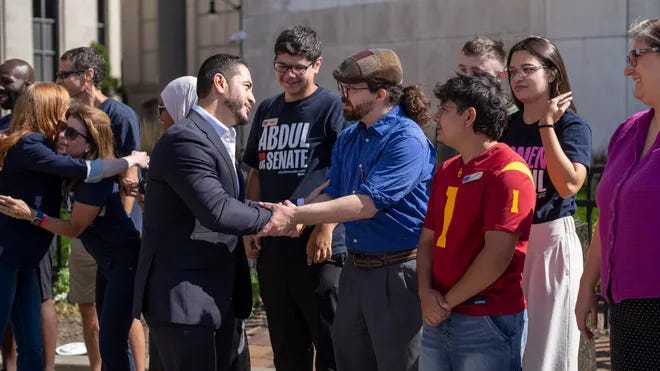
It shouldn’t be too difficult to understand why the progressive movement is celebrating the recent primary victories in places like Michigan, and before that in New York City. From their perspective, this has been a long time coming.
For nearly a decade, and through three election cycles, they’ve felt shut out by the Democratic establishment. Many still believe that in 2016 Bernie Sanders, who in their minds was the obvious frontrunner and had inspired an enormous grassroots movement, was denied the nomination by party insiders determined to usher in Hillary Clinton. Whether that perception is entirely accurate is beside the point. It became part of the movement’s identity. Down with the tired, nepotistic establishment. Bring in the fresh voices, the people who can truly make America great! Sorry, um, not great “again.” That wouldn’t be right. Lots of unforgivable flaws—chattel slavery, for one—it never was great.
Then came Donald Trump. For many, a nightmare come true.
Joe Biden’s victory brought relief to most Democrats—he wasn’t Donald Trump. But not to the progressive wing. Biden governed as a centrist, occasionally throwing a bone to the language and priorities of the left, yet never quite convincing its most committed activists that he shared their ambitions. Then, after Biden withdrew, Kamala Harris, another establishment Democrat, became the nominee, shoehorned into the election without having gone through a competitive primary. She lost to Trump, and the nightmare continued.
Housing, once attainable for most Americans, has become so expensive that owning a home no longer feels like something to imagine, let alone hope for. Healthcare is scarcely more encouraging. If you are self-employed or working freelance, premiums alone can cost well over a thousand dollars a month, often more than most people, young or not so young, can realistically afford.
It’s not difficult to imagine how all of this looks to a twenty-five- or thirty-year-old who may not know much about the failed history of socialist movements and is simply trying to build a life.
Into that very real need come candidates promising dramatic change. Most are intelligent, articulate, energetic, and they speak with confidence about transforming institutions that many voters have come to distrust. Whether one calls their politics democratic socialism, progressivism, or something akin to Marxism, the appeal is easy enough to understand. When existing systems seem incapable of solving problems that affect everyday life, proposals that once sounded radical begin to sound practical.
In that sense, I understand why someone might vote for Zohran Mamdani. I understand why someone might vote for Abdul El-Sayed. Even though I disagree with almost everything they advocate, I don’t find their appeal mysterious.
What I do find mysterious is something else.
Why does Israel occupy such a central place in this movement’s imagination?
These are politicians, the bulk of whose supporters are worried about rent, mortgages, medical bills, childcare, student debt, and the simple possibility of building a decent life. Yet somehow the Jewish state, a country of about ten million people, repeatedly finds itself at the center of every conversation.
Why this country? Why this issue? Why has Israel become the barrel into which so many unrelated grievances seem to be poured?
First, there is AIPAC, a fully legal, bipartisan American lobbying organization that exists to support Israel. It’s not unlike any number of other American advocacy organizations that support allied countries, including those representing Armenia, Greece, India, and Taiwan. So, what’s different about AIPAC?
For starters, AIPAC supports Israel. Why that should be an issue will be covered in a moment. Secondly, it is extraordinarily successful. Arguably more successful than any other country-focused advocacy organization in the United States. Jewish success has always produced two very different reactions. Some people admire it. Others resent it.
Abdul El-Sayed has repeatedly described Israel as committing 'genocide and apartheid' and condemned American support for what he calls a genocidal state. But if AIPAC disappeared tomorrow, I suspect Israel would remain every bit as central to the progressive imagination. In a recent CNN interview, El-Sayed stated that his opposition to U.S. military aid for Israel also extends to defensive systems such as Iron Dome. 'I don't believe that there's really a difference between offensive or defensive weapons.”
Israel has become the poster child for a progressive movement that sees it—wrongly, I must add—as the embodiment of everything it has been trained to oppose: colonialist, imperialist, white, privileged, an ethnostate—genocidal. The last word has become the most potent of all. Repeated often enough, the charge requires no proof. The accusation becomes evidence. Once a country has been successfully branded genocidal, many people conclude that almost any punishment becomes justified.
Yahya Sinwar would have appreciated the technique.
Third, candidates like Zohran Mamdani slurped up hostility toward the Jewish state with their breakfast cereal. His father, the influential post-colonial scholar Mahmood Mamdani, has for decades described Zionism as a settler-colonial project, referring to Israeli survivors of the Holocaust as 'yesterday's victims turned today's perpetrators.' One hesitates to blame the son for the ideologies of the father, although in cases where there is such continuity, it becomes hard not to notice why Zohran Mamdani repeatedly describes Israel as an apartheid state, accuses it of genocide, and says he cannot support Israel as a Jewish state.".
That Mamdani spews animus against Israel is readily apparent. It has become a regular feature of his public discourse. And yet, from his telling, he has nothing against Jews. Like Abdul El-Sayed, he has gone to considerable lengths to distinguish anti-Zionism from antisemitism. He insists that his objection is not to Jews, but to the Jewish character of the Jewish state. I suspect the day is coming when people in positions of power will no longer feel the need even to make that distinction.
But let me be clear about what is being discussed here. Israel is a multi-racial, multi-ethnic, multi-religious democracy. It is also the only Jewish state in the world, home to roughly half of the world’s Jewish population. So the idea of separating Jews from Israel, which has become a regular talking point of progressive politicians and on social media is, from my perspective, ludicrous.
A final thought.
Some people, not all, but some, simply do not like the idea of the Jews, once bedraggled, stateless for two thousand years, scorned and scattered through exile, having a state of their own. They cannot countenance a strong Israel that is well armed and unwilling to tolerate its own people being slaughtered, as occurred on October 7. A defenseless Israel, dependent on a fickle world to come to its aid, is easier to accept than one capable of defending itself.
For anyone interested in that same phenomenon, I recommend Dara Horn’s remarkable book People Love Dead Jews. Its title is sardonic. Its argument is devastating.
So, with a hearty mazal tov to Abdul El-Sayed, I also recommend that he find a scapegoat other than the Jewish state—and, by extension, the Jews themselves—as a rhetorical device for solving the world’s problems.
History offers no shortage of examples of where that habit leads. It has never ended well for those who couldn’t shake it.

No posts
Comments
Nothing yet. Say the first thing.
Sign in to join the conversation.