
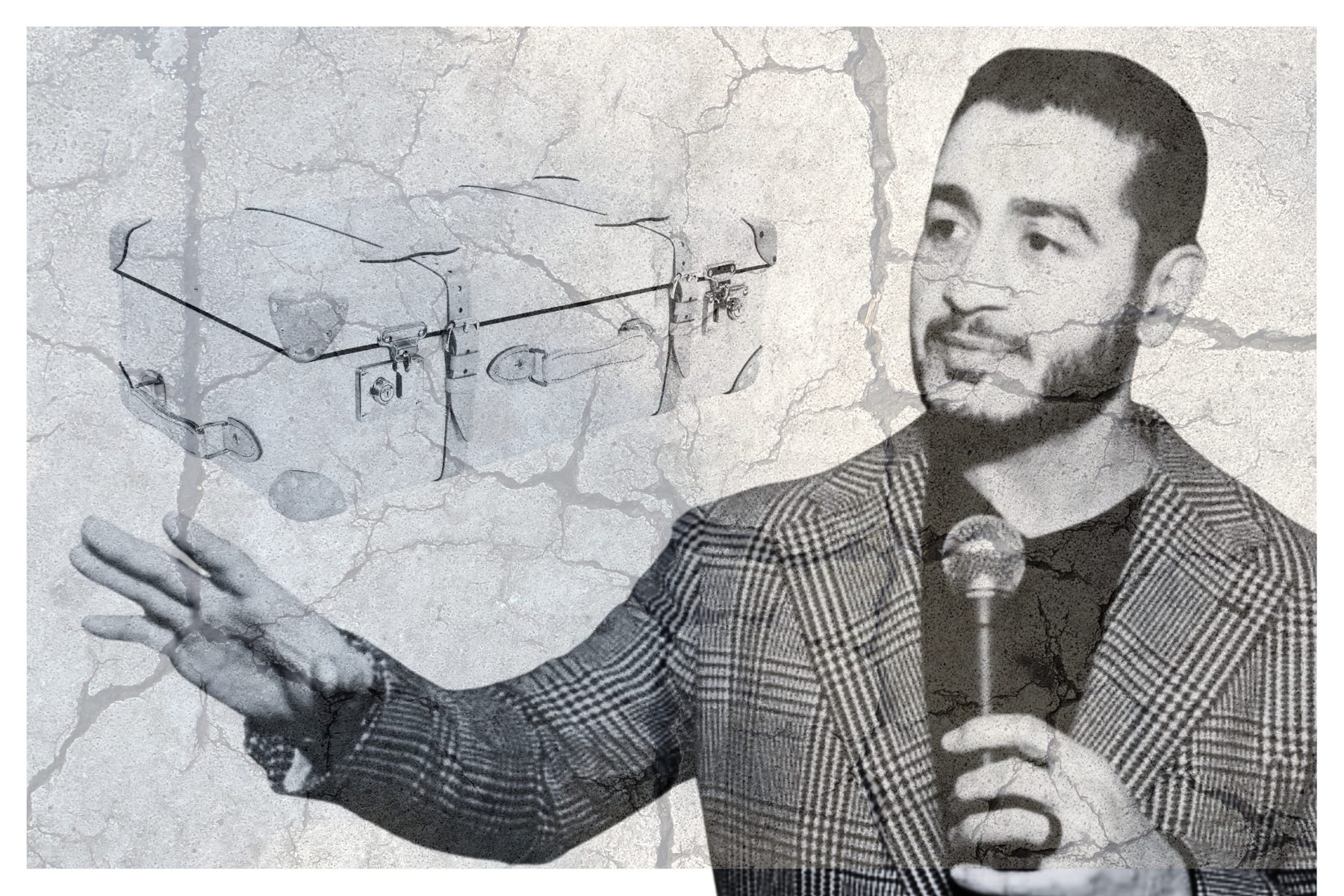
As a Rhodes Scholar with a doctorate in public health, Senate hopeful Abdul El-Sayed understands well the effects of cortisol and chronic stress on human beings — much as Trump, without a medical degree, seemed to understand instinctively in 2016 how angry people pay attention, and how, once attentive to a message, they often begin to follow the messenger.
While El-Sayed’s message is not based entirely on his animus toward the Jewish state, it unquestionably plays an outsized role. The role anti-Israelism has come to occupy in transforming the Democratic Party — the speed of that transformation and its growing appeal to voters — should be alarming to anyone who holds even a modicum of support for Israel.
Let’s discuss for a moment not simply the current government of Israel, led by Netanyahu, a man who chose to bring into his coalition Bezalel Smotrich and Itamar Ben-Gvir, two far-right politicians who have made inflammatory statements and whose actions may be worthy of criticism. If the criticism of Israel were directed only at specific actions and accompanied by suggestions for change, that would be entirely reasonable.
But El-Sayed, like Zohran Mamdani, goes much further. He has repeatedly described Israel’s conduct in Gaza as “genocide.” He has argued for ending or dramatically restricting U.S. military aid to Israel. He has portrayed AIPAC as a corrupting force in American politics and has suggested that its influence has helped perpetuate the war. Those are legitimate political positions to advocate. What concerns me is not simply the positions themselves, but the political energy they now generate. In a CNN interview he said the Israeli government is “pretty damn evil” — and, pressed on the comparison, extended the same word to Hamas: “We can say both.” It is a strange kind of evenhandedness, one that treats a sovereign government at war against the organization who just murdered, raped, and kidnapped some fifteen hundred of its citizens, and the terrorist organization that started it as morally interchangeable.
Consider his response to the March 2026 attack on Temple Israel in West Bloomfield, where a man drove a truck loaded with explosives — and carrying a rifle — into a synagogue housing a preschool of roughly 140 children. The explosives failed to detonate; the attacker died of a self-inflicted gunshot wound before anyone else was hurt. His brother, reportedly a Hezbollah commander, had been killed days earlier in an Israeli airstrike in Lebanon, along with a niece and nephew. Asked about the attack, El-Sayed said only that “hurt people do hurt people” and that events six thousand miles away don’t stay there.
As I read it, the implication was hard to miss: an act of terror against a preschool recast as the downstream consequence of Israeli policy — the same logic that has been used again and again to rationalize the atrocities of October 7, 2023. Temple Israel’s own rabbi, Jen Lader, publicly rebuked him for it.
Given that El-Sayed comes from an Egyptian family background and has spoken critically about Israel throughout his political career, his views are, in some regard, understandable. What is far more alarming is his attractiveness to voters who have no such personal connection to the conflict. For them, Israel represents everything wrong with America and American power. Their complaints are based largely on an ideology of oppressor versus oppressed — a simplistic, myopic worldview that sees wealthy Western nations as inherently suspect and those of the Global South as inherently virtuous.
There is an urge among many in our country to tear down our institutions and remake them wholesale. The problem with this, among many others, is that the framework for what comes next is rarely articulated with any clarity. That, of course, presents little problem for voters who have themselves become radicalized. And where do we find one of the major engines of that radicalization — one that has become a litmus test for anyone wishing to find a place within much of the Democratic Party? In the demonization of Israel.
As I write this, I find myself thinking about the upcoming second anniversary of the murder of Hersh Goldberg-Polin, who was shot at point-blank range in a tunnel in Gaza, together with five other hostages. They have come to be known as the Beautiful Six.
It isn’t hard to recognize a certain sickness: the relentless excoriation of Israel coupled with the silence surrounding these cruel and senseless murders.
El-Sayed’s criticism of AIPAC — the American Israel Public Affairs Committee — has been vitriolic and false. He has repeatedly argued that AIPAC’s influence distorts Democratic politics. “The reason that we’ve seen this war fought is because of the impact of AIPAC in our politics.”
Only a short time ago, many people would hardly have recognized the name, much less known what the acronym stood for. Now this entirely legal organization, which until recently enjoyed broad bipartisan support, has become the principal villain for much of the progressive wing of the Democratic Party. I should add, the ascendant wing, as we have seen in the New York primary elections and elsewhere.
El-Sayed’s goals are about the remaking of America. That is not unusual for politicians. What is unusual is that one of his principal political instruments is the same instrument that has so often been used by those seeking power throughout history: the demonization of the Jews, this time through the medium of the Jewish state.
It is easy to say that anti-Israelism has no connection to anti-Judaism. I have heard many people repeat what has now become a familiar refrain: “Being anti-Israel doesn’t mean you are anti-Jewish.”
The sheer frequency, popularity, and political force that anti-Israelism now possesses should make anyone pause before accepting that claim too readily.
Imagine someone devoting enormous energy to arguing that Mexico should cease to exist as the nation-state of the Mexican people, while insisting they have nothing against Mexicans. One would naturally wonder whether those two claims could comfortably coexist.
As propagandists have long understood, repetition has extraordinary power. Repeat something often enough and it begins to feel self-evident. “Israel committed genocide.” “Israel is an apartheid state.” “Israel is uniquely evil.” Repeated often enough, assertions begin to acquire the status of unquestioned facts.
Michigan’s primary takes place on Tuesday, August 4. El-Sayed is an American citizen — bright, well-spoken, highly educated, and telegenic — the kind of candidate whose ambitions plausibly extend well beyond a Senate seat.
It is that history — not paranoia, but memory — that makes the current moment feel different. There are Jews who, since the Shoah, have kept a travel bag ready by the door: a passport, some cash, maybe a few diamonds — portable wealth, as they call it.
No doubt they were told, more than once:
“This is a bit crazy, no?”
No posts
Comments
Nothing yet. Say the first thing.
Sign in to join the conversation.