
On August 10, Substack writer Rarely Certain published “With ‘friends’ like this, Jason Arday doesn’t need enemies”, admitting that the collapse of Arday’s reputation had become entertaining. They said, “I wish the story would now move on. My prurient enjoyment of every new and humiliating exposure of his cheating and fabulism comes from the worst part of me and it no longer needs feeding.” The piece ended by wishing him luck rebuilding his life.
Four days later, Jason Arday was dead.
Most likely, this was a suicide. We do not yet have an official cause of death, so I cannot state that as fact, but it is not some outrageous inference. Arday had already resigned from Cambridge, saying the relentless accusations, speculation, and public commentary had gotten to a point where the personal toll was too much.
There were serious allegations against him. I won't argue he was secretly innocent, either. Suppose he plagiarized, lied about his biography, or gained undeserved accolades.
What, exactly, was supposed to happen next?
At some point, Jason Arday stopped being “a person.” When the cancel campaign begins, that ends; you’re whatever you’re being labeled. You represent that particular problem or wrongdoing to the mob, and they are attacking you as an analog for the injustice. If they defeat you, it’s a step closer to a just world.
In Plato Is a Bitch: A.I. and Bomberguy, I argued that the contemporary obsession with plagiarism reproduces a much older conception of justice: the belief that social order depends on the right people occupying the right positions. And here we are, right back there.
The mob essentializes, attacks, and somehow the world doesn’t get any better.
The evidence that Jason Arday plagiarized is pretty convincing. More than 100 passages in his PhD thesis were reportedly similar to an earlier dissertation, and Retraction Watch documented similar problems in his published work.
But I just don’t think plagiarism matters in the way we’re encouraged to think it does.
Copying doesn't inherently harm society’s knowledge; in fact, that’s literally how people learn. The real harm lies in our incentive system, which rewards property owners who succeed in the market. This system allocates money, jobs, recognition, and security based on ownership and credit. Although some see the ethical issue of plagiarism as separate from laws and property, where do ethics come from?
Again, I’ve made that argument at considerably greater length before, so I won’t repeat it all here (but hbomb colleague Big Joel recently demonstrated it’s very much about intellectual property, if you’re interested).
That does not mean I think people’s actions don’t matter. Quite the opposite. But if people are going to condemn something somebody has done, I want to know what actually happened, what harm it caused, and what could address that harm. “This proves what kind of person they are” answers none of those questions.
Some of the allegations against Arday potentially involved problems far more serious than plagiarism. Retraction Watch reported that material apparently taken from another researcher’s work appeared as quotations attributed to participants Arday claimed to have interviewed himself. If interviews or data were fabricated, I think that matters more than copying because it means any conclusions he came to are conjecture at best, an outright fabrication at worst (and unusable/unreliable either way).
That is to say, my goal isn’t to defend Arday, regardless of my opinion on plagiarism. If he falsified research, I actually consider that a serious problem. The issue is that either way, it becomes the only thing that matters when people consider Arday, which destroys his avenues for correcting his wrongs.
Jason Arday was no longer Jason Arday, he was “The PLAGIARIST.”
Interestingly enough, he had already been made into something larger than an academic employee. When Cambridge announced his appointment in 2023, it highlighted that he would become its youngest Black professor, noted his autism diagnosis, his account of not speaking until age 11 and learning to read and write in his late teens, and his journey from a disadvantaged upbringing to Cambridge. Arday later recalled people celebrating “not simply my appointment, but what it represented.”
Before becoming “The PLAGIARIST,” Arday was called “The Success Story,” with Cambridge showcasing his rise as proof that talent can overcome disadvantaged beginnings. Elite institutions love to use the less fortunate to improve their reputation.
Once Arday’s academic offenses were put out into the world, the story completely reversed. If his success could now be seen as obtained illegitimately, then the plagiarism wasn’t just something bad bad no no he had done after arriving at Cambridge. It was evidence that he never should have been there in the first place.
Thus, the supposed injustice was no longer simply that Arday had copied someone else’s work or even falsified research, but that an impostor had received the rewards belonging to a legitimate scholar.
This is where plagiarism starts functioning as something considerably larger than plagiarism. “The PLAGIARIST” isn’t merely somebody who copied. He’s somebody out of place.
And that brings us back to a pretty specific conception of justice.
That conception comes from Plato’s Republic. In Plato Is a Bitch: A.I. and Bomberguy, I talked about Plato’s definition of justice as a society where everyone occupies the position appropriate to them and performs the function suited to their nature. The rulers rule. The producers produce. People stay in their lanes. What you are dictates what you are allowed to be, and thus where you’re allowed to be. My less academic translation was: know your place, bitch.
Modern meritocracy assumes that those at the top earned it, and those at the bottom are there due to merit, effort, or ability. The hierarchy vanishes behind the belief that everyone ends up where they deserve to be. When people do wrong, they are labeled wrong and pushed out.
Arday created a particularly satisfying scandal for this worldview because his wrongdoing could be read as proof that he had somehow outsmarted the sorting mechanism. As I mentioned earlier, an impostor had taken the place, earning the position, credentials, book deal, and accolades that rightfully belonged to a genuine scholar.
This is evident in media coverage, social and insitutional. Toby Young wrote an article for The Spectator called “Professor Arday is the gift that keeps on giving”, calling him a “DEI poster boy” and joking that he increasingly seemed like an elaborate Sacha Baron Cohen character created to demonstrate the stupidity of liberals. Suddenly, Arday’s academic achievements, his running, childhood, charity efforts, and entire biography could all serve as evidence in the same case: indicating that this guy was never meant to be here.
That treatment clearly benefited the political right. The Arday story blew up and became a symbol in arguments against DEI, Black academics, and liberal institutions. Since his death, many have rightly concentrated on that aspect of the story. There was indeed a racialized right-wing campaign centered on him. Ignoring this would be foolish.
However, I notice a trend emerging: people on the left framing this as the right's doing to Jason Arday.
Nope. Sorry. Not for one minute. The left has been ravenous for plagiarist blood for years.
Hbomberguy’s Plagiarism and You(Tube) has now been watched more than 41 million times. It is Hbomb’s most-viewed video by an enormous margin. I criticized it when it came out because, despite beginning with real systemic problems around ownership and compensation, it ultimately turns plagiarism into a story about types of people.
What types? Well, the legitimate, moral creator and the impostor, deceitful consumer masquerading as a creator. The person who has something authentic to say and the person pretending to be them.
“I do worry there are people out there who will never get the chance to become who they are because they’re too busy trying to be like someone else who at best has it figured out for themselves just a little bit.
I feel like I know who I am and how to live my life, and that makes me feel happy and somewhat complete. And I don’t think I’d have ever found myself if I was trying to chase someone else’s sense of completeness.
-Hbomberguy, Plagiarism and You(Tube)
In my documentary, I called this a modern version of the Platonic division between the person legitimately occupying a station and the person who has trespassed into it.
Hbomb even acknowledges near the end that he does not know how plagiarism could be addressed systemically and worries that even trying might make things worse. His practical answer is essentially to expose plagiarism publicly, draw attention to it, and let audiences “decide who deserves their support.”
And then audiences learned to do that.
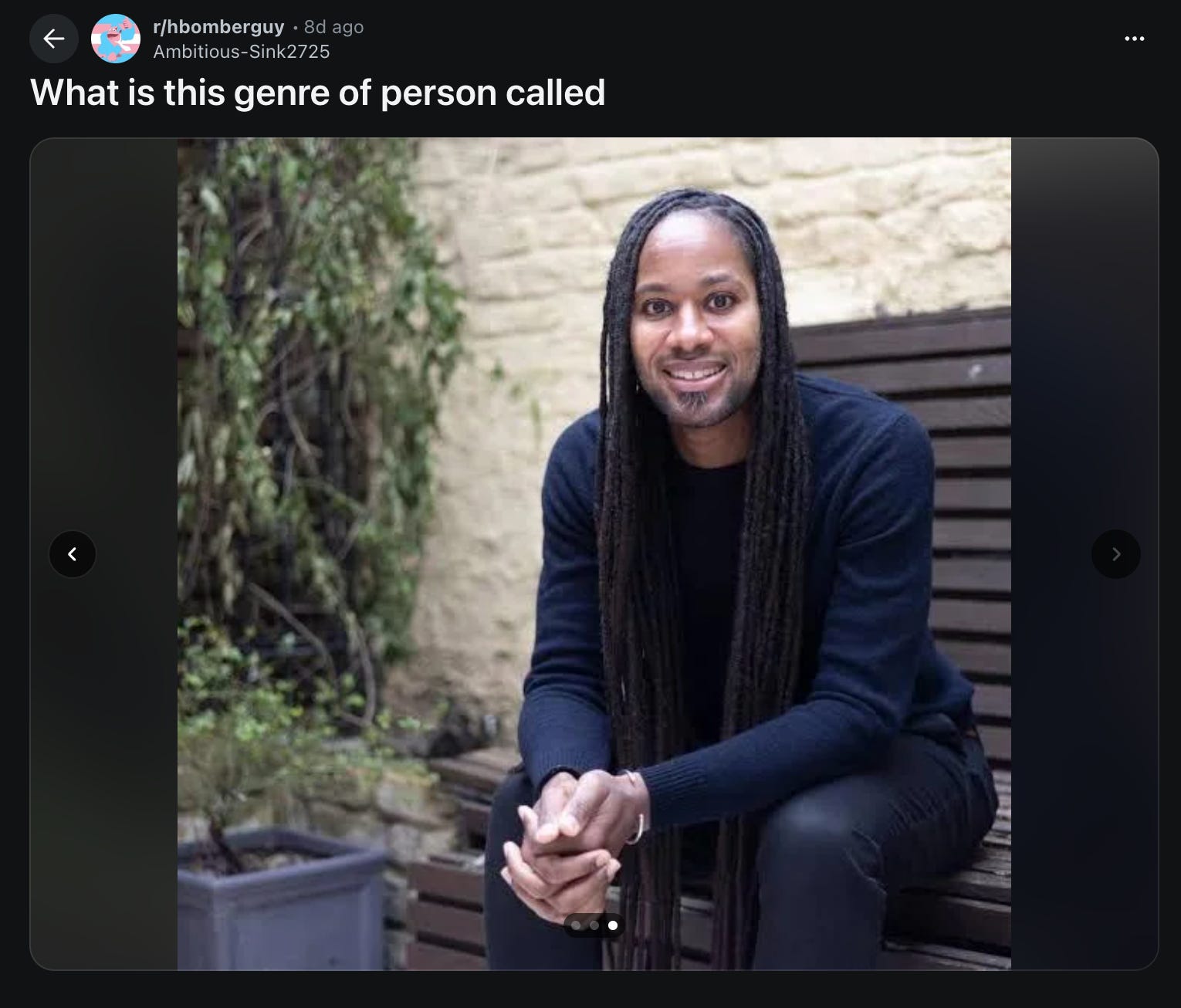
While Arday’s scandal was unfolding, somebody posted his picture in Hbomberguy’s subreddit alongside George Santos and Tommy Tallarico (the subject of another famous Hbomb exposé). The title was “What is this genre of person called?”
The poster explained that Arday “lied and plagiarized a lot,” said nobody had yet compiled all the material, and encouraged readers to “google his name and go down the rabbit hole.” Commenters offered categories: “Grifter.” “Compulsive liar.” Another called him the “final boss” of this type of person. Someone asked whether James Somerton, the main target of Hbomb’s plagiarism video, also belonged in the category.
That is almost comically perfect for what I am saying. It’s not about what happened, what harm was caused, or what needs to be corrected. “What genre of person is this?” One user gave away the game, replying simply “targets.”

That is the exact transformation I am talking about. These people absolutely refuse to view others through any lens but their wrongdoings, which (I guess) makes it okay to see them only as “targets.”
And this was not confined to Hbomb’s fans, social media, or the right. On August 10, Novara Media, hardly a right-wing anti-DEI outlet, published “The Jason Arday Saga Is a Story of Great British Gullibility”. Its author explicitly rejected the right-wing racial conclusions being drawn from Arday’s case and warned about the consequences for other Black academics.
He also said he found the story “mostly hilarious,” basking in Arday’s “self-own.”
You can oppose racism and the right while enjoying watching the target get torn down. You can yell that "Plagiarism is an unforgivable moral failure" and claim to "defend vulnerable creators," yet still participate in a culture where “exposing someone” is a sick form of entertainment.
The left pretends it has no role in Jason Arday’s death or dismisses its own attacks on him, despite their condemnation of “anti-DEI.” A large chunk of the left has built a culture of exposing plagiarists' failures (some have made significant amounts of money doing so, as well) and can't pretend they had no part in his downfall.
These people are as guilty as anyone they point at on the right, because they refuse to accept that, firstly, their “ethical concerns” are actually protecting economic dynamics. And secondly, reducing people to a single thing they did and attacking them as a representation of what they believe they must reject essentially ends the difficult but important work that actually holds society together
This involves understanding what repair means, determining what changes are necessary going forward, and differentiating between accountability and punishment. It also requires identifying what constitutes effective accountability. People need to allow others to make mistakes without that error defining who they are or affecting how we interact with them.
But why bother with any of that noise when you can reduce people to something they’ve done and let that dictate how you treat them forever?
Jason Arday’s departure should have settled this. It didn’t. So, what was Arday supposed to do next?
Real accountability includes a path forward. This doesn't mean avoiding consequences or forcing everyone to trust again. Rather, it requires plausible steps a person could take tomorrow that truly matter.
Requesting a change in behavior is the way, but people are just assigning a permanent status.
Once we decide what somebody is, it doesn’t matter what they do. They’re supposed to just fuck off to the void. And some actually do, sadly.
If their subsequent actions aren’t allowed to influence how these people are viewed, then this straight up cannot be called “accountability.”
It’s just banishment.
I'm not asserting that Jason Arday was a good person because I can’t know that. Simplistic labels like “good" or “bad" diminish his actions and overlook what steps might be necessary, what things he could have done to learn and grow. Cambridge sold him as "The Success Story," while critics later branded him "The PLAGIARIST." Despite these contrasting judgments, both labels simplify him into a category that supposedly explains everything.
Platonic justice and elitism underpins this. Plato’s “justice” says people have a “true nature” and should be placed accordingly. The deserving scholar belongs at Cambridge; the impostor does not. The good stay, while the bad are pushed out.
There is another option. People who do wrong must not become The Wrong™.
No posts
Comments
Nothing yet. Say the first thing.
Sign in to join the conversation.