
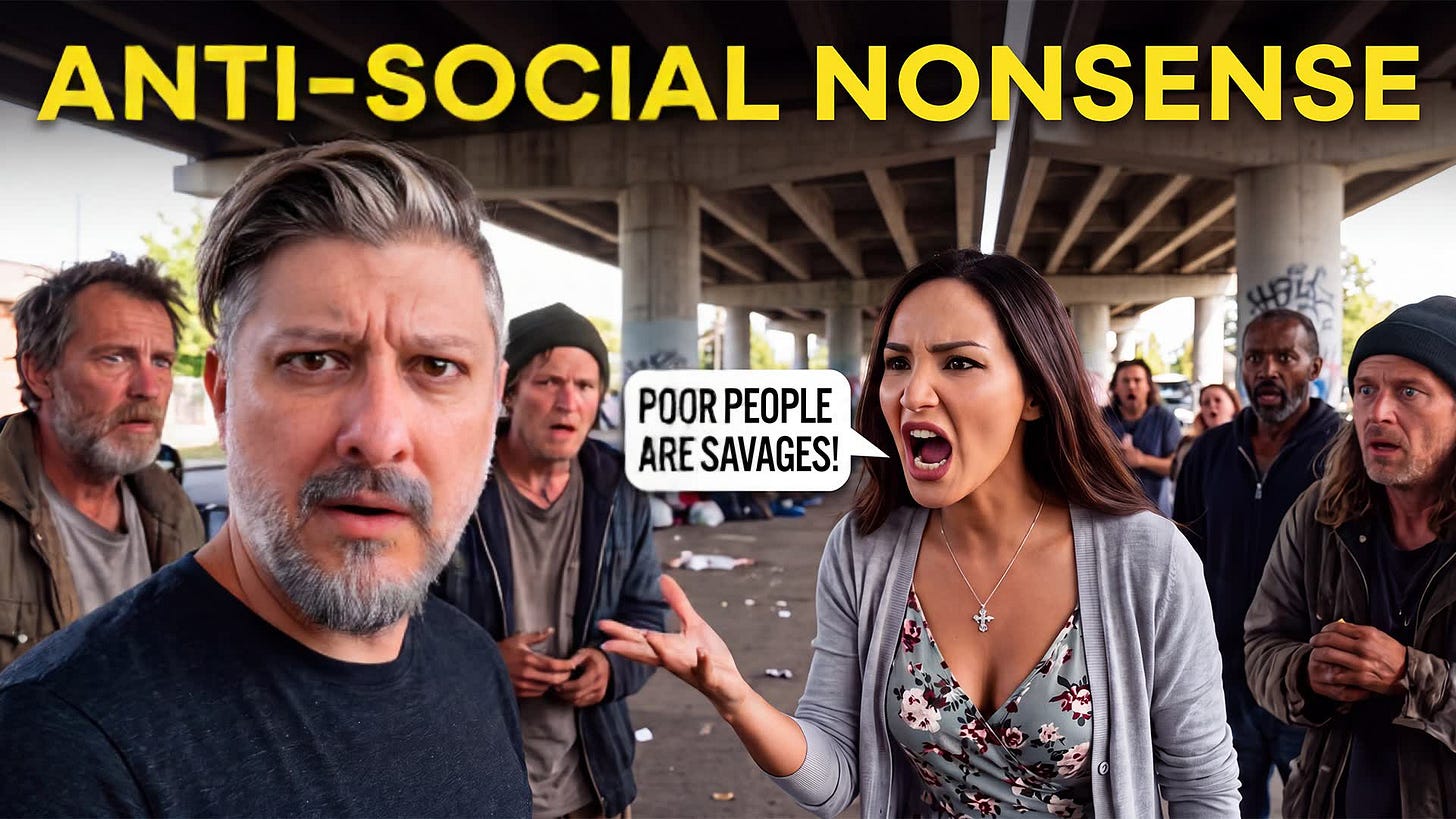
This article is based on a video I uploaded yesterday. There are minor differences, as the video was not scripted and this version has been transcribed and edited to work as an article.
Politics is supposed to be dealing with problems that are bigger than any one person can solve. Crime, healthcare, housing, poverty, education, infrastructure aren’t problems created by one person, nor can they be solved by one. They come out of the way millions of people interact through institutions and economic relationships that none of us control, individually and often collectively speaking.
But to move forward, eventually we have to ask what is producing them. What conditions keep recreating the same problem? Who benefits from those conditions staying in place? What makes them so difficult to change?
A lot of contemporary politics seems increasingly uninterested in those questions. Instead, “political people” look for someone to blame. Find the bad people, condemn them, punish them, defeat them, get rid of them. Once you know whose fault something is, that starts to feel like an explanation in itself.
But simply finding a scapegoat isn’t anything of the sort. Knowing who you’re angry at doesn’t necessarily tell you why the problem exists or what would stop it from happening again. And if politics loses interest in that distinction, it stops being a way of solving social problems and turns into an endless exercise in passing moral judgment on everyone around us.
I came across an unusually clear example of this in a clip where Lauren Chen (a right-wing commentator) is responding to Wisconsin gubernatorial candidate Francesca Hong. Hong was discussing crime, public safety, and the enormous amount of money spent on incarceration.
“I want us to be sensible and realistic, but we know now that the billions invested in the criminal legal system is not working. We are spending, um, on incarcerating an individual more than tuition for UW Madison. That, you know, this is about making sure that local law enforcement, um, you know, is working with community, that we are taking resources from, uh, the state and investing in things like public education.”
-Francesca Hong
You can disagree with any specific proposal or think a particular program will not work, or even that some other use of public money would be more effective. What Hong is saying is not controversial, though: social conditions affect social outcomes. If we want different outcomes, we should investigate whether changing those conditions produces them.
Lauren Chen responded with something pretty wild:
“They’re basically holding you hostage. They’re saying unless you fund these people’s lives, unless you fund daycare for them, their public schooling, very expensive lunches, after school programs, their healthcare, then you’re basically leaving them no choice but to commit violence, violent acts upon you and your businesses. They’re holding you hostage. Like, this is ransom. Make no mistake about it. They’re ransoming your safety.”
-Lauren Chen
“Give these people what they want, or they are going to hurt you” is an extraordinary transformation of the original claim. “Material conditions can contribute to crime” has become “poor people are personally threatening you with violence unless you give into their heinous demands, like public schools and lunch programs.”
I’ve dealt with similar nonsense while trying to materially explain something undesirable. If you explain why people become reactionary, someone will accuse you of sympathizing with reactionaries. If you explain why people commit crimes, someone will accuse you of excusing criminals. If you explain the conditions that produce some form of destructive behavior, the explanation itself gets treated as a defense of the behavior.
But if the goal is actually to change an outcome, you really need to know why it happens. People respond to incentives, opportunities, desperation, risk, available alternatives, and the institutions surrounding them. Do you know why people steal money? It’s generally because they don’t have money.
Of course, poor people do not universally steal, wealthy people are perfectly capable of committing crimes, and identifying a social cause does not eliminate people’s agency or responsibility.
If someone commits a crime, it is perfectly coherent to hold that person responsible for deciding to while also asking why it appeared to be a worthwhile option and what conditions would make that decision less likely for other people. Instead, people like Chen (on the right or left) are obsessed with questions of moral status. Are these people good? Are they responsible? Do they deserve help? Have they sufficiently earned our concern?
And there’s another part of Chen’s argument that makes it especially remarkable. This is not a fabulously wealthy industrialist explaining why the poor should accept their place in society. Chen is a content creator who has experienced significant professional and economic downward mobility. She previously co-founded a media company with her husband. That company collapsed, and she is now trying to rebuild a career as an individual media personality.
Despite this, she is portraying people who are likely in worse situations than her as barely civilized animals who will attack the good people if they aren’t bought off with… daycare, I guess? That’s a really impressive lack of self-awareness.
This is not merely an argument against a specific welfare program, nor is it something that only concerns criminals. It’s the threat of the poor people! The poor are a dangerous population requiring pacification! Give them schools, daycare, and healthcare! If you don't, they'll come after you! That’s what they’re saying!!!
Downward mobility should make the artificiality of these divisions increasingly obvious. The person worried about losing work, those unable to afford healthcare, struggling with rent, or relying on unemployment insurance may not be identical in circumstances to Chen’s, but I would think she might be a bit more humbled and aware given what she has seen.
Now, I don’t think the left is actually better.
The right can simply say that other people’s problems are not your problem, that irresponsible people deserve what they get, or that somebody is trying to take what belongs to you. The left’s rhetoric is usually different; they’re more likely to claim that their behavior originates in compassion, but so much of contemporary left politics instead tells us that other people are harmful, that their consumption must be scrutinized, that their language must be monitored, that their associations reveal what kind of person they are, and that people who don’t conform should be subject to disciplinary action and exclusion.
One side can be openly anti-social while the other provides an elaborate vocabulary explaining why anti-social behavior is actually an expression of care. The result is still a political culture overwhelmingly concerned with identifying defective individuals and correcting their conduct.
The right says that the bad people should be punished because they are bad. The left frequently says that the bad people should be punished because allowing them to continue being bad would hurt vulnerable people. The rhetoric and moral justification differ, but tell me what’s materially different.
This is where we can begin to observe fandom dynamics within politics, too; people can be right about an important issue and accumulate a kind of political credit from it. Once that pet issue is identified, criticism of their other positions starts to feel like an attack on the pet issue to people who care about it.
Lauren Chen herself provides a useful example because she has taken positions sympathetic to Palestinians and hostile to the conventional American relationship with Israel. I’m not sure whether the underlying basis is imperialism or “the Jews,” though, and I don’t really care. Ultimately, it does not matter for the point I am making here. Suppose she is completely correct about Palestine and for good reasons. That does not make what she is saying about poor people any less grotesque.
Being correct about Palestine does not excuse contempt for poor people, just as being correct about capitalism does not excuse treating everyone around you like garbage. Someone on the left having the “correct” position about racism, trans people, labor, AI, Palestine, or anything else does not mean shit about who they are as a person.
What I’m getting at is we really shouldn’t judge people based on positions. Imagine that everyone in Palestine were sent to North America as a refugee, or more pointedly, as a poor person. Does Lauren believe that at that point they deserve no assistance? Are they savages now that they are no longer in danger of being blown to bits?
Political people tend to read disengagement as ignorance or apathy, but I think it’s worth looking at what political culture is actually asking people to engage with. So much of it amounts to figuring out who it’s acceptable to hate, mock, dismiss, or blame.
If your politics teaches you to hold huge parts of the population in contempt, who are you expecting to build anything with? And if you claim to be fighting for ordinary people while constantly showing how little you seem to like ordinary people, what exactly are you offering them?
The Lauren Chen example is extreme, but the tendency behind it is everywhere. We’ve reached a point where trying to understand why someone behaves badly is often treated as making excuses for them. Once that happens, politics has very little room left for anything besides punishment, blame, and deciding who deserves what.
And that’s most of what people encounter when they look at politics: an endless fight over which group of people is awful and whose problems we’re allowed to sneer at. I don’t think it’s particularly mysterious why so many people decide they’d rather stay out of it.
No posts
Comments
Nothing yet. Say the first thing.
Sign in to join the conversation.