
The project was already dead.
Nobody had said it out loud yet.
Three months earlier, Alex had stood before the executive team and presented “the future”.
A new enterprise scheduling platform.
Cleaner workflows.
Better resource allocation.
Less duplication.
More transparency.
The business case was compelling.
The vendor demonstrations were polished.
The implementation plan was meticulous.
The budget was approved.
Training sessions were scheduled.
The organisation committed.
So was Alex.
Three months later, reality arrived.
Fewer than 15 per cent of staff were actively using the platform.
Support requests continued to climb.
Routine work now took longer than before.
Across the organisation, teams had built their own Excel spreadsheet workarounds to keep delivering work.
The platform wasn’t streamlining operations.
It was creating new ones.
There were only two realistic options.
Accept that this strategic project had failed.
Or find another explanation.
Alex chose the second.
Another round of training.
A compliance dashboard.
Weekly adoption reports.
More communication.
Greater accountability.
The language changed almost overnight.
The platform was no longer the problem.
Staff were.
The project no longer existed to improve the organisation.
The organisation now existed to justify the project.
How does that happen?
How does a thoughtful, experienced leader slowly stop responding to reality?
Not because they become less intelligent.
Because, somewhere along the way, the strategy stopped being an explanation.
It became part of their identity.

Every strategy begins life as a hypothesis.
A thoughtful attempt to explain reality and improve it.
Perhaps this workflow will reduce duplication.
Perhaps this technology will improve service.
Perhaps this restructure will clarify responsibility.
Good leaders don’t stumble into these decisions.
They investigate.
Consult.
Challenge assumptions.
Accept responsibility.
That isn’t the problem.
The problem begins later.
Quietly.
Almost invisibly.
The language changes.
First:
I think this might work.
Then:
I recommended this.
Then:
I led this project.
Eventually:
If this fails, what does that say about me?
That’s the moment leadership becomes dangerous.
Not because the strategy failed.
Because the strategy became personal.
Evidence is no longer evaluating the idea.
It’s evaluating the person.
Every new piece of contradictory data becomes psychologically expensive.
Not because the organisation cannot afford to change.
But because the leader believes they cannot.
This is why Constructive Detachment follows immediately after Environment Architecture.
The previous pillar asked us to move capability out of ourselves and into the environment.
This one asks an equally important question.
Once you’ve built the system, can you stop identifying with it?
Every workflow.
Every reporting structure.
Every technology platform.
Every strategy.
Is only today’s best explanation of reality.
Reality has no obligation to remain the same.
Neither should we.
The architect’s discipline is simple.
Hold the purpose firmly.
Hold the method provisionally.
Purpose deserves commitment.
Methods deserve evidence.
Everything else in this article flows from that distinction.
It is comforting to believe this only happens to poor leaders.
It doesn’t.
In fact, experience often increases the risk.
In one of the foundational studies in organisational psychology, Barry Staw found that decision-makers who felt personally responsible for an earlier decision were significantly more likely to continue investing in it after receiving evidence that it was failing (Staw, 1976).
Subsequent research has shown that escalation of commitment is shaped by more than sunk costs.
Reputation.
Political capital.
Past success.
Personal responsibility.
Ego threat.
Previous investment.
All make it harder to let go (Sleesman et al., 2012).
The irony is uncomfortable.
The same qualities that helped leaders build support for a strategy often become the qualities that prevent them from abandoning it.
Experience gives us confidence.
Confidence makes us persuasive.
Persuasiveness makes us influential.
Influence makes it easier to defend yesterday’s decisions long after reality has moved on.
Competence can become the mechanism that protects attachment.
Which is why Constructive Detachment is not primarily an intellectual discipline.
It is an emotional one.
Stoicism has never asked us to care less.
It does ask us to care about the right things.
Marcus Aurelius repeatedly reminded himself that being corrected was not an injury.
Persisting in error was.
Truth was the objective.
Not consistency with yesterday’s opinion.
That principle becomes profoundly practical in leadership.
Constructive Detachment is the discipline of remaining fully committed to the purpose while allowing reality to revise the method.
Notice what remains fixed.
Purpose.
Principles.
Responsibility.
Notice what remains provisional.
Strategies.
Workflows.
Technology.
Structures.
Processes.
The mistake is confusing methods with principles.
Methods deserve commitment.
They don’t deserve permanence.
Timeless Core asked us:
What principles should guide us when certainty disappears?
Constructive Detachment asks the next question.
Which parts of our strategy should remain open to revision when certainty returns?
Hold the purpose firmly.
Hold the method provisionally.
That single distinction changes a lot.
Changing a workflow is no longer abandoning your principles.
Replacing a platform is no longer admitting defeat.
Revising a strategy is no longer a threat to your identity.
If anything, it becomes evidence that your identity was never attached to the strategy in the first place.
The hardest moment to remain objective is not after a project begins to fail.
It’s before it begins.
Once political capital has been invested, objectivity becomes expensive.
So don’t just rely on future judgement.
Support it.
Before launching any significant initiative, create a Revision Contract.
Not because you expect failure.
Because you expect reality to teach you something.
The Revision Contract asks you to make seven commitments before implementation begins:
Purpose: Define the problem you’re actually trying to solve.
Current hypothesis: Record why you believe this approach will solve it.
Observe reality: Decide what observations would strengthen or weaken that belief.
Review: Commit to a deliberate moment of reflection rather than relying on ad hoc judgement.
Revision trigger: Identify what evidence would justify reconsidering the approach.
Decision: Make it clear who remains accountable for explaining any decision to continue, adapt or stop.
Recovered capacity: Decide in advance how the time, money and attention will be redirected if the initiative ends.
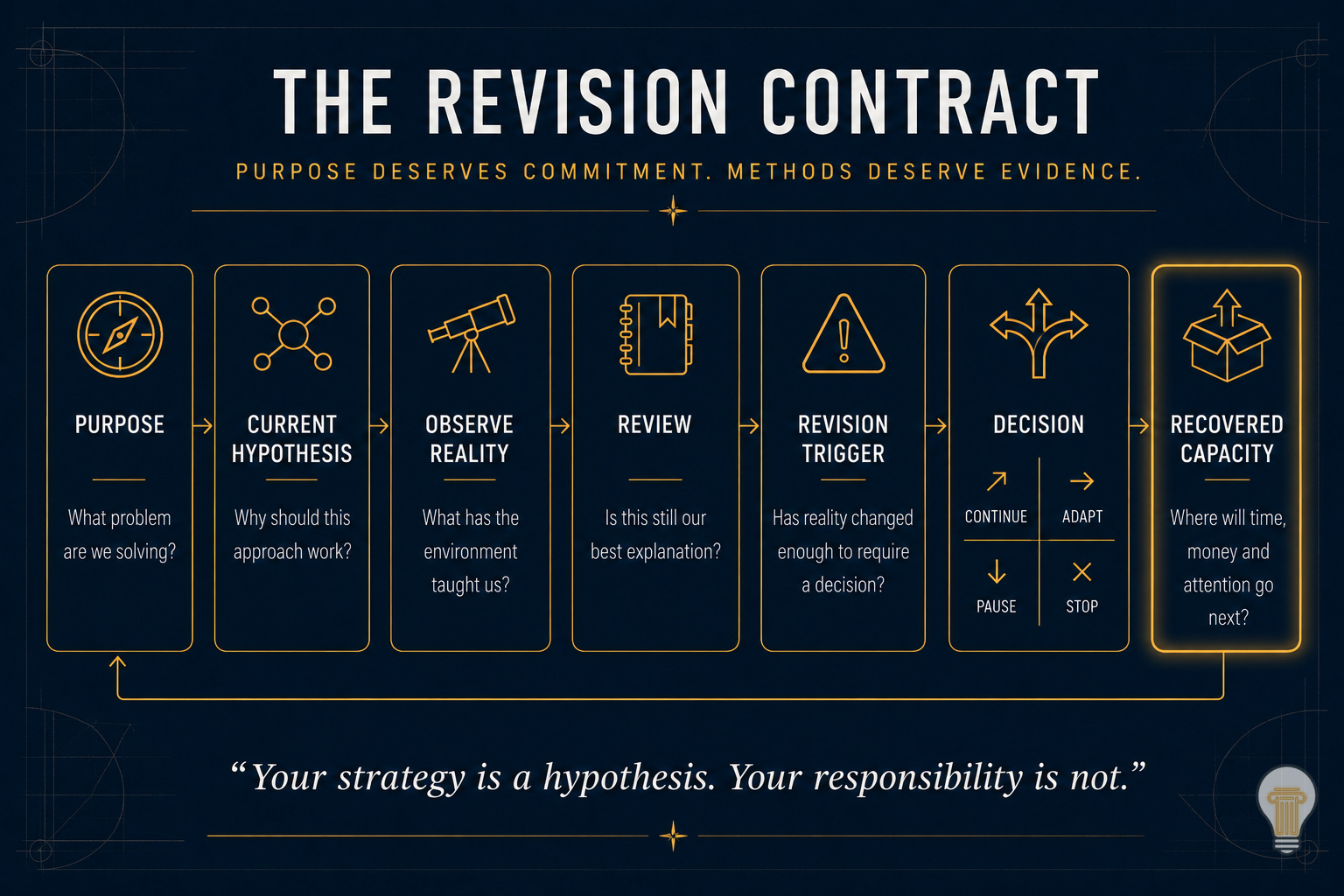
Notice what’s missing.
There is no automatic kill switch.
No spreadsheet that decides for you.
No algorithm replacing your judgement.
The Revision Contract does something useful beyond the model itself.
It prevents future-you from moving the goalposts on yourself.
When the review arrives, the evidence is compared against criteria agreed before pride or ego became involved.
That changes the conversation.
Not:
“How do we save this project?”
But:
“What is reality telling us now?”
Those are very different questions.
One of the earliest signs that reality has changed is rarely found in a dashboard.
It appears in behaviour.
A staff member exports data into Excel.
A team quietly ignores the new workflow.
Someone creates a manual shortcut.
The temptation is to interpret these as compliance problems.
Constructive Detachment instead asks:
What is this workaround trying to accomplish?
Every workaround is evidence.
It tells you the formal system is failing somewhere.
Perhaps the technology is poorly designed.
Perhaps implementation introduced unnecessary friction.
Perhaps incentives still reward the previous behaviour.
Perhaps the workaround creates unacceptable risk.
The workaround doesn’t tell you the answer.
It does tell you where to investigate.
The detached leader treats resistance as diagnostic information before treating it as defiance.
That single habit changes the relationship between leaders and their teams.
People stop hiding reality.
So reality can start arriving earlier.
One final trap remains.
When the evidence changes, many leaders drift away from the original strategy.
Projects slowly lose funding.
Meetings disappear.
Platforms receive fewer updates.
Nobody admits the decision has changed.
It simply… fades.
That protects reputations.
But it also teaches the wrong lesson.
Constructive Detachment asks leaders to make revision visible.
Not performative.
Visible.
Something as simple as:
I sponsored this approach because it was the best explanation we had at the time.
The evidence has changed.
So will our approach.
That sentence actually does something remarkable.
It separates identity from judgement.
It tells the organisation that changing your mind is not failure.
Ignoring reality is.
It also creates psychological permission for everyone else.
If the leader can update their thinking without embarrassment...
...perhaps everyone else can too.
That is how learning cultures emerge.
Not from slogans.
From modelling the way.
Every leader eventually discovers that one of their best ideas wasn’t.
The technology they championed.
The process they designed.
The structure they defended.
The initiative they believed would transform the organisation.
Reality eventually reaches all of them.
The question is never whether you will be wrong.
The question is what happens next when you are.
Some leaders spend enormous amounts of energy defending yesterday’s answers.
Others ask a different question.
What would I believe if this weren’t my idea?
That’s Constructive Detachment.
Not less commitment.
Better commitment.
Commitment to purpose before method.
Commitment to truth before ego.
Commitment to learning before consistency.
Every strategy eventually becomes incomplete.
Every model eventually encounters reality.
Every organisation eventually reaches the limits of yesterday’s thinking.
The question is never whether your ideas will need to change.
It’s whether your identity allows them to.
Because the future does not reward leaders who were right first.
It rewards leaders who remain teachable longest.
Your strategy is a hypothesis.
Your responsibility is not.
Comments
Nothing yet. Say the first thing.
Sign in to join the conversation.