
A few years ago, I wrote an article arguing that Thomas Shelby embodied remarkable resilience.
I still think that article contains useful ideas.
I also think I was wrong about its central claim.
Thomas Shelby, the fictional protagonist of Peaky Blinders, isn’t compelling because he’s resilient.
He’s compelling because he’s exceptionally competent in a crisis.
Those aren’t the same thing.
It’s an easy distinction to miss. We often use resilience as shorthand for anyone who remains calm under pressure, absorbs setbacks, or keeps functioning while everyone else falls apart.
Shelby certainly does all of those things.
He walks into dangerous rooms with a pulse that never seems to change. He delays emotion long enough to think. While others react, he calculates. It’s part of what makes Peaky Blinders so captivating. Shelby appears to possess complete command of himself, even as the world around him fractures.
It’s tempting to call that Stoicism, and many have.
Academics often describe Shelby as representing a form of “stoic masculinity”, characterised by emotional restraint, rational action and composure under threat (Mueller, 2022). Others argue the series uses the trauma of the First World War to explain, and at times complicate, his violence and emotional distance (Larke-Walsh, 2019).
But I think those analyses point towards something even more interesting.
Like all compelling fiction, Thomas Shelby isn’t valuable because he gives us someone to imitate.
He’s valuable because he gives us someone to recognise.
Fiction rarely teaches us what to become.
It reveals what we already are.
Shelby reflects a pattern that extends far beyond Birmingham in the 1920s.
Modern organisations are full of people just like him.
Not gangsters.
Professionals.
The project manager who becomes indispensable whenever everything starts falling apart.
The executive who steadies a room during a restructure but feels strangely restless when things are stable.
The academic who carries every crisis because everyone knows they’ll find a way through.
The leader who never seems overwhelmed.
We call these people resilient.
Sometimes that’s true.
Sometimes they’ve simply become highly adapted to environments that keep producing emergencies.
Those are very different things.
Crisis competence and resilience solve different problems.
Crisis competence helps you function when conditions become dangerous.
Resilience allows you to remain capable after the conditions change.
That distinction is important more today than ever.
Not because our workplaces have become more chaotic, although many certainly have.
Because the kind of capability the future rewards keeps changing.
The qualities that made you effective five years ago may not be the qualities that make you effective five years from now.
Which raises an uncomfortable possibility.
What if your greatest strength has turned into your greatest constraint?
Thomas Shelby didn’t become calm because he read Marcus Aurelius.
He became calm because panic gets people killed.
Whether or not his character accurately reflects the psychological realities of every First World War veteran isn’t really the point. Peaky Blinders presents Shelby as a man whose internal architecture was forged under extraordinary conditions. The battlefield rewarded vigilance, emotional restraint and rapid decision-making. Those qualities weren’t philosophical aspirations. They were survival mechanisms.
In war, hesitation carries consequences.
Emotional composure becomes functional.
Hypervigilance may keep you alive.
The tragedy is that wars eventually end.
Skills developed for one environment don’t automatically disappear when the environment changes. They often become habits. Habits become identity. Identity then becomes incredibly difficult to question.
Shelby survives the war.
But the war never entirely leaves Shelby.
That’s what makes him such a compelling character.
His greatest strengths are also his deepest constraints.
The qualities that allow him to navigate violence, betrayal and uncertainty make it difficult to trust, to rest, or to imagine a life that isn’t organised around the next crisis.
It’s easy to watch this unfold on screen and assume we’re observing an exceptional man in exceptional circumstances.
I’m not so sure.
The modern workplace produces its own versions of this pattern.
Different stakes.
Different consequences.
The same underlying mechanism.
Spend enough years working inside organisations that reward urgency, firefighting and constant availability, and you begin adapting to those conditions.
You learn to respond immediately.
To anticipate problems before they emerge.
To absorb uncertainty without showing it.
To become the person everyone calls when something goes wrong.
Those adaptations can build remarkable capability.
They can also become difficult to put down.
The environment changes.
The operating system doesn’t.
Adaptation isn’t the problem.
It’s one of humanity’s greatest strengths.
The professionals who flourish are rarely those who resist change. They’re the ones who respond to it.
The problem begins when adaptation stops being a choice.
What starts as an intelligent response to one environment slowly hardens into the only way we know how to operate.
The habit that once made us effective slowly becomes the person we believe ourselves to be.
Thomas Shelby illustrates this with unusual clarity.
His emotional restraint isn’t inherently good or bad.
Neither is his vigilance.
Neither is his capacity to remain calm while everyone else panics.
Each was an intelligent adaptation to extraordinary circumstances.
The tragedy is that the adaptation outlived the environment that created it.
His capabilities remained.
So did the assumptions beneath them.
That’s what makes adaptation so deceptive.
Success rarely tells us when an adaptation has expired.
Quite the opposite.
The better it once worked, the harder it becomes to recognise when the environment has changed.
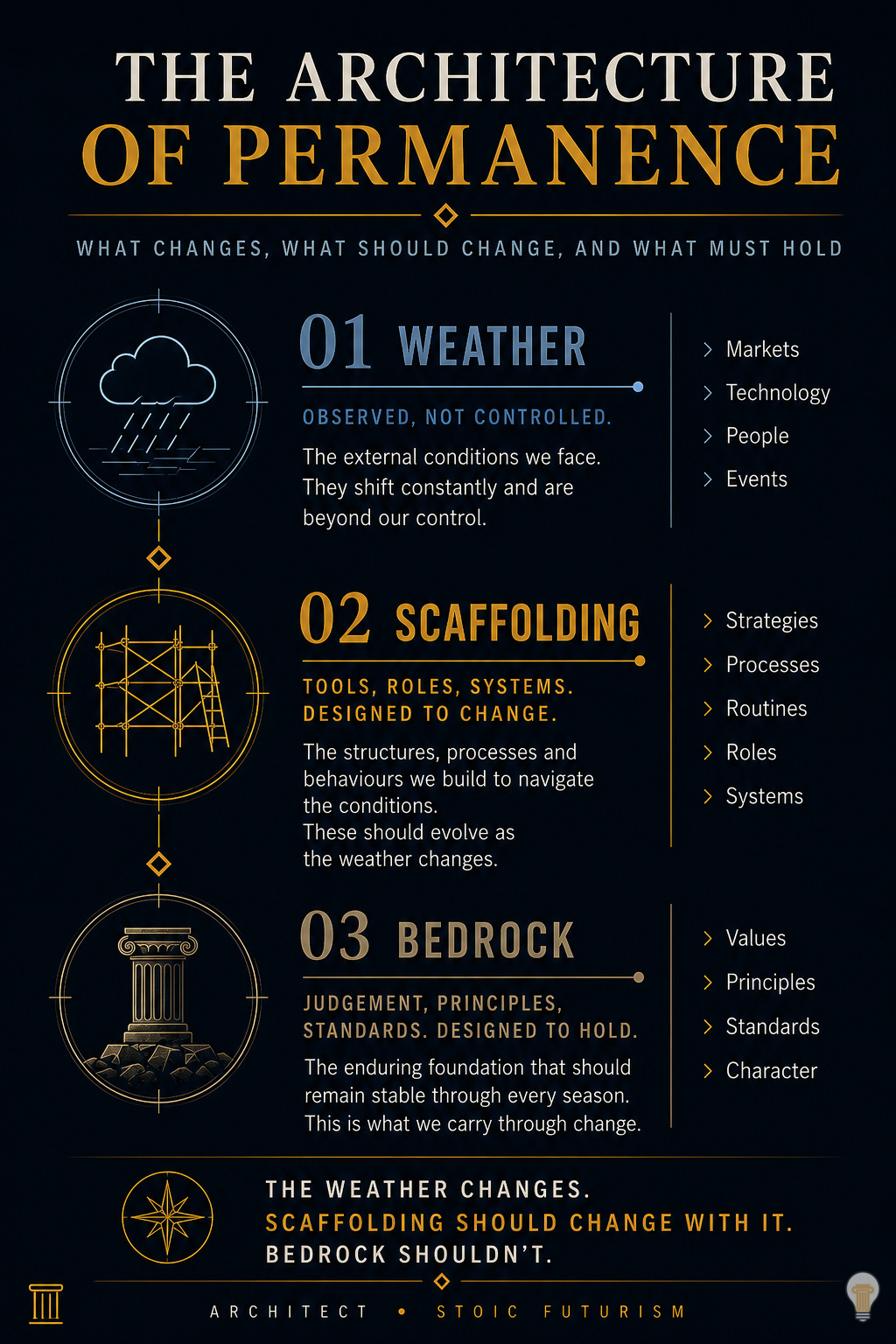
In The Architecture of Permanence, I argued that most people make a surprisingly simple mistake.
They confuse what should change with what shouldn’t.
The weather changes.
Scaffolding should change with it.
The bedrock shouldn’t.
Weather is the environment.
Scaffolding is how we adapt to it.
Bedrock is the judgement and character we carry through it.
The mistake is promoting scaffolding into bedrock.
Treating temporary adaptations as permanent identity.
War was Thomas Shelby’s weather.
His emotional containment, hypervigilance and relentless control became scaffolding that helped him survive it.
There was nothing irrational about those adaptations.
They solved exactly the problem they were designed to solve.
The mistake came later.
The weather changed.
The scaffolding stayed.
Over time, it stopped being something he used.
It became something he was.
That’s the crisis competence trap.
Not that we adapt.
That we forget what we adapted to.
Thomas Shelby isn’t the only person whose adaptations outlive the conditions that created them.
Modern organisations produce this pattern every day.
Not through war.
Through incentives.
Spend enough years in an environment that rewards constant availability and you become available before anyone asks.
Spend enough years solving everyone else’s problems and you stop noticing you’ve become the solution to problems that were never yours to carry.
Spend enough years rescuing struggling projects and your identity quietly shifts.
You are no longer someone who can lead through crisis.
You become someone who unconsciously needs crisis to demonstrate your value.
It rarely happens consciously.
At first, the adaptations are rewarded.
You’re praised for staying calm during restructures.
For answering the late-night phone call.
For absorbing uncertainty without complaint.
For fixing the project everyone else has abandoned.
Eventually, the organisation begins describing you in flattering terms.
Reliable.
Dependable.
Safe pair of hands.
Eventually, you begin describing yourself the same way.
That’s the trap.
Not because those qualities are bad.
Because they slowly become the person you believe yourself to be.
In The Strategy Is Not You, I argued that good leaders learn to separate themselves from their strategies. A strategy is a theory about reality, not an extension of your sense of self. When methods become identities, evidence becomes psychologically expensive because every challenge to the method begins to feel like a challenge to who you are. If reality changes, wisdom requires the humility to let reality revise the strategy rather than defending it.
The same principle applies to our own adaptations.
Calmness is not your identity.
Hypervigilance is not your identity.
Being the rescuer is not your identity.
They’re adaptations.
Adaptations should remain tools, not identities.
Some may still serve you.
Some may have imperceptibly become constraints.
That’s why I think resilience deserves a more careful definition than we usually give it.
Real resilience isn’t emotional suppression.
It isn’t looking composed while everything falls apart.
It’s retaining enough freedom to change your methods without losing yourself.
Or put another way, crisis competence asks:
“Can I function in these conditions?”
Resilience asks:
“Can I still change when the conditions do?”
That’s a much harder question.
Because changing environments don’t simply demand new skills.
They ask us to loosen our grip on identities that no longer fit.
This is why I believe the future of work is ultimately less about technology than identity.
Artificial intelligence, automation and organisational change aren’t just introducing new tools.
They’re exposing which of our adaptations were timeless and which were only ever temporary.
The capabilities that created successful careers ten years ago may not disappear.
But many will become scaffolding rather than bedrock.
The manager whose value came from having all the answers may now need to become the person who asks the best questions.
The specialist who built a career on information scarcity may need to build a new one around judgement.
The leader who became indispensable through personal heroics may need to design systems that no longer require rescuing.
The temptation is to defend yesterday’s adaptations because they once worked.
The wiser response is to ask a different question.
What part of me is bedrock?
And what part was just built for weather that has already passed?
Thomas Shelby performs extraordinarily well in one kind of environment.
Crisis.
That’s genuine capability.
It would be absurd to deny it.
But resilience isn’t measured by how well you perform under one set of conditions.
It’s measured by the range of conditions across which your capabilities remain available.
I’d describe that as your Resilience Range.
Not how much pressure you can tolerate.
But how many different environments you can remain effective within.
A useful place to begin is with four questions.
Crisis
Can I preserve judgement when pressure rises?
Ambiguity
Can I move before certainty arrives?
Stability
Can I work well without creating urgency or needing constant stimulation?
Recovery
Can I stop fighting after the danger has passed?
Each environment asks something different of us.
Many professionals discover they’re remarkably capable in one or two.
Far fewer realise they’ve become dependent on those conditions.
The executive who thrives during restructures becomes restless when the organisation settles.
The consultant who solves impossible problems struggles to delegate routine work.
The leader who built a career through heroics unconsciously creates situations that require another rescue.
Capability hasn’t disappeared.
Its range has narrowed.
Every generation inherits different weather.
Ours happens to include artificial intelligence, accelerating technology, institutional uncertainty and careers that increasingly refuse to follow predictable paths.
We’ll adapt.
We always do.
The real question is whether we’ll remember that adaptation was never supposed to become our identity.
The qualities that helped you survive one chapter of your life deserve gratitude.
They don’t automatically deserve permanence.
Some scaffolding needs to be dismantled once the building can stand on its own.
Otherwise yesterday’s survival strategy becomes tomorrow’s limitation.
I no longer think Thomas Shelby is an especially useful model of resilience.
I think he’s something more valuable.
A warning.
He reminds us that extraordinary capability can become an extraordinary prison if we stop distinguishing between who we are and what once helped us survive.
Thomas Shelby mastered control.
Stoicism asks something harder.
Freedom.
Not freedom from difficulty.
Freedom from becoming captive to fear, reputation, comfort, or even the habits that once helped us survive.
Every chapter of life teaches us something.
Some lessons become bedrock.
Others are scaffolding.
Wisdom is in knowing the difference.
The future won’t just ask whether you can remain calm under pressure.
It’ll ask whether you can recognise when the pressure has changed.
Because the qualities that once kept you alive may eventually stop you living.
Every adaptation solves yesterday’s problem.
Wisdom lies in recognising when yesterday has ended.
Resilience isn’t carrying every adaptation into the future.
It’s knowing which parts of yesterday deserve tomorrow.
Comments
Nothing yet. Say the first thing.
Sign in to join the conversation.