
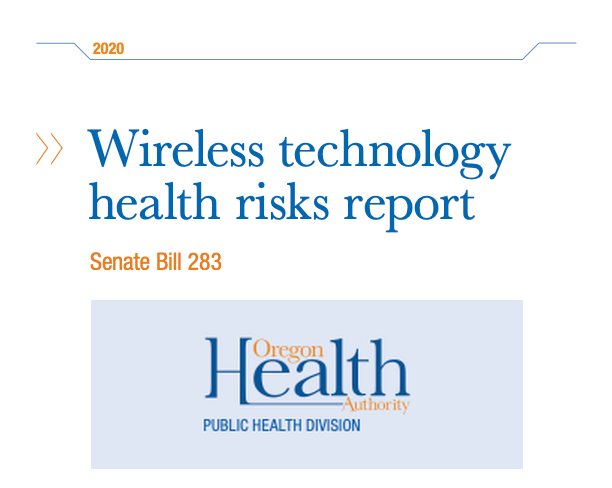
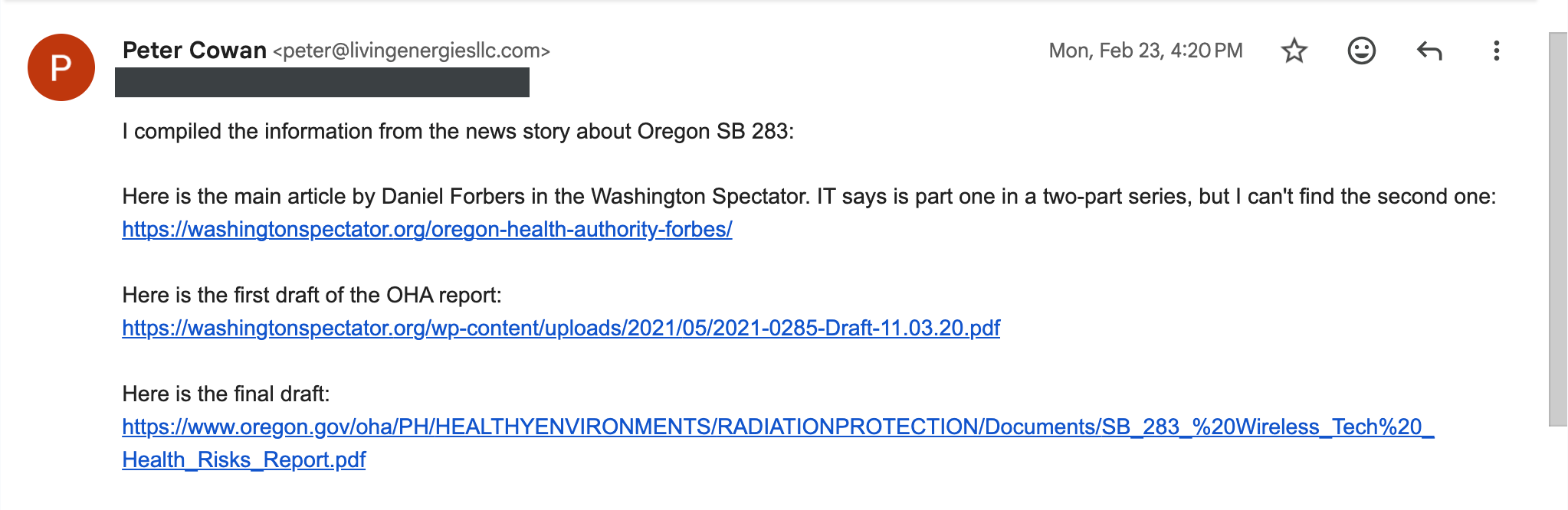
On February 23 this year, I emailed a set of links to the members of Oregon for Safer Technology (OST), a nonprofit devoted to finding safer ways to live with the technology around us. The links concerned Oregon SB 283: a review the state legislature had ordered the Oregon Health Authority (OHA) to make of the health effects of wireless radiation on schoolchildren, a review whose integrity had been called into question, and whose first draft had only surfaced because a state employee, on her own initiative, gave it to a reporter. The email gathered most of the public record I could find, including the final report, hosted on the official OHA website. I’d been at the Capitol the week before, handing legislators that same link, and I was days from briefing a state senator about it. I checked the page on the OHA website before I sent the email. It loaded fine.
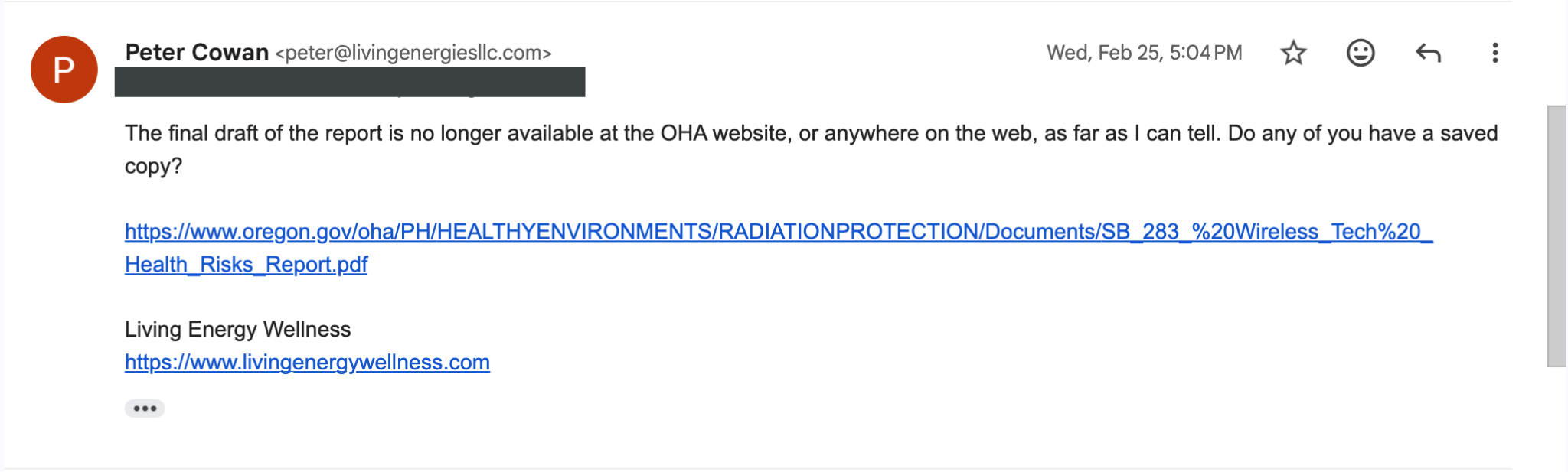
Two days later, on Wednesday, February 25, I went back to pull the Wireless Technology Health Risks Report for that briefing. It was gone.
It was not a redirect. Not a warning that “this page has moved.” Rather, a 404: a “Page Not Found” web server error appeared. The page that had been live two days earlier, containing the document I’d been discussing at the Capitol only days before, no longer existed. The report was not the only thing gone. So was a six-page FAQ OHA had published in January 2021, summarizing what SB 283 required of the agency. Two significant documents that had been available only days before had disappeared, with no notice or explanation of any kind.
I spent years writing firmware — the low-level code that runs on a device’s own chips — for wireless routers, the high-powered kind that blanket hotels, office parks, and stadiums. Those years showed me a gap I haven’t been able to forget: the space between what the industry says about wireless safety in public and the unease that runs just beneath the surface in private. A state agency quietly erasing its own reassuring report had, to my eye, the same shape: a calm public face, with the unease stirring underneath.
This is the story of what was in those documents, why someone might want them gone, and what I learned when I tried to find out whether removing them broke any law.
The Tuesday before sending that email, I was at the State Capitol in Salem. OST had reserved a table there, and I had agreed to help months earlier. By the time the day arrived my priorities had shifted, but I decided at the last minute to make an appearance. When I got there I found I had little appetite for standing behind a table handing out literature. So instead I spent the day walking the building with David Morrison.
David owns Morrison Books, in the heart of the Hawthorne District in Portland, OR: a niche shop of rare and collectible titles — with a particular emphasis on the esoteric and the inconvenient — which he calls a hobby. It is lit by old-style incandescent bulbs, with rare jazz playing in the background: a true relic. Ask him how he’s doing and he’ll say, “Not bad, considering,” the considerations being overpopulation, climate change, creeping Fascism, and the relentless spread of wireless infrastructure. His worry about the latter began when a cell tower was installed on Arbor School, where his daughter attended. No one could tell him with any confidence that it was safe. She transferred to Portland Public Schools, and around 2011 he sued the district over the wireless networks PPS was installing in classrooms. He lost, though not on the merits: the judge ruled that the question belonged to the FCC, not the courts, and noted from the bench that he took no satisfaction in the result. David was treated, by most accounts (including his own), as a crank, but he kept going anyway.
Sometime around 2015, David’s cause found a champion: Rep. Alissa Keny-Guyer, a Portland Democrat, and she was no one’s idea of a crank. She has a Master in Public Health degree, reads scientific studies to inform her legislation, was the chief sponsor of the state’s Toxic-Free Kids Act, and was — for the record — pro-vaccine and pro-fluoride. The issue of wireless radiation’s safety in schools ultimately resonated with her only through the monomaniacal persistence David brought to it, after he first raised it at a constituent coffee. Once she looked, she had the training to read the studies for herself, and what they showed alarmed her enough to change her own habits. In 2017 she introduced a bill that would have required the state Department of Education to draft a public statement on the hazards of wireless network technology in classrooms, and to see that every K-12 school in Oregon, public and private, disseminated it. She kept hearing a familiar script in opposition to her bill. It was the same move once used to stall on the dangers of lead and other toxins: you can’t prove, 100 percent, that it causes harm. The bill died.
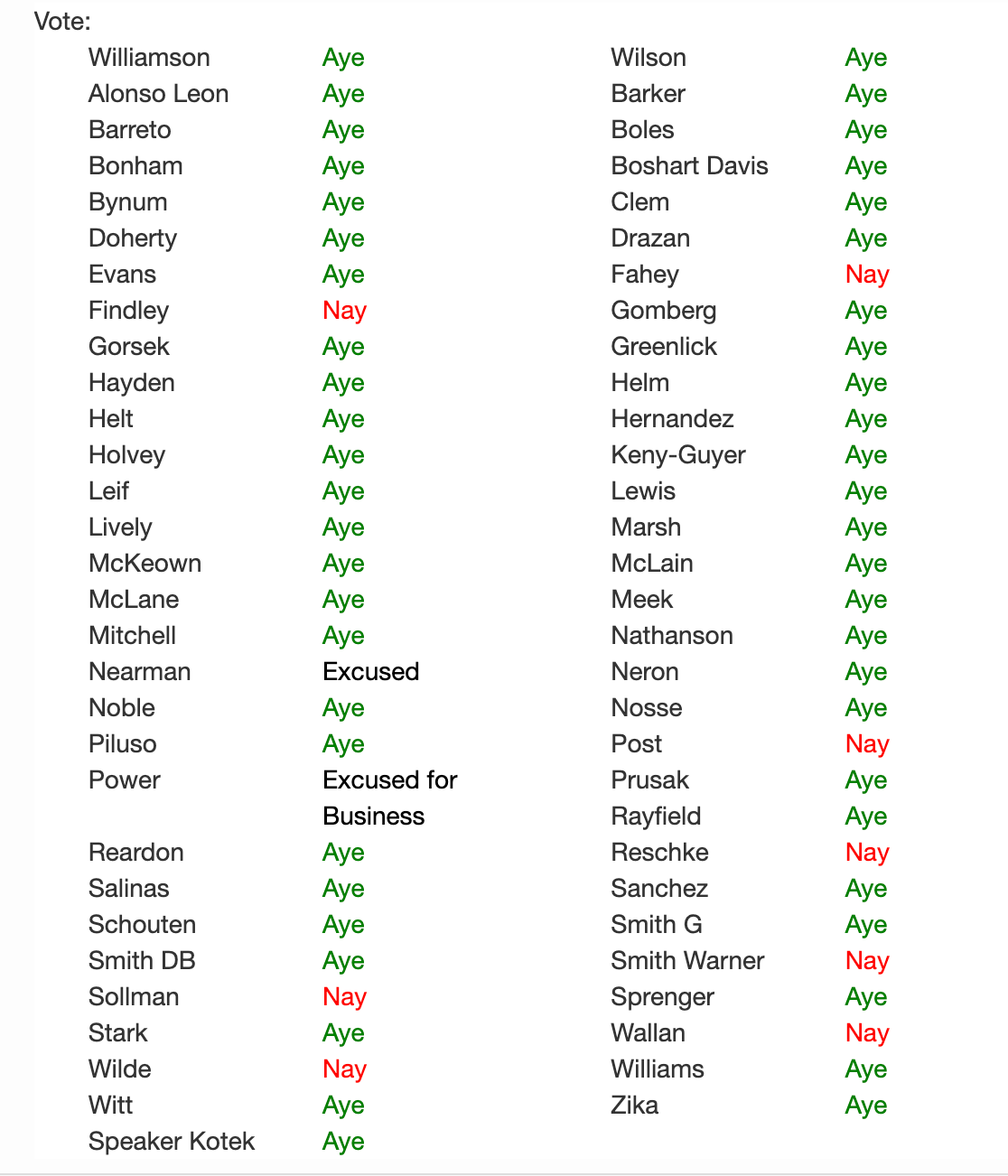
In 2019, Keny-Guyer paired up with Sen. Laurie Monnes Anderson on a narrower bill. Senate Bill 283 passed that year, directing the Oregon Health Authority to review the science on the health effects of wireless radiation in schools. It specifically directed that the review rely only on independently funded studies — the kind not paid for by the wireless industry. If OHA found harm, the state Department of Education would be required to act on it. The health of more than half a million Oregon schoolchildren rode on the answer, and a finding of harm in Oregon would have set a national precedent, with consequences far beyond its borders. What Keny-Guyer hoped for was that OHA would treat the assignment as a chance to do a real, precautionary, state-run review, one that could stand as an objective measure of the science as it was known to that point. SB 283, the first of its kind in the country, passed unanimously in the Senate and 50–8 in the House, with bipartisan support in both chambers. That a marginalized but relentless activist, a man driven by his heart to fight injustice wherever he found it, got even this far is not a small thing, but he got there by handing the fight to legislators who knew how to win it.
David Morrison is also the kind of man who walks the halls of the Capitol with a stack of flyers announcing that “OHA committed a felony.” The charge is not without merit. In 2020, the agency rewrote the drafts of its report to strip out findings that pointed to evidence of harm from wireless radiation. Then, in 2021, by withholding records from a citizen’s public records request, it may have broken the law. But David overstates the case. What he is describing, tampering with a public record under ORS 162.305, is a Class A misdemeanor, the most serious class of misdemeanor, but not a felony. Yet the substance of his charge holds. Withholding the first draft from a lawful records request was arguably that crime, and the agency’s eventual release of it does not undo the concealment that came first. When David says “felony,” it is because to him the offense is so grave that the law as written does not do it justice.
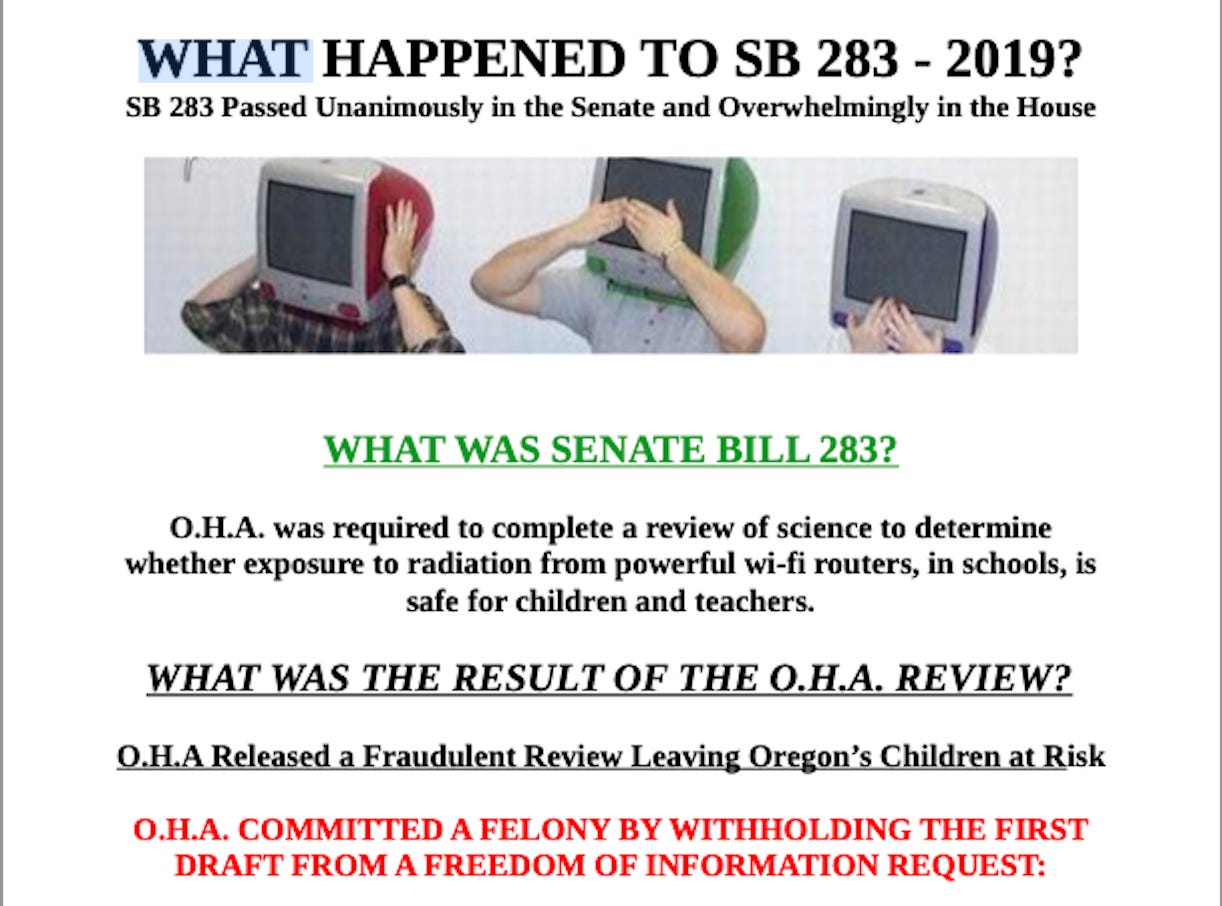
The lesson of these years, he told me, was about process more than science: “The most important thing I have learned … is how corrupt our regulatory agencies are. OHA was willing to preserve the status quo at the expense of the health and safety of children and teachers.” His blunt view: “Those responsible should be in jail for child endangerment.”
I spent the day a step behind him; he saw an open-and-shut case, and I saw a problem of process and transparency that I did not yet know how to diagnose. That gap, between what David proclaimed through his flyers and what I could prove, turned out to be the story.
Although this is, at root, a story about government accountability, the underlying concern behind SB 283 is not fringe. The American Academy of Pediatrics recommends that families reduce children’s exposure to wireless radiation and has pressed the federal government to tighten its limits, on the grounds that children’s thinner skulls absorb more of it than adults’ do. In a 2017 guidance, California’s Department of Public Health named pregnant women, children, and teens as potentially more at risk. France wrote the precaution into national law in 2015, banning WiFi from spaces built for children under three and requiring it to be switched off in primary-school classrooms when it isn’t being used to teach. You needn’t believe any of these bodies has the science settled to see the point: assessing the risks of exposure was a legitimate assignment for a public health agency, and ‘insufficient evidence, nothing to worry about’ was not the foregone conclusion that OHA bent over backwards to reach.
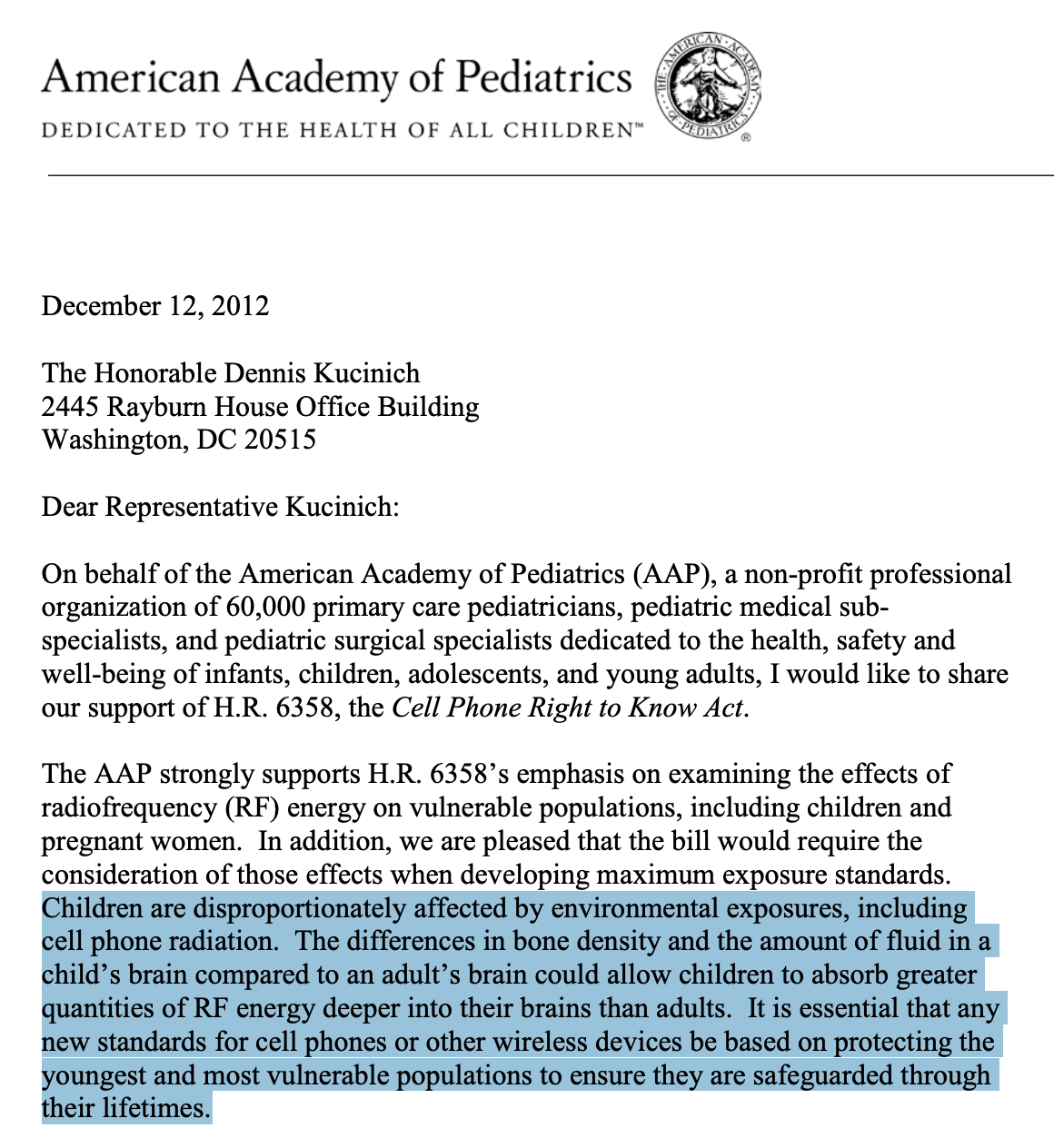
At each desk in the Capitol I told staffers the same thing. As a firmware developer for WiFi hardware, I worked in a building saturated by our own gear: hundreds of high-powered wireless devices running at once. New hires always noticed. Most everyone, shortly after starting the job, would ask some version of the same question: is it actually safe to sit in the middle of all this radiation? And they would get back, from the same manager, the same answer, almost word for word. This was non-ionizing radiation, not the ionizing kind, nothing like an X-ray, perfectly safe. It had the cadence of a line rehearsed and delivered many times. When I later proposed building a WiFi router with a simple off switch, a button to cut the wireless signal while leaving the wired connection running, that same manager looked at me as though I’d suggested something obscene. “Why would we want to do that?“ he said. “We don’t want people to think WiFi is bad for them.“ I have thought about his answer for a long time. It was not a statement about safety. It was a statement about perception.
I was telling some version of this when Darius Englan, a legislative aide to state senator Noah Robinson, caught up with me in the hall. He’d overheard the part about firmware, and he wanted to tell me about his own years working at radio stations in southern Oregon. The stations owned tall towers and leased space to cellular carriers. The standard practice, he said, was for the climbers to call the station before any ascent and have the antennas powered down. Those who climbed without calling first often came back with headaches. He asked me to come back and brief his boss, and we set the meeting for the following week. That briefing is the one I’d been preparing when I went back to the OHA report’s page and found the documents missing.
The full inventory of what went missing on February 25 includes: the SB 283 report itself; a six-page FAQ OHA published in January 2021 summarizing what SB 283 required of the agency; and the pre-2021 minutes of OHA's Radiation Advisory Committee, the public advisory body for OHA's Radiation Protection Services.
The SB 283 report was not fully destroyed, though, and where it survived turns out to be the most telling thing about how it vanished. Everywhere the Radiation Protection Services program controlled its own web presence — the program pages where the report had lived and been linked — the documents are gone. The report itself survives in two places, and they are the two that OHA does not administer.
One is a server OHA’s program doesn’t run: the shared OHA/ODHS publications repository, run jointly by OHA and the Oregon Department of Human Services (ODHS), maintained by a separate Shared Services office, where the report is catalogued as an official state publication (le3498.pdf). You can open it today, but only if someone hands you the exact web address, because nothing on OHA’s public pages links to it. The other is the State Library of Oregon’s digital archive, which preserved the report under the Oregon Documents Depository Program and stamped it “for informational purposes” and “may not be suitable for legal purposes,” kept available because the library, by law, would not let it disappear. The disappearance stops exactly at the edge of the agency’s own reach. What OHA’s program controlled is gone; what lived on a system it didn’t run survived.
The Radiation Advisory Committee’s minutes were never part of the state library’s depository, are not in the State Archives and no shared server holds them. The report survived because separate institutions, doing their own jobs, held copies it could not control. The minutes simply vanished.
The public-facing trail of documents, meanwhile, was not only removed but also rewritten. The Radiation Advisory Committee’s Meeting Archive page, which as recently as February 2025 reached back to 2008, now begins in 2021 — pre-2021 entries simply lifted out. But the agency’s own search index was left alone: search the OHA site for “Senate Bill 283” and you still get hits, including a February 2020 Radiation Advisory Committee minutes file that 404s when clicked. The metadata was left behind when the files were pulled.
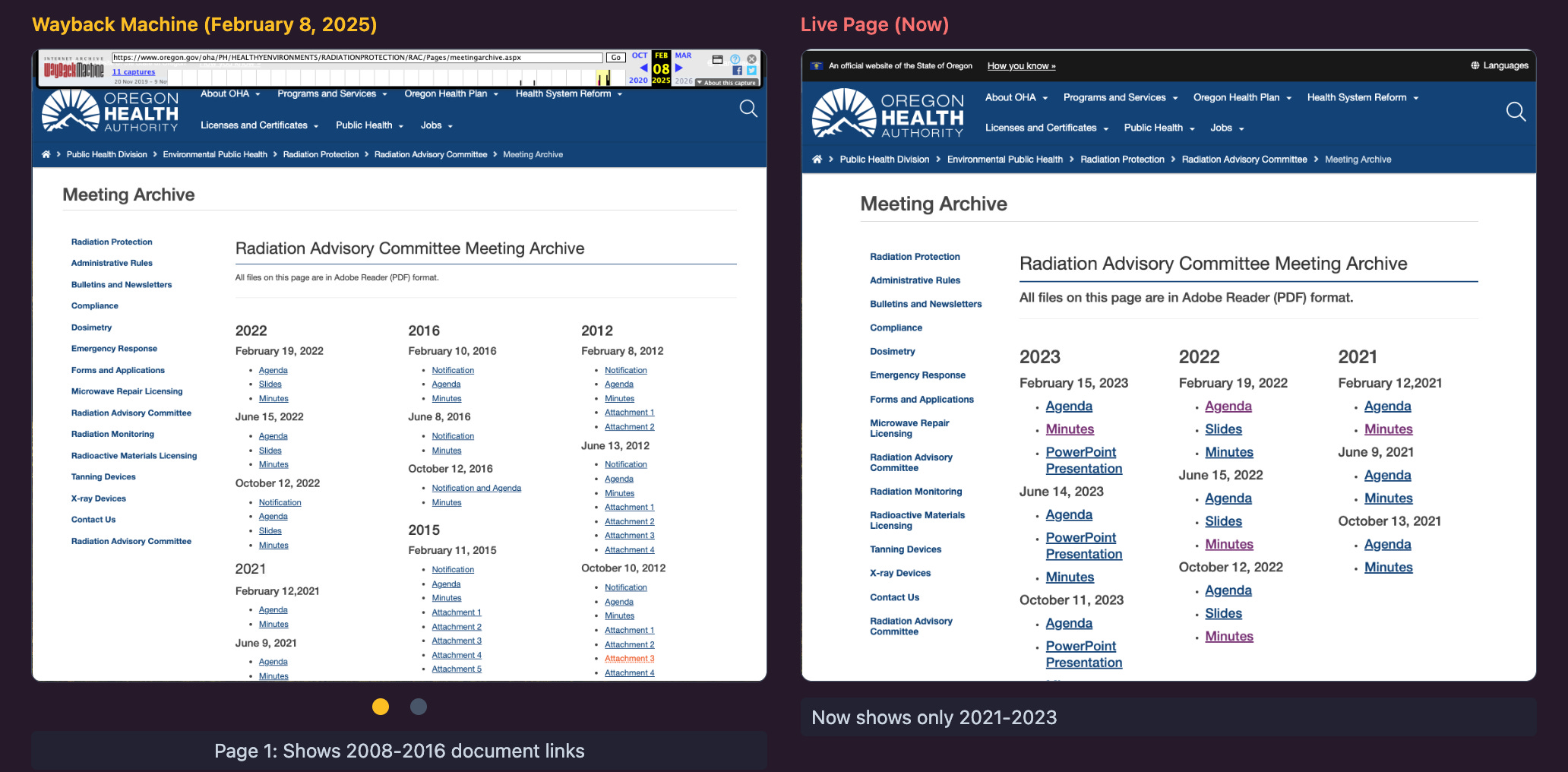
None of this bears the markings of an accidental or inadvertent removal. The boundary is too clean. Real accidents are messier. This looks more like a cleanup that didn’t quite cover its tracks.
And the cleanup did not stop in February. The link to the SB 283 report on the Radiation Protection Services landing page — the program’s own front door — survived the original removal. It was still in place as of April 10. By the time I came back for a final fact check on June 13th, the link had been taken down too, and the program’s home page no longer mentioned the report at all.
To rule out any innocent explanations one by one, I wrote software to check every URL, systematically, against every place it should have been served. I also went looking through OHA’s own 2024–2027 Strategic Plan and Digital Accessibility Roadmap for any policy that would justify the removal, and came back with nothing. The full record is laid out on my forensic analysis page: each URL, its current status, and its last live capture.
Why would anyone bother to pull a five-year-old report off a website, one that had changed no law and triggered no mandate? The answer is in the report, or rather, in what was removed from it before it was published. To see the motive, you have to read the version that came first.
OHA released the final report around five o’clock on New Year’s Eve, December 31, 2020. The timing all but guaranteed the press would turn a blind eye. Its lead author was Ali K. Hamade, the agency’s deputy state epidemiologist — a Ph.D. toxicologist and a board-certified Diplomate of the American Board of Toxicology. The report concluded there was insufficient evidence to say wireless radiation in school settings is associated with adverse health effects.
Early in 2021, an activist named Cynthia Franklin of Consumers for Safe Cell Phones filed two public records requests: one for all the drafts of the report, and a second for the internal communications behind it. OHA withheld the first draft from her. Investigative reporter Daniel Forbes got it another way. By his account, OHA staff stonewalled him too, but he eventually reached the agency’s public records and internal litigation process coordinator, Jeanne Windham, on the phone. Windham proved to be the rare OHA staffer who shot straight: she took the initiative to confirm that an earlier draft existed, and then sent it along to Forbes — the November 3 version, with its full Microsoft Word change log intact. Forbes set out the manipulation in detail in The Washington Spectator in 2021 (Forbes 2021), and his account remains the fullest published record of what happened. The change log it preserved is a line-by-line ledger of what the report had said before, and what was taken out.
Forbes’s investigation preserved all five drafts and their Microsoft Word change logs. Read in order, they show the report’s findings of harm being stripped out in two waves: the first in plain view as page after page of tracked deletions of evidence of harm; the second wave after the change-tracking had been turned off. The earliest draft is the baseline: what the report said before it was edited into its published shape.
The first draft, the one withheld from Franklin, did not hedge. On page 37, in plain declarative sentences, it set down categorical findings of harm: “All studies that investigated the reproductive system found a negative association with RFR exposure ... EMF exposure is related to higher miscarriage and unexplained spontaneous abortion“. (”Negative association” here means the opposite of no effect: every study tied exposure to harm.) “All the studies that investigated the outcomes of general health and symptoms of ill health found that RFR exposure negatively impacted health.” Neither sentence survived.

The draft was specific about children, the population SB 283 was written for. It stated that prenatal and childhood RF exposure could lead to adverse effects on childhood development, and that exposure could lead to genotoxicity, the genetic damage that can precede cancer. Both statements were cut.
Through its toxicity section the draft recorded one affirmative finding after another, each later deleted: that exposure can affect the ECG signals of the heart and thereby its function; that some studies suggested effects on cognitive function, such as memory; that a review of male-fertility studies found 21 indicating negative effects on the reproductive organs and sperm, including reduced motility and DNA damage. The section closed on a flat statement of its own: it is evident, the draft said, that exposure to RFR could affect the human body, especially hearing, brain and cognitive function, the heart, and the reproductive system. All of it struck out in editing, and missing from the published report.

Those deletions were the first wave: the report's most explicit findings of harm struck through in red in the earliest draft delivered to Forbes. Hamade is the author of every redline deletion, but the senior OHA administrator overseeing the report, André Ourso, was already involved in editing the drafts. He made three editorial comments on the first draft; they appear in purple marginal boxes on pages 13, 24 and 26. Two are minor. The third asks the author to add introductory framing on "what is needed to infer a causal relationship." This is the scaffolding the report's eventual conclusion of “insufficient evidence” would rest on. The second draft shows that hand pressing harder.
This time Ourso left eight editorial comments. Two carried weight. The first sat beside the report’s account of a multicenter study of brain tumors in children and adolescents, which, in the subset of children whose phone companies’ own usage records were available, found the risk of a brain tumor rising with time since the subscription began, roughly doubling among those who had paid for service the longest. “Maybe an explanatory sentence of why we would see this increase?” Ourso supplied the explanation he wanted: (i.e., over time we will see an increase in cancer incidence in a population and that this observation is not related to a causal factor). The finding was that risk climbed with length of exposure; the explanation he reached for recast it as the sort of rise a population sees anyway, unrelated to cell phones.
His second note sat beside a study of early childhood cancers in British children, which the draft had flagged as jointly funded and designed by the British government and the mobile telecommunications industry, precisely the industry money SB 283 was written to keep out. “Just a note, we may get questions that this is not an independent study,” wrote Ourso

A week later the third draft appeared with both requests met, and with the change-tracking switched off. The brain-tumor study now carried a disclaimer: the evidence, it said, was mixed, lacked a meaningful exposure-response relationship, and was subject to recall bias, and so could not establish a causal link. Each of those three grounds is contradicted by the study itself. The elevated risk came from the carriers’ own records, not from children remembering how much they’d used a phone, so recall bias cannot account for it; and a risk that climbs the longer a child holds a subscription is a textbook exposure-response relationship. The funding disclosure on the British study, meanwhile, was simply gone, the one explicit flag that a cited study carried industry money, struck from a report whose mandate was to exclude it.
And the same draft added the sentence the whole report now rests on. Its signature finding does not appear in the earlier drafts at all: “Overall, the available epidemiology research examining RFR health effects does not provide sufficient evidence to conclude that RFR exposure in school settings is associated with adverse health effects.” It surfaced here, in the one version produced with no redlines and no margin notes. The deletions came first; the reassuring conclusion they made defensible came last.
The same untracked draft did one more thing. It added to the methods a formal rule excluding all animal and in vitro studies, and tightened the literature filter until a dozen more studies dropped from the count, with no record of which ones. The methodology that justified the conclusion was assembled right beside it.
Step back from the drafts and look only at the counts of studies finding harm versus those finding none. The withheld first draft carried them in the open: on page 37, thirty-three studies suggesting harm versus nineteen finding none in one category, thirteen versus seven in another. Every one was deleted. But the per-study determinations beneath them survived, buried in the report’s own appendix. Re-sum them, even after the animal and in vitro studies had been walled out and a dozen more dropped from the filter, and the count comes to 84 finding an adverse effect against 82 that did not; 85 against 81 once you correct a single miscoded glioma study OHA had logged as showing no effect.
“Insufficient evidence” was a characterization their own manipulated data did not support.
Or take a single deletion. The cut about “prenatal and childhood RF exposure could lead to adverse effects on childhood development” was a paraphrase of a single paper the first draft had cited: Sage & Burgio (2018). The paper went out of the citations along with the sentence; the published report makes no reference to either. As Forbes wrote, “the simple phrase ‘adverse effects of childhood development’ doesn’t remotely do Sage and Burgio justice.” Their abstract states:
Symptoms of retarded memory, learning, cognition, attention, and behavioral problems have been reported in numerous studies and are similarly manifested in autism and attention deficit hyperactivity disorders, as a result of EMF and RFR exposures where both epigenetic drivers and genetic (DNA) damage are likely contributors. Technology benefits can be realized by adopting wired devices for education to avoid health risk and promote academic achievement.
This is why the report was worth removing. A document assembled this way is not one an agency wants examined closely: categorical findings of harm cut one by one, the counts that exposed them deleted, the reassuring conclusion added last and without a trace as to its authorship. For almost five years, almost no one would, despite a flurry of pushback in 2021 from scientists, EMF-safety advocates, and Forbes himself that faded within months. Then David Morrison began walking it around the State Capitol, handing legislators a flyer that cried “felony.” Within days, the link was dead.
Morrison’s cries of “felony” had been about the document tampering in 2021. My focus was a different act, years later: not a draft edited behind closed doors, but, rather, finished, published records taken off the state’s own website. Looking at that 404 “Page not found” error, I started wondering: when a state agency removes public documents from its website, has it broken any law, and if it has, whose job is it to do something about it?
I called the Oregon State Archives first, because removing public documents sounds like a records problem. A State Archives staffer, who asked not to be named, explained that it isn’t. Under Oregon’s retention rules, a record is “accessible” as long as someone inside the agency can still open it on a shared drive. Public access is not part of the test. Taking a document off a public website violates nothing, provided a copy survives somewhere an employee could find it. Questions about public access, he told me, belonged to the Department of Justice; the practical path, he suggested, was to file a public records request and take it up with the state’s Deputy Public Records Advocate Yufeng Luo.
Her office, she explained, exists to help citizens pry records loose. It can work with a requester at any stage — before a request is filed, while one is pending, or after it has been denied — but its leverage comes from having an active request in play. It cannot act on a disappearance on its own. And posting documents online, she went on, is a courtesy the state has adopted, not a legal duty: pulling a file off the website doesn’t mean the record is gone, only that the public can no longer reach it without asking. The agency may still hold it on an internal drive; it has simply stopped making it available. As she put it, taking the documents down didn’t make them vanish: it’s just that “they’re no longer affirmatively available to the public” on the front-facing website. And because some of what had vanished was meeting minutes, she sent me on to the Oregon Government Ethics Commission (OGEC).
The Commission handles public meetings law, and the bulk of the missing files were the minutes of OHA’s Radiation Advisory Committee. I reached out to Susan V. Myers, OGEC’s Executive Director. “Lots of people think that minutes somehow have to be posted,” she said. “They do not.” Taking already-published minutes back down therefore falls outside the commission’s jurisdiction, “because it’s not a requirement in the public meeting law.” The one remedy the law does provide only sharpens the irony. A formal grievance must be filed within thirty days of the violation — and the violation the law contemplates is the failure to make minutes available “within a reasonable time after the meeting,” a phrase the Attorney General’s office reads to allow anywhere from a few days to about three weeks. The clock starts the moment that reasonable time elapses, and runs for thirty days, whether anyone is looking or not. If no one is, the window closes. For minutes that were published, left up for years, and then pulled, there is no provision at all, because the law does not imagine an agency doing that. She referred me to the Department of Justice.
So I circled back to Luo, the Deputy Public Records Advocate, whom I had also asked about the criminal statute. ORS 162.305, tampering with public records, makes it a crime to, “without lawful authority,” knowingly destroy, mutilate, conceal, remove, falsely alter, or make a false entry in any public record. Three features fit what happened almost exactly. “Conceals” and “removes” sit right beside “destroys,” so destruction is not required; pulling an indexed, accessible document off a website is, in plain terms, removal. The required mental state is only “knowingly,” and OHA’s own search index, still pointing at the dead pages, is evidence the agency knew the records existed. And the statute’s “lawful authority” exception would require a rule that authorized the removal, and I could find none; nothing grants an agency the power to take a record still inside its retention period out of public reach. On paper, the statute describes the conduct. In practice, when Luo had researched court records for prosecutions under the statute, she had found that it happened “maybe once.” She further clarified:
“The bar is that you have someone on camera opening the file cabinet and lighting a fire, against a strong presumption that public bodies act in good faith.”
“Good faith” — a benefit of the doubt the state wrote into its own law.
And there is the wrinkle that the State Archives staffer had already raised: because a copy still sits on a state server, the agency can argue nothing was truly “removed” at all, only taken off the public website. Whether DOJ would read “removes” to reach a website deletion, with the record still on a shared drive, is an open question — one I could not safely ask before a records request had locked the records in place. Luo had laid out the bind directly: filing a request, she acknowledged, would tip off the agency to my interest. It would also, under Oregon Administrative Rule 166-030-0045, suspend any scheduled destruction of the records it covered — turning any further destruction into the kind of tampering case the DOJ would not have to puzzle over.
The only move left to a citizen who notices records have gone missing, she said, is the one the State Archives staffer had described: file a request, wait the statutory fifteen business days or more, and pay whatever the agency estimates for staff, IT, and attorney time, unless you can show you’re capable of “meaningfully disseminating” the records, a fee-waiver standard that, in practice, means you’re the press. She, too, pointed me to the Department of Justice.
Even the rules meant to govern these records contradict each other. One OHA schedule lets the Radiation Advisory Committee’s minutes be destroyed after ten years; a separate, general rule requires the minutes of state boards and commissions to be kept permanently. Which rule applies depends on whether the committee counts as a “committee” or as a “board or commission,” and nothing cleanly settles that. It hardly matters: even the shorter, ten-year clock leaves the 2019–2022 minutes years away from eligibility for destruction in 2026.
Every call had ended the same way. The Archives Division sent me to the Public Records Advocate, and to DOJ. The Deputy Public Records Advocate sent me to the Ethics Commission. The Ethics Commission sent me to DOJ. And the only concrete action any of them could name (file a records request) leads, when an agency stonewalls it, to DOJ as well. Each office was built for a different scenario than the one in front of me: a bad retention practice, a flawed meeting, a denied request. None was built for an agency that publishes documents for years and then removes them. And the Department of Justice, the destination every road shared, is the office whose institutional job is to defend state agencies like OHA when they are challenged.
When I put the question to DOJ myself, they answered in exactly those terms. I had asked, in writing: Had DOJ advised OHA on the removal of the records? Was DOJ aware of any legal basis the agency had cited for taking them down? And did DOJ have any comment? The answer came back from a DOJ spokesperson: “Any potential advice from Oregon DOJ to client agencies is subject to attorney-client privilege. We suggest you reach out to OHA directly with these questions.”
DOJ couldn’t tell me whether it had advised OHA, because anything it had told OHA was privileged — on OHA’s behalf. The office every regulator had pointed me toward was the office structurally incapable of answering my question.
Three regulators. Three referrals. All roads lead to the agency's own lawyer.
This is soft corruption. All too common in Oregon. The kind a state too pleased with its own self-congratulatory virtue no longer sees in itself. The kind that takes hold where power runs unchallenged.
David Morrison proclaimed “felony” at OHA’s concealment of the first draft. He had the grade wrong, but the gravity right. What I’d found in the 2026 removal was stranger than the crime he was describing: an act a statute seemed to fit, but that no office would claim and no one had to answer for.
What Oregon lacks is not a statute. It is a process. When a public record of interest is removed from a state website, there is no requirement to log it, to announce it, to justify it, or to preserve a public-facing copy, and no office whose job it is to notice. There is, in fact, no requirement that the documents be available online at all, a startling thing to be able to say in 2026. Other states are less casual about it. In Illinois, a public body that fails to post the records the law requires has committed a Class B misdemeanor, and the meetings whose minutes went unposted can have their decisions voided in court.
Here in Oregon, the grievance clock runs from the act, not its discovery. A removal designed to go unseen is effectively unchallengeable by the time it’s seen.
Close that gap and most of this becomes impossible. Leave it open and the only things standing between a state health study and oblivion are a state library following a depository rule and a separate agency, ODHS, that did the right thing.
I have filed the records request the Deputy Public Records Advocate recommended: for the documents and for any communications or server logs concerning their removal. By law, that request now suspends any scheduled destruction of those records. I filed it on June 22nd; a response is due within fifteen business days. With the request on file and the records protected from destruction, I put the question directly to the Department of Justice — the destination every regulator pointed to. DOJ confirmed it could not address the question, citing attorney-client privilege owed to OHA itself.
OHA’s own press office answered separately. Jonathan Modie, an agency spokesperson, attributed the removal to OHA’s Web Governance Plan, which holds that “the OHA website may only contain current content. It is not an archive.” Under the policy, reports come down at two years, meeting materials at one. Perhaps by coincidence, perhaps by design, the version of the governance document Modie pointed to was dated February 25, 2026 — the same day I discovered that the documents had disappeared.
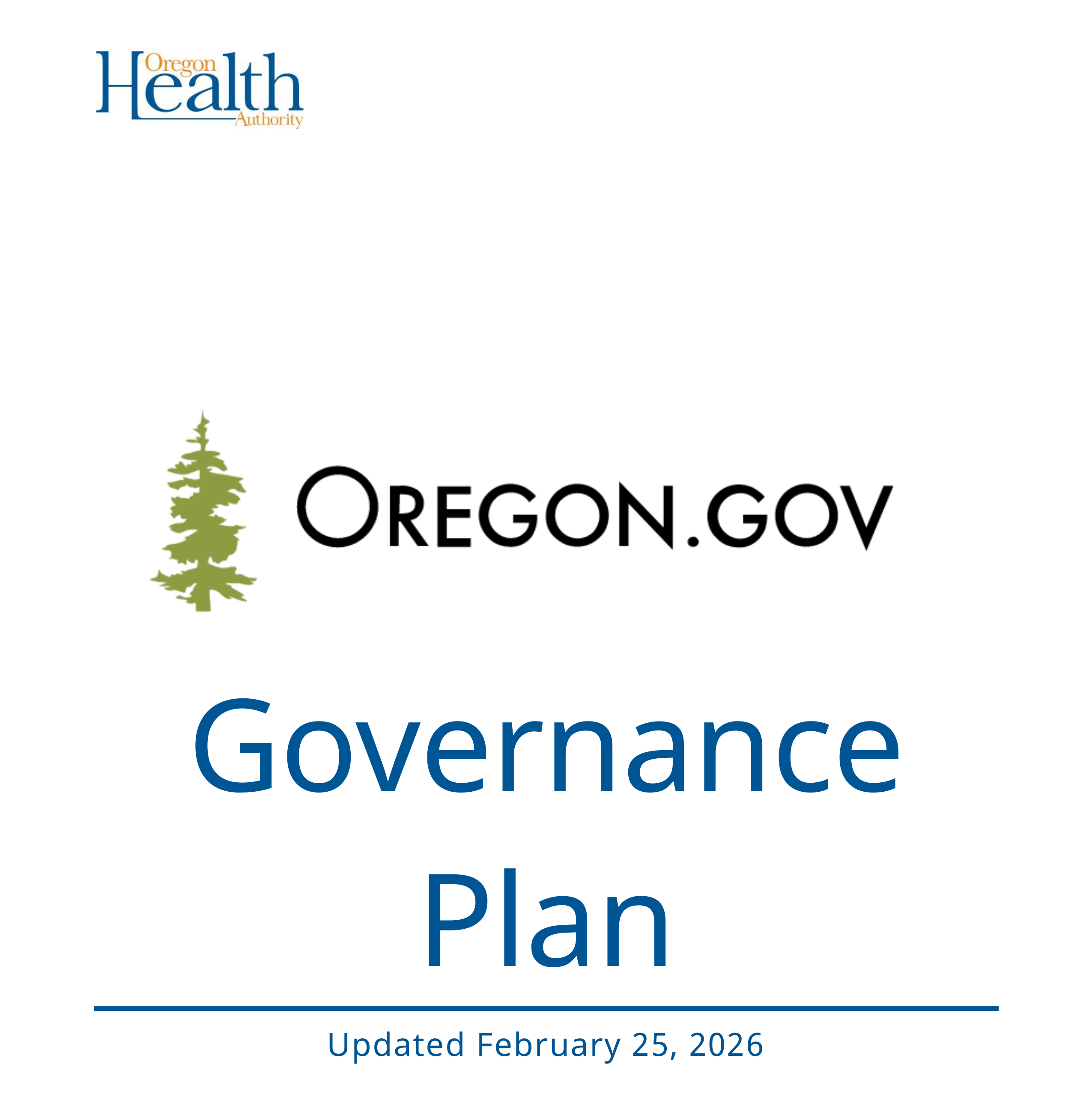
This policy explanation accounts for little. It doesn’t explain why other OHA divisions still host older content. It doesn’t explain why the search index was left untouched. It doesn’t explain why the pre-2021 RAC minutes survived five to seventeen years past their stated one-year shelf life. It doesn’t explain why the link on the program’s own landing page survived at least another six weeks.
And the policy doesn't actually preordain what happened. The Radiation Protection Services program was explicitly authorized to create an archive exception, and didn't. Asked who authorized the removal, Modie named the policy's oversight bodies, not the people who made the call.
Asked whether OHA would restore the documents, Modie wrote that the agency was “making arrangements to make the report and FAQ available on its website again due to renewed public interest.” Public interest, OHA appears to be saying, is what keeps a record online. The week David Morrison stood at the Capitol handing legislators flyers about the SB 283 report was the week public interest was peaking. By OHA’s own logic, the removal should never have happened in the first place.
There is a precedent for all of this. The last time these documents were forced into the open, by Cynthia Franklin’s 2021 records request that turned up the tampering, what OHA had done was no regulatory gray area. It fit a crime on the books, and reporter Daniel Forbes carried it to the people whose job is to act on exactly that: OHA’s oversight body, the Oregon Health Policy Board; the Oregon State Police; the state Department of Justice; and, ultimately, the governor’s office. Each was shown the conduct. Not one would act. The 2026 removal had fallen into a void where no law reached it; the 2021 concealment was its mirror image, a law that fit exactly. The result was the same. Nothing at all.
That failure, the crime no one would prosecute, is where Part 2 begins.
The investigation continues on my personal website, where the documentary record behind this article is laid out in full. Each entry below opens an interactive page where you can step through the evidence yourself.
The Removal Record — Every URL OHA pulled offline, its current status, and the date of its last live capture. Tracks the original February 25, 2026 cleanup and every subsequent removal since.
Inside the Drafts — The line-by-line change log of OHA’s SB 283 report: every deletion in red, every margin note, every sentence cut on the way to “insufficient evidence.” Read the version that came first.
The Investigation Timeline — The full chronology, from the 2011 lawsuit to the 2026 removal. Every key date in legislation, manipulation, concealment, and recovery, in one navigable sequence.
OHA’s Response — The full text of the agency’s account of the February 2026 removal, including the inquiry sent to OHA’s press office, the response, and the Web Governance Plan policy cited as authorization.
Corrections: An earlier version of this article mistakenly stated that the First Draft of the OHA report was not distributed to any reviewer. In fact, the First Draft was sent to the first reviewer listed on the title page, André Ourso. As confirmed in an email from OHA spokesperson Jonathan Modie to Forbes on May 3, 2021, the editorial comments in the First Draft’s purple marginal boxes were made by Ourso. There are three such comments from Ourso, on pages 13, 24, and 26. Ourso received the First Draft, read it and commented on it.
Also, the earlier version of this article mistakenly said that Ourso made two marginal notes in the report’s Second Draft. He actually made eight comments in that draft.
No posts
Comments
Nothing yet. Say the first thing.
Sign in to join the conversation.