
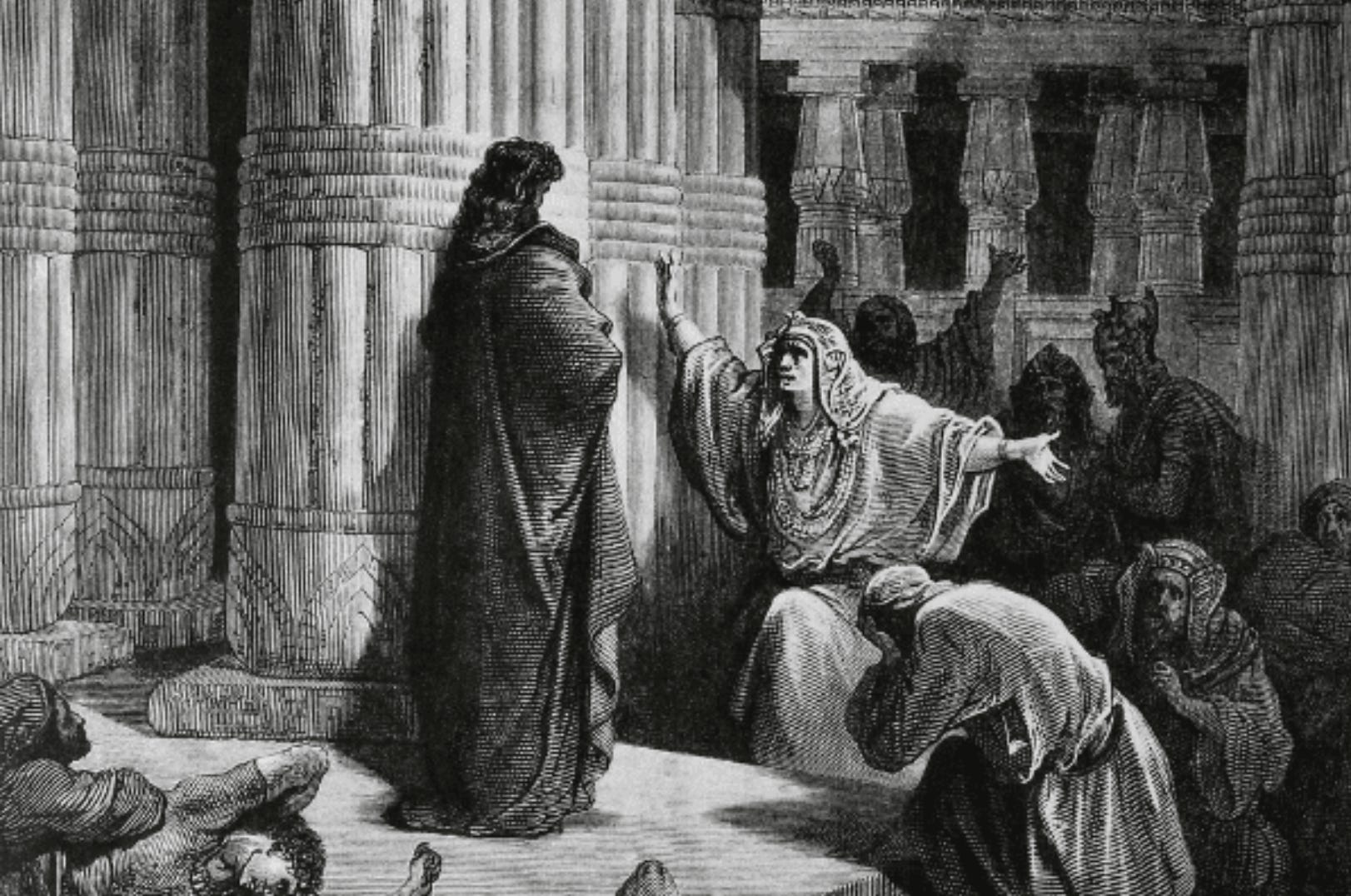
In the book of Exodus, we read that Moses is sent by God to confront Pharaoh and deliver the Israelites from Egyptian bondage.
We read in 3:19 that God knows Pharaoh will resist “unless a mighty hand compels him.” In other words, it will not be until God displays his power that Pharaoh will see he is overmatched and relent. And that power is the plagues.
But in 4:21, we find a startling statement:
“When you go back to Egypt, see that you perform before Pharaoh all the wonders that I have put in your power; but I will harden his heart, so that he will not let the people go.”
God will make Pharaoh resist those very same mighty acts that in 3:19 are supposed to break Pharaoh’s will. In 3:19, Pharaoh’s resistance is his own doing; in 4:21, his resistance is the will of God.
This is a real tension of the story. It is not simply that God will harden Pharaoh’s heart, but that the cause of Pharaoh’s hard heart is said to come from two sources.
These passages almost force us to read them off of each other; and here is where a little Hebrew might help.
In 3:19, a “mighty hand” is needed to compel Pharaoh to acquiesce. In 4:21, God will “harden” Pharaoh’s heart. Both “mighty” and “harden” are formed from the Hebrew root chazaq. This overlap is striking. On the one hand, in 3:19 it is God’s chazaq that will serve to convince Pharaoh to release the Israelites. But on the other hand, in 4:21 it is again God’s chazaq that will prevent Pharaoh heeding the power of the plagues.
Here is my point. Both are actually true in the plague narrative. Early on, Pharoah’s heart is hard against the plagues — that is 3:19 at work.
But beginning with the 6th plague, and again in plagues 8-10, Pharoah is ready to give in, only to have God harden Pharoah’s heart against his will. That’s where we see 4:21 in action.
This feels like a bit of a cat and mouse game. Pharaoh is God’s plaything that he’s happy to revive in order to have another go at him.
It seems to me that the end purpose for this back and forth is to ensure that Pharaoh will, as an act of the hardening of his heart by Yahweh, command his soldiers to ride into the Red Sea, where they are killed. Pharaoh must be kept in the game until justice is done—justice for trying to obliterate the Israelite population by throwing the male infants into the Nile back in chapter 1. That justice is found in the 10th plague (plague of death) and the drowning of the Egyptian army in the Red Sea (better, “Sea of Reeds”) incident.
In biblical logic, this is “eye for an eye.”
But I am troubled by God hardening anyone’s heart so they can feel the full impact of divine wrath. But here, as in so many of my posts, the point isn’t my or anyone else’s evaluation of the text, but simply an attempt to understand the logic of the text itself.
And in this instance, that logic says that the exodus is a play in which God is author, producer, director, and principle actor. The purpose of 4:21, then, is not to introduce some abstract philosophical notion of God’s sovereignty. It is to show the Israelites that their deliverance and God’s vengeance against their enemies are both in God’s control.
No posts
Comments
Nothing yet. Say the first thing.
Sign in to join the conversation.