
Disembodied stories of change. Pioneer projects dying through like-minded monotony. Few “getting” your work. Too often, transformative work remains in bubbles. Against that background, Ecosystem Choreographies proposes an embodied and dynamic approach to developing leadership and communications – by designing for resonance in the fields where it can be received. So that deep transformational work becomes a financial, temporaral, and energetic priority. On 20 May, I facilitated a workshop for regenerative practitioners, sustainability leaders, and impact entrepreneurs who share a common pattern: their work is transformative, yet it keeps reaching the same circles. The bubble.
If you’re doing transformative work such as systems-change facilitation, bioregional development, or embodied leadership, you’ve likely felt this tension. Your work can land beautifully within communities who already speak the language. Yet when you try to reach decision-makers, funders, or stakeholders operating in business-as-usual, something gets lost. The translation fails. The depth flattens. The urgency doesn’t transmit.
The work gets perceived as “nice-to-have” rather than strategic necessity.
This isn’t about working harder or “being more authentic” as if that were a final destination. It’s about three fundamental gaps between deep work and lasting ripples.

Through years of working with leaders at EU-level, “in” sustainability, and regeneration, I’ve identified three gaps that keep transformative work isolated:
How deeply are we listening to the cultural soil of the fields we serve?
Rather than just labelling audiencies, this is about understanding the conditions of their cultural meaning-making and repertoire for action. How they see and listen to the world and people they work with, how they face the situation at hand, what cultural repertoire they have access to (storytelling, gestures, postures etc.).
What narratives are present in their field? What traumas remain unacknowledged? Which possibilities are stirring beneath the surface but lack language or legitimacy?
One workshop participant shared: “ When I was working in fashion, everybody was doing a lot, but nobody was actually listening to each other. And that the kind of the seeds I’m planting now. To listen more.”
What this can imply:
Invisibilization: not recognizing who and what is already present (incl. more-than-humans), allowing patterns like ecocide to become background noise
Normalization of harm: what psychologists call desensitization, what climate psychologists call Shifting Baseline Syndrome
Pseudoinnovation: “discovering” what was never lost, ignoring existing solutions and those who’ve been doing this work all along
How can we play our role in enabling our ecosystem to thrive?
The modern Western culture has sophisticated its means of disembodiment: body-mind disconnect, systemic outsourcing of responsibility, general numbing of somatic and emotional intelligence.
Embodying our role in our field of work, like a species in an ecosystem, means standing out through our own irreplacable essence, rather than pretending to be like everyone else. But rather than a single essence, it is multifaceted and can change over time.
A participant reflected upon his work with impact investors. The exercise brought him to explore moving beyond “pioneer bubbles” by getting inspiration from pioneer archetypes (such as Fern and Dandelion) that create conditions for partnering with successors, so that their pioneer work can take root and spread.
What this can imply:
Polarization between subjective perspective (artist) and pure audience focus (marketer), missing the reciprocal middle ground
The growing gap between narratives and experienced reality (climate denial, conspiracy theories, greenwashing)
The mindfulness trap: spiritual bypassing that pretends all change comes “from within” as if inner and outer were entirely separate
At what levels can we reach decision-makers with what transformation actually offers?
It’s not that regenerative work lacks value but that we’re often unconscious about the levels at which the multidimensional value touches others. How it is present through sharing, or different modalities of experience (somatic, cognitive, emotional etc.). Furthermore, communicating our value within the dominant scarcity paradigm risks to this work being framed superficially.
One participant named it: “I have felt resistence towards using traditional marketing advice for painpointing. What I see in the US, is that there is a large avoidance of dealing with the roots of issues. Everything is put below the carpet.”
What this can imply:
Everything flattened into decontextualized problem-solution framing
Trauma-mining marketing that perpetuates pain to sell temporary relief (painkiller solutions)
The difference between transformative and shallow work becoming invisible to decision-makers
During the workshop, we explored Ecosystem Choreographies: a framework for learning to move differently through our fields of work. It is designed to enhance the cultural repertoire of being, receiving, and acting in the world within the context of a modern culture that has largely lost access to that wisdom from ancestry.
Too often the “standard changemaker” sounds like everyone else, fails to communicate from a place of essence, and sees their work being absorbed by business-as-usual. The choreography is stuck.
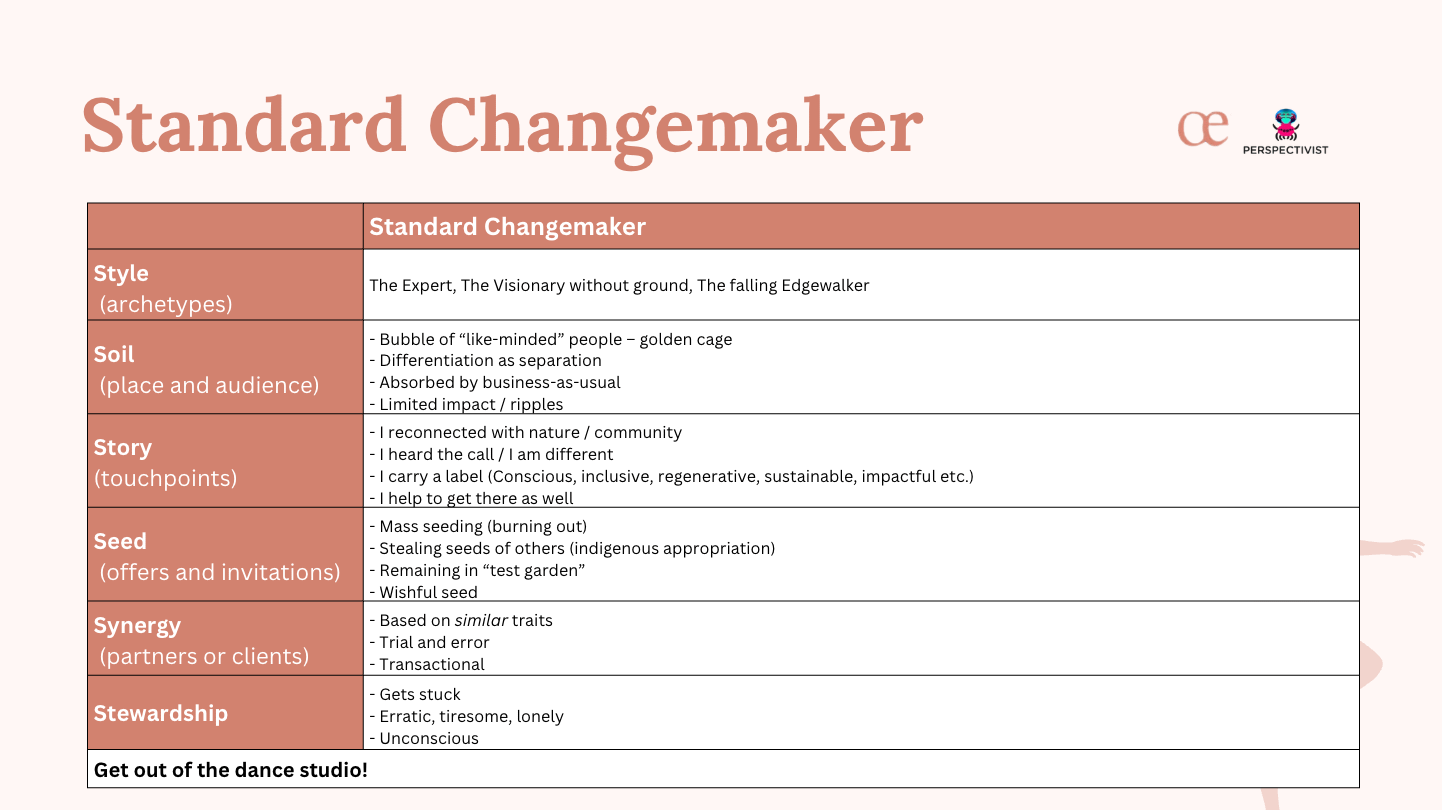
Map the cultural territory of your audiences not as market segments, but as living ecosystems shaped by stories, values, historical patterns.
What narratives are present in your field? What traumas remain unacknowledged? Which possibilities are already stirring beneath the surface but lack language?
When it’s stuck: You’re offering solutions before sensing readiness. You speak a language your field doesn’t yet have capacity to hear.
When it’s in flow: You know the difference between resistance that means “not yet” and resistance that means “not this.” You attune to cultural conditions that either enable or block transformation.
Inhabit your unique leadership presence: your rhythms, your edges, your way of holding space.
Rather than pretending to be someone or something, it means inviting the wisdom of archetypal roles, as expressions of ourselves. This allows us to be present more consciously, and more attuned to the roles and options for action available in specific situations.
When it’s stuck: Your presence feels artificial. You sound like everyone else in your field. Your expertise is visible but your essence isn’t felt.
When it’s in flow: Your presence communicates before words. People experience your essence through how you move, not just what you say. You can shift between roles while maintaining coherence.
Articulate what your work enables to grow as lived capacities, shifts in awareness, new possibilities for action.
When it’s stuck: Your value proposition sounds like problem-solution. Generic benefits. Decision-makers hear “nice to have” rather than strategic necessity.
When it’s in flow: You name what becomes possible through your offer / invitation: greater agency, deeper belonging, regenerative capacity. Decision-makers recognize this as strategic because you’ve made multidimensional value visible.
Move 4: Story (Addresses: Embodiment)
Narrate the transformation you enable in ways that land viscerally, not just intellectually.
When it’s stuck: Your story is either all expertise (CV facts, credentials) or all personal journey (memoir without professional anchoring). Decision-makers can’t connect your lived experience to their needs.
When it’s in flow: Your story skillfully weaves elements that can touch audiences at different levels of maturity and wisdom. You are consciously inviting participation into your story, and share it as a living example of what it means to be part of something bigger. It becomes an invitation into your world (of work).
Map how your work creates ripple effects: how the value you generate for one stakeholder creates conditions for value elsewhere in the ecosystem.
When it’s stuck: You present your value in isolation. Decision-makers see individual services rather than systemic contribution.
When it’s in flow: You make visible the reciprocal relationships. Who else benefits when this succeeds? What becomes possible for the wider field? Value multiplies through connection.
Choreograph the conditions for collective, complementary, and coordinated movement.
Who else is needed to regenerate this field? What complementarities and capabilities must come together for breakthroughs to emerge?
When it’s stuck: You’re working alone or only with people who already think like you. You see transformation as your responsibility to push through.
When it’s in flow: You curate relationships, convene unlikely allies, create containers where different perspectives cross-pollinate. You choreograph the wider ecosystem whose movements, synchronized, generate systemic shifts.
Why This Matters Now
We’re in a moment where the most urgent transformation, such as climate adaptation, bioregional regeneration, decolonization of epistemologies, and restoration of belonging is being done by practitioners who often can’t land their work where it’s most needed.
Meanwhile, those with greater access to resources, decision-making power, and systemic leverage often can’t recognize transformative depth when they see it.
The challenges is about reconnecting the movement between them, between the bubbles. While bubbles can potentially ground the work in fertile soil, the magic happens when they start to weave ecosystems, and fertilize the fields at their in-betweens.
It’s about learning to move between worlds. Between the destructive patterns still dominant and the regenerative cultures already stirring. Between who we’ve been and who we’re becoming. Between isolation and genuine ecosystem.
This is what Ecosystem Choreographies addresses: a practice of sensing and moving that creates conditions for transformation to emerge through collective choreography. Yours and others’, human and more-than-human, visible and beneath the surface, pragmatic and deep.
The choreography begins with sensing where you are.
Take the Three Gaps Diagnostic: a 20-minute self-assessment that reveals which gap is most present in your work right now:
👉 Take the diagnostic here
You’ll receive:
An understanding where your work resonates and where not (yet)
Clear identification of your biggest barrier
Specific next steps you can take immediately
If the diagnostic reveals patterns you’re ready to address, the Choreographic Resonance Assessment (Module 0) maps your current choreography across all six moves, giving you clarity on where you’re in flow and where practice is needed.
The Question That Closes
During the workshop’s grounding exercise, I invited participants to sense into a final question:
What wants to move through you, and through your field, today?
What’s actually alive, asking for movement, pulling you toward it?
That’s where the choreography begins.
Because transformative work doesn’t stay in bubbles when we learn to choreograph the space between worlds. When we close the gaps between our embodiment, our attunement, and the value we offer.
When we stop commanding transformation and start creating conditions where it can emerge.
The Choreographic Resonance Assessment and Cœureographers Programme are available for regenerative practitioners ready to move their work beyond the bubble. The investment: €300 for the assessment (credited toward the full 4-month programme if you choose to continue). More information: tidycal.com/1xgwkjn/assessment
Comments
Nothing yet. Say the first thing.
Sign in to join the conversation.