
By the time Nigerian soldiers arrived in the Christian village of Kawel, it was already over.
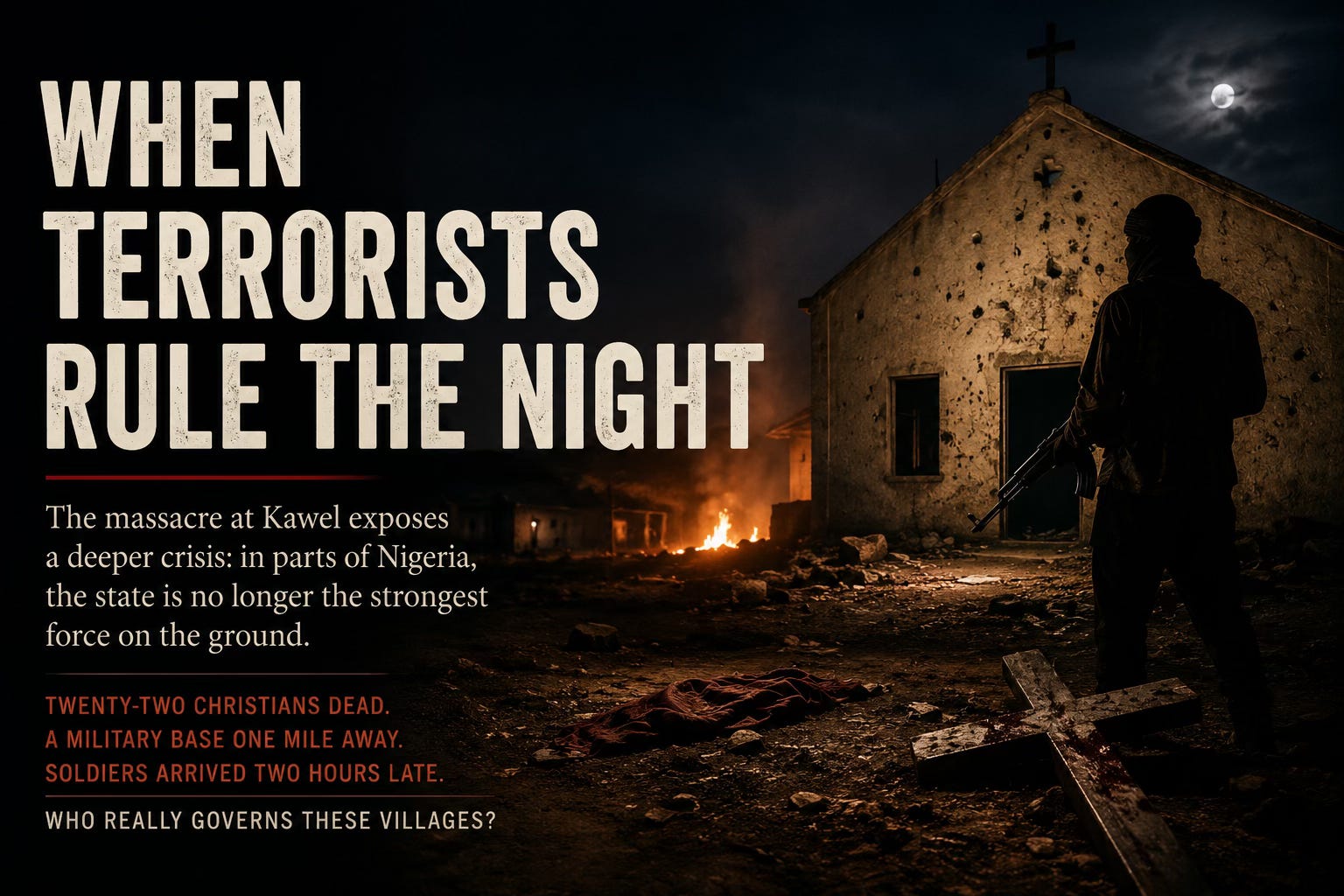
Twenty-two Christians were dead.
A pastor lay among the bodies. A retired army officer who had stood guard outside his home was gone. Patients had been murdered inside a government clinic. A civilian defender had charged three terrorists armed with AK-47s with nothing more than a knife, killing one before he was shot dead. Another pastor died defending his wife with a hunting rifle.
The massacre lasted roughly two hours.
The military base was approximately one mile away.
If that fact does not disturb you, it should.
The attack on Kawel in Plateau State on June 22 was not an isolated tragedy. It is another chapter in a conflict that has steadily transformed parts of central Nigeria into territory where armed Islamist terrorists increasingly exercise power while the state struggles—or refuses—to stop them.
One week earlier, terrorists struck Nigeria’s National Institute for Policy and Strategic Studies near Jos, killing two soldiers and a police officer. That same day, attacks were also reported on the outskirts of Jos, including the killing of a traditional district leader. The violence is no longer confined to remote villages. It is creeping ever closer to the political and administrative heart of Plateau State.
Then came Kawel.
Shortly after midnight, armed terrorists speaking Fulani attacked the village. According to survivors, they shouted “Allahu Akbar” as they first assaulted a police post before moving to a nearby government clinic, where they killed patients, caregivers, and a clinic attendant. From there, they spread house to house through the predominantly Christian community.
The local civilian guards never had a chance.
Ten men equipped with hunting rifles and slingshots found themselves facing dozens of attackers armed with AK-47 rifles and machine guns.
Their resistance was courageous.
It was also hopeless.
One guard spent the night leading families to safety because, as he later explained, “Everywhere we turned, they were there.”
That sentence captures more than one night’s terror. It describes the growing reality for many Christian communities across Nigeria’s Middle Belt.
One defender, Seth Lot Damwesh, met three armed terrorists at his front door armed only with a knife. He managed to stab one attacker before he was shot in the stomach and head, buying enough time for his wife to escape.
Another victim, Rev. Markus Azi, refused to abandon his home. Armed with only a hunting rifle, he confronted the attackers long enough for his wife to flee before he was killed outside his house.
By sunrise, both men were buried in a mass grave alongside nineteen other victims.
For years, Nigerian officials have attempted to soften the language surrounding these massacres. Organized terrorist attacks become “communal clashes.” Armed jihadists become “hoodlums.” Entire campaigns of violence are dismissed as isolated criminality.
But changing the vocabulary does not change reality.
Reality is measured by bullet holes in clinic walls.
Reality is measured by widows who watched their husbands die so they could live.
Reality is measured by pastors buried beside retired soldiers and ordinary farmers whose only crime was remaining in their ancestral communities.
Perhaps the most alarming aspect of the massacre was not merely the brutality of the attackers but the absence of the state.
Throughout the assault, distress calls were made to security forces. Soldiers from Operation Enduring Peace were stationed roughly one mile away.
They arrived around 6 a.m.
The terrorists had already gone.
“We are dealing with a dangerous situation here,” he warned. “These are not a ragtag army. They are educated, intelligent and sophisticated. They operate like an unconventional army.”
His conclusion should alarm every Nigerian.
“The Nigerian government has lost its monopoly on legitimate violence.”
That observation reaches beyond Plateau State. A functioning nation exercises authority over its territory and protects its citizens. When armed groups can launch coordinated nighttime assaults, overwhelm local defenses, ignore nearby military installations, and withdraw at their leisure, sovereignty itself begins to erode.
The people of Kawel did everything governments ask citizens to do. They reported the attack. They called for help. Local guards defended their neighbors despite impossible odds.
What they lacked was a government capable of responding before the killing was finished.
This pattern has become painfully familiar.
Villages are attacked.
Survivors call for help.
Security forces arrive after the terrorists have withdrawn.
Officials condemn the violence.
Then another village is attacked.
The tragedy is not only that twenty-two Christians were murdered in Kawel.
The tragedy is that the massacre will likely disappear from international headlines within days, just as so many others have.
Imagine if armed terrorists attacked a Christian village in Europe, killed twenty-two people over two hours, overran a police position, executed patients inside a government clinic, and withdrew before security forces arrived from a base one mile away.
The story would dominate global news.
Nigeria deserves no less attention.
The Christians of Plateau State deserve no less concern.
The people of Kawel are asking for something every government owes its citizens: protection.
Until Nigeria demonstrates that terrorists cannot slaughter entire communities with impunity, one question will continue to overshadow every official statement and every promise of justice.
Who governs these villages after midnight?
For the people of Kawel, the answer on June 22 was not the Nigerian state.
No posts
Comments
Nothing yet. Say the first thing.
Sign in to join the conversation.