
The Trump administration deserves credit for taking another meaningful step against the Islamic State’s financial network. By sanctioning Nigerian financiers and businesses accused of moving money for ISIS-West Africa (ISWAP), Washington has demonstrated that terrorist organizations cannot survive without the financial systems that sustain them.
But sanctions alone will not stop the bloodshed in Nigeria.
Every bank account frozen is important. Every money-transfer network disrupted matters. Yet for the Christians living under constant attack across northern and central Nigeria, these actions address only one part of a much larger problem.
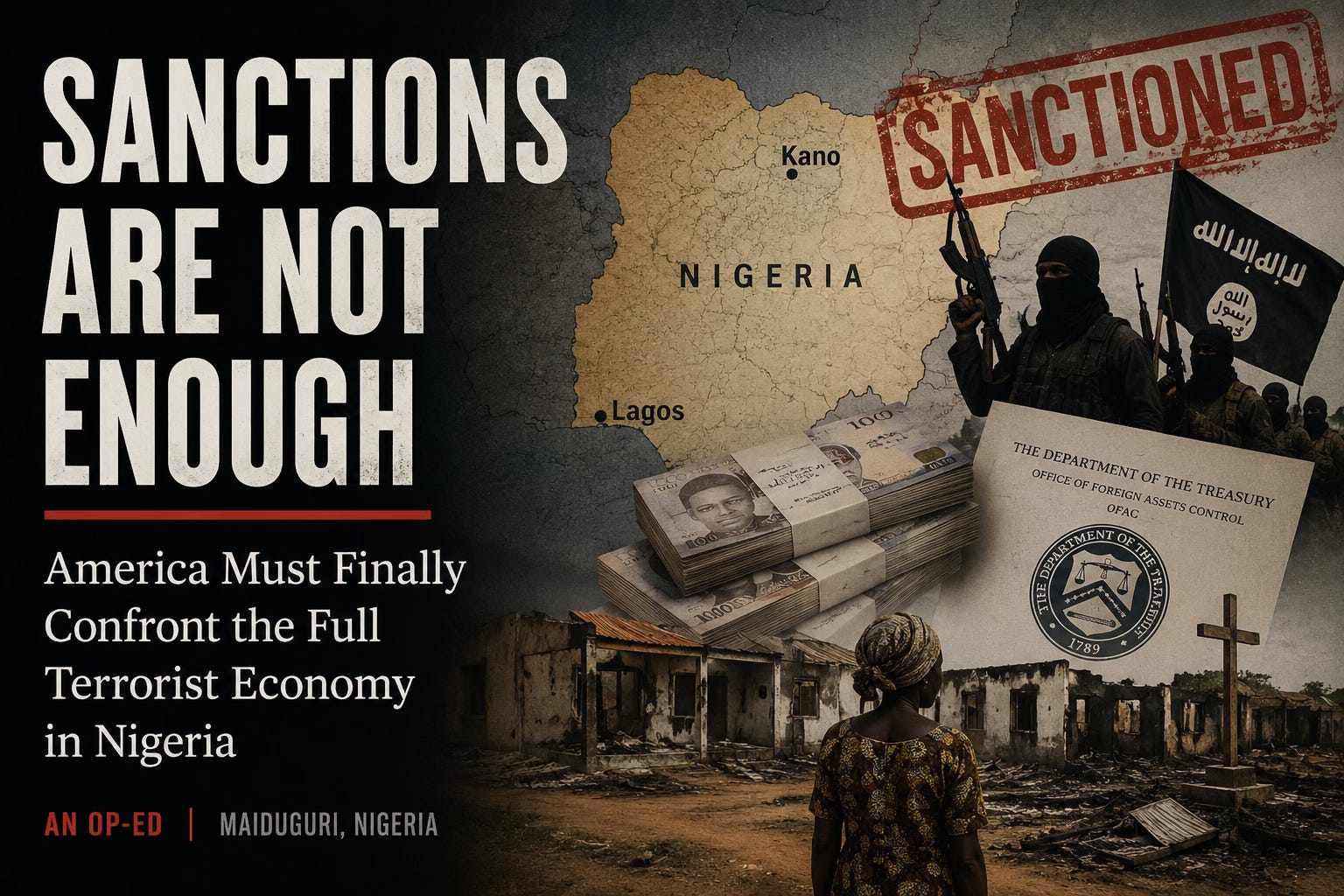
According to the U.S. Treasury’s Office of Foreign Assets Control (OFAC), Nigerian national Mukhtar Adamu Muhammad allegedly conducted financial transactions on behalf of ISIS-West Africa, while three Nigerian Bureau de Change companies—Faisal Exchange Limited and Manhattan Bureau de Change Limited in Kano, and Nine to Nine Exchange Bureau De Change Limited in Lagos—were designated for allegedly supporting those financial operations. A Turkey-based financial services company was also sanctioned as part of the same action.
The Treasury described the sanctions as part of a coordinated effort to dismantle ISIS financial networks stretching across Europe, the Middle East, and West Africa. Assets under U.S. jurisdiction have been frozen, and Americans are prohibited from conducting business with the designated individuals and entities.
State Department spokesman Tommy Pigott emphasized that the network stretched “from France and Syria to Türkiye and Nigeria,” illustrating how modern jihad operates through international financial channels rather than isolated local cells.
This is good policy.
Terrorism requires money. Fighters need salaries. Weapons must be purchased. Vehicles require fuel. Kidnappers must launder ransom payments. Financial sanctions increase the cost of doing business for terrorist organizations and complicate their operations.
But financing is only one side of the equation.
The other side is territory.
ISIS-West Africa continues to operate from significant enclaves around Lake Chad. Armed Fulani jihadist groups continue to terrorize Christian farming communities across the Middle Belt. Villages are attacked, churches burned, pastors murdered, and families driven from ancestral lands. The result is not simply terrorism—it is demographic transformation.
Too often, policymakers speak as though these are separate conflicts.
They are not.
Whether under the banner of ISIS, Boko Haram, ISWAP, or Fulani Ethnic Militia, the outcome is strikingly similar: Christian communities emptied, agricultural land abandoned, local economies shattered, and governments unable—or unwilling—to provide lasting security.
Money moves these organizations.
But ideology motivates them.
That distinction matters because financial pressure alone cannot defeat a movement driven by religious conviction and expansionist goals.
The Treasury sanctions also highlight something many Western observers overlook: terrorism in Nigeria is deeply interconnected with international financial systems. The designated network reportedly stretched across multiple continents. This is not merely a Nigerian problem. It is part of a global jihadist ecosystem that moves money, recruits fighters, shares intelligence, and adapts when pressure is applied in one region.
The United States appears to understand this reality. Pigott noted that the sanctions followed successful U.S.-Nigerian cooperation that resulted in the May 16 operation killing Abu Bilal al-Minuki, identified as ISIS’s second-highest-ranking official.
That operation demonstrates what effective counterterrorism looks like: intelligence cooperation, targeted military action, and sustained financial pressure working together.
What remains missing is equal attention to the civilians who bear the cost of this war every day.
The overwhelming majority of those displaced in Nigeria’s Middle Belt are not financiers or combatants. They are farmers, pastors, mothers, and children whose only crime is being a Christian. While terrorist financing rightly receives international attention, the systematic destruction of these communities often receives little more than passing notice.
If Washington truly intends to “defend religious minorities,” as the State Department declared, then financial sanctions should be accompanied by consistent diplomatic pressure on Nigerian authorities to protect vulnerable communities, prosecute those responsible for mass killings, and restore displaced families to their homes.
Following the money is essential.
Following the bodies is equally necessary.
Sanctioning financiers weakens terrorism’s infrastructure. Protecting civilians undermines terrorism’s purpose.
Both are required.
The Trump administration has taken an important step by recognizing that terrorist networks cannot function without financial facilitators. Now it should take the next step by recognizing that terrorist organizations also depend on something else: the expectation that the world will eventually stop paying attention to their victims.
That expectation must prove false.
No posts
Comments
Nothing yet. Say the first thing.
Sign in to join the conversation.