
The Sunday Brew | Issue #3, Aug‘26 | Free
Welcome to The Sunday Brew, weekly 1-2-3 newsletter by The Percolator. Every Sunday we drop in your inbox 1 story in a picture, 2 concepts, ideas or frameworks to expand your horizons and 3 news from the week, to keep you updated.
If you are not a paid subscriber, here is what you missed last week:
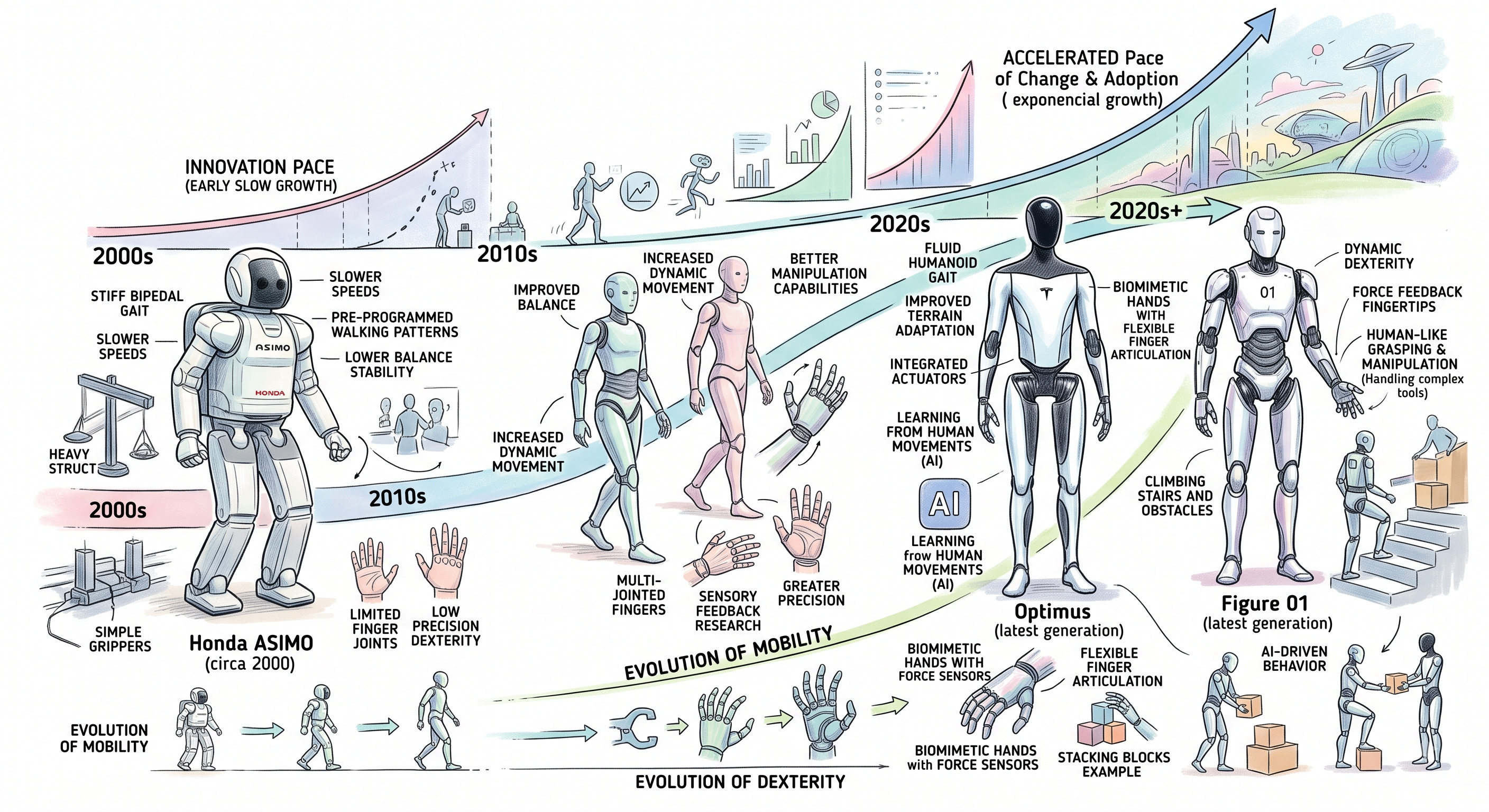
ONE STORY IN A PICTURE
The Humanoid Robot Evolution
TWO IDEAS, FRAMEWORKS OR CONCEPTS
This week we bring to you two Concepts: Scaling Law & Creative Destruction
Scaling laws define the mathematical relationships that dictate how a system’s operational characteristics change as its physical or computational dimensions increase.
When an architecture expands, its core properties rarely grow at a linear rate. Instead, they follow precise distributions where variables such as energy consumption and processing capability scale disproportionately to the system’s absolute size. Recognising these functional curves allows engineers to predict the exact capabilities and resource requirements of a massive framework by extrapolating data from a smaller functioning model. This mathematical predictability replaces speculative development with rigorous quantitative forecasting.
In the development of advanced computational networks, such as large language models, these scaling principles strictly govern performance improvements. Researchers have identified that increasing the volume of training data and the allocated computational power results in a highly predictable reduction in output errors. The correlation is so stable that professionals can determine the precise capital and processing resources required to achieve a specific target performance before the training cycle begins. The architecture scales predictably, meaning that capability gains become a direct function of resource allocation rather than novel algorithmic discoveries.
Expanding a system also introduces severe compounding constraints. As computational structures grow, the energy required for data transfer and processing scales aggressively, demanding entirely different infrastructural support. Professionals designing these expansive frameworks must account for these non-linear resource demands to prevent thermal or memory bottlenecks. By building architectures that anticipate the heavy physical burden of scale, organisations can ensure their systems remain functional and economically viable as they expand their operational capacity.
🚀
Creative destruction describes the continuous mechanism where technical and operational advancements dismantle established commercial structures to generate new economic value.
As novel methodologies enter the market, they render existing business models obsolete. This displacement represents a necessary structural correction that forces capital away from stagnant enterprises. The introduction of superior efficiencies fundamentally alters competitive dynamics, requiring established organisations to adapt their core operations or face liquidation. This constant internal mutation ensures an economy remains productive by reallocating resources towards their most capable current applications.
For professionals managing corporate strategy, this dynamic dictates that survival cannot rely on protecting legacy assets. When a superior standard emerges, it rapidly degrades the value of older infrastructure and previously dominant skill sets. Incumbents often attempt to defend their market share through regulatory capture or aggressive pricing, but these defensive tactics ultimately fail against genuine structural advantages. The capital freed from declining sectors naturally flows toward emerging industries to fund the next iteration of commercial progress. This reallocation forces companies to actively cannibalise their own profitable divisions to develop new capabilities before competitors displace them.
Navigating continuous obsolescence requires rigorous operational flexibility and a willingness to discard outdated investments. Leaders must structure their organisations to anticipate the inevitable decay of their current revenue streams. By directing research resources towards displacing their own primary offerings, firms can control the disruption rather than becoming its victims. Acknowledging this phenomenon as a permanent economic condition forces strategists to build adaptable frameworks capable of absorbing severe market shifts.
🚀
An Earnest Appeal
The Percolator is built like a magazine, but without the team or organisation. It takes research, writing, editing, and a steady rhythm to publish longform essays twice a week. Paid subscriptions make this work possible, and sustainable.
If you’ve found value here, I’d love for you to consider upgrading. Paid subscribers unlock every essay, can comment and join the chat, and a chance to feature their own notes and stories.
👉 Please upgrade to paid and help keep the brew strong. It costs less than two coffees a month, but unlike coffee, the energy lasts longer.
THREE NEWS FROM THE WEEK
TCS and Rolls-Royce have successfully operated a modern aero gas turbine through a fully simulated flight cycle using 100% hydrogen, marking an industry-first milestone in sustainable aviation propulsion.
The demonstration, the culmination of a four-year programme originally announced by Rolls-Royce and easyJet in 2022, validated hydrogen combustion, fuel-system integration and engine-control technologies across take-off, cruise and landing phases. TCS, which joined the initiative in 2024, supported engineering, testing, data analytics and risk management activities alongside partners including NASA and the UK Health and Safety Executive.
Rolls-Royce said the test produced valuable insights into how pure hydrogen behaves in a contemporary gas turbine and will inform future propulsion programs, including its UltraFan developments. The firms emphasised that while hydrogen can eliminate in-flight CO₂ emissions when used at scale, the demonstration does not mean hydrogen-powered passenger aircraft are immediately ready for commercial service. Technical challenges remain around hydrogen production, storage, airport infrastructure and overall life-cycle emissions depending on how the hydrogen is produced.
Industry executives framed the milestone as a crucial step toward decarbonising aviation and accelerating innovation through cross-sector collaboration. TCS highlighted its role in accelerating validation through digital engineering and systems integration.
Aviation policymakers, manufacturers and carriers will now need to align on standards, refuelling logistics and regulatory pathways to translate the test’s engineering success into operational reality.
➖
BRICS leaders are exploring the integration of national instant payment systems with central bank digital currencies (CBDCs) to streamline cross-border payments and reduce transaction costs, Reserve Bank of India Governor Sanjay Malhotra said.
Speaking to Brazilian media and reported by TV BRICS, Malhotra described the effort as an exploratory push without a defined technical model or timeline, with discussions still focused on assessing potential benefits and feasibility. India, holding the BRICS chairmanship in 2026, has placed financial connectivity and CBDC linkage on the summit agenda, signalling intent to advance concrete outcomes during its tenure. The RBI is also pursuing broader goals of internationalising the rupee and expanding the use of national currencies in trade, aligning with other bloc members’ interest in alternatives to traditional payment corridors.
BRICS now includes ten countries with diverse currencies and regulatory regimes: Brazil, Russia, India, China, South Africa, Egypt, the UAE, Ethiopia, Indonesia and Iran, creating significant coordination challenges for any shared infrastructure. Governor Malhotra acknowledged that technical parameters and governance arrangements remain undefined, underscoring the need for extensive harmonisation across legal, operational and cybersecurity domains.
Partner countries such as Nigeria, which joined BRICS as a partner in 2025, are monitoring developments as the initiative could later expand beyond current members. While the proposal promises lower costs and faster settlement for intra-BRICS trade, experts caution that practical implementation will require robust cross-border standards and phased pilot programmes before any full-scale rollout.
➖
Tencent is set to become the largest shareholder in Chinese AI firm Manus after agreeing to buy Meta Platforms’ roughly $2 billion stake, sources told Nikkei Asia, completing a transaction Beijing ordered unwound earlier this year.
The deal, led by Tencent alongside prior investors including Sequoia China and ZhenFund, follows a forced separation after China’s National Development and Reform Commission in April barred Meta’s acquisition of Manus on national security grounds. Manus, which Meta bought in December 2025, had integrated its autonomous AI agent technology into Meta’s products before regulators demanded the companies reverse the transaction and suspend data sharing. Since then, Manus split operations, relocated some staff outside China, and resumed independent operations in August.
Reuters reported Tencent negotiated to lead a consortium to buy Manus back for about $2 billion, a price close to Meta’s original payment. Manus’s revenue reportedly grew to an annualized $400–500 million post-acquisition, partly aided by access to Meta’s advertising systems, though buyers view current terms as favourable.
Under the new structure, Tencent will hold the largest single stake but remain a minority investor alongside earlier backers; Manus said it will continue serving global users, with some accounts potentially affected during the transition. Tencent had not immediately commented. The transaction marks a notable reassertion of domestic control over advanced AI assets as Beijing tightens oversight of foreign investments in sensitive technology.


The Sunday Brew by The Percolator brings to you curated news on tech, business & entrepreneurship, from across the internet to give your week a perfect start.
Share your thoughts and opinions on the topics covered in this newsletter by leaving a comment and joining the conversation.
Comments
Nothing yet. Say the first thing.
Sign in to join the conversation.