
The Founder’s Brew | Issue #2, Aug‘26 | Premium
Welcome to The Founders’ Brew, your Thursday ritual of sharp insight, data-backed thinking, and practical tools for modern founders. Each week we unpack one essential theme from the start-up world — combining frameworks, case studies, and field-tested resources you can apply immediately.
If you’re reading this on the free plan, you’re missing the deep dive, founder frameworks, and downloads that follow. Upgrade to The Founders’ Brew Premium to unlock full essays, data visuals, and subscriber-only templates.
» » » Check out subscribers’ benefits.
In this issue of The Founders' Brew, we examine the physical infrastructure that carries the global internet and the growing geopolitical conflicts surrounding it.
Nearly all international data travels through subsea optical cables resting on the ocean floor. While these networks rely on advanced photonics, they are no longer just engineering projects. They have become primary arenas for statecraft and national security disputes.
We detail how Western governments restrict Chinese involvement in the supply chain to maintain strategic autonomy. Furthermore, we analyse the shift from state-owned telecommunications consortia to private technology corporations funding their own proprietary routes across the seabed.
The Physical Reality of Subsea Photonics
Statecraft and Strategic Autonomy
The Shift from State to Corporate Infrastructure
Territorial Waters and Sovereign Friction
Security and Deterrence in the Deep Ocean
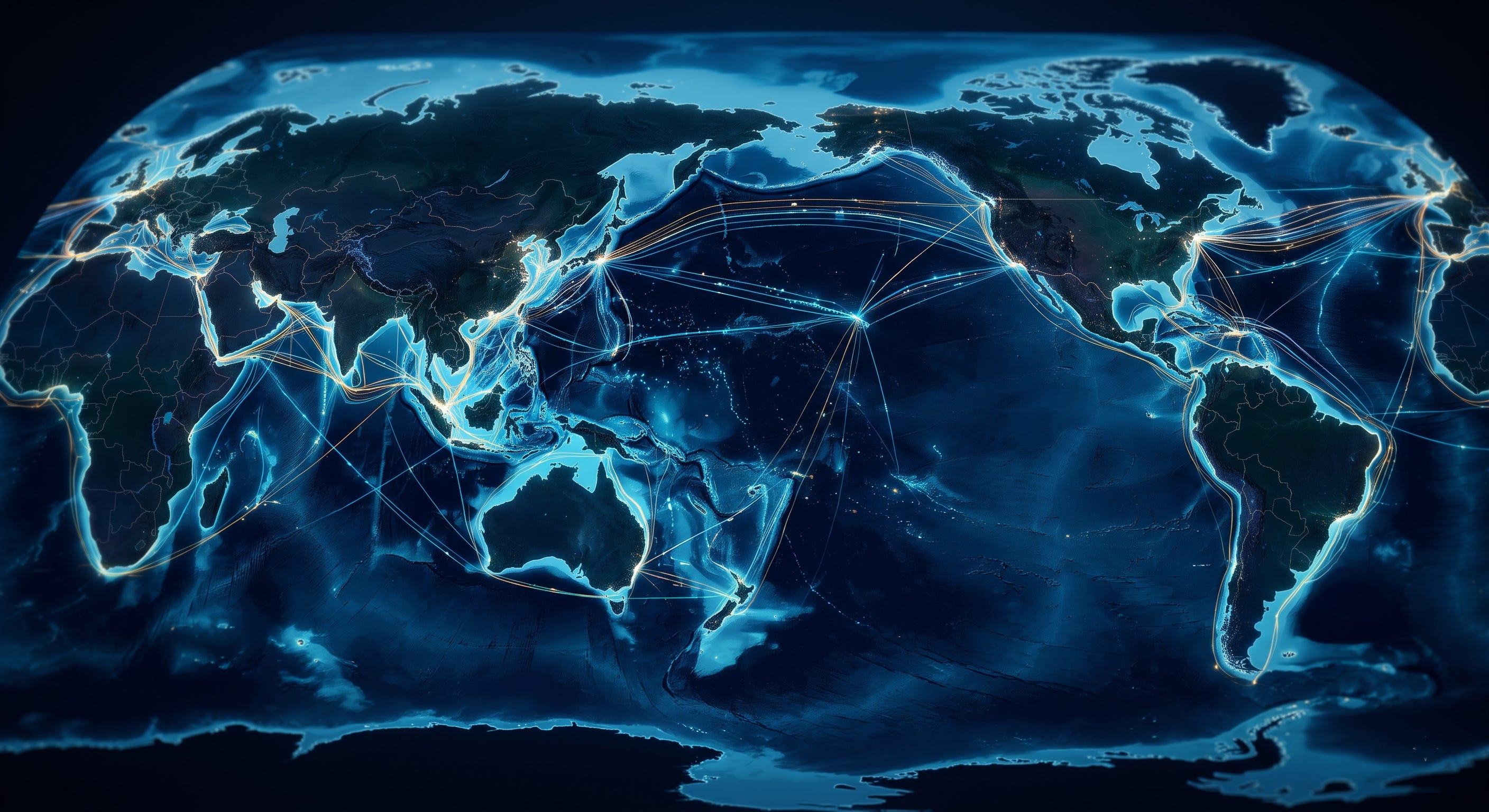
Underneath the ocean surface lies the physical reality of the global internet. Nearly five hundred optical cables lie on the seabed, carrying the vast majority of international data and trillions of dollars in daily financial transactions. These subsea networks rely on advanced photonics to transmit information across continents.
Over recent years, they have become a primary arena for global geopolitical competition. The supply chain for this infrastructure is highly concentrated. For decades, companies in the United States, France, and Japan dominated the construction and maintenance of these links. More recently, Chinese firms have gained significant market share. This shift has prompted coordinated efforts from Western governments to restrict their involvement due to national security concerns. This rivalry manifests in delayed projects, rerouted cables, and intense diplomatic pressure.
When private consortia attempt to lay new routes across the Pacific or along the African coast, they face complex national security reviews alongside conflicting maritime regulations. The United Nations Convention on the Law of the Sea provides a basic legal framework. However, the treaty was drafted long before digital connectivity became a core priority for national governments. Coastal states now increasingly assert sovereignty over their exclusive economic zones to control where and how data flows.
Simultaneously, major technology companies are funding their own private cables to bypass legacy routes and secure dedicated capacity. This shifts the balance of power away from traditional state-owned telecommunications operators. It places massive geopolitical influence directly in the hands of a few corporate actors. The physical integrity of these photonics networks determines the stability of the global economy, yet they remain vulnerable to both accidental damage and targeted sabotage.
Understanding this hidden infrastructure reveals how modern statecraft is practised through control of the physical pathways that carry our digital existence. To grasp the implications, one must understand both the technical architecture and the political decisions that shape it.
🚀
Comments
Nothing yet. Say the first thing.
Sign in to join the conversation.