
Brewed for Work | Issue #4, July ‘26 | Premium
Welcome to Brewed for Work, your Tuesday ritual for sharper thinking about careers, workplaces, and the shifting nature of professional life.
If you’re reading this as a free subscriber, consider upgrading to the paid tier for full access to deep-dive essays, exclusive workbooks, and interactive polls. Your subscription keeps this independent newsletter fully brewed and your career better caffeinated.
» » » Check out subscribers’ benefits.
In this issue of Brewed for Work, we examine the emergence of the neuromorphic workplace and its direct impact on professional autonomy.
Modern building management systems now monitor biometric and environmental data to adjust lighting, temperature, and sound in real time. While these automated shifts aim to reduce physical fatigue and support concentration, they introduce complex questions regarding continuous biological surveillance.
We explore how this transition from passive architecture to active observation alters the daily office experience. The text analyses the erosion of personal agency alongside the urgent need to establish clear boundaries for data privacy and explicit employee consent.
Today’s Issue at a Glance:
From Passive Spaces to Active Observers
The Daily Reality of Algorithmic Adjustments
Navigating Privacy and Biological Monitoring
The Erosion of Personal Agency
Defining Boundaries for the Monitored Professional
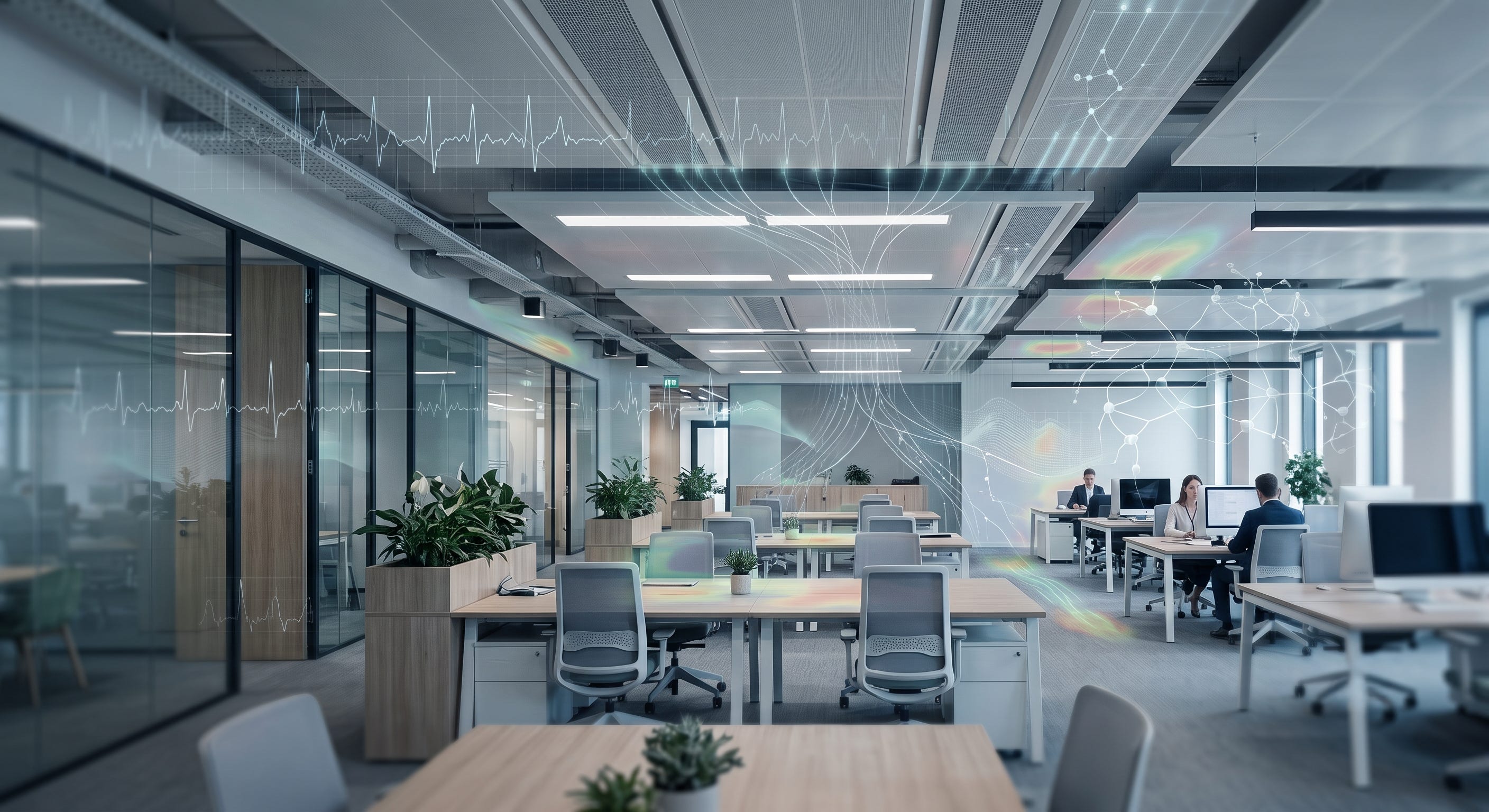
The physical workspace has historically functioned as a static container for human output, demanding that professionals adapt their physiological needs to fixed lighting, uniform temperatures, and open-plan acoustics.
The neuromorphic workplace reverses this dynamic. By continuously monitoring biometric and environmental data, modern building management systems can now measure the collective cognitive load of their occupants and adjust the environment in real time. This shift from passive architecture to active observation introduces a profound change in the daily professional experience. Sensors tracking carbon dioxide levels, acoustic variance, and aggregated physiological markers allow a building to lower the ambient temperature during periods of afternoon fatigue or adjust lighting spectra to support sustained focus.
The immediate benefit is a measurable reduction in physical discomfort and extraneous cognitive strain. When an environment mitigates distractions automatically, it theoretically frees mental resources for deep work. However, the operational reality of these reactive environments creates a tension between physical optimisation and professional autonomy. When a building reads the room and alters its state based on algorithmic interpretations of biological stress, it inevitably crosses into the realm of biological surveillance.
The normalisation of this continuous telemetry forces employees to navigate a workspace that responds visibly to their internal states. This dynamic raises pressing questions about data ownership, consent, and the erosion of individual agency over basic environmental factors.
While the prospect of an office that actively mitigates fatigue is compelling, the implementation of neuromorphic design requires a careful evaluation of how algorithmic paternalism affects the psychological contract between employer and employee. The professional must now work within a system that assumes it knows what their body needs better than they do. By substituting personal choice with automated environmental control, the neuromorphic office fundamentally alters the nature of workplace comfort, requiring workers to negotiate their boundaries within an intelligent physical space.
Comments
Nothing yet. Say the first thing.
Sign in to join the conversation.