
The Founder’s Brew | Issue #5, July ‘26 | Premium
Welcome to The Founders’ Brew, your Thursday ritual of sharp insight, data-backed thinking, and practical tools for modern founders. Each week we unpack one essential theme from the start-up world — combining frameworks, case studies, and field-tested resources you can apply immediately.
If you’re reading this on the free plan, you’re missing the deep dive, founder frameworks, and downloads that follow. Upgrade to The Founders’ Brew Premium to unlock full essays, data visuals, and subscriber-only templates.
» » » Check out subscribers’ benefits.
In this issue of The Founders' Brew, we examine the macroeconomic drivers forcing liquidity events in 2026 for capital-heavy sectors like space and fusion.
The transition from private venture funding to public market scrutiny requires a fundamental shift in how hardware founders structure their early capitalisation tables. Institutional buyers now demand predictable milestone achievement and contracted government revenue rather than theoretical potential.
By analysing how underwriters price the timeline to commercialisation, we provide actionable intelligence for early-stage entrepreneurs. We discuss the specific financial indicators separating successful public offerings from stalled private ventures, helping you align commercial milestones with market precedents.
The Transition to Public Scrutiny
Predictable Revenue in Orbital Operations
Valuing Scientific Milestones in Fusion Energy
Structuring Offerings for Institutional Buyers
Secondary Effects on Early-Stage Capitalisation

This text serves as a self-contained brief summarising the core thesis regarding institutional demand for capital-intensive technologies in the current financial cycle.
The macroeconomic drivers forcing liquidity events in 2026 for space and fusion companies represent a significant shift in how public markets evaluate deep technology assets. Historically, institutional buyers demanded immediate cash flow and proven profitability before absorbing high-capital expenditure ventures.
The 2026 environment demonstrates a modified framework where predictable milestone achievement and contracted government revenue substitute for traditional earnings multiples. We are observing a structural adjustment where underwriters price the timeline to commercialisation rather than historical financial performance. Space companies are establishing predictable revenue through orbital operations and launch services, transitioning away from speculative research into reliable industrial execution. Concurrently, fusion energy firms are accessing public and crossover capital prior to sustained commercial power generation by demonstrating rigorous scientific progress.
Public market investors are increasingly willing to fund the final, capital-intensive stages of reactor development or orbital infrastructure when the technical risk has been demonstrably isolated. We outline how underwriters evaluate these specific assets, offering immediate analytical value for founders navigating early capitalisation strategies. The transition from private venture capital to public scrutiny requires structural foresight regarding valuation models and investor expectations.
Founders must understand how the performance of these 2026 public offerings will directly dictate venture capital deployment and term sheets over subsequent funding cycles. By examining the financial structuring required to bring these high-capital expenditure companies to market safely, entrepreneurs can align their own commercial milestones with this newly established public market precedent. The focus remains strictly on exit mechanics and the empirical criteria institutional buyers use to justify large-scale capital deployment in scientifically validated technological domains. This precedent forces early-stage hardware founders to reconsider their capitalisation tables from seed funding onwards.
Institutional buyers are actively looking for companies that have mitigated core engineering risks and are focused solely on scaling production or operational capacity. By studying the current public offerings in the space and fusion sectors, founders can structure their capital raises to meet the exact financial indicators that institutional underwriters require for successful exits.
🚀
The accumulation of private venture capital in space and fusion over the preceding half-decade has created immense pressure for realisable returns, leading directly to the current 2026 offerings.
Over the past five years, private capital markets directed unprecedented sums into these hardware-heavy sectors. The fusion industry alone absorbed nearly $10 billion in private capital by late 2025 across more than fifty companies. This capital accumulation enabled rapid prototyping and significant engineering milestones, but it also initiated a countdown for liquidity. Limited partners in deep technology venture funds are now demanding clear exit pathways, forcing a transition from private funding rounds to the rigorous evaluation of public markets. Institutional investors assess these companies using metrics based on demonstrable revenue and derisked technology rather than the theoretical potential that satisfied early venture capitalists.
The transition requires a fundamental shift in how founders present their companies to capital allocators. In private markets, valuations often scale alongside scientific breakthroughs or the expansion of total addressable markets. Public markets require a different financial architecture entirely, demanding visibility into unit economics, order backlogs, and capital expenditure timelines. Underwriters evaluating the 2026 cohort are heavily scrutinising the precise ratio of capital invested to technical risk retired. Companies that fail to demonstrate a clear path from research and development to commercial execution face significant pricing discounts or failed offerings entirely.
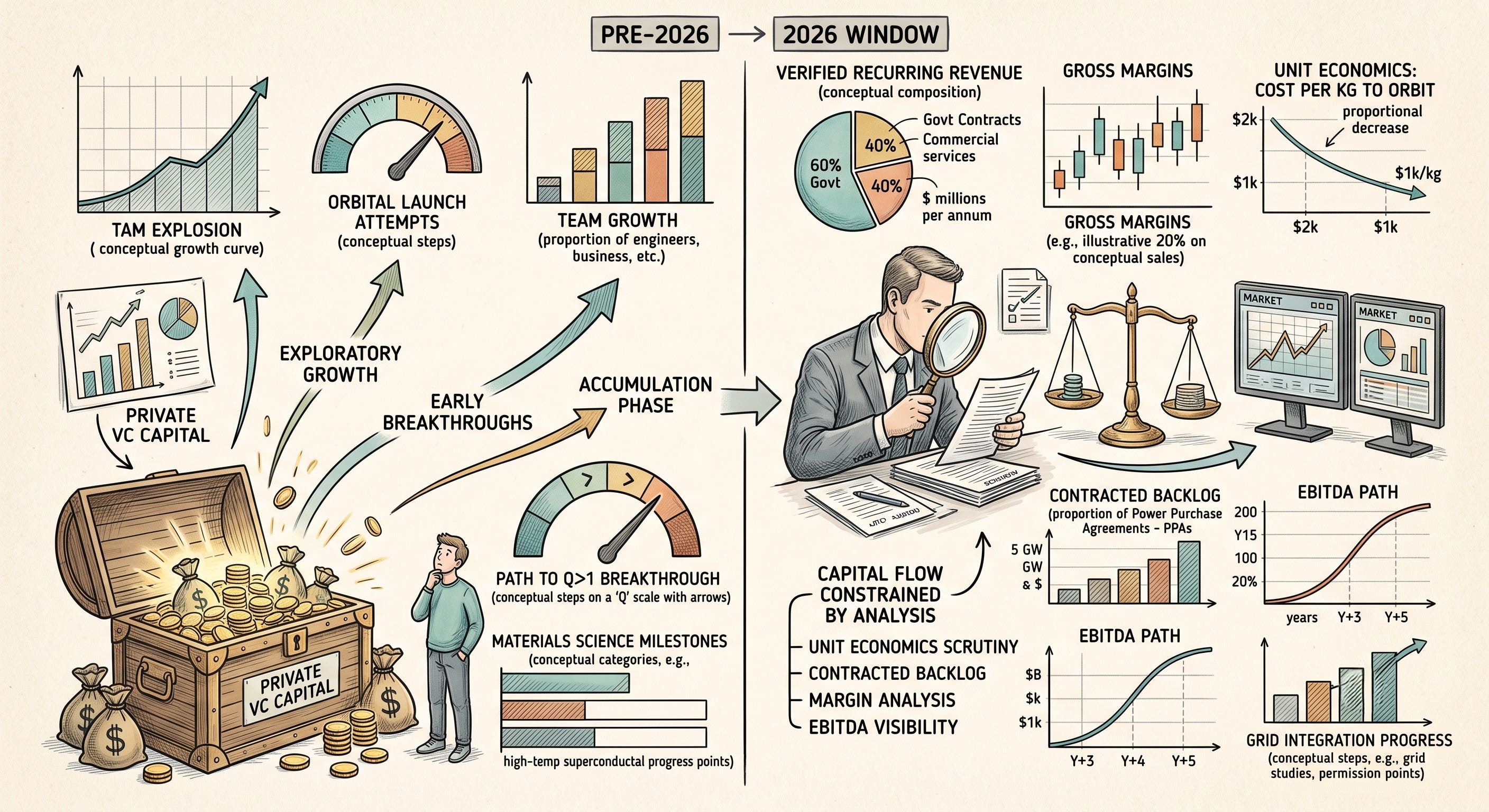
This shift in scrutiny is particularly evident in how investment banks model the weighted average cost of capital for these entities. A fusion company or orbital logistics provider carries inherent execution risk, which public analysts factor into their discount rates. To achieve favourable pricing, these firms must provide public investors with transparent, audited metrics that validate their technological readiness levels. The 2026 liquidity window demonstrates that while public capital is available for capital-intensive ventures, it is strictly gated behind rigorous financial predictability and the elimination of fundamental scientific uncertainty.
Founders must prepare for this environment by establishing stringent internal controls and financial reporting mechanisms long before they file their preliminary prospectuses. The companies successfully navigating this transition are those that operated with public company discipline during their Series B and Series C rounds, avoiding the structural debt and operational bloat that often accompany excessive private funding.
🚀
The space industry provides the clearest template for how capital-intensive hardware companies can establish the financial predictability required by institutional buyers.
Companies focused on launch capabilities and orbital infrastructure have systematically moved beyond research and development to secure reliable government contracts and commercial partnerships. The successful initial public offerings of firms like Voyager Technologies and Firefly Aerospace in 2025 established a pricing baseline, proving that public markets will handsomely reward space companies possessing diversified revenue streams. These companies achieved their valuations by demonstrating recurring revenue from defence technology and commercial space infrastructure, insulating them from the volatility of individual mission failures.
Institutional buyers evaluating space assets in 2026 prioritise companies that have secured long-term commitments, such as United States Space Force contracts or international defence agreements. This contracted backlog functions as a proxy for traditional profitability, allowing analysts to model future cash flows with a high degree of confidence. For launch providers, the critical financial indicator is the marginal cost per kilogram to orbit. SpaceX established the industry standard by significantly reducing this metric through booster reuse, forcing competitors to prove they can operate at similar economic efficiency. When evaluating a new launch provider, public investors scrutinise the company’s ability to maintain healthy gross margins while competing against established orbital infrastructure titans.
Beyond launch capabilities, the emerging market for orbital data centres and satellite communications requires massive upfront capital expenditure. Companies operating in this segment must prove they can acquire and retain commercial subscribers at scale. Institutional investors rely on the ratio of customer acquisition cost to lifetime value, adapting software-as-a-service valuation frameworks to orbital hardware. The capital required to manufacture, launch, and maintain a satellite constellation is immense, meaning companies must demonstrate rapid revenue generation immediately following deployment.
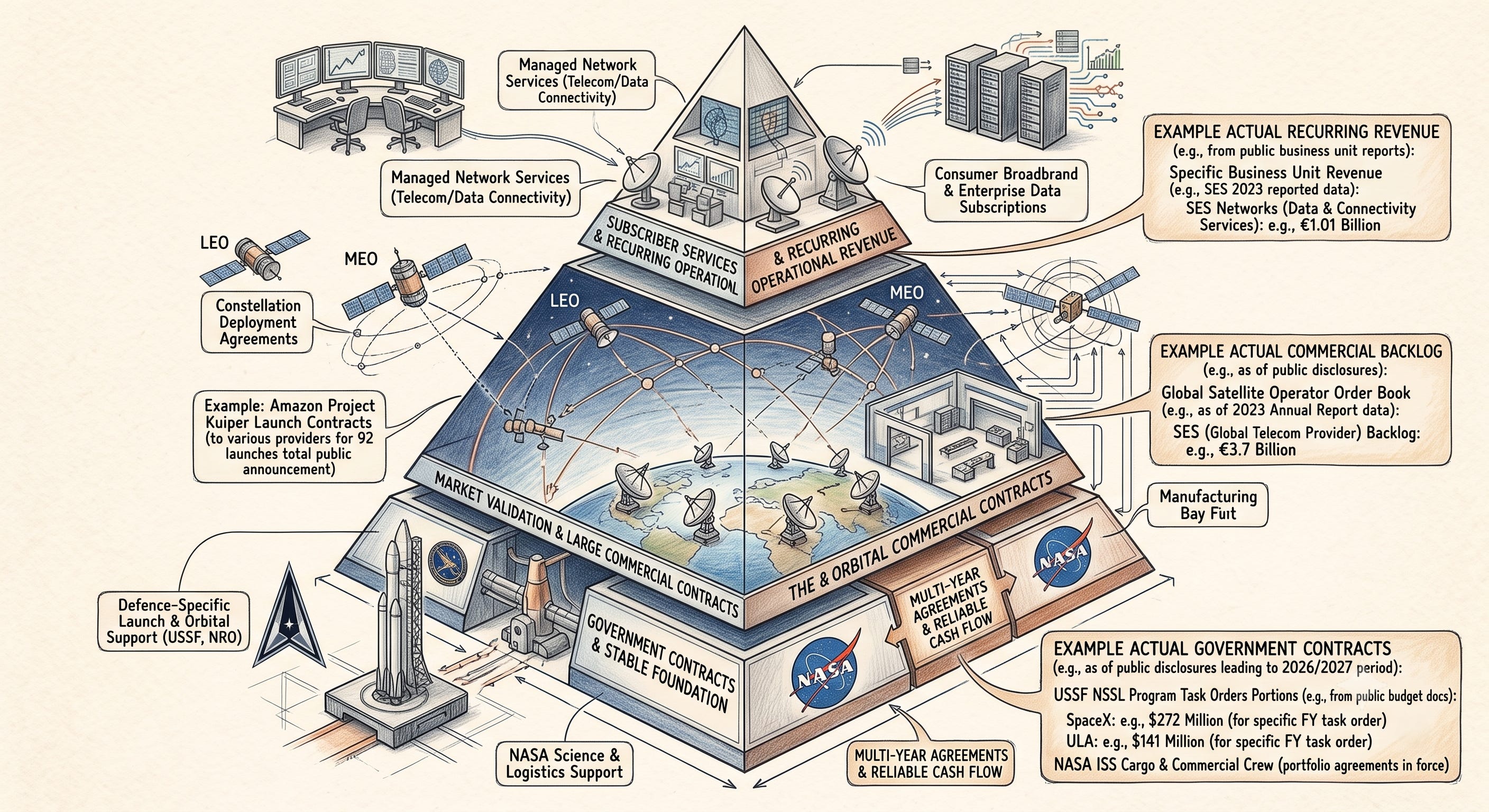
Founders building in the orbital economy must therefore design their business models around early revenue generation and capital efficiency. Securing a government testing contract or a commercial payload commitment before finalising the hardware design is no longer just a strategic advantage; it is a prerequisite for public market viability. The 2026 offerings show that institutional capital will absorb the extreme capital needs of space operations only if the company has eliminated market demand risk through binding commercial agreements. This mathematical approach to valuing orbital infrastructure provides a clear roadmap for early-stage companies aiming for eventual public liquidity. The financial models used by underwriters now incorporate precise probability weightings for mission success, regulatory approvals, and spectrum allocation.
Founders must recognise that technical brilliance cannot compensate for a lack of commercial traction when facing public market scrutiny. By prioritising early revenue generation and rigorous cost control, space technology startups can build the robust financial profiles necessary to attract institutional capital in public markets.
The fusion energy sector presents a unique financial profile, as these companies are attempting to access public and crossover capital prior to sustained commercial power generation.
Valuing these entities requires underwriters and institutional investors to price scientific progress rather than traditional cash flow or order backlogs. The capital intensive final stages of reactor development demand funding scales that often exceed the capacity of private venture capital, necessitating public market involvement. To justify these valuations, analysts focus heavily on objective, verifiable scientific milestones that indicate a reduction in fundamental physics risk.
The core metric governing fusion valuation is the engineering energy gain, often represented by the equation:
\(Q = \frac{P_{\text{fusion}}}{P_{\text{input}}}\)
Private fusion companies must demonstrate consistent progress toward Q > 1, where the fusion reaction produces more energy than is required to sustain the plasma. Recent achievements by private entities, such as maintaining plasma temperatures above 150 million degrees Celsius, serve as the technical proxies for future commercial viability. When a fusion company prepares for a liquidity event, the underwriting syndicate evaluates the firm’s historical rate of progress on these specific thermodynamic and magnetic containment parameters.
Public capital is deployed to fund the transition from these successful prototype machines to grid-scale commercial reactors. This transition requires industrial manufacturing capabilities, such as the mass production of high-voltage pulsed capacitors and high-temperature superconducting magnets. Institutional investors assess the supply chain readiness and the capital efficiency of the proposed power plant designs. They also evaluate the strength of commercial offtake agreements, such as the multibillion-dollar power purchase agreements signed by companies like Commonwealth Fusion Systems. Even if the actual electricity delivery is scheduled for the early 2030s, these binding commitments from major industrial players provide the financial scaffolding necessary to support a 2026 public valuation.
Founders in similarly deep technology sectors must understand how to translate complex scientific achievements into financial value. You must define clear, incremental technical milestones that directly correlate with a reduction in commercialisation risk. By structuring your engineering roadmap to produce verifiable data points at regular intervals, you can maintain investor confidence throughout the lengthy development cycle.
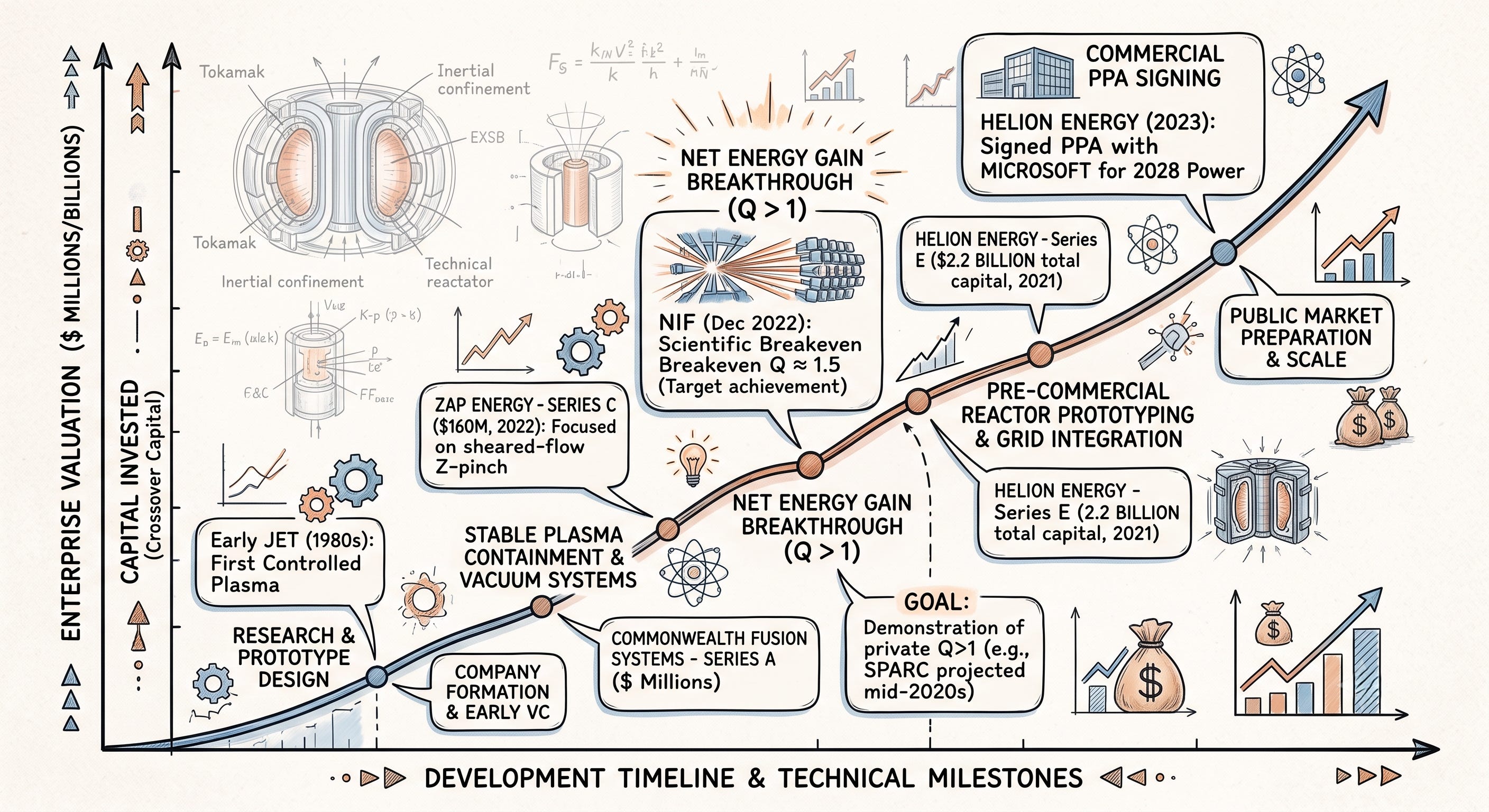
The fusion industry proves that public markets are capable of funding decades-long research initiatives, provided the scientific progress is transparent, externally validated, and backed by committed industrial partners anticipating the final commercial product. The mathematical modelling for these investments relies on complex probability distributions regarding reactor operational timelines and baseload electricity pricing forecasts. Therefore, technical founders must become adept at explaining how their specific confinement approach or laser efficiency directly improves the projected levelised cost of energy.
Bridging the gap between plasma physics and project finance is the essential skill required to secure institutional capital for scientific endeavours of this magnitude.
The mechanics of the initial public offerings themselves reveal the precise financial structuring required to bring high-capital expenditure companies to market safely.
Investment banks must price these distinct assets to balance long-term growth expectations against the inherent risks of unproven technology or delayed commercialisation. A standard public offering structure is often insufficient for hardware-heavy deep technology, requiring underwriters to implement bespoke mechanisms to stabilise the stock price and guarantee sufficient operational runway.
One critical mechanism is the heavy involvement of strategic corporate investors acting as anchor buyers during the offering. When industrial giants or established technology conglomerates take significant allocations in a space or fusion offering, they signal strong commercial validation to broader institutional investors. These strategic partners often agree to extended lock-up periods, restricting their ability to sell shares and thereby reducing early trading volatility. For founders, securing a strategic investor prior to an offering provides a crucial layer of pricing support, demonstrating that major industry players view the technology as fundamentally sound and commercially necessary.
Additionally, companies approaching the public markets in 2026 are heavily utilising non-dilutive government funding to bolster their balance sheets. Grants from defence departments or energy ministries provide a stable capital base that does not dilute equity holders. When pitching to institutional buyers, executives highlight this non-dilutive capital as a buffer against cost overruns during the final stages of hardware development. A strong public-private partnership signals regulatory alignment and government support, which significantly lowers the perceived risk for public market investors.
The implementation of staged lock-up periods is another vital structuring tool. Rather than allowing all early investors and employees to sell their shares simultaneously after a standard 180-day window, underwriters are structuring staggered releases based on both time and technical milestones. For example, a portion of founder equity might only become liquid once the company achieves a specific orbital launch cadence or sustains a targeted plasma temperature. This milestone-based liquidity aligns the incentives of early shareholders with those of the new public investors, ensuring that the management team remains entirely focused on executing the technical roadmap.
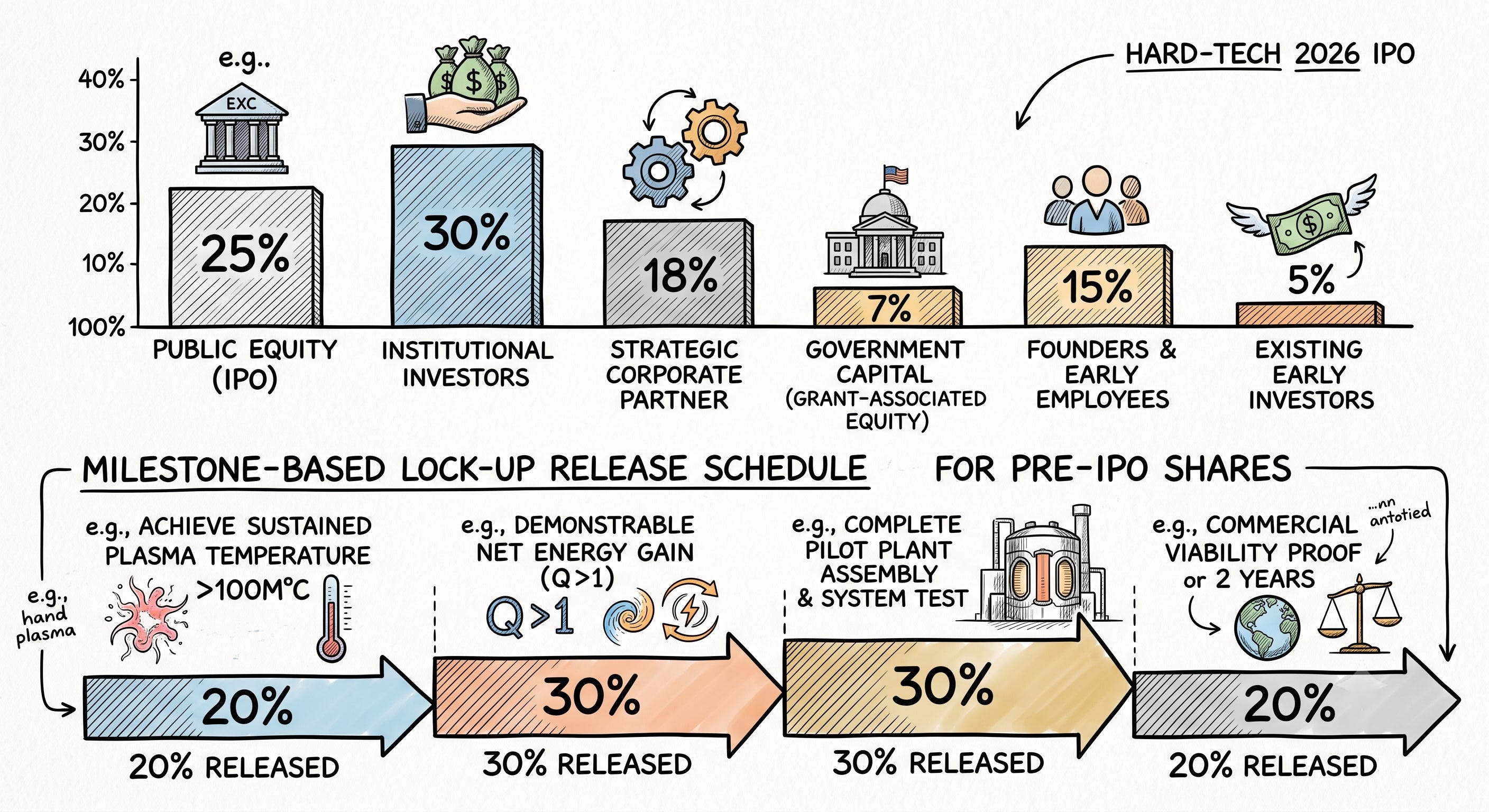
Founders planning for eventual public market access must negotiate their early venture capital term sheets with these future structuring requirements in mind, avoiding terms that could complicate a milestone-driven public offering. Investment banks are also employing sophisticated pricing models that factor in the distinct capital expenditure cycles of hard-tech firms. They establish conservative base-case valuations supported by existing cash flows or government contracts, while presenting the upside of the core technological breakthrough as an unpriced call option for investors. Understanding these underwriting strategies allows technical founders to better position their companies during the critical months preceding a public listing.
The performance of these 2026 public offerings directly dictates venture capital deployment and detailed valuation models over subsequent early-stage funding cycles.
When institutional investors reward space and fusion companies with strong public valuations, early-stage venture capitalists adjust their own risk parameters to fund the next generation of hardware founders. Conversely, if these high-profile offerings fail to maintain their initial pricing, early-stage capital will quickly retreat from capital-intensive sectors, frequently demanding unreasonable traction metrics for seed and Series A rounds.
Founders currently raising early capital must construct their capitalisation tables and commercial milestones to align perfectly with this newly established public market precedent. You must absolutely avoid the common trap of optimising solely for the highest possible valuation in your current round, as this can severely restrict your options if the public liquidity window narrows. Instead, prioritise bringing on investors who understand the specific capital expenditure requirements of hardware development and who can provide bridge financing if technical timelines extend beyond initial projections.
Your early commercial milestones must directly reflect the strict empirical criteria that institutional buyers are currently demanding from public companies. Rather than focusing exclusively on expanding the theoretical capabilities of your technology, you should direct engineering resources toward securing pilot contracts or producing verifiable efficiency metrics. The goal is to build a financial profile that clearly isolates the remaining technical risk and demonstrates a logical progression toward predictable revenue.
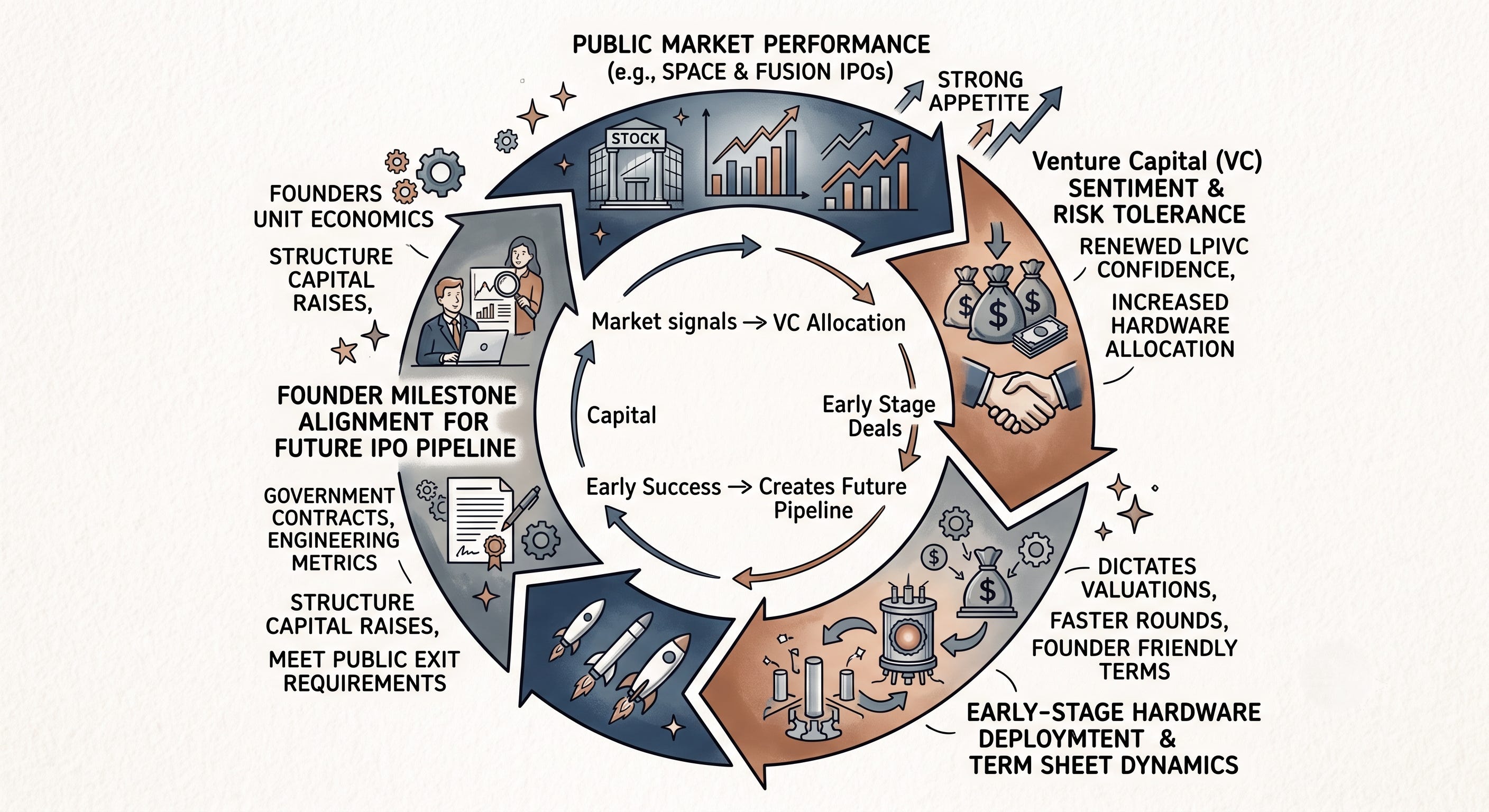
You must also establish rigorous corporate governance and transparent financial reporting standards from the outset. Public market investors require deep visibility into supply chain resilience, unit economics, and capital allocation efficiency. By embedding rigorous public-company discipline into your startup during the seed stage, you significantly reduce the friction associated with later-stage diligence and eventual public offerings.
The 2026 liquidity environment clearly proves that building a successful hard-tech company requires as much financial engineering as it does technical innovation. Founders who master both disciplines will secure the capital necessary to bring their hardware to market, while those who ignore the mechanics of institutional finance will struggle to survive the transition from private venture backing to very strict public market scrutiny.

Thank you for being subscribed to The Founder’s Brew. Please send us any questions or specific topics that you would like us to write about and we will do our best to create that for you.
Comments
Nothing yet. Say the first thing.
Sign in to join the conversation.