
During my first year managing the digital side of the Victoria’s Secret Fashion Show, the thought was “more is better.” We launched multiple games, swapped them at midnight, and ran the sweepstakes for weeks. It drove some awareness, but missed the real goal: getting people to watch the show.
When I started working on the next year's campaign, looking at the data told me exactly what we needed to do next. Scrap the complexity and develop a program that focused on our end goal: driving tune-in, followed by sales. This meant:
One game.
A focused call to action: Watch the show, then answer the questions to enter the sweepstakes.
We posted questions before airtime to build excitement.
Results:
Tuned-in viewers rose sharply.
Engagement soared.
Traffic spiked so high we crashed both our site and our vendor’s entire system.
Their engineers saw errors they didn’t even know existed.
Optimizing digital experiences isn't just about aesthetics or efficiency, it drives measurable results. In the context of the Victoria’s Secret Fashion Show campaign, simplifying the engagement funnel led directly to our core outcome: more people tuned in, interacted, and ultimately moved down the purchase path.
This mirrors what conversion data continues to show today. For ecommerce and landing pages, average conversion rates sit at 2.5 to 3 percent. But streamlined pages, those with fewer fields, clearer calls to action, and less visual noise, can perform significantly better:
Expedia added $12 million in annual revenue by removing a single form field.
A travel brand saw a 104% lift in conversions after reworking their CTA copy.
And in broader CRO studies, businesses with well-optimized landing pages have hit conversion rates up to 55 percent.
The pattern is clear: when the experience is easier to follow, more people complete the action. That’s true whether you’re trying to get someone to sign up, make a purchase, or, like Victoria's Secret, tune in for a primetime show.
Not every campaign has a prize or a payout. But when you do introduce incentives, like a sweepstakes, point system, or cash equivalent, you need to be precise about what you’re rewarding.
The Victoria’s Secret campaign is one example: we offered the chance to win, but only if viewers watched the show and submitted their answers. The incentive wasn’t the giveaway itself. It was the behavior we tied it to.
That same thinking applies to reward-based apps, like those that give users points for walking, checking in, or completing tasks. If your reward system isn’t tied directly to your product’s core value or business goal, you risk misalignment. You might get activity, but not outcomes.
Is this driving the behavior I actually care about?
Am I making the reward feel achievable without losing business value?
Will this lead to sustained engagement or just a short-term spike?
Don’t make users jump through hoops. Each extra click or field is friction.
Focus squarely on your end goal. For us, that was viewership; for you, it might be signups, purchases, or downloads.
Clarity always wins. A single, strong CTA outperforms a cluttered array.
Use cloud infrastructure. Our traffic crash became a lesson in scalability.
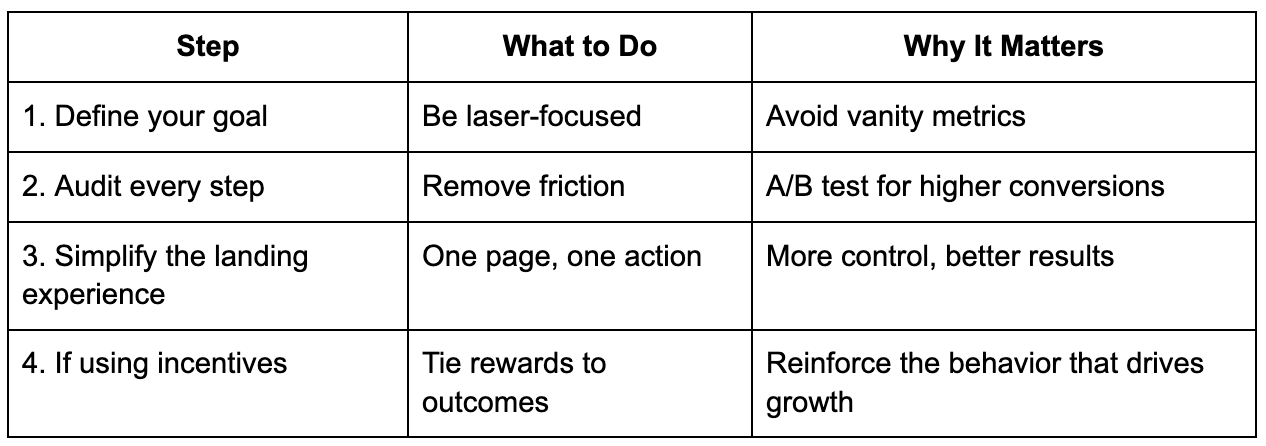
This campaign taught me that less can absolutely be more. Cutting complexity doesn’t mean cheapening a campaign. It means strengthening it. In 2025, with consumer attention fractured and CRO benchmarks rising, simplicity isn’t just elegant. It’s essential.
Focus on a clear goal. Remove noise. Incentivize the right action. And build for what happens next. Clarity, not complexity, wins.
Have you ever run a campaign that was way too complicated? Drop your story in the comments, I’d love to hear what you learned.
No posts
Comments
Nothing yet. Say the first thing.
Sign in to join the conversation.