

When I moved back to England from France I chose to live in a backwater of a town on the fringes of the country I had left all those years before.
It is a very fine town in some very fine countryside and near a river. And best of all it has a railway line, one that not only goes to London but that stops in all kinds of interesting places on the way.
Two weeks after I moved in, Lockdown descended. I had had no chance to explore or to meet my new neighbours. I was friendless but at least I wasn’t homeless.
As soon as I could use the railway, I did.
I was waiting on the station platform when a woman sharing my bench started to talk. In our chat I explained my circumstances, how I hadn’t had much chance to meet anyone and so on and she said,
‘I don’t know how you feel about this but I think it might be a good idea for you to join the Women’s Institute.’
I didn’t know how I felt about it either but I gave it a try. My new friend turned out to be the chairperson of the local branch and I trotted along to several of the talks that they organised each month.
The talks were not earth-shattering but they passed the time in the little backwater and gave women a chance to get out of the house and to meet other women.
One of the talks was given by a woman who sold scarves from her home nearby. She showed us how to use the scarves to dramatic effect and sold them afterwards to a queue of women eager to smarten up on their release from Lockdown.
Another talk was on the theme of blind dogs, or rather dogs for the blind. It was fairly interesting but very short and there were no dogs.
Then there was a Christmas party. I had been asked to go along and help in arranging the tables. So off I trotted nice and early. I wanted to do my bit and didn’t want to let anyone down. The place was already full of women all desperate to be useful. There is no woman as desperate as a woman desperate to be useful.
I went from group to group asking to be given a job but no-one would relinquish her role or even let me share it and there was no further need for setting out paper plates and cups, jugs of orangeade and plates of triangular sandwiches.
I wasn’t even permitted to put out the serviettes. I went home and watched Aussie Gold Hunters.
The only interesting talk to be advertised at the WI that season was about Octavia Hill, the founder of the National Trust. I went along to that too but it was cancelled at the last minute. This meant that I didn’t get the bouquet of flowers that would have been given me since it was my birthday month.
I did, though, join in a quiz held in a local pub and that was a pleasant way to spend-an-evening aka waste-some-time.
The Women’s Institute was very genteel. Everyone wanted to be helpful and nice and approved of. Everyone was kind in the way that women are, competitively kind in fact.
I am not sure if, when I registered and paid my subscription, I read the terms and conditions. Nothing had made me think that this organisation was anything other than what it said on the can, an institute for women.
Women’s Institute had been its name from the start when it had first formed in Canada at the end of the nineteenth century.
It had quickly spread to other countries and its membership had soared.
Its inception and early years had coincided with major movements and worldwide upheavals.
Trades unions were being formed, labour parties were being established. Men were demanding rights at work. And women were demanding the vote.
There was in fact a huge threat to the status quo. Revolution was in the air and was actually taking place in some countries.
The ruling classes had a lot at stake. If they wanted to keep the status quo, they needed to keep the workers in their place and to prevent women getting a foothold in the corridors of power. It was feared, with good reason, that if every working man and woman had the vote, socialism would spread.
There is a theory that the world war that began in 1914 was deliberately created and encouraged: in this way, all the dangerous radical men making waves in the unions and political parties could be got out of the way and turned into cannon fodder.
Women were already being arrested, imprisoned and tortured by forced feeding. If men were sent away to fight, and if women were persuaded to put their demands on the back burner for the foreseeable future, some kind of hell would be let loose in the fields of war abroad but at least the revolution at home could be staved off.
It worked: the men went off to war seeming to believe that they had made a free choice to fight for their country and that it was their own patriotism that won the day, as well as believing that they had an enemy that needed to be obliterated, though even now people have trouble deciding what it was that those soldiers in the rat-infested trenches were fighting for.
The women’s suffrage movement ceased its campaigning on the outbreak of hostilities and put its energies into supporting the war. The Women’s Institute went on with its jam-making and fruit-bottling and knitting which were, at that time, by no means irrelevant. Knitting, before the days of off-the-peg clothing, was essential and fruit-bottling and jam-making were crucial, even in peacetime, before the introduction of refrigeration.
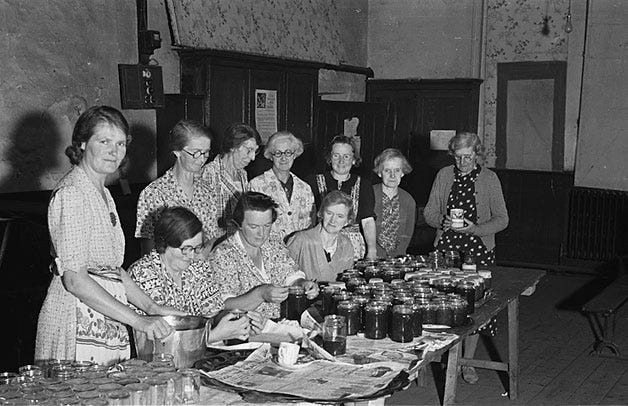
Women’s Institutes continued to concentrate on social welfare, demanding free milk for children and nursery places for the little ones, extra women police officers and more midwives for rural communities. It campaigned for clean rivers and worked for the protection of nature. In the second world war it worked on behalf of evacuated children and in the seventies and eighties it concentrated on spreading information about AIDS.
All in all, the WI seems to be a jolly good thing. At the bare minimum it gives women the chance to get out of the house and to meet other women. But those in charge seem to think it needs ‘enriching’. It will be ‘enriched’, they say, if it admits men to the Women’s Institute.
Not any men, of course, only certain special ones, the ones with sexual fetishes, the ones with the urge to be women or at least to pretend to be women. In other words, exactly the men who should be treated with caution and not admitted to women’s spaces.
If the WI put forward the idea that it should be renamed as the Women’s and Men’s Institute and told us openly that this was their intention, then we could discuss the matter and decide whether or not we want to continue with our membership. But, as always with ‘trans’ issues, deception, lies and secrecy are the order of the day, a stealthy invasion being the other side of the shouting, drum-banging, whistle-blowing hysterics that mark the public face of trans.
When I joined the WI a year or two ago, its policy stated,
Membership of the WI is open to women who have reached the Age of Majority (18 years). There is no upper limit to becoming a WI member.
I didn’t have to prove that I was a woman or show my assigned-at-birth certificate and I didn’t even have to state that I had been living as a woman for a few days or weeks or months. Nor did I have to wear lipstick and sequins but could just turn up in a pair of jeans and not a scrap of makeup and still I would be accepted as authentically female and therefore qualified for membership.
It all seemed simple and straightforward.
I had no idea that behind my back, so to speak, the Institute I had just paid my subs to, was lying and deceiving. Without consulting the membership or even letting it know, the WI had launched its new enriching idea and had already been enlisting men claiming to be women to the institution which for its whole lifetime of well over a century had been exclusively for women.
I wasn’t the only one to notice this deception. Other members had spotted it too and had begun to make a fuss, a very polite feminine fuss but a fuss nonetheless.
The WI was obliged to clarify. It did so like this:
Transgender WI membership Policy
This policy has been written to provide guidance for members who have questions relating to transgender WI members. Transgender is an inclusive, umbrella term used to describe the diversity of gender identity and expression for all people who do not conform to common ideas of gender roles.
Whatever did it mean? Who had written it? As far as I was aware, the word ‘transgender’ had never even been mentioned in the WI before and I had not heard of any discussion on the subject. But now suddenly the WI was giving us an unsolicited lecture on the word, ‘transgender’ and its meanings, using words that seemed familiar from elsewhere - ‘umbrella’, ‘diversity’, ‘gender’, ‘conform’ - and ended with a conclusion that upended the terms I had signed to.
It no longer said, Membership of the WI is open to women who have reached the Age of Majority (18 years).
But now said, Anyone who is living as a woman is welcome to join the WI and to participate in any WI activities in the same way as any other woman.
In other words, any man who sleeps in a bed (or on a sofa or in a car) and eats off a plate (or off a piece of cardboard or off the floor) like any woman might do, could now join our exclusive Institution. And he didn’t even have to prove where he slept or ate let alone prove that he had transitioned.
I had underestimated the WI. It was not just up-to-date on the best way to tie a scarf, divide a sandwich into triangles or talk to a guide dog; it was so well informed on all things trans you might even think it must have been subjected to some kind of propaganda.
It had really done its homework and gave us prepared answers to its own prepared questions, without letting us know who had done the preparations and why.
Q&A What does transgender mean?
Transgender is an inclusive umbrella term including: Transsexual is a medical term describing people whose gender and biological sex do not line up, and who often seek medical treatment to bring their body and gender identity into alignment. There are several terms used to commonly describe transsexual people, including MTF (abbreviated term for male to female transsexual people), FTM (abbreviated term for female to male transsexual people) and transman and transwoman (common language terms used to describe FTM and MTF transsexual people).
Could it be that the WI was protesting a little too hard? From total ignorance on the subject of trans we were subjected to intricate details of a condition that very few of us would ever come across. They went on:
Intersex people are born with chromosomal anomalies or ambiguous genitalia. Intersex infants are often assigned a gender and subjected to surgical procedures. Some intersex people develop gender identity issues.
This was a lot more complicated than learning how to tie a scarf to perfection. Surely we had heard enough? Did we really need to know more? Would we be welcoming MTFs and FTMs as well as ‘intersex people’ and people with ‘ambiguous genitalia’ into the Women’s Institute?
Bi-gendered people have a gender identity that encompasses both genders - masculine and feminine. Non-binary people are those who don't feel male or female. They may feel like both or like something in between. They may have a gender that changes over time or they may not relate to gender at all. Crossdresser is a term used to describe people who dress in clothes associated with their opposite sex, as defined by socially accepted norms, but still identify with their biological sex.
How were we meant to know the difference between an ‘erotic transvestite’ and a ‘social transvestite’? Did we need to keep a look out for any stirring under the clothes of the transvestite to see if he was aroused by being in the WI surrounded by real live women?
An erotic transvestite is a person who gets sexually excited by the dressing. A social transvestite, however, simply feels more comfortable in such clothes.
What were we meant to do if we discovered that the person sitting next to us listening to a talk on delphiniums was sexually excited?
What does gender reassignment involve? It might involve surgery, hormone treatment or simply a permanent decision to live and dress as a member of the opposite sex.
All in all the WI had given us a lot of intricate details about a lot of male fetishes involving women. But nowhere, not anywhere in the literature or elsewhere, was there any mention of the subject that is of serious concern to women: the numbers of young women and girls having their breasts sliced off and interfering with their natural hormonal development in order to achieve their ‘gender reassignment’.
The Women’s Institute had given itself away.
This was not a coherent explanation of sexual confusion; it was a manifesto and, like any manifesto, it had been put together by its adherents with the aim of persuading or cajoling its readership into going along with its arguments.
The entire propaganda was based only on men. Only men ‘cross-dress’, only men ‘live and dress as a member of the opposite sex’: women gained the public’s acceptance to wear trousers a long time ago, about the same time the WI was formed in fact.
The WI had been sneaky about admitting men to its ranks. It had clearly known that it was not acting within its own constitution and was keen to fudge the matter. It was behaving like a put-upon woman submitting to a coercive bully and maintaining an impassive face for her friends and relations.
It had not been upfront and, even when it was pushed into giving some response, the WI created its own terms. It would provide both the questions and the answers and it would tell women not only what they should accept but how they should respond.
And how was it going to do that? It would need help. And who would be best placed to help? Who, indeed, would put the questions and answers for the Women’s Institute to present to its members as a fait accompli?
The Women’s Institute did not loudly announce who was directing it, who was standing over it like a dominating husband forcing it to agree to his demands. But it did let us know:
Information source: https://www.stonewall.org.uk/sites/default/files/transgender_booklet_2004.pdf
Yes, Stonewall, that successful influencer of just about all public bodies from the police to the education system and the health service, yes, Stonewall had extended its reach to the Women’s Institute not only giving answers to questions about men who like to pretend to be women but also setting the questions themselves.
It would seem that the WI had not done any research into Stonewall despite the worrying issues concerning it that were by now already apparent.
And, not content with determining the subject and the terms, Stonewall also directed the WI membership as to what it was supposed to think and feel in relation not only to men in its ranks but to the deception that had been played on it.
Q: Is there a legal difference regarding whether someone has had gender reassignment surgery?
A: No and it is very unhelpful to think about anyone in those terms. Some transgender people may never have any kind of gender reassignment surgery but everyone is entitled to be treated in the same way, in the gender in which they identify.
Q: Can male to female transgender people join a WI and attend WI events?
A: Yes – anyone living as a woman is welcome to join the WI and take part in all WI activities. They should be treated in exactly the same way as all women who are part of your WI.
Q: Can crossdressers join the WI?
A: No – only those living as women can join the WI and take part in all WI activities.
Q: Can we ask for written evidence to prove that someone is a transgendered individual?
A: No – this could be very offensive and hurtful.
!
Stonewall had got its size 14 foot in the door and would now go on pushing for total penetration.
In no time at all, men were admitted to the Membership Committee making decisions about who could and could not join the organisation.
A man claiming to be a woman appeared on the front cover of the WI magazine and an interview with him (called ‘her’ by the mag) graced the issue.
Not surprisingly, the fuss in the WI was becoming a little less polite and ladylike. A group of desisters was formed. Calling themselves ‘the Women’s Institute Declaration’, they wrote: We are disappointed to see that a trans-identified male has been appointed to the Membership Committee and asked for the WI to stop admitting men. The Women’s Institute, taking the side of rogue men against its long-time loyal women members, responded by saying it was ‘proud’ to accept transgender members.
The campaigners responded that the Women’s Institute had got itself into an ‘untenable position’, and, that its constitution had been ‘de facto changed’ without the consent of its 180,000 members. Saying that the WI could no longer ‘legitimately campaign for women-specific issues’, it started a petition calling for the admission of new trans members to be put on hold, a compromise that will surely only cause more difficulties in the future, an attempt to ‘be kind’ that can only lead to confusion.
The campaigners stated, ‘By failing to define what a woman is, by having a wide description for a trans woman and by not allowing respectful debate, or debate of any kind, the NFWI has de facto forced individual Women’s Institutes to accept men.
‘This has been achieved by poor drafting of policies, poor advice from advisers and is harmful to women as a whole.’
When will the time come when MPs, party leaders, media channels et al learn that to lie about such fundamentals as sex means that at the very least you will tie yourself in knots, and you may well be digging your own grave? The old hot chestnut is being tossed around from political parties to newspaper columnists to the NHS and way beyond: ‘What is a woman?’
‘There is no definition of what a woman is,’ the campaigners say of the WI. ‘If you cannot define the group you seek to represent, how can you understand their needs and demands?’
Good question. But who will provide the answer? Stonewall?
No posts
Comments
Nothing yet. Say the first thing.
Sign in to join the conversation.