
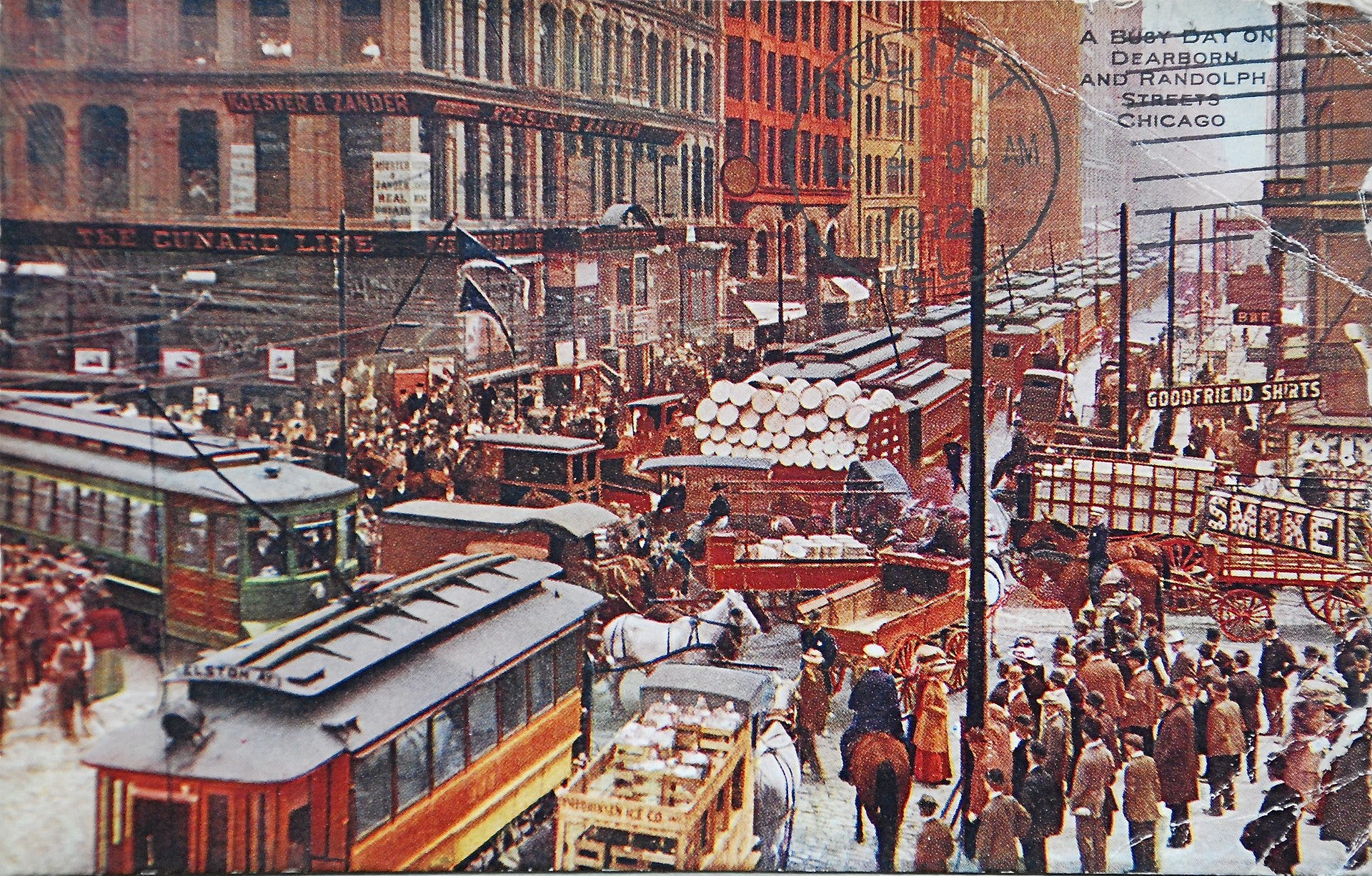
If you’ve lived in an American metropolitan area old enough to have been urbanized by the early 1900s — which is many of them — you’re familiar with your city’s downtown. Perhaps you’ve visited it regularly to shop, work, or attend events. It’s also quite possible that you almost never visit it. Nowadays, plenty of people work in suburban offices (or remotely, of course), and can access all of the shopping and entertainment that they need without trekking downtown.
Either way, however, the concept of “downtown” that you’re familiar with — large-scale stores, high-rise offices, very little residential housing — is a unique product of early 20th-century America, a very particular time and place in urban development. During this time, downtowns were glorious, frenzied, and altogether incredible places. American cities featured a typology of “downtown” that was distinctive on the world stage: central, hyper-dense clusters of high-rise office buildings and department stores, combined with very few full-time residents.
Through the first half of the 20th century, downtowns started to face serious struggles as cities decentralized. Policymakers and business interests began making increasingly desperate efforts to keep urban activity intensely concentrated in one central business district. As it turned out, saving downtowns would not be so easy.
This is the premise of Robert Fogelson’s book Downtown: Its Rise and Fall, 1880-1950, published in 2001. Downtown is a worthwhile and comprehensive history, rich with insights on the arc of downtowns across American cities, both economically and politically.
Fogelson takes a top-down historical approach, noting that his book “is about power, not feelings.” We learn about the arc of downtowns primarily through the relatively influential urbanites of the time, such as politicians, business interests, and urban planners. The book is also full of entertaining anecdotes about how people coped with the rapidly changing urban environments of their era.
Today, as downtowns continue reeling from the pandemic’s long tail, Downtown forces us to be realistic about the future of our cities. COVID isn’t the first time that cities have struggled with decentralization and collapsing real estate values in their urban cores.
In fact, many efforts to preserve downtowns in the early 20th century only worsened their declines. While some have fared better than others, all downtowns are now shells of their former selves, and these previous struggles demonstrate how difficult it is to save the American mold of downtowns. To achieve a recovery of our downtowns, we must see downtowns’ past as a warning against an urban form that we are unlikely to ever replicate.
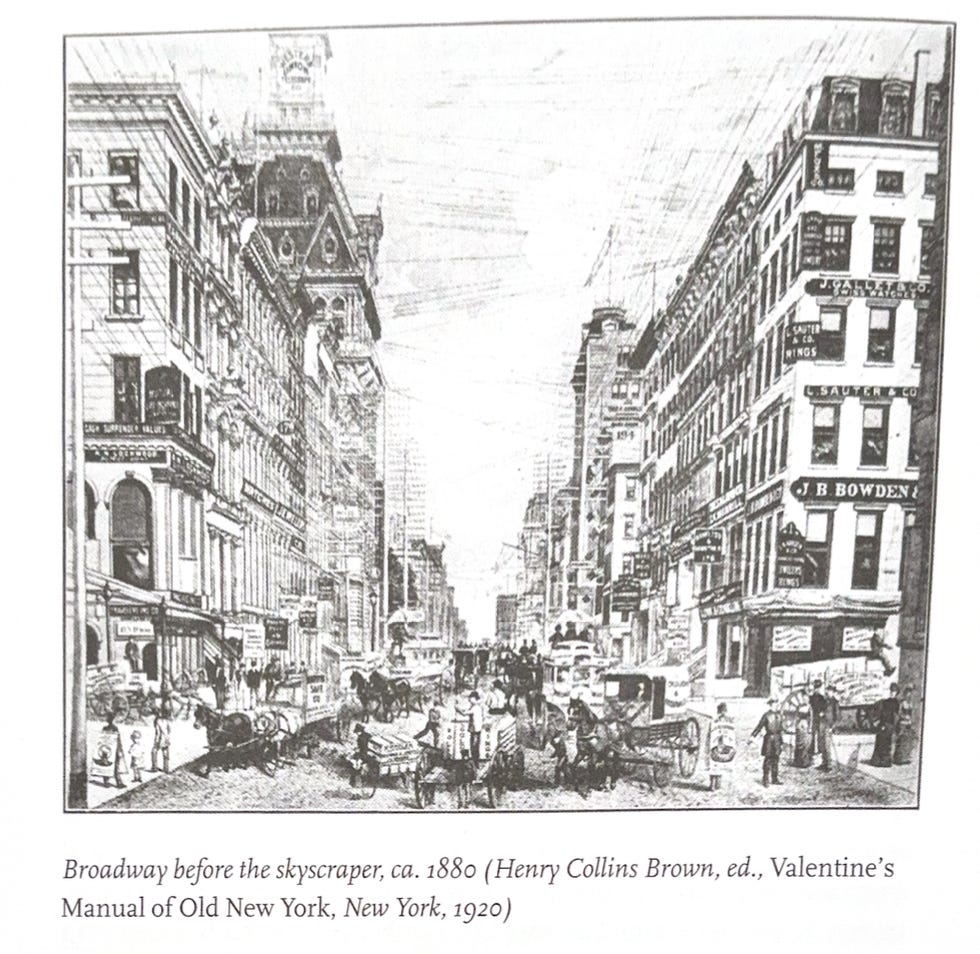
Americans first started referring to “downtowns” in the late 1800s. The term arose from one specific downtown: lower Manhattan, which could be contrasted with the quieter, residential “uptown.” As American cities began to grow at incredible rates in this period, much of the resulting commercial activity was funneled into downtowns. Because this development was concurrent with the rise of electric and steam-powered railways, as well as larger and more complex business organizations, downtowns featured hyper-dense concentrations of commercial activity.
This wasn’t just in the usual suspects, such as New York City, Chicago, Philadelphia, or San Francisco. Downtowns were prominent across a surprisingly wide range of cities: Fogelson discusses Rust Belt cities such as Detroit, Pittsburgh, and Cleveland, sunbelt Los Angeles and Nashville, and even substantially smaller cities like Tampa.
At the turn of the 20th century, downtowns were the central focus of every urban area in America. Take one representative factoid: in this period, the term “central business district” would have made little sense — there was no other “business district.” The hyper-dense collection of buildings and businesses at the core of American cities was the dominant and uncontested core of urban economic activity.
A key distinction of American downtowns was the separation of residential housing from downtown business districts. Many Americans believed this separation was crucial to the success of cities. In part, this came from subjective, moralistic views on quiet residential living, as Americans often valued the prospect of living away from the bustling city. At the same time, residential separation from business districts arose from economic reasons. Downtown land was becoming immensely valuable, and residential real estate struggled to compete with commercial uses that could earn considerably more revenue.
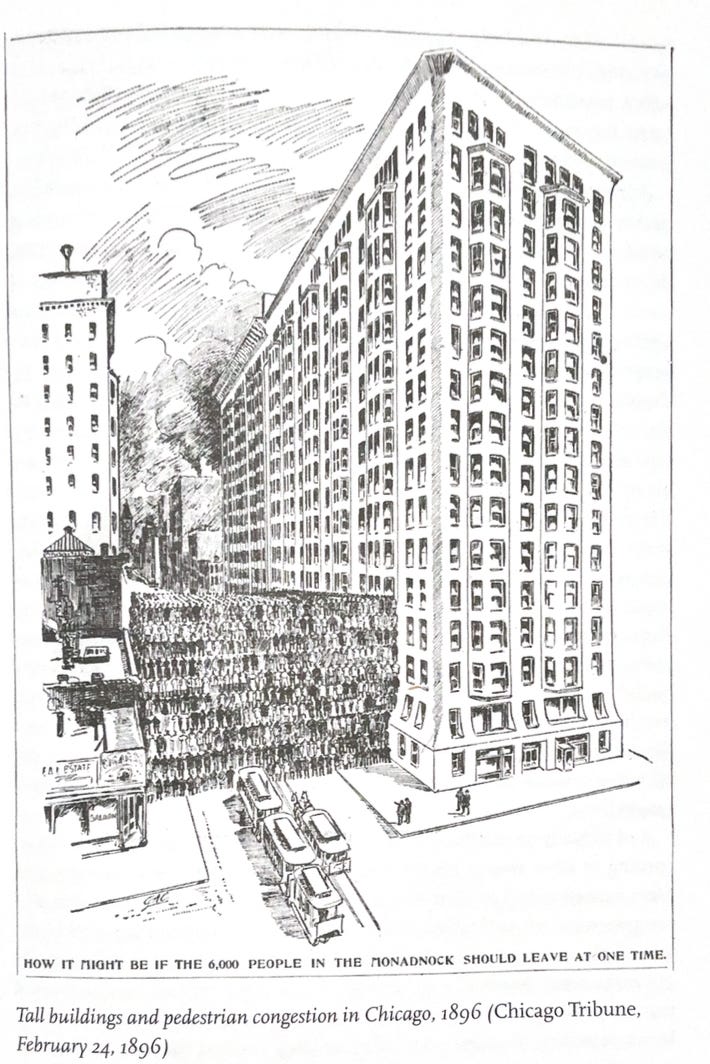
Downtowns faced substantial growing pains during this period, as an explosion in downtowns’ daytime population made it challenging to get people in and out of the city each day. Even before cars became widespread, congestion was an issue for streetcars, carriages, and even the flood of pedestrians streaming through city streets. At-grade streetcars, the predominant form of mass transportation, could not avoid the traffic swarming downtown roads.
In response, cities sought to develop rapid transit systems, which could move people in and out of downtowns far more efficiently. This began with the construction of elevated train lines in New York and Chicago during the 1870s and 1880s. Elevated lines were not always popular, as they had substantial externalities at the time. They were extraordinarily loud and cast shadows over the streetscape. Since they initially used steam engines, the trains spread pollution across the city and literally dripped oil and hot cinders over the heads of passersby.
Downtown advocates turned towards subways around the turn of the century. But although countless American cities drew plans to develop subways connecting downtowns and neighborhoods, surprisingly few succeeded in implementing this vision. Mass transit had, up to this point, been a private enterprise, but the capital investment of subways was prohibitive without some sort of direct public funding. Debates over the degree to which subways would be privately or publicly funded and managed, combined with further arguments about how to fairly and effectively route subways, left many cities at a standstill. Relatively few American cities successfully built strong rapid transit systems, despite their pressing need to address downtown congestion.1
As another common response to overcrowding in downtowns, policymakers and business interests sought to restrict the density of buildings. In the late 1800s, downtown height restrictions and density controls were a fairly radical new idea, responding to an equally radical degree of technological change: the invention of elevators, followed by steel-frame buildings, was allowing buildings to climb taller and taller. This accelerated worries about congestion, and raised new concerns about fire safety, sanitation, and aesthetics.
The movement to limit heights was, in many ways, successful. By the 1890s, the first crude height limits had been established in Chicago and Boston, and many other cities followed suit in the next couple decades. By 1916, New York City’s debates about height limits culminated in the first comprehensive zoning ordinance among American cities.
Although downtowns certainly weren’t perfect, there was a widespread notion that Fogelson calls “spatial harmony”: the idea that downtowns and the surrounding areas have a mutually beneficial relationship, each depending on the other’s success. Since downtowns were for business, and the outlying areas were for living, neither part of a city competed with the other. Fogelson writes that “the parks were commonly regarded as the ‘lungs’ of the city, the streets as the ‘arteries,’ the depots and wharves as the ‘mouth,’ the telegraph and telephone lines as the ‘nervous system,’ and the business district, not the city hall, as the ‘heart.’” All worked together as part of a complex organism.
However, downtowns’ good health would not last. Soon enough, the concept of spatial harmony would begin to falter, and outer urban areas began to grow without depending on downtowns — or even at their downtowns’ expense.
Through a series of economic and political changes that encouraged decentralization, downtowns’ prominence decayed through the first half of the 20th century.
The Great Depression was a shot across the bow for downtowns. Office buildings fared very poorly during the Great Depression, leading to a sudden surge of demolitions in downtowns. In a desperate attempt to reduce property taxes and operating costs, property owners replaced their buildings with parking lots and garages that became known as “taxpayers.” This was a preliminary instance of deterioration to the downtown fabric. Fogelson writes that “‘taxpayers’ were as much a legacy of the depression as ‘Hoovervilles,’ bread lines, soup kitchens, and dance marathons.”
Beyond the Great Depression, some decentralization was inevitable, and at times it was even beneficial. Each successive improvement to transportation technology — horse-powered streetcars, then electric streetcars, then grade-separated rapid transit — had enabled city residents to live further from downtowns, expanding the geographic footprint of cities. The rise of cars would serve a similar purpose.
Between the pressure of car ownership and post-Depression struggles, many observers grew increasingly pessimistic about downtowns’ futures. A growing number of neighborhood commercial clusters provided residents with more convenient access to their shopping needs — leading to a breakdown in the aforementioned notion of “spatial harmony,” since downtown businesses began to see themselves in direct competition with other parts of the city. As rates of car ownership continued to climb, congestion only worsened, generating fears that downtowns were becoming less accessible to city residents. Downtown advocates began to worry that without heavy-handed intervention, downtowns would continue to decline.
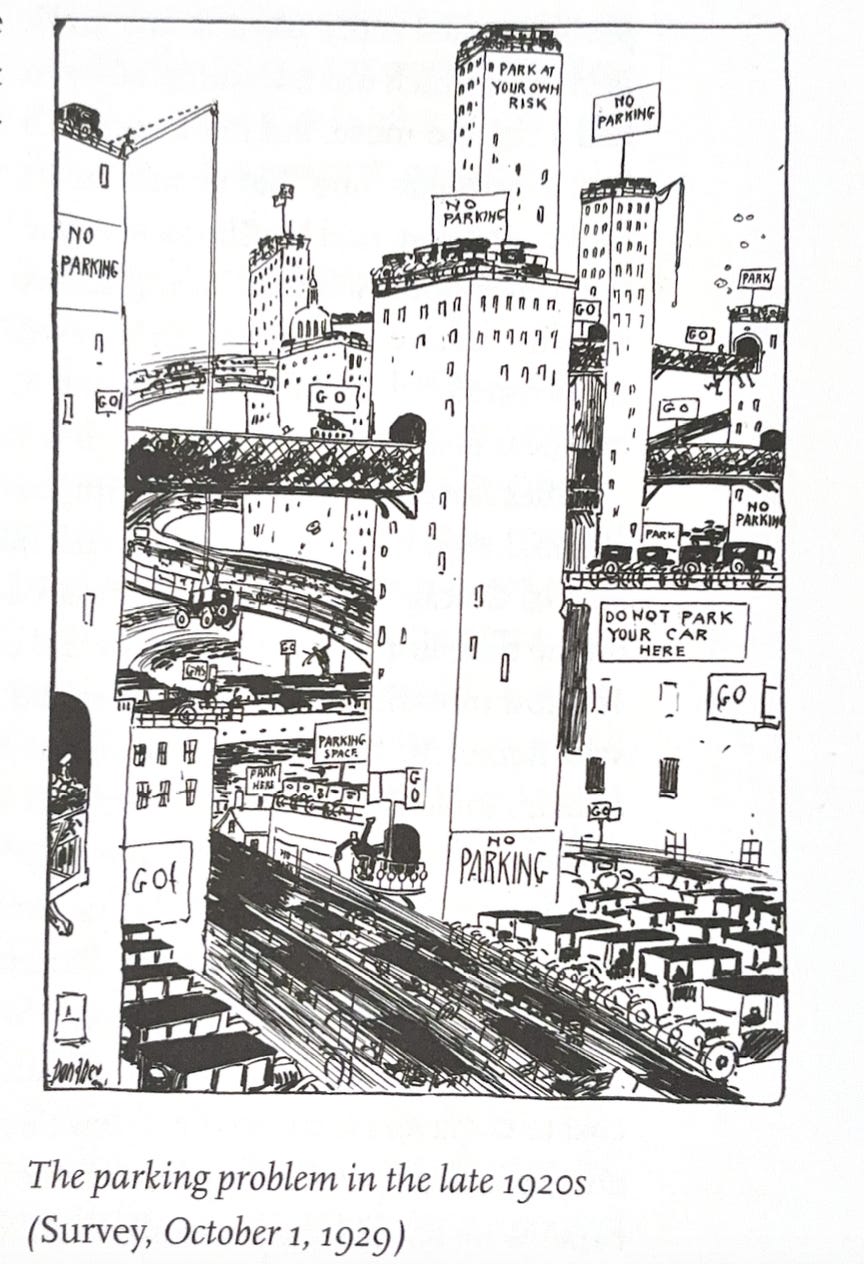
Cars, however, had a key difference relative to previous improvements in transportation technology. While streetcars and elevated rail were occasionally nuisances for downtowns, their construction required minimal direct damage to the existing fabric of downtowns. And by moving many people at once, they could effectively serve dense concentrations of offices and shopping. On the other hand, cars are fundamentally at odds with the geometry of dense downtowns: they quickly clog the roads, and their need for parking quickly creates issues.
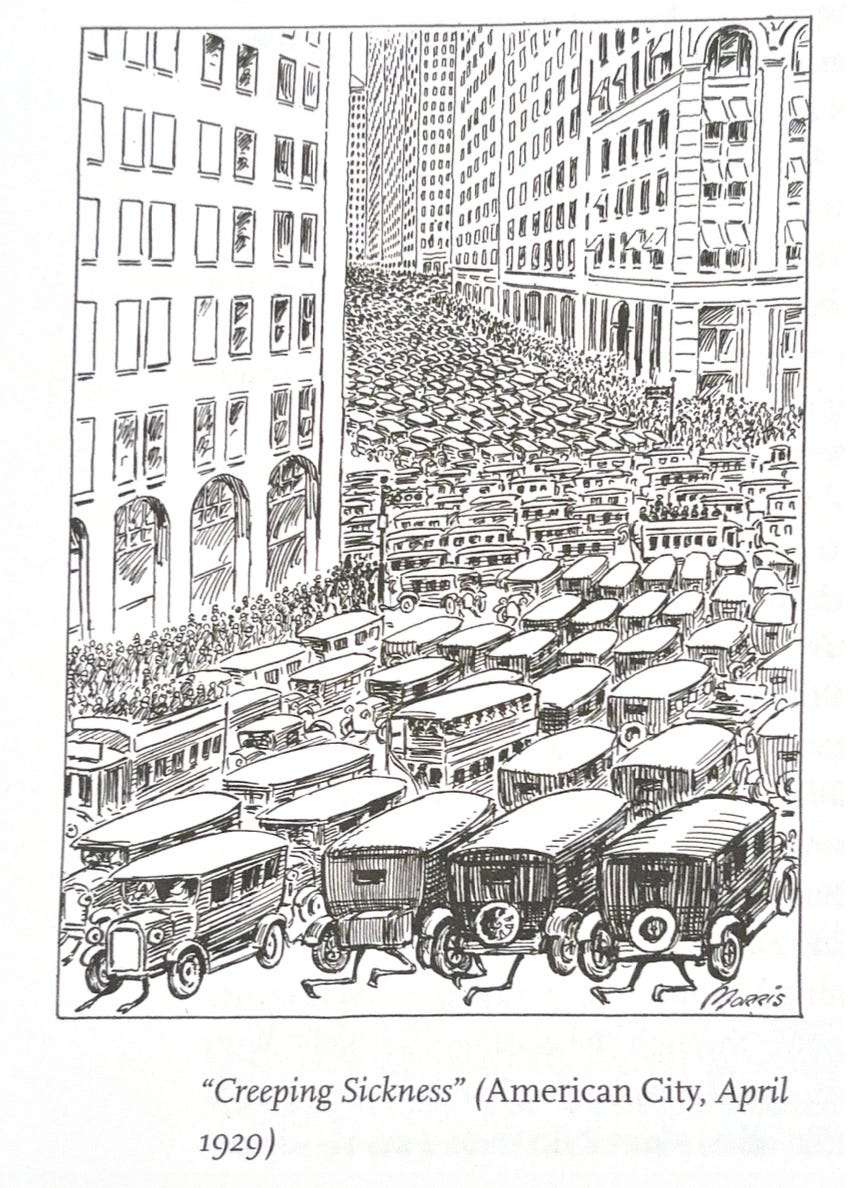
By and large, decisionmakers in American cities embraced private cars, destroying segments of our urban fabric to do so. They sought to widen existing streets and redesign traffic patterns so cars would more freely flow through downtowns. The natural conclusion of these efforts was to build larger, faster roads, with greater separation from surrounding traffic — that is, highways. Early highway efforts included Chicago’s Lower Wacker Drive and New York’s now-demolished West Side Elevated Highway, which were carrying meaningful amounts of traffic by the early 1930s. These efforts further culminated in the new concept of “freeways,” which had no traffic lights or intersections at all. Downtown planning and lobbying efforts set the stage for federal funding of large-scale freeways in the 1950s, and the rest is history (and beyond the scope of Fogelson’s book).
Since many downtown interests assumed that increased car access would primarily increase traffic towards downtowns — instead of decentralizing activity — they also turned their attention towards parking facilities. Many drivers had been parking their cars on the street, which only exacerbated congestion and sparked debates about how to restrict and regulate on-street parking. Through the 1930s and 1940s, the private supply of off-street parking had also grown steadily.
Still, downtown interests were worried; in 1946, the Urban Land Institute called parking “the most important single problem facing the central business districts of large cities today.” Against the warnings of some who argued that parking was a highly inefficient use of space, they successfully lobbied cities to contribute public dollars towards adding thousands more downtown parking spots in off-street garages and lots.
In their desperation, downtown business interests also “invented blight.” Throughout the early 20th century, many reformers had fought to improve slum housing, initially through regulation, and by the 1930s, through slum clearance and publicly-funded redevelopment. These kinds of urban renewal efforts were narrowly focused on replacing poor-quality housing, and prioritized replacement housing for the low-income residents that were displaced. Housing reformers had been the leaders of these efforts, and most downtown representatives were not interested or involved in these discussions.
By the mid-20th century, downtown interests realized that core-city slum neighborhoods, which were often adjacent to downtowns, presented an opportunity to try and “renew” downtowns. They could get rid of poor-quality housing, while also solving another problem: fewer and fewer middle and upper class people were living near downtowns.
Instead of replacing slums with better housing for the poor, these actors sought to replace slums with large public investments or higher-end housing. They were ultimately able to restructure the rules and incentives of public subsidy programs in order to do so on the federal government’s dime. In Title I of the 1949 Housing Act, the federal government committed resources to “renew” blighted areas, but it did not require those sites to be redeveloped with lower-cost housing, nor did it practically require replacement housing for the low-income residents displaced during slum clearance. Instead, this new wave of slum clearance sought to “curb decentralization — to induce the well-to-do to move back to the center by turning the slums and blighted areas into attractive residential communities — and, by so doing, to revitalize the central business district and ease the cities’ fiscal plight.”
At this point, however, downtown decline was well underway, and these desperate efforts would not stop it. Through the 50s and 60s, suburbanization accelerated, accompanied by new development patterns like suburban office buildings and the rise of the shopping mall. Federal mortgage policies encouraged thousands of households to buy homes in the suburbs. Downtown had passed its peak, and its glory would never return.
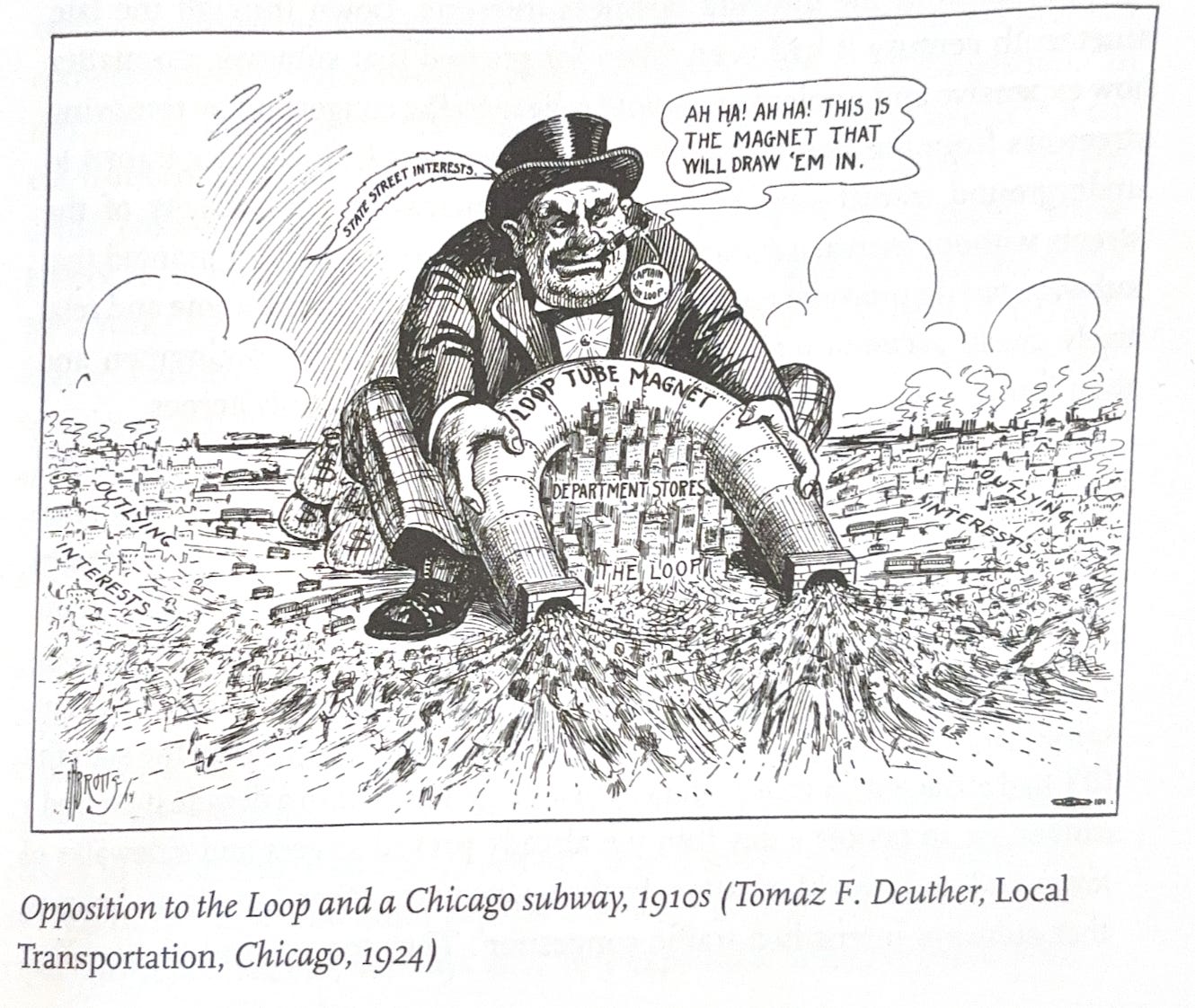
Did the plight of mid-20th-century downtowns demand a publicly-supported solution? Or should policymakers let different districts of cities ebb and flow on their own? It can’t always be the role of local governments to subsidize individual businesses, or even spatial clusters of businesses, when they struggle. Private firms are constantly closing and opening, and the level and nature of economic activity will always be changing in any given part of a city. If business is flowing out of the downtown core and into other neighborhoods (or more generally, from one part of the city to another), it’s not clear that we should take policy measures to prevent that change.
Distributional questions present one possible justification for directing resources towards particular locations of cities. For example, we might want to subsidize economic activity in parts of a city that have more vulnerable residents.
However, this is probably not a good argument for subsidizing downtowns in particular. In the 20th century, one reason that cities worked so hard to save downtowns was that the downtown business interests were a very powerful political force. But cities are fiscally constrained, and investing in downtown revitalization can come at the expense of other neighborhoods. In the case of urban renewal and highway construction, this tradeoff was at its most severe, as entire sections of neighborhoods were destroyed in an effort to save downtowns. We ought to be attuned to how the gains and losses are distributed when trying to prop up any particular part of a city.
On the other hand, a couple different reasons might justify the public sector stepping in to protect and improve downtowns.
The first reason is the existence of positive and negative externalities. Perhaps more so than any other part of a city, downtowns’ fates are intertwined with the fates of cities at large; when downtowns thrive or suffer, the rest of the urban environment often thrives or suffers too.
One mechanism for these externalities is through fiscal impacts. We’re seeing an example of such negative externalities today, as steep declines in downtown real estate values since COVID have drained property tax revenue from cities. Now, cities face difficult choices between raising other kinds of taxes or shrinking their budgets. This modern case echoes a narrative present throughout Fogelson’s book: concerns that downtown property values would decline often pushed cities to make policy and invest resources dedicated towards downtowns.
Downtown decline could have other negative externalities throughout cities, too: for example, when downtowns struggle, their cities’ transit systems are likely to falter, too, as well as downtown cultural amenities that benefit from clustering downtown. Or downtowns might support local agglomeration effects when high-quality businesses co-locate, and a push from the public sector can support a business cluster strong to activate these effects.
Another, related justification for public investment in downtown is that urban areas might face “multiple equilibria.” I’ve considered these dynamics in previous writing about urban decline. Urban growth and decline is full of feedback loops, both positive and negative. Thus, a sufficiently painful change in a neighborhood’s fortunes — such as new transportation technology or a collapse in real estate values — could initiate a negative feedback loop, and knock a neighborhood from one equilibrium to a worse one. As consumers, residents, and investors withdraw from the area, its struggles will only accelerate.
If there is a risk of this kind of negative feedback loop, that’s another reason to invest public resources in downtowns. By stepping in to stall negative feedback loops — though that’s easier said than done — we might have been able to, and might still be able to, prevent downtowns from falling into worse equilibriums.
More abstractly, it’s worth asking whether something is lost when downtowns disappear. When I see pictures of the downtowns of old, with hundreds of pedestrians cramming the streets, it’s hard not to feel wistful. Even walking around much of modern Manhattan, as exciting of an experience as this can be, does not quite seem to match the jam-packed streets of the Financial District in 1920.
Alternatively, when I walk through the dead-quiet southwest corner of the Loop at 7:00pm on a weeknight, or meander through Minneapolis’s empty skyways on a Friday afternoon, I feel a bit sad for the vibrant places that we’ve lost. An intangible spark of civic identity and urban life seems to have faded along with our downtowns.
Even if there were valid justifications for saving downtowns, could we really have preserved them as robust, vibrant centers of urban activity?
Perhaps not. Mistaken decisions by city planners and downtown interests clearly exacerbated downtowns’ decline, but as Fogelson writes, “decentralization was largely, though not exclusively, the result of market forces.”
To some degree, decentralization brings positives. While I enjoy Chicago’s downtown, it’s preferable that today, I can access most shopping and leisure activity in neighborhood commercial areas, which only requires me to walk or take a short transit trip. It was similarly inevitable that widespread car ownership would empower more people to visit suburban areas and live more of their lives outside of downtowns. Cars, of course, are fast and convenient in the right contexts. While we surely could have embraced cars in less destructive ways, they would still have had a decentralizing effect.
On the other hand, downtown boosters were less wise to plow highways through their cities to create “access” to downtown, or to destroy old buildings for parking lots. In retrospect, these decisionmakers were deeply misguided about the factors that made downtowns worth visiting in the first place, and underrated the inherent spatial inefficiency of cars. They also undervalued the displacement costs of building freeways: for example, one economist estimates that accounting for the increased mortality of those displaced by interstate highways raises their costs by 10%.
Worse, decisionmakers ignored contemporaneous warnings that prioritizing car traffic flow was a doomed effort. As just one example among many, Fogelson quotes a 1920s streetcar executive warning that “the supply of street space will never catch up with the demand” in downtowns.
This all happened while cities failed to build political coalitions to invest in upkeep and development of transit systems. Although the fiscal and political-economic barriers here were strong, some cities did much better than others in maintaining robust transit systems, which seems to have benefited the long-term trajectories of those urban cores. Still, it seems unlikely that simply building better rapid transit could’ve saved downtowns.
Similarly, destructive slum clearance efforts may have enriched certain neighborhoods (by replacing poor residents with richer ones) and helped cities on the margin, but certainly could not stem the tide of central-city decline. Of course, slum clearance also came at great expense to the poor urban residents who were displaced without strong alternative destinations. With time, mid-20th-century urban renewal also looks more like a wrongheaded, costly attempt to save downtowns — but also another endeavor that was marginal to the tidal wave of change hitting American cities at the time.
Policymakers’ and business interests’ most laudable efforts to save downtowns may have modestly slowed decline, while other decisions only hastened it. In addition to their impacts on downtowns, some of these efforts were very costly to certain residents (particularly those displaced by urban renewal and highway construction). Yet on the whole, the fall of downtowns did not seem particularly subject to the good or bad decisions of particular cities. It’s hard to say that we could’ve done much to save downtowns.
As today’s downtowns reel from COVID and remote work, it’s easy to see the historical parallels. Remote work served as yet another decentralizing shock, making it easier to live and work further from the urban core. While there has been some recovery from the initial pains of the pandemic, five years later it’s clear that there’s no simple fix to rejuvenate downtowns.
This brings us to the ultimate, and somewhat uncomfortable, lesson of Downtown. While the possibilities for rich and varied urban life remain vibrant today, they won’t look like the hyper-clustered and commercially-driven downtowns that we’ve long had in America.
So Downtown urgently reminds us that cities must be adaptable. In successive generations, urban activity will continue to change in many ways that we cannot possibly anticipate, creating benefits concurrent with disruption and growing pains. We won’t always be equipped to deal with these changes. But we can seek to do better than our downtown predecessors, who fought to maintain a business-oriented downtown structure that was not sustainable or robust, making many wrongheaded and overly destructive decisions along the way. Recovering from our current commercial real estate pains will require downtowns to develop far beyond the intentions under which they were initially built. We ought to foster an environment that lets a thousand unexpected flowers bloom.
At the same time, Downtown shows that much of cities’ fates are tied to technological and cultural shifts much bigger than the decisions of any particular local government. Widespread car ownership, and the resulting decentralization in commercial activity, had unavoidable impacts. Although different cities fared relatively better than others, none of them could avoid the 20th-century’s great hollowing out. No magic trick could have prevented any particular city from facing this decline.
That’s not to say that cities have no agency over their fates. Of course, all sorts of policy decisions — housing regulations, transportation infrastructure, amenities like safety and schools — can matter for growth at the local level. Local policies can also have large impacts on the lives of individual urban residents, even without radically changing the aggregate fates of downtowns or cities at large. But while urban policy matters, it can pale in comparison to larger shifts that determine cities’ fates.
The once-bustling downtowns of American cities were something of a historical anomaly, born of a very particular place and time in global urban development. Although that anomaly has had a long tail, still visible in weaker form throughout our cities today, it is an anomaly nevertheless. In this longer perspective, the pandemic only served as one additional, painful blow to an urban typology that had been disappearing for a long time.
There are plenty of reasons to have continued faith in the spirit of urbanism — in the idea that humanity is at its strongest when we all come together in complex, unpredictable, and generative urban environments. But this ideal won’t come from the past of American downtowns. The urban cores of the 21st century, and beyond, must seek new ways to thrive.
All cartoons are photos taken directly from Fogelson’s book, except for the header photo, which comes from Wikimedia Commons.
No posts
Comments
Nothing yet. Say the first thing.
Sign in to join the conversation.