
This year, I moved to a warmer climate. I have only ever lived in the Northeast, save for one questionable summer in the East Bay after college and a semester abroad in Ecuador. Anyway, the shift five hundred miles south of my OG home in New York is notable from a what-to-wear perspective.
Summer is hotter. (Also yeah, climate change!) People wear less clothing. People also basically live at the community swimming pool.
The bellies are out.
Or — are they? I’ve seen so many folks sucking it in, and even more clients and readers share this reality behind closed doors. One reader wrote:
You’ve mentioned sucking in your stomach is bad, but I’ve been doing it ever since middle school… how do I stop? Every time I try to stop, I unconsciously go back to sucking in!
I thanked this reader profusely for saying the quiet part out loud. Lots of cool kids subconsciously suck in our bellies, and even when we do our damndest to let it the fuck go, it can feel next to impossible.
I include myself in this narrative because I’ve been there, and I get it.
So let’s get into why this happens, why it’s important, and how to set the bellies free.

“Sucking in” can create tension in the abdominal wall, compensation patterns in the abdominal muscles, and a shitton of intra-abdominal pressure. None of these are great for your pelvic floor.
Because sucking in can be a trained movement and a guarding pattern that is subconscious, it’s indeed quite tough to quit the habit.
People respond to different interventions, but my experience is that focusing on supporting the body and allowing for safe breath expansion seems to be the winning move over time!
Okay, fine, let’s talk about abs. On the anatomical relationship between abdominal fascia and the pelvic floor.
The big question. On diet culture and the question of weight in pelvic floor dysfunction.
Under pressure. SO much of the “problem” with sucking in one’s belly is the excess intra-abdominal pressure it creates. If you’re like, Wtf is intra-abdominal pressure and why does it matter!? then this one is for you!
To be honest, I don’t think there’s enough discussion about the impact on diet culture and pelvic floor dysfunction. And of course, when I looked into the research, there is only mechanistic evidence for what I’m about to share, which is to say that there are no clinical research trials explicitly examining the relationship between sucking in and pelvic floor dysfunction.
There are, however, studies that show an increased incidence of pelvic floor dysfunction in people with eating disorders (EDs), including this excellent retrospective study, this one showing that pelvic floor dysfunction was predictive of bloating and GI distress in folks with EDs, and this one demonstrating an increase in urinary incontinence.
So, yeah. I’d say we’re really onto something here.
Here’s the well-established collective consensus among the pelvic health community: Sucking in and/or gripping the abdominal wall increases intra-abdominal pressure, and, shockingly, creates a lot of background tension in the abdominal muscles themselves, often the obliques and rectus abdominis. This creates an abundance of opportunity for the pelvic floor to respond in a way that is adaptive to these changes: incontinence, pain and tension, digestive discomfort, prolapse. The list goes on.
These behaviors also tend to come with a side of holding one’s breath. At the minimum, trying to make ourselves smaller doesn’t encourage an expansion of the rib cage and softening of the belly, which is literally the definition of a functional inhalation.
And then we’ve got clothing. Shout out to my skinny jean babies, shout out to my low rise friends. Extra love to my ultra-high waisted compressive leggings girlies (I’m writing this in electric blue leggings that fit those descriptors). Tight, compressive clothing is designed to literally hold the abdominal tissue and do the sucking in for you. Breathing becomes harder because you’d literally have to push against a forceful fabric in order to optimally expand. This creates a gnarly feedback loop.
Lastly, there’s pain. I heard from many readers with endo and adenomyosis who talked about the experience of reflexively tensing their abdominal wall because of pain. This makes sense — this is your body doing it’s best! — and, ironically, the chronic guarding creates more pain in the long term.
Ashley said it best when she shared her story of anxiety and endometriosis: “It can be too tender to fully expand and takes me conscious effort. I feel like I still go back to it when I’m not thinking... It’s been a part of causing a lot of hip, pelvic, and back pain in my guess because it asked my core to kind of curl in on itself and helped create (alongside the endo) weak but overactive/tender pelvic muscles. Sometimes it’s like I physically CAN’T relax, it’s so interconnected.”

I took the time to lay out all the reasons why this happens because the first step to shifting this pattern is not being an asshole to yourself.
But seriously. You are a good person. And your body probably has a lot of very good reasons why it thinks sucking in and/or gripping the ever loving hell out of your belly is a great idea.
In my 1:1 coaching, I invite clients to reconsider their lens. Many people enter into the work thinking that they need to be fixed. This creates a pretty intense binary where, if one approach doesn’t work for their body and/or life, they feel like they’ve failed.
You have not failed.
This takes away the binary and shame, and that ultimately creates a lot more space for ease and productive work. Let’s use that as a way to break down an approach forward!
Curiosity:
At a macro level, consider why your body thought that sucking in was a good idea. Really get curious! And then, if/when it is happening on a day to day basis, that’s another opportunity to get curious — Is there something going on in your day that felt stressful? Are you having a pain spasm? This rolls right into…
Kindness:
Seriously. Your body is not a problem to be fixed. The more kindness we can have for ourselves, the more open we can be to radically shifting tough to change patterns, especially if they hold any emotional weight.
If this feels tough for you, consider working with a mental health therapist who specializes in eating disorders (as appropriate, and always the first line of care in acute ED status) or a coach or practitioner who specializes in somatics. Which brings us to…
Care:
How you care for yourself is going to depend on what’s going on for you. It may be as simple as wearing looser clothing that allows your belly to expand naturally. The fabulous Anna Maltby reports that “I started paying more attention to making sure my clothes were giving my belly enough room to expand and relax, and that made a huge difference! I’m now so sensitive to it that I cannot bear things like Spanx or compression tights. I feel like they make me so uncomfortable and really mess with my digestion!”
I very much co-sign that loose clothing is a huge win, but I also want to say that if brightly colored spandex brings you joy (ahem, hi, it’s me) that’s okay! Be sure to make sure you’re not wearing it all day.
For many of us, breath patterns have been significantly disrupted and there are legit compensation patterns happening all over the body, so a wardrobe change or consistent reminder to take a breath isn’t going to cut it.
And if this is you, let me repeat: You’re not broken.
I find that giving the belly a consistent opportunity to expand, along with the whole rib cage both mobilizing and expanding, is the best long term strategy. Bodies are different, and different bodies will respond to different movement interventions, but here’s a classic one that I love:
I also LOVE breathing in a belly down position with a pillow under my chest. Imagine that your fave person ever has their hand on the back of your ribcage, and breathe into that imaginary hand as you inhale (exhalations are neutral and natural).
There is a lot to be said for the concept of safety here — your body needs to truly, deeply, madly believe that it is safe to soften and expand. So while I’ve offered prone and tabletop positions here, your personal bod may do better with something like a legs up the wall, for example. I encourage you to experiment, find a practice you LOVE, and try to integrate it into your day to day as a little movement/rest treat. (Psst — if you’re looking for ideas on movement that is body autonomy focused with a ton of options, I’ve got you covered at Tidal Work.)
There’s also a question that one reader asked around the push-pull of “good posture” and a relaxed belly, and this is hella real.
Here’s my hot take: Your core (and pelvic floor!) is designed to be reflexive. It should work when there are demands on it, and chill TF out when there are not.
Ideally, we would all walk and squat and hang and do more functional movement (see all of Katy Bowman’s work for more on this, highly recommended) and we wouldn’t need a ton of targeted exercise. But alas, we live in late stage capitalism, replete with diet culture, none of which is a personal failing on literally anyone’s part. Many of us have grippy abdominal walls, weak derrieres, and hunched, rigid thoracic spines. And we’re fucking good people.
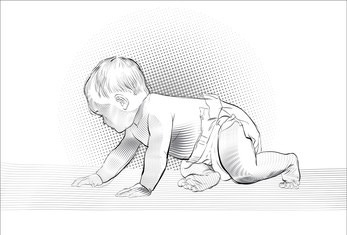
If you’re struggling with this, the first thing to know is that this is a full body operation. Simply doing one core exercise or release, or “pulling your shoulders back” (PSA, please don’t do this ever) is not gonna cut it. This is also a scenario where individualized care is ideal, because everyone’s drivers of dysfunction and compensation are going to be different!
I would recommend prioritizing release work first, then playing with deep core work, particularly in tabletop and high kneeling positions, because they do a great job working on the deep core in both the front and back. (And obvi, this isn’t medical advice!) Crawling is fun and a great way to begin! Try crawling with a tissue box, book, or yoga block on your back. I promise it’s a good time.
Okay, it feels appropriate to take a deep breath, right!? Let’s do that.
While diet culture and pelvic floor dysfunction’s effects are vast and varied, and the individual approaches may be different, here’s the big thing I want you to remember: You’re so not alone. The more I talked about this phenomenon, the more it felt ubiquitous.
Be curious, be kind, and take good care. As always, I am rooting for you.

Adventures in Vaginas (and other parts) is my labor of love, dedicated to you.
If you want to support my work and mission to expand access to quality pelvic health education that is gender inclusive and shame-free, please consider sharing this post or becoming a paid subscriber.
To learn more about my 1:1 practice and request a free 15 minute consultation, click here.
Tidal Work is my therapeutic movement platform for body autonomy. Everyone is invited to dive in there.
Comments
Nothing yet. Say the first thing.
Sign in to join the conversation.