
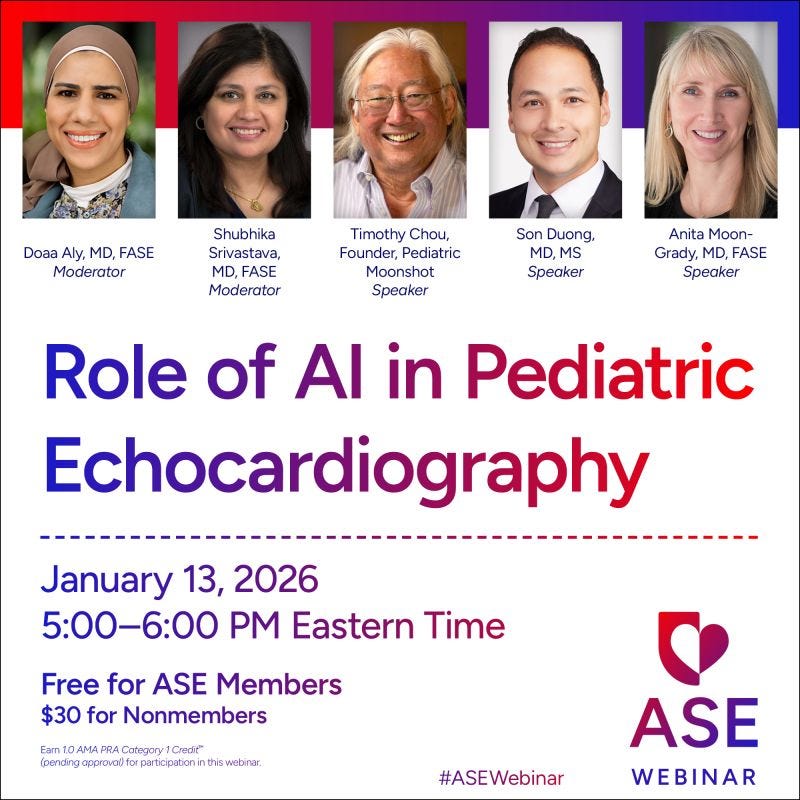
The landscape of pediatric cardiology is undergoing a profound transformation. At a recent webinar hosted by the American Society of Echocardiography, leading experts gathered to discuss how artificial intelligence is reshaping the diagnosis and treatment of congenital heart disease—and the ambitious infrastructure needed to bring these innovations from research labs to hospital bedsides worldwide.
The Current State: Promising But Limited
Dr. Anita Moon-Grady, President of the Fetal Heart Society and Director of UCSF’s Fetal Cardiovascular Program, opened the discussion with a sobering reality check. While AI models have achieved an impressive 89% sensitivity in detecting fetal congenital heart disease—far exceeding the current 30-50% detection rate in the United States—specificity remains problematic at 91%. When applied to California’s 3.5 million annual births, this would still generate 310,000 false positives.
“We’re nearly there for fetal congenital heart disease,” Dr. Moon-Grady explained. In collaboration with Dr. Rima Arnaout’s Lab at UCSF, she and her team have developed models that can identify five standard fetal heart views and classify them as normal or abnormal. In a groundbreaking validation study using data from the Netherlands, their AI model detected 27 of 31 cases that clinicians had missed, while human experts only caught 11.
The technology shows particular promise for providing assistance in teaching and quality improvement. FDA-cleared models are already available on ultrasound machines, providing real-time prompts and measurements to assist sonographers. However, the “black box” problem persists—these models remain difficult for humans to interpret, potentially eroding trust among both clinicians and patients. She referenced three papers in her talk: Coarction of Aorta Detection, Neural Ensemble CHD detection and one on fetal cardiac biometrics. You can see a short description a link to the original publication and the size of the training data set in the links.
The Technical Evolution: From Supervised to Foundation Models
Dr. Son “Sonny” Duong from Mount Sinai’s Kravis Children’s Heart Center provided crucial context on AI’s technical evolution. Traditional supervised learning requires painstaking human labeling—one input must have one known output. This approach works well for specialized tasks like measuring right ventricular fractional area change but proves inefficient when dealing with the vast heterogeneity of congenital heart disease.
The future lies in foundation models using self-supervised learning, similar to how ChatGPT was trained. These models learn from the data itself, generating their own labels without explicit curation. “A human can learn to identify mitral valve disease X versus Y with only a couple instances,” Dr. Duong noted. “Foundation models could enable similar few-shot learning in AI.”
Recent papers on multitask models like EchoPrime demonstrate this potential. These systems can predict 39 different elements of an echo report simultaneously, moving closer to automatic report generation. More remarkably, they can make accurate predictions on conditions not even included in their training data—like detecting amyloidosis or STEMI from standard echocardiograms.
The Infrastructure Challenge: Bringing AI to Scale
Dr. Timothy Chou, founder of the Pediatric Moonshot and former President of Oracle’s Cloud Computing business, presented perhaps the most ambitious vision: a purpose built, global distributed AI infrastructure to enable privacy-preserving, real-time AI agents/applications at the point of care.
The statistics are stark. Eighty-six percent of rural U.S. counties have no pediatric cardiologists. India has just 300 for its entire population. Rwanda has one. Yet just the 500 children’s hospitals perform 7-8 million ultrasound studies annually—a treasure trove of data that remains locked away in isolated systems.
“Centralized AI, meaning moving all that ultrasound imaging to some data center in Iceland, is never going to work,” Dr. Chou explained. Data sizes are too large, security requirements too strict, and privacy concerns too significant.
His solution? Move the application to the data rather than the data to the application. The Pediatric Moonshot is deploying cloud servers directly inside hospitals and clinics, providing real-time access to imaging data while preserving privacy through distributed, federated, swarm learning. In this approach, only the learned neural network weights—essentially floating-point numbers—are shared across sites, never the actual patient data.
The next step is funding the $50M to complete the Distributed AI Lab for Children’s Medicine: 32 sites, 3,000 servers, 2,000 terabytes of annual data flow, and 6 million patient digital twins. These “twins” combine clinical data from electronic medical records with information from wearables and home monitoring, creating comprehensive profiles “from genetic code to zip code.”
The Path Forward
All three speakers emphasized that significant challenges remain. Current AI models work well on the data they were trained on but often fail when deployed “in the wild” with different populations, equipment, or imaging protocols. The analogy of a Waymo car trained in San Francisco struggling in London resonates deeply.
But the potential applications are transformative: disease-precise AI agents continuously scanning patient populations for rare conditions, trial-precise agents matching patients to experimental therapies, diagnostic agents improving detection rates in underserved areas, and survivorship agents helping adults born with congenital heart defects receive appropriate lifelong care.
As Dr. Moon-Grady concluded, “We need a lot of partnership with a lot of people, and we need to build trust with patients and end users.” The technology is advancing rapidly. The infrastructure is being built. What remains is the collective will to bring AI’s promise from the lab to every child who needs it—wherever they may be.
Appendix
See the webinar (for a fee) at https://aselearninghub.org/topclass/topclass.do?expand-OfferingDetails-Offeringid=21236088.
For a copy of all the slides download from https://drive.google.com/file/d/1_-Ve48G63e75xiBOF1qfTrE_qYnMU5SC/view?usp=sharing
No posts
Comments
Nothing yet. Say the first thing.
Sign in to join the conversation.